Friday, May 20, 2016

Canyon de Chelly: Heart of the Navajo Nation


“For nearly 5,000 years, people have lived in these canyons - longer than anyone has lived uninterrupted anywhere on the Colorado Plateau.  In the place called Tseyi, their homes and images tell us their stories. Today, Navajo families make their homes, raise livestock, and farm the lands in these canyons. The National Park Service and Navajo Nation actively work together to manage park resources.” ~ National Park Service.
Canyon de Chelly ca. 1904; public domain photo by Edward S. Curtis

Canyon de Chelly National Monument (pronounced de Shay) was established on April 1, 1931 as a unit of the National Park Service. Located in northeastern Arizona within the boundaries of the Navajo Nation, the monument is comprised of three canyons: de Chelly, del Muerto, and Monument.

Both maps from National Park Service; in public domain

These canyons were cut by streams that spring from the Chuska mountains east of the monument. The land belongs to the Navajo Nation. Canyon de Chelly National Monument is one of the most visited national monuments in the United States. Tourists can drive along the South Rim and North Rim where overlooks offer dramatic views of the canyon below. They are not allowed into the canyon by themselves, except for one trail leading down from the rim to the White House Ruins. If they wish to explore the canyon floor, they must be accompanied by a park ranger or a Navajo guide.
 
 
White House Ruins ca. 1873; photo by Army Corps of Engineers; public domain
 
One of the longest continuously inhabited areas of North America, the monument preserves ruins of early indigenous tribes who lived there, including the Ancient Pueblo Peoples (also called Anasazi). The monument covers 83,840 acres (131.0 sq mi; 339.3 km2) including the floors and rims of the connected canyons.
 
The canyons are known for steep walls dotted with greenery and hundreds of ancient pueblo ruins. The unique architecture, artifacts and rock imagery have been amazingly preserved, providing a peek into the lives of the pre-historic inhabitants. Built between 350 and 1300 A.D, these dwellings were built by the Ancient Puebloan People. In the 1700s, Navajo Indians were driven southwest by their enemies, eventually settling in Canyon de Chelly.

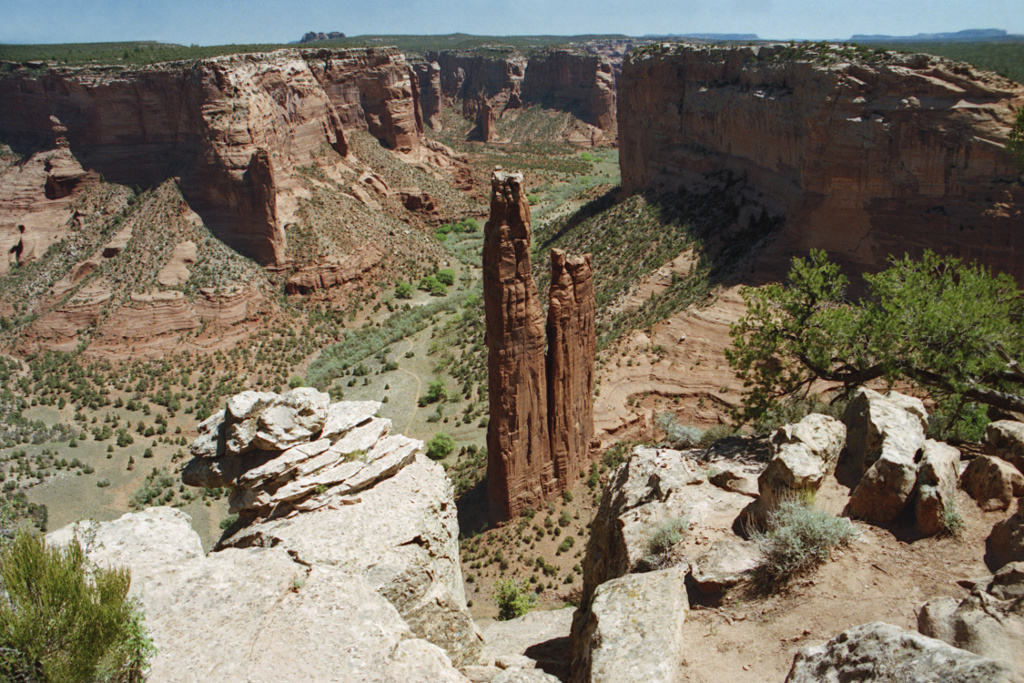
Canyon de Chelly's most unusual geological feature is Spider Rock, an 800-foot sandstone spire that juts from the canyon floor.

Spider Rock; photo © Brian W. Schaller / License: CC BY-NC-SA 3.0orFAL 1.3

Now I will let Josie Tseda, the Navajo heroine of CAPTURING GABRIEL, tell you a little about her homeland as she takes Gabriel on a tour of the canyon. You might call this book a modern day western, set mainly in the rugged mountains of Colombia with horses, gunplay and sexy romance. Eventually, it comes home to Canyon de Chelly.


As Josie drove, she pointed out pueblo ruins built into the rock walls and petroglyphs – paintings and etchings created by ancient peoples who once lived in Canyon de Chelly.

“The canyon is one of the longest continually inhabited areas in North America, so archaeologists say. The Anasazi, our Navajo word for ancient ones, built the pueblos, but other, older ones, lived here long before them.”
 
“Do you trace your roots to those ancients?” Gabriel asked.
 
“No, they were the ancestors of the Pueblo and Hopi people. We Navajo come from a different line called Athabaskan. It is said our old ones migrated from the far north hundreds of years ago. They settled in New Mexico and parts of Arizona and traded with the Pueblo people.”
 
“How did the Navajo come to be here in Canyon de Chelly?”
 
She shrugged. “They warred with other tribes and Spanish settlers who invaded our lands. Many Diné – as we call ourselves – fled into what is now Utah and Colorado. Others took refuge in the mountains and canyons. The Spanish found this place, of course, and on a winter day in 1805, their soldiers attacked the Diné living in the canyon. The two sides fought all day. At the end, 115 Navajo lay dead in a cave where they sought refuge. We call the place Massacre Cave. It lies in Canyon Del Muerto to our left. I will take you there.”
 
Gabriel stayed silent while she drove to the site. When they got out to view the cave, he said grimly, “You have reason to hate anyone of Spanish blood, including me.”
 
She sent him a startled glance. “Don’t be silly. What happened here was tragic but that was over two hundred years ago. It has nothing to do with you and me.”
 
“Does it not?”
 
“No, of course not. The Diné fought whites here too, but I don’t hate all white people.” She shivered in the biting wind. “Come on, I’m cold and this place gives me the creeps. Besides, I have something special to show you.” Gripping his hand, she hurried him back to the Jeep.
 
Sorry for telling him about Massacre Cave and making him feel bad, she drove him to the junction of Canyon de Chelly and Monument Canyon where Spider Rock soared skyward.
 
"Madre de Dios!” Gabriel exclaimed as she stopped the Jeep.
 
“Welcome to Spider Rock,” she said, opening her door and stepping out. A blast of wind immediately buffeted her, but she grinned at the look of awe on his face when he joined her to stare up at the eight-hundred-foot-tall tower of stone. “This is the most famous site in the canyon. It’s even been used in television commercials.”
 
“Amazing! But why the strange name for such an impressive monolith?”
 
She laughed lightly. “In our creation story, it is said Spider Woman possesses supernatural power, kind of like you Guardians. She loved the Diné and because monsters roamed the land long ago, killing many people, she gave special power to two of our heroes to find Sun-God, their father. Sun-God showed them how to kill all the monsters. Because Spider Woman saved the Diné, she became one of our most honored gods. Her home is said to be on top of Spider Rock.”
 
“That is a long climb even for a spider woman,” Gabriel said skeptically. “But she has super power. I suppose that makes it easy for her, sí?” Grinning, he drew Josie to his side, sheltering her from the wind.
 
She wrapped her arm around his waist. “Sure. She also taught us how to weave on a loom. Since then, the Navajo have become fine weavers. But the goddess can be fearsome. As children we are warned to behave or Spider Woman will let down her web and carry us up to her home, where she will devour us.”
 
“Fearsome indeed!” Gabriel chuckled, eyes glinting as he gazed down at her “But you must have been a good little girl, since she did not get you.”
 
“Hah! My father might think different.” Giving him a mischievous grin, she was glad to sees she’d managed to lighten his mood. “If you’d like to see the canyon from above, I’ll drive us around the rim.”
 
“I will enjoy anything you wish to show me, querida.” Turning to face her, he kissed her, warming her better than any fire could.
 
They returned to the Jeep and she headed back to the canyon entrance. From there, she wended along the South Rim Drive, stopping at several overlook points where they got out to gaze at the canyon from above. The last stop was Spider Rock Overlook.
 
“What a magnificent sight,” Gabriel said. “I see why you love this land.”
 
“Yeah, it is gorgeous,” she agreed.
 
“Sí, most gorgeous.” He spoke in a soft, caressing tone.
Looking up, she found him gazing at her with such adoration that she caught her breath and stared, hypnotized by his moss-green eyes.

***Canyon de Chelly fills an important role in not only Capturing Gabriel, but in the entire Romancing the Guardians series.
 
Find all of my books here:  Amazon Author Page
 
My Social Sites:

Wednesday, May 18, 2016

Alice Tubbs: A Free Spirit of the Old West by Sarah J. McNeal

Most of us have either heard of, or unearthed in our research the wild and wicked ways of the old west. Just so happens, the old west was home to some pretty crazy, eccentric, and innovative residents—including the members of the “gentler” sex. Yes, women could be a mite different out there on the plains of America. Maybe it was the harsh circumstances of their existence or the feeling of freedom the west provided these people, or maybe it was their real nature, but the women of the west were not your conventional mild mannered darlings.

I’ve written about some of these wild and crazy women recently, but I did not want to leave this captivating subject without presenting good old Alice Tubbs.
Not to be confused with the poor or rough beginnings of so many women of the west, Alice was born in Sudbury England as Alice Ivers. She moved with her family to America in 1865. Her family sent her to a boarding school for young ladies and I am certain they expected a proper young lady who would marry a gentleman and make them proud. Well, parents usually have dreams for their kids that may not turn out the way they had hoped.

Some have speculated that Alice’s father taught her to play poker, but others believe Alice learned by watching her gambler husband, Frank Dunning, wheel and deal those cards. In any case, the end result was, after moving out west, Alice began cleaning out just about every cowboy stupid enough to play cards with her. Because of her extraordinary skills, she became known as “Poker Alice” and won approximately $250,000 over her lifetime. That’s huge money for those days.

Alice began to travel the country after her husband died and played in some of the most populated towns in the west. She ran a table in a saloon owned by Bob Ford, the man who shot Jesse James and, in fact, was there when someone shot Bob down.


Photo credit: South Dakota Historical Society

This well-bred woman wore the best dresses money could buy. Some believe she wore these fantastic dresses to distract her male competitors, but I believe she just wanted to look pretty despite the fact that she usually smoked big cigars. I’m trying to imagine how others must have perceived that well-dressed woman with a big stogie hanging from her lips. Alice created the expression, “Praise the Lord and place your bets, and I’ll take your money with no regrets.” Okay, she wasn’t exactly a poet, but it was a bit intimidating for her to say that. Our lovely, proper Alice, liked to quote scriptures and never played cards on Sunday. Such a fine lady, wouldn’t you say?
After some time, Alice married Warren Tubbs and retired from the gambling tables to have children and raise them on a chicken farm. However, in 1910, after her second husband died, Alice pawned her wedding ring to pay for Warren’s funeral, and next thing ya know, she went right back to the poker table and won enough money to get her ring back. Now that’s the lady we all love.

Alice married a third time and opened a casino near Fort Meade in South Dakota. Winters there must have created big business for her. What else could people do in South Dakota during winter besides hunker down? Before Alice died in 1930 she was arrested for operating a brothel, murdered a man once for his bad behavior, publicly defied Prohibition laws, and finally, at age 75 earned a gubernatorial pardon. I couldn’t find anything about her children and what became of them in my research. I can’t help but think they must have been a bunch of free spirits like their mother though. 

Well, there you have it, another wild and inventive western woman living the way she wanted. Could it happen anywhere else besides the old west?—well maybe, but it wouldn’t be half as interesting.


My Wilding western romances begin with Harmonica Joe’s Reluctant Bride where I introduced Belle, the owner of a bordello, saloon, and gambling establishment named The Iron Slipper. If I had known about Alice Tubbs then I could have used her character to define Belle.  In the second Wilding romance, the young man Banjo has inherited the saloon from Belle, but with the help of Lola Wilding, transforms it into a hotel for decent folk. You can find all my Wilding western romances by clicking onto “The Wildings” in my list of media places after my bio., or check out my Wildings books and bargains on my Amazon Author’s Page listed after my bio.


Sarah J. McNeal is a multi-published author of several genres including time travel, paranormal, western and historical fiction. She is a retired ER and Critical Care nurse who lives in North Carolina with her four-legged children, Lily, the Golden Retriever and Liberty, the cat. Besides her devotion to writing, she also has a great love of music and plays several instruments including violin, bagpipes, guitar and harmonica. Her books and short stories may be found at Prairie Rose Publications and its imprints Painted Pony Books, and Fire Star Press. Some of her fantasy and paranormal books may also be found at Publishing by Rebecca Vickery and Victory Tales Press. She welcomes you to her website and social media:


Monday, May 16, 2016

The Buffalo Chip Lady by Linda Hubalek

Ada McColl gathtering buffalo chipsI love looking at old photos collected on historical  internet sites like KansasMemory.org. One of the most famous photos, that of a woman gathering cow chips, depicts the typical life of a pioneer woman in many people’s minds.

Here’s this woman, stuck out on the Western Kansas plains, with nothing but the flat prairie behind her—and she’s gathering dried buffalo manure to use as fuel to cook her family’s meals.

That was life for the women homesteading on the plains with no trees for fuel. Unless you lived on a river that had trees on its banks, you were pretty much out of luck. Prairie fires kept trees from foresting the Plains before towns and farms changed the landscape. So you gathered whatever you could find to burn, and people soon found out that dried manure gave a nice slow burning heat.

However, one of the interesting internet links with this photo on the Kansas Memory.org site is the story behind the staging of this picture. Yes, a young woman that wanted to be a photographer set it up. In 1893 Ada McColl posed for her camera, and her mother Polly actually took the picture featuring Ada, and her little brother Burt, (mistaken for a girl because of his clothing). You can read the whole story of the Pioneer Photographer: The Story of the Cow Chip Lady in this link (then scroll down to page 10).

I always wonder about the people and scenery in old photos, so it was neat to find the story behind this particular one. Even though Ada staged the shot, it was a common chore for many a woman on the Kansas prairie in the 1850-1870s. Ada would have used her family's cow herd's dried manure to fill her wheelbarrow because the buffalo herds were gone from the state twenty years before this picture was taken.

But Ada gave us more than a glimpse of how the first pioneers  scrounged for buffalo chips after a herd passed through the area. She showed the view of the endless prairie in the horizon, the taste and smell of the dirt blowing on her face from the constant wind, the dry gritty feel of the dried manure on her hands, and the weight of the wheel barrow.
That's what I aimed to portray in my books... not only visual sights for the reader, but for all their senses as well. But, I have to admit, this picture says a lot without words...

Thanks for stopping by to enjoy today's Sweethearts of the West Blog.


Linda Hubalek

Saturday, May 14, 2016

One of the Oldest Professions


One of the Oldest Professions

            Prostitution is known as one of the oldest professions in history, and the trade was instrumental in settling the West. In the lawless West, women were barred from most jobs and wives had no right to own property, however, madams owned large tracts of lands. Prostitutes made the highest wages of all American women, and some madams funded irrigation and road-building projects.

            Prostitutes won and enjoyed the freedoms denied a married woman or women in general. Before employer offered health was a reality, madams provided their employees with free health care, as well as room and board.

            In the movies, we often see prostitutes as the victims of violence, alcoholism, and drug abuse. And this did happen often, especially in some of the earlier establishments. In a time when women were told they couldn't protect themselves from violence, and women had no legal recourse against spousal rape, many madams hired police officers to protect the women who worked for them.

            Though contraceptives were banned, prostitutes made possible their production and distribution. Doctors would make condoms available to single men to keep them from catching a disease, but were denied them to prevent pregnancy in their wives.

            Women were taught they belonged in the "private sphere," and couldn't travel unattended. Prostitutes traveled at will by themselves and were brazenly "public women." When social dancing became popular in the 1910s and 1920s, prostitutes invented many of the dance steps that were fashionable in the era. The makeup, clothing, and hairstyles of prostitutes, which were maligned for their overt sexuality, later became fashionable among American women—red lipstick, short fringed dresses, and short hair cuts.

            A study by the U.S. Department of Labor in 1916 found that the major legitimate occupations for women were department store clerk and light manufacturing. Their average weekly salary was $6.67. Since there were many women who needed work, the over supply pushed wages down to a minimum. However, the demand for prostitution was enormous, especially in the West, and the number of workers was kept small due to the fear of stigmatism.

            According to historian Ruth Rosen, "'The average brothel inmate or streetwalker"—the lowest positions in the trade—"received from one to five dollars a 'trick,' earning in one evening what other working women made in a week.'" In a 1916 study, prostitutes made between $30 and $50 per week, while skilled male union workers averaged $20 a week.

            This information was paraphrased from excerpts from the chapter —"How 19th Century Prostitutes were Among the Freest, Wealthiest, Most Educated Women of Their Time." A Renegade History of the United States, by Thaddeus Russell, Copyright 2010. Published by Simon & Shuster, Inc.


Women of Controversy in Waco, Texas

The following is from a blog post I wrote in 2010, but since I have several books written about Waco, I'd like to include this.

My time travel romance, MyHeart Will Find Yours, is set in 1880s Waco, Texas, and another time travel romance, Birdie's Nest, is set in 1890s Waco. Located on the Brazos River, in its early history, Waco was known as Six-Shooter Junction. Trail drives herded their cattle across the Brazos in Waco and the cowboys usually spent time in the bawdy houses of the Reservation or Two Street as the red-light district was known. Drinking in the multitude of saloons and card games sometimes led to fights, often involving the use of firearms.

When the suspension bridge opened in 1870, and the railroad arrived in 1871, business in Waco thrived. Trail drives repeatedly lost cattle when herding their livestock across the Brazos. It wasn’t uncommon for a man to be caught in the undertow and drown. Cattle bosses were willing to pay the 50 cents per animal to get their cattle across safely.

In her book, A Spirit So Rare, Patricia Ward Wallace broaches the topic of how women forged a path in the early history of Waco. Her chapter on prostitutes is titled "Women of Controversy". Since prostitution plays a minor role in one my western time travel romances and a major one in the other, I’d like to borrow her title and share some of what I learned.

The first noted record of prostitution in Waco is documented in an 1876 city directory. Matilda Davis of 76 N. Fourth St. is listed as a madam with 10 occupants in her house. The women listed their occupation as actress. Waco had no playhouse at the time. In 1879, the city issued the first license for a bawdy house for an annual fee of $200 and a good behavior bond of $500.

Waco officials legalized prostitution within the Reservation in 1889 making Waco the first town in Texas and the second in the United States to condone a controlled red-light district. Madams paid a yearly fee of $12.50 for each bedroom and $10.00 for each bawd. Prostitutes paid an additional $10.00 license fee and paid the city physician $2.00 twice a month for a medical exam. This guaranteed they didn’t ply their trade outside their designated territory and were disease free. The city prohibited drinking within the area. Fines for violators ranged between $50 and $100. With the large number of prostitutes it’s easy to see the city benefited from trade within the Reservation.

Prostitutes were prohibited from being seen on the streets outside the Reservation yet they were allowed to trade with local businesses. No more than two at a time could travel via a city hack to the stores. Usually tradesmen sent clerks to the curb with merchandise. Some storeowners required the prostitutes to stop at the back door.

Life was hard for these working girls. Violence abounded in the bordellos as did drug and alcohol use and abuse. Though licensed, the police had little to do with the establishments. The madams disciplined the women in their houses and maintained order among their clientele. On occasion the police were called when robberies or assaults occurred.

Waco’s most famous madam was Mollie Adams. She had worked in another house but in 1890 opened her own three-room operation. By 1893 she had a seven-room establishment. In 1910 she’d obtained enough wealth to commission a house to be built by the same firm that built the First Baptist Church of Waco and the building now the Dr. Pepper Museum. Her home at 408 N. Second St., had indoor plumbing, electric fixtures, two parlors, a dance hall, and a bell system wired to every room. Her portrait, included here, hung over the fireplace. 

Though wealthy at this point in her life, she died in an indigent home in 1944. Lorna Lane, the madam in Madison Cooper’s epic novel, Sironia, is supposedly modeled after Mollie Adams.

In 1917, the US Government ordered cities with military bases to shut down red light districts to protect the health of America’s soldiers. Not wanting to lose Camp MacArthur and its 36,000 troops, the city shut down the Reservation in August of 1917. It is rumored some bawdy houses managed to continue business through the 1920s.

It's interesting to note that the Waco Convention Center sits where the Red Light District, known as the Reservation, was once located.

References:
Wallace, P. W., A Spirit So Rare, pp. 148-156.

Photo:
Courtesy of Texas Collection, Baylor University, Waco, Texas


Thursday, May 12, 2016

The Fear of Fear Itself

http://kathleenriceadams.com/

This Friday is Friday the 13th. You may as well walk under ladders, cross paths with black cats, break mirrors, and ignore chain emails with reckless abandon, because it’s an unlucky day anyway.

Nowadays, much of the western world looks at Friday the 13th as a day of bad luck. That hasn’t always been the case. In fact, there is no record of the superstition before the latter half of the 19th Century, and the notion didn’t become widespread until the 20th Century. It still isn’t universal: In Hispanic and Greek cultures, Tuesday the 13th is the day for bad luck. In Italy, it’s Friday the 17th.

Superstitions arise from fear—of an object, a place, a person, an idea… You name it, and there’s probably a related superstition born of someone’s bad experience, coupled with his or her refusal to shut up about it. When a fear becomes so extreme that a person can’t cope, the fear becomes a phobia.

Most people have heard of triskaidekaphobia, or fear of the number 13. Whether they can spell the word is another matter.

Friday the 13th is such a fearsome date, there are two words meaning “fear of Friday the 13th”: friggatriskaidekaphobia and paraskavedekatriaphobia. One is based on a Norse root word; the other on Greek. If you can pronounce either, you’re braver than I.

Sadly, very few phobias have short, easy-to-say names. That, in itself, can provoke a phobia: hippopotomonstrosesquipedaliophobia, or the fear of long words. Seems to me there ought to be a name for fear of the word that means fear of long words.

Is there a word for the fear of fear? Yep: phobophobia. Fortunately, that term is short. Afflicting a phobophobe with hippopotomonstrosesquipedaliophobia would be crueler than necessary. (I really do think there should be a word for the fear of that word—or at least the fear of typing that word.)

There are a ton of phobias (no wonder folks become phobophobic!), but in the interest of preventing pinaciphobia—the fear of lists—I’ll name only a few.

Pteronophobia is the fear of being tickled by feathers. Evidently no one is afraid of being tickled by anything else, because there is no term for a general fear of tickling.

Chromophobia is the fear of bright colors. I’m surprised anyone escaped the psychedelic ’60s without developing this one.

Eisoptrophobia, or the fear of your own reflection, must be especially vexing for narcissists but handy for vampires.

Pteridophobia is the fear of ferns. Anthophobia is the fear of flowers and stems. People who are afraid of all plants are botanophobic. Needless to say, none of those people do much gardening.

Didaskaleinophobia is the fear of going to school. Don’t tell your children.

Both caligynophobia and androphobia are rare in romance novels, thankfully. The former is fear of beautiful women; the latter, fear of men.

Likewise, few characters in romance novels—particularly heroines—suffer erythrophobia, or the fear of blushing.

Another rarity in romance novels is peladophobia, or fear of bald people. It’s difficult to be afraid of something that doesn’t exist.

The flipside of that coin is being afraid of that which does exist. That’s panphobia, or fear of everything.

Nomophobia is surprisingly common—or maybe not so surprisingly. It’s the fear of losing your cell phone.

Anatidaephobia is the fear that somewhere in the world, a duck is watching you. No, I did not make that up.

Someone did make up this one, though: luposlipaphobia, or the fear of being pursued by timber wolves around a kitchen table while wearing socks on a newly waxed floor. We can thank Gary Larson, creator of The Far Side, for that one.

What are you afraid of? Tell us in the comments. I’ll bet there’s a word for it.

I wonder if there’s a word meaning fear there’s no term for your phobia...


A Texan to the bone, Kathleen Rice Adams spends her days chasing news stories and her nights and weekends shooting it out with Wild West desperados. Leave the upstanding, law-abiding heroes to other folks. In Kathleen’s stories, even the good guys wear black hats.

Her short story “The Second-Best Ranger in Texas” won the coveted Peacemaker Award for Best Western Short Fiction. Her novel Prodigal Gun won the 2016 EPIC Award for Historical Romance and is the only novel-length western historical romance ever nominated for a Peacemaker.

Visit Kathleen’s hideout on the web at KathleenRiceAdams.com, or connect with her on Facebook, Twitter, Google+, and/or Pinterest.


Tuesday, May 10, 2016

HANDBAGS: A HISTORY


Handbag fetish or addiction, no matter what you call it, I have it. Yes, I admit it and it's worse than my shoe addiction. Yikes! Geez, this may be worse than I originally thought. But hey, I can't be the only one, right???

Anyway, that's what sprung this idea for our talk today. Purses have shown up throughout time in many shapes and forms. From the earliest of time, both men and women carried pouches to carry sundry bits of importance, like seeds, items of religious significance and medicines. They were made of bits of animal skins, later cloth, and knitted string to look like net. Each might be decorated to personal tastes with shells, feathers and the like.


Traditional wallets began as early as the 16th century, as small leather pouches with a drawstring with which to tie to a belt loop. Women carried sweet bags that held lavender or other scents to freshen their clothing and handkerchiefs. It was around this time pockets were introduced into clothing to carry small personal belongings.


Bettina Feldt's 18th Century Clothes and Accessories

Women also carried bags tied around their waists and worn under their skirts, as seen above.

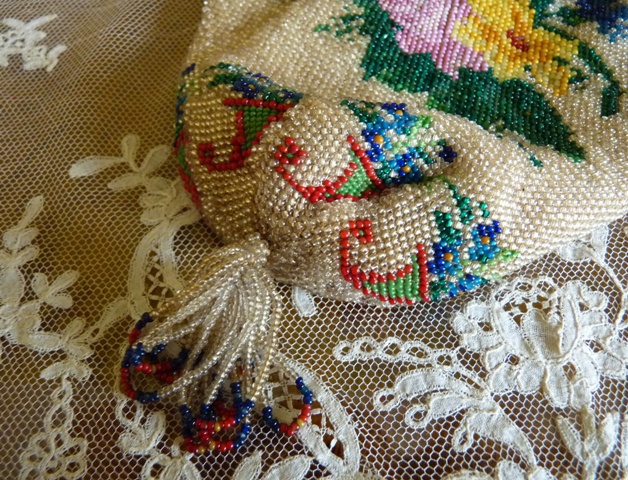
The mid-1800s showed a variety of handbags from the beaded and embroidered drawstring to a flat style that could be either square or circular in design.
.


Patterns for these were offered in popular ladies magazines of the day.


Early 20th century saw another change in the style of handbag carried by the modern woman. Two purses I'll share with you belonged to my grandmother, Faith, and her sister, Stella.


They are circa 1910-1915 and I framed them to showcase and preserve them.

 During World War II, shoulder bags became popular and have evolved to include over the arm, clutch, crossbody and tote. Some men briefly carried a messenger or casual bag in the 70's and even today they might be seen carrying one, but purses or handbags are largely used by women. I know I usually carry the kitchen sink. I want to have anything for any situation, a hold over from my mom days, I suppose.

This past weekend, Mother's Day, my som graciously bought me a shiney new handbag that caught my eye at the leather store at Grapevine Mills Mall. It's turquoise with silver hardware. I obviously needed it, and it's prreeetttty. Don't you agree?


Well that's what I have to say today. Chime in and let me know what you think. Do you get as ga-ga as I do over a purse or is there something else that trips your trigger?

I'd like to wish all a happy belated Mother's Day!

Hugs to all,
Carra
xoxoxoxo