Showing posts with label Navajo Nation. Show all posts

Tuesday, February 20, 2018

New Book Coming & Navajo Myth


I am so happy! I just sent Tempting Adam off to my editor. Cover art is also being designed by Kim Killion. I hope to publish this 7th book in my Romancing the Guardians series within the next two weeks. Yay! Then I’ll hurry on with the finale in book 8, tentatively titled The Great Joining.


As some of you know, this continuing series centers around seven characters who possess psychic powers and a set of secret scroll handed down through time from their Tuatha de Danaan ancestors. The de Danaan were a legendary race of demi-gods according to Irish mythology. Reading about them gave me the idea for the Guardians saga.
Bobby C. Hawkins; https://creativecommons.org/licenses/by-sa/3.0/deed.en


However, the Navajo people, their homeland and mythology also became increasingly important as this series progressed. I’ve talked about Canyon de Chelly, heart of the Navajo Nation before. It’s a haven for the Guardians that will come under attack by their enemies in book 8. Today I’d like to give you a quick peek at Navajo beliefs and one character who appears in many of their myths: naughty Coyote.

The Navajo creation myth (Dineʼ Bahane') describes the primeval rise of the Navajo people and forms the basis for their traditional way of life. The story begins with the Nilch'i Diyin (Holy Wind) being created, the mists of lights arising through darkness to animate and bring purpose to the four Diyin Dineʼé (Holy People), supernatural and sacred beings in three different lower worlds. All these things happened before the Earth was created and humans only existed in spiritual form.

According to the myth, the Fourth World produced the first physical humans, who in turn, gave birth to the Hero Twins. The twins had many adventures helping to rid the world of various monsters. Multiple batches of modern humans were created a number of times in the Fourth World and the Diyin Dineʼé gave them ceremonies which are still practiced today.

This is a simplification of the actual creation myth. You can read it in detail here: https://en.wikipedia.org/wiki/Din%C3%A9_Bahane%CA%BC

Coyote howling, wikipedia public domain

Now meet Coyote (mąʼii in Navajo). Although he is a trouble-maker, he is one of the most important and revered characters in Navajo mythology. Coyote's ceremonial name is Áłtsé hashké which means "first scolder". In Navajo tradition, Coyote appears in creation myths, teaching stories and healing ceremonies.

One story caught my eye, not only because it teaches a good lesson but because in it, Coyote tangles with a horn toad. Also known as horned frogs (they're actually lizards) they are the mascot for Texas Christian University. Located here in Fort Worth, TCU is my daughter’s alma mater, and hubby and I are huge fans when football season rolls around.

Okay, here is part of the tale. I don’t dare share the whole piece for fear of copyright infringement. But you can read the rest & more coyote stories here: http://www.lapahie.com/Mythology.cfm
 
Horned frog (lizard) wikipedia public domain

 Coyote and the Horned Toad


By Harrison Lapahie Jr.
Horned Toad was very busy in her cornfield, where the corn was just ripening. Coyote came to her and said, "Please give me some of your delicious corn." "No," said Horned Toad. Coyote asked her four times; then she picked some corn for him.

"Corn is very hard to raise," Horned Toad told him. "We have to hoe the weeds away from it and pick off the bugs and worms that want to eat it. We even have to water it during dry weather. I can't afford to give all my corn away."

Coyote kept begging. Horned Toad said he couldn't have any more.

Then Coyote ran out into the field and-pulled off a big ear of corn, stripped the husks away and began eating the kernels. Horned Toad grabbed one end of the ear, and, when he gulped it down. Coyote also gulped Horned Toad down inside him.

Since she wasn't there to scold him, he ate all the corn he could hold. Then he lay down in the shade. He felt very lazy, but when he heard birds flying down to eat the corn, he raised his head and shouted at them. "Go away! Don't bother my corn," he shouted "Don't you know it takes work to raise corn? I have to hoe it and water it, and all that."

Down inside him, Horned Toad made some sort of noise. Horned Toad was very angry with Coyote and wanted to do something to get even with him. As she lay inside Coyote's stomach, she called, "Hey, Cousin!" Coyote jumped up and looked around to see who was calling. He saw nobody, and he lay down again. The second time he heard someone calling, he jumped up again and ran around the edge of the cornfield, looking for the person whose voice he had heard.

This happened four times. The fourth time that Horned Toad called, Coyote realized where the sound was coming from and he looked down at his stomach and asked, "Is that you making noises inside me?" "Yes," replied Horned Toad. "I'm going to take a little walk down here and see what I can find."

Soon Coyote began to feel strange, and he told Horned Toad to lie down and be still. Instead, Horned Toad continued to walk around, and she tugged at different parts of Coyote's insides.

Lyn Horner is a multi-published, award-winning author of western historical romance and romantic suspense novels, all spiced with paranormal elements. She is a former fashion illustrator and art instructor who resides in Fort Worth, Texas – “Where the West Begins” - with her husband and a gaggle of very spoiled cats. As well as crafting passionate love stories, Lyn enjoys reading, gardening, visiting with family and friends, and cuddling her furry, four-legged children.

Amazon Author Page: http://amzn.to/Y3aotC
Newsletter:  Lyn’s Romance Gazette http://eepurl.com/bMYkeX
Website:  Lyn Horner’s Corner 


Friday, May 20, 2016

Canyon de Chelly: Heart of the Navajo Nation


“For nearly 5,000 years, people have lived in these canyons - longer than anyone has lived uninterrupted anywhere on the Colorado Plateau.  In the place called Tseyi, their homes and images tell us their stories. Today, Navajo families make their homes, raise livestock, and farm the lands in these canyons. The National Park Service and Navajo Nation actively work together to manage park resources.” ~ National Park Service.
Canyon de Chelly ca. 1904; public domain photo by Edward S. Curtis

Canyon de Chelly National Monument (pronounced de Shay) was established on April 1, 1931 as a unit of the National Park Service. Located in northeastern Arizona within the boundaries of the Navajo Nation, the monument is comprised of three canyons: de Chelly, del Muerto, and Monument.

Both maps from National Park Service; in public domain

These canyons were cut by streams that spring from the Chuska mountains east of the monument. The land belongs to the Navajo Nation. Canyon de Chelly National Monument is one of the most visited national monuments in the United States. Tourists can drive along the South Rim and North Rim where overlooks offer dramatic views of the canyon below. They are not allowed into the canyon by themselves, except for one trail leading down from the rim to the White House Ruins. If they wish to explore the canyon floor, they must be accompanied by a park ranger or a Navajo guide.
 
 
White House Ruins ca. 1873; photo by Army Corps of Engineers; public domain
 
One of the longest continuously inhabited areas of North America, the monument preserves ruins of early indigenous tribes who lived there, including the Ancient Pueblo Peoples (also called Anasazi). The monument covers 83,840 acres (131.0 sq mi; 339.3 km2) including the floors and rims of the connected canyons.
 
The canyons are known for steep walls dotted with greenery and hundreds of ancient pueblo ruins. The unique architecture, artifacts and rock imagery have been amazingly preserved, providing a peek into the lives of the pre-historic inhabitants. Built between 350 and 1300 A.D, these dwellings were built by the Ancient Puebloan People. In the 1700s, Navajo Indians were driven southwest by their enemies, eventually settling in Canyon de Chelly.

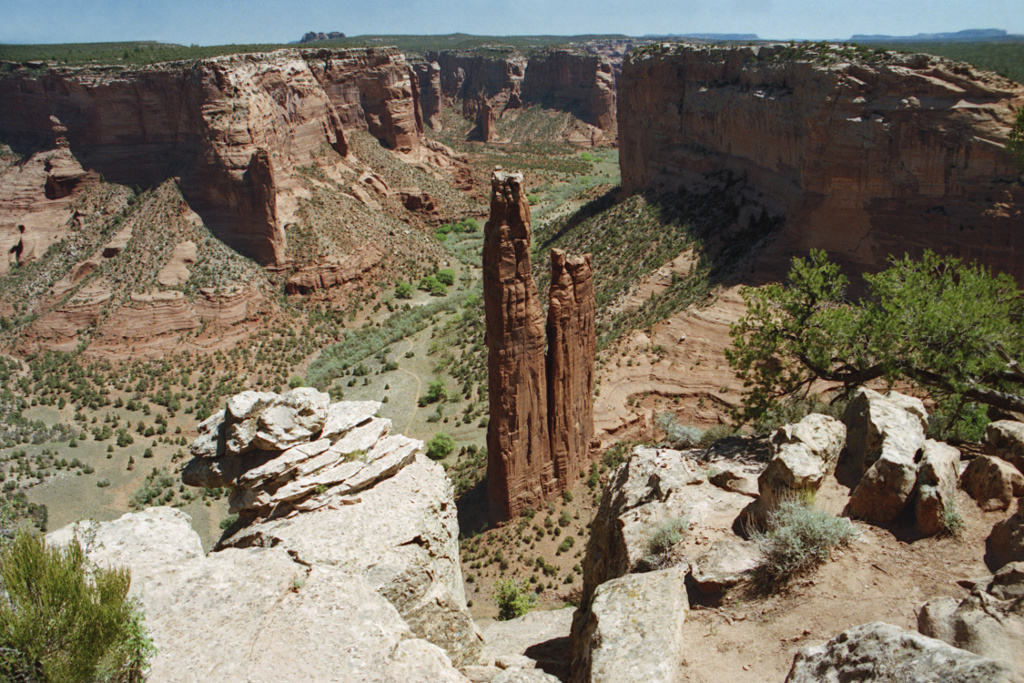
Canyon de Chelly's most unusual geological feature is Spider Rock, an 800-foot sandstone spire that juts from the canyon floor.

Spider Rock; photo © Brian W. Schaller / License: CC BY-NC-SA 3.0 — or — FAL 1.3

Now I will let Josie Tseda, the Navajo heroine of CAPTURING GABRIEL, tell you a little about her homeland as she takes Gabriel on a tour of the canyon. You might call this book a modern day western, set mainly in the rugged mountains of Colombia with horses, gunplay and sexy romance. Eventually, it comes home to Canyon de Chelly.


As Josie drove, she pointed out pueblo ruins built into the rock walls and petroglyphs – paintings and etchings created by ancient peoples who once lived in Canyon de Chelly.

“The canyon is one of the longest continually inhabited areas in North America, so archaeologists say. The Anasazi, our Navajo word for ancient ones, built the pueblos, but other, older ones, lived here long before them.”
 
“Do you trace your roots to those ancients?” Gabriel asked.
 
“No, they were the ancestors of the Pueblo and Hopi people. We Navajo come from a different line called Athabaskan. It is said our old ones migrated from the far north hundreds of years ago. They settled in New Mexico and parts of Arizona and traded with the Pueblo people.”
 
“How did the Navajo come to be here in Canyon de Chelly?”
 
She shrugged. “They warred with other tribes and Spanish settlers who invaded our lands. Many Diné – as we call ourselves – fled into what is now Utah and Colorado. Others took refuge in the mountains and canyons. The Spanish found this place, of course, and on a winter day in 1805, their soldiers attacked the Diné living in the canyon. The two sides fought all day. At the end, 115 Navajo lay dead in a cave where they sought refuge. We call the place Massacre Cave. It lies in Canyon Del Muerto to our left. I will take you there.”
 
Gabriel stayed silent while she drove to the site. When they got out to view the cave, he said grimly, “You have reason to hate anyone of Spanish blood, including me.”
 
She sent him a startled glance. “Don’t be silly. What happened here was tragic but that was over two hundred years ago. It has nothing to do with you and me.”
 
“Does it not?”
 
“No, of course not. The Diné fought whites here too, but I don’t hate all white people.” She shivered in the biting wind. “Come on, I’m cold and this place gives me the creeps. Besides, I have something special to show you.” Gripping his hand, she hurried him back to the Jeep.
 
Sorry for telling him about Massacre Cave and making him feel bad, she drove him to the junction of Canyon de Chelly and Monument Canyon where Spider Rock soared skyward.
 
"Madre de Dios!” Gabriel exclaimed as she stopped the Jeep.
 
“Welcome to Spider Rock,” she said, opening her door and stepping out. A blast of wind immediately buffeted her, but she grinned at the look of awe on his face when he joined her to stare up at the eight-hundred-foot-tall tower of stone. “This is the most famous site in the canyon. It’s even been used in television commercials.”
 
“Amazing! But why the strange name for such an impressive monolith?”
 
She laughed lightly. “In our creation story, it is said Spider Woman possesses supernatural power, kind of like you Guardians. She loved the Diné and because monsters roamed the land long ago, killing many people, she gave special power to two of our heroes to find Sun-God, their father. Sun-God showed them how to kill all the monsters. Because Spider Woman saved the Diné, she became one of our most honored gods. Her home is said to be on top of Spider Rock.”
 
“That is a long climb even for a spider woman,” Gabriel said skeptically. “But she has super power. I suppose that makes it easy for her, sí?” Grinning, he drew Josie to his side, sheltering her from the wind.
 
She wrapped her arm around his waist. “Sure. She also taught us how to weave on a loom. Since then, the Navajo have become fine weavers. But the goddess can be fearsome. As children we are warned to behave or Spider Woman will let down her web and carry us up to her home, where she will devour us.”
 
“Fearsome indeed!” Gabriel chuckled, eyes glinting as he gazed down at her “But you must have been a good little girl, since she did not get you.”
 
“Hah! My father might think different.” Giving him a mischievous grin, she was glad to sees she’d managed to lighten his mood. “If you’d like to see the canyon from above, I’ll drive us around the rim.”
 
“I will enjoy anything you wish to show me, querida.” Turning to face her, he kissed her, warming her better than any fire could.
 
They returned to the Jeep and she headed back to the canyon entrance. From there, she wended along the South Rim Drive, stopping at several overlook points where they got out to gaze at the canyon from above. The last stop was Spider Rock Overlook.
 
“What a magnificent sight,” Gabriel said. “I see why you love this land.”
 
“Yeah, it is gorgeous,” she agreed.
 
“Sí, most gorgeous.” He spoke in a soft, caressing tone.
Looking up, she found him gazing at her with such adoration that she caught her breath and stared, hypnotized by his moss-green eyes.

***Canyon de Chelly fills an important role in not only Capturing Gabriel, but in the entire Romancing the Guardians series.
 
Find all of my books here:  Amazon Author Page
 
My Social Sites:

Monday, July 20, 2015

Canyon de Chelly, Home of the Navaho

This month, I’m going to talk about Canyon de Chelly National Monument and the part it plays in my newest release, Decoding Michaela. 
 
  
By Yoopernewsman real name Greg Peterson (Own work) [CC BY-SA 3.0 (http://creativecommons.org/licenses/by-sa/3.0)], via Wikimedia Commons
 
Canyon de Chelly (pronounced de Shay) National Monument was established on April 1, 1931. The canyon is located in northeastern Arizona within the boundaries of the Navajo Nation and is wholly owned by the Navaho Tribal Trust of the Navajo Nation. It is the only National Park Service unit jointly managed with a Native American tribe.
 
One of the longest continuously inhabited places in North America, Canyon de Chelly contains ruins of early inhabitants, the Ancient Pueblo People (also called Anasazi.) The monument covers 83,840 acres and encompasses the floors and rims of three canyons: de Chelly, del Muerto, and Monument. These canyons were cut by streams originating in the Chuska Mountains just to the east.
 
clip_image001
White House Ruins by Hydrargyrum at en.wikipedia [Public domain], from Wikimedia Commons
 
The name Chelly (or Chelley) is a Spanish rendering of the Navajo word Tséyiʼ, meaning "canyon" or "inside the rock". The Spanish pronunciation de’tʃeʎi was adapted into English: de shā.
 
Canyon de Chelly had long been home for the Navajo people before it was invaded by Mexican forces led by Lt. Antonio Narbona in 1805. Later, in 1863, Col. Kit Carson and U.S. troops defeated the Navajo within the canyon, resulting in their removal to the Bosque Redondo reservation in New Mexico. Due to poor water and lack of fire wood, they were allowed to return to their native land in May 1868.
 
clip_image002[4]
Navajo Woman & Child, near Canyon de Chelly, by Ansel Adams [Public domain], via Wikimedia Commons
 
Today, approximately forty Navajo families live in the park. Most park visitors view Canyon de Chelly from the rim, following North Rim Drive and South Rim Drive. Ancient ruins and geologic structures, such as the towering Spider Rock, are visible in the distance from turnoffs along the routes. Visitors are allowed into the canyon only when accompanied by a park ranger or an authorized Navajo guide. The only exception to this rule is the White House Ruin Trail.
 
Canyon de Chelly - Spider Rock
Spider Rock by Daniel Schwen (Own work) [CC BY-SA 4.0 (http://creativecommons.org/licenses/by-sa/4.0)], via Wikimedia Commons
 
The National Monument was listed on the National Register of Historic Places on August 25, 1970. In 2009 it was recognized as one of the most-visited national monuments in the United States. 
 
Canyon de Chelly is the setting for the final portion of Decoding Michaela (Romancing the Guardians, Book Two). It will also be featured in upcoming books in this continuing series, and will play a major role in the final book, when the Guardians of Danu come together to battle their enemies.
 
Pageflex Persona [document: PRS0000038_00074]
 
Now here’s a look at the canyon through Michaela’s eyes. Her guide is Josie Tseda, who stars in the next book, Capturing Gabriel.


Josie drove them into the canyon the next morning in her Jeep. It was a rough, dusty ride but even without the promise of seeing Lara, the scenery was worth any discomfort. The sheer rock walls and fantastic formations were painted in amber, crimson, burnt umber and orange hues that took Michaela’s breath away. Carved out of the walls were caves, some small, some large enough to hold the ruins of apartment-like stone structures.

Pointing to one such cave, Josie said, “See those pueblo ruins? They were built by the ancient ones who lived here in prehistoric times. Canyon de Chelly is a national monument because of those ruins. They’re guarded by Park Rangers. Tourists are allowed to hike only on one self-guided trail. If they want to see more of the canyon, they have to hire a licensed Navajo tour guide.”

Obviously proud of her heritage, she added, “The canyon lies within the Navaho Nation and a number of families live here. They mostly farm and ranch either sheep or cattle, or both. My dad has a small place up ahead. He grows peaches and herds a few sheep for their wool, which he weaves into blankets.” She chuckled. “Tourist love Navajo blankets.”

As they wound through the canyon, Michaela admired the narrow valley dotted with fruit orchards and pastures where cattle and sheep grazed. Among the green patches stood farm houses or domed, multi-sided hogans, the traditional Navajo shelter, Josie explained. She turned onto a bumpy path leading to one of the latter. As they stopped outside the entrance, an older man with long graying hair walked outside. His dark copper face was lined with age but he stood straight, head erect. He smiled broadly when Josie jumped out of the Jeep.

“Yá'át'ééh, daughter.”

“Yá'át'ééh, Father,” she replied, rushing to give him a hug. “I have brought you more guests.”


Decoding Michael is available on these sites:

Amazon

Apple

Barnes & Noble

Kobo