Showing posts with label history. Show all posts

Saturday, April 22, 2023

Rosita - LIttle Rose - Colorado

Post by Doris McCraw aka Angela Raines

driving toward the Wet Mountain Valley
Photo (c) Doris McCraw

Rosita, which means Little Rose in Spanish, was a silver mining town in Custer County Colorado in the Wet Mountain Valley area. It was a favorite of the writer Helen Hunt Jackson and the setting for her children's story "Nelly's Silver Mine".

It is also the setting for my fictional story tentatively named "Pauline".

The town itself was founded in 1872 and quickly grew with tents and log cabins. Shortly after there were now stores and of course carpenters and a hotel a saloon and by 1874 it had around 1000 residents and approximately 400 buildings. It also for a brief period of time was the county seat of Custer County. 

Image of Rosita, CO around 1888

Unfortunately for the town, the silver mines which were the reason for its being had short-lived silver veins. In the early 1880s, the towns of Silver Cliff and Querida grew as Rosita lost in population. In 1886 the town of Silver Cliff became the new county seat of Custer County after about a four-year fight. (On a side note, the town of Silver Cliff had its own drama when they expected the Denver and Rio Grande railroad to put a spur through but instead the depot was built in the town of Westcliff on land owned by Dr. Bell a friend of Gen. Palmer the owner of the Denver and Rio Grand.)

Briefly, in 1875 there was what they called the Pocahontas Mining War. It seems two men came into town promising to establish a bank but instead claimed ownership of the Pocahontas mine at the behest of the two men a Major George W Graham came to town to secure the mine. He arrived vowing revenge on certain townspeople. This major Graham was an escapee from the Colorado Territorial Prison. According to a story from Wikipedia, a mob of townsmen went to the mine where Graham then begged them to let him go. They told him to run. As he did so the mob shot him in the back. That same day according to the Corners inquest they stated Graham had taken 36 shots to his body. The body was taken in a wagon and buried outside of town. No one was ever charged with his murder.

Rosita Cemetery from Find A Grave

Today Rosita is now a ghost town although there are probably around a hundred residents and it has seasonal residents also. The Sangre de Cristos and the Wet Mountain Valley are still some of the most beautiful places in Colorado. Its name lived up to the beauty of its locations but the people in the town back then, that's another story.

Until Next Time: Stay safe, Stay happy, and Stay healthy.

Doris


Wednesday, February 22, 2023

Let's Talk About Bonanza - Colorado That Is


Post by Doris McCraw aka Angela Raines

Photo property of the author

Bonanza. The name brings up dreams of gold, and silver, of hitting the big time. That is what happened in the Colorado town of Bonanza. This is just south of Tin Cup, and west of Canon City, where portions of my novel "The Outlaw's Letter" takes place.

The town site sits over 9,400' in the mountains about forty miles southwest of Salida, Colorado. The story is that a man named Tom Cooke from Salida was in the mountains looking for wild horses when he came across a vein of silver. The town grew quickly to over 1,000 residents after its founding in 1880.

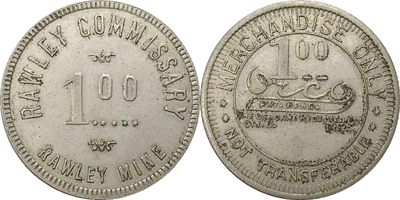
Token coin with the value of $1.00, issued by the Rawley Mine Commissary in Bonanza
from Wikipedia

The Daily Enterprise, a Bonanza town newspaper ran from  May 2, 1882, to July 13, 1882, for a total of 38 issues.  What is fascinating is in the inaugural issue they carried a story about women's garters. Below is the full article: 


Jeweled Garters.

New Yorik Sun. The fashion of wearing jeweled garters has spread so rapidly that jewelers ell keep them in stock. They are very expensive. A member of a conspicuous firm explains: “The rage is nonetheless strong and it promises to spread indefinitely as the trend is as unlimited as the purse. All the prominent society women and many who are not in society wear them. You see, women constitutionally delight in pretty things and their adornment is of more interest and enjoyment to them than anything else. If you will come downstairs I’ll show you the stock:.” 

There was a show-case full of them, each pair mounted in a velvet box. The pattern was the same in all as far as the band was concerned. The band was a full inch wide, made of fine elastic and covered with beautiful woven silk of every conceivable shade, pale blues and warm reds predominating. They are designed to match the tint of the dress worn with them. 'ln one case two heart-shaped clasps, of colored gold, inlaid with crossbars of " turquoises and pears, joined the ends of a scarlet band with little tie frills of silk along the edges. The price was $l9O. A pair with two oval clasps of hammered gold, perhaps an inch in length, could be bought for $43, while the cheapest pair with plain gold clasps, was $46

“It's a curious fact,” said the jeweler, “that the cheap ones won’t sell. When a customer wants an elegant garter he, I mean she, Is willing to pay for it.”

 A pair that cost $225 had two shields with three large pearls in each and little diamonds at the edge. Another pair was expensive though its delicate lace, which was arranged in a fuffy bow-knot, with two little gold disks clasped in the center.

At another establishment, the jeweler said: “The majority of them are made to order. Your visit is opportune, as 1 have just finished the most expensive pair that, ever left my factory. The price is $1,200.” In this, the lace and pearl-colored silk band was joined by an elaborate clasp. On one side was the lady's monogram in pearls; on the other the coat-of-arms, with frosted storks’ heads, a crest of delicately carved gold, and a motto set in chip diamonds. It was a present from a mother to her daughter, who is to be married soon.

“Has the demand for such garters increased?” 

“It is a hundred percent, greater than last year, and grows constantly.”

In the final issue was found this article: 


I hope you found these tidbits interesting. Until next time:

Stay safe, stay happy, and stay healthy.

Doris


Sunday, January 22, 2023

A Look at Two Early Colorado Towns

 Post by Doris McCraw aka Angela Raines

Photo property of the author

This post is a look at a couple of towns in Colorado that I'm fascinated with. As you can imagine, they have a history that drew me to them. 

In the case of Rico, Colorado, it was the town where Joe and Harriett Ward's daughter ran away to, lived, and died there. While the Ward story I've told in other posts and in a symposium paper, I didn't talk about their daughter. The accepted story is that she couldn't take the lifestyle her parents were living so ran away and then committed suicide. I feel there is more to this story, and hope to pursue a closer version of what really happened. 

Rico town hall - from Wikipedia

Rico was a mountain town a mining town located in the San Juan mountain range about 27 miles from Telluride, Colorado, and 30 miles from Durango, Colorado. Below are a couple of articles from the newspaper that was published in the early days of the town. I find it fascinating what they were interested in.


Rico Sun News


Rico Record Oct 18, 1883


Spar City is another town that has a boom/bust story and has lived on as a private reserve. It came into being during the heyday of silver mining but folded after silver was demonetized in 1893. It was located close to the town of Creede, Colorado. Around 1905 a group from Kansas bought the town and all that was in it as a place of their own to come to. 

Below is a short piece from their short-lived newspaper. Electricity was a source of interest back then.


Spar City Spark March 20, 1893

Until next time when I take a look at more of the Colorado towns, stay safe, stay happy, and stay creative.

Doris


Tuesday, November 22, 2022

It's Holiday Season


Post by Doris McCraw aka Angela Raines


The holidays are upon us. From Thanksgiving to Christmas time seems to fly. For myself, I've always preferred Thanksgiving over Christmas although I do enjoy both holidays. I thought perhaps a little look back might be fun as I myself gear up for my own celebrations.


From the November 18, 1898 issue of
The Chaffe County Record.

I love this advertisement from the "Pikes Peak Echo - Colorado College

December 7, 1885


How do you all celebrate Thanksgiving? Do you have turkey or ham? Friends, family? Whatever form your celebration takes, have a wonderful day.

Photo Property of the Author


HAPPY THANKSGIVING

Doris McCraw


Thursday, September 22, 2022

Pikes Peak - What's in a Name


Post by Doris McCraw aka Angela Raines


Pikes Peak
Photo Property of the Author

Most have heard of Pikes Peak, but do you know the other names that this mountain has had? Read On.

1. Tava - this is the name that the Ute called the mountain. The word means "Sun Mountain"

2. Montana del Sol - this is the name the first Spanish explorers used for the mountain. Translated it is "Mountain of the Sun"

3. El Capitan - this is the name the Spanish explorers used later. The definition is "the Captain" or "the Leader". This may have come into use as the peak is the easternmost of the 14ers on the Front Range of Colorado.

4. Heey-otoyoo- this is the name the Arapahoes gave the mountain. Translated it means "the Long Mountain"

5. Grand Peak - this is one of the names Zebulon Pike called the mountain in his journals.

6. Highest Peak - this is another name that Zebulon Pike for the mountain in his journals.

7. James Peak - This was in honor of Edwin James the botanist with the Long Expedition who actually climbed to the top in 1820.

8. Pike's Highest Peak - a number of the early explorers, trappers and settlers called the mountain by this name.

9. Long Mountain - The use of this name may have been for Stephen Long, the leader of the expedition of which Edwin James was a member.

10. Pikes Peak - the name we all know the mountain by today. Named for Zebulon Pike, who tried, but never climbed the mountain that bears his name. 

The mountain has also had many elevations over the years.

14,109', 14, 147', 14, 500', 14, 110', and finally 14, 115' which is the official altitude today. (And no, it is not the tallest peak in Colorado. The tallest is Mt. Elbert, near Leadville, at 14,433')

For fun, here is a link to the cameras at the top of the mountain: Cameras at the top of Pikes Peak

For a full article on the Peak: History Colorado article


I've just published a book about the early women doctors who are buried in Evergreen Cemetery, in Colorado Springs, CO. the town that sits on the base of Pikes Peak.

Amazon or Books2Read


Until next time, Happy Reading. Doris McCraw


Monday, July 12, 2021

The Alabama-Coushatta Tribe of Texas by Bea Tifton

The Alabama- Coushatta tribal reservation, located near Livingston, Texas, is the oldest reservation in Texas. The reservation lies nestled in the Big Thicket of East Texas on 10, 200 acres.  The tribe has a sovereign government with its own police and emergency services.

 The tribes originally lived in Alabama, but by 1780, the tribes both migrated to East Texas. The Alabama-Coushatta fought with the revolutionaries during the Mexican War of Independence from Spain. After the war, the Mexican government recognized both independent tribes and offered them land to settle permanently.  The lands are marked as belonging to the tribes on early maps of the regions, including Stephen F. Austin’s map of Texas from 1829. 

 Sam Houston arranged a treaty with the tribes in 1836 before the Texas Revolution. The treaty provided land in exchange for both tribes’ promise that they wouldn’t side with the Mexican armies in the revolution. The tribal members acted as guides for Houston’s army and gave food to Texas refugees running from Santa Anna’s army. 

 Today the reservation offers several opportunities for tourists. Visitors can rent cabins or even a six-person tepee. Fisherman can buy day passes and people can rent canoes, paddleboats, and kayaks.


Although it is on hold during the pandemic, the Alabama-Coushatta tribe hosts a yearly pow wow in early June. Visitors can watch Native American dancers from all over the United States demonstrate various Native American dances. The pow wow grounds also have booths with Native American arts and crafts and both Native American and contemporary food. 


 East Texas is a beautiful part of the state and the Alabama-Coushatta reservation offers a glimpse into another culture and a history that helped make up the history of the state of Texas and of the United States. 

For more information, visit the Alabama-Coushatta website: www.alabama-coushatta.com.