“For nearly 5,000 years, people have lived in these
canyons - longer than anyone has lived uninterrupted anywhere on the Colorado
Plateau. In the place called Tseyi, their homes and images tell us their
stories. Today, Navajo families make their homes, raise livestock, and farm the
lands in these canyons. The National Park Service and Navajo Nation actively
work together to manage park resources.” ~ National Park Service.
 |
| Canyon de Chelly ca. 1904; public domain photo by Edward S. Curtis |
Canyon de Chelly National Monument (pronounced de Shay) was established on April 1, 1931 as a unit of the National Park Service. Located in northeastern

 |
| Both maps from National Park Service; in public domain |
These canyons were cut by streams that spring from the Chuska
mountains east of the monument. The land belongs to the Navajo Nation.
Canyon de Chelly National Monument is one of the most visited national
monuments in the United States. Tourists can drive along the South Rim and North Rim where overlooks offer dramatic views of the canyon below. They are not allowed into the canyon by
themselves, except for one trail leading down from the rim to the White House Ruins. If they wish to explore the canyon floor, they must be accompanied by a park
ranger or a Navajo guide.
 |
| White House Ruins ca. 1873; photo by Army Corps of Engineers; public domain |
 |
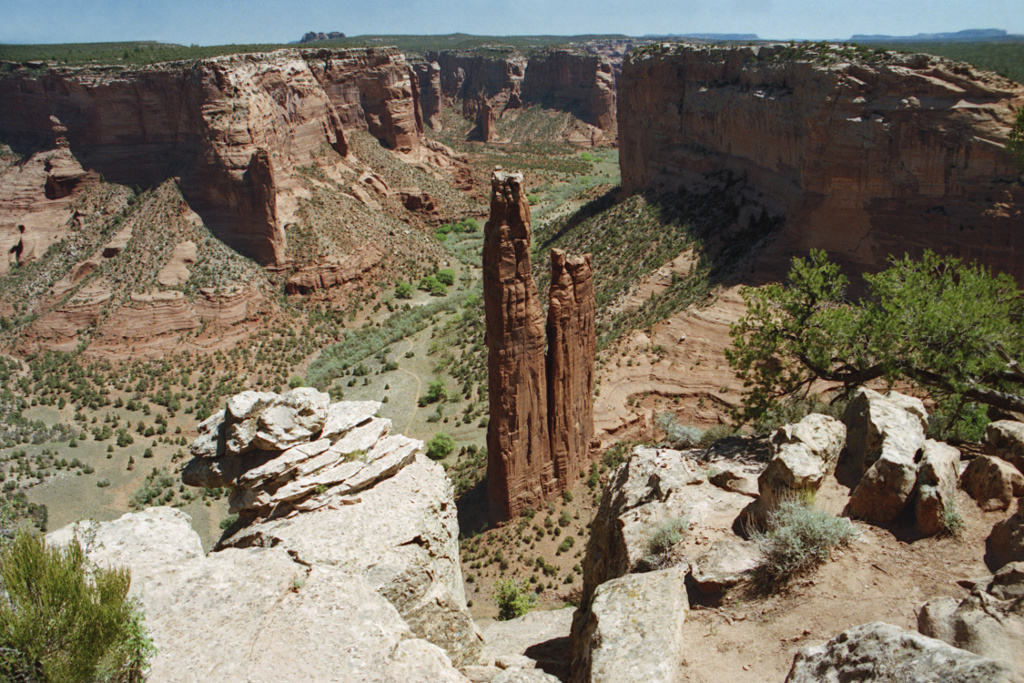
| Spider Rock; photo © Brian W. Schaller / License: CC BY-NC-SA 3.0 — or — FAL 1.3 |
Now I will let Josie Tseda, the Navajo heroine of CAPTURING GABRIEL, tell you a little about her homeland as she takes Gabriel on a tour of the canyon. You might call this book a modern day western, set mainly in the rugged mountains of Colombia with horses, gunplay and sexy romance. Eventually, it comes home to Canyon de Chelly.

As Josie drove, she
pointed out pueblo ruins built into the rock walls and petroglyphs – paintings and etchings created by ancient
peoples who once lived in Canyon de Chelly.
“The canyon is one of the longest continually inhabited
areas in North America , so archaeologists say.
The Anasazi,
our Navajo word for ancient ones, built
the pueblos, but other, older ones, lived here long before them.”
“Do you trace
your roots to those ancients?” Gabriel asked.
“No, they were
the ancestors of the Pueblo New Mexico and parts of Arizona and traded with the Pueblo
“How did the
Navajo come to be here in Canyon de Chelly?”
She shrugged.
“They warred with other tribes and Spanish settlers who invaded our lands. Many
Diné – as we call ourselves
– fled into what is now Utah and Colorado Massacre
Cave
Gabriel stayed
silent while she drove to the site. When they got out to view the cave, he said
grimly, “You have reason to hate anyone of Spanish blood, including me.”
She sent him a startled glance. “Don’t be
silly. What happened here was tragic but that was over two hundred years ago.
It has nothing to do with you and me.”
“Does it not?”
“No, of course
not. The Diné fought
whites here too, but I don’t hate all white people.” She shivered in the biting
wind. “Come on, I’m cold and this place gives me the creeps. Besides, I have
something special to show you.” Gripping his hand, she hurried him back to the
Jeep.
Sorry for
telling him about Massacre Cave and making him feel bad, she drove him to the
junction of Canyon de Chelly and Monument
Canyon
"Madre de Dios !”
Gabriel exclaimed as she stopped the Jeep.
“Welcome to
Spider Rock,” she said, opening her door and stepping out. A blast of wind
immediately buffeted her, but she grinned at the look of awe on his face when
he joined her to stare up at the eight-hundred-foot-tall tower of stone. “This
is the most famous site in the canyon. It’s even been used in television
commercials.”
“Amazing! But
why the strange name for such an impressive monolith?”
She laughed
lightly. “In our creation story, it is said Spider Woman possesses supernatural
power, kind of like you Guardians. She loved the Diné and because monsters roamed the land long ago,
killing many people, she gave special power to two of our heroes to find
Sun-God, their father. Sun-God showed them how to kill all the monsters.
Because Spider Woman saved the Diné, she became one of our most honored
gods. Her home is said to be on top of Spider Rock.”
“That is a long climb
even for a spider woman,” Gabriel said skeptically. “But she has super power. I
suppose that makes it easy for her, sí?” Grinning, he drew Josie to his
side, sheltering her from the wind.
She wrapped her
arm around his waist. “Sure. She also taught us how to weave on a loom. Since
then, the Navajo have become fine weavers. But the goddess can be fearsome. As
children we are warned to behave or Spider Woman will let down her web and
carry us up to her home, where she will devour us.”
“Fearsome indeed!”
Gabriel chuckled, eyes glinting as he gazed down at her “But you must have been
a good little girl, since she did not get you.”
“Hah! My father
might think different.” Giving him a mischievous grin, she was glad to sees she’d
managed to lighten his mood. “If you’d like to see the canyon from above, I’ll
drive us around the rim.”
“I will enjoy anything
you wish to show me, querida.” Turning
to face her, he kissed her, warming her better than any fire could.
They returned to the
Jeep and she headed back to the canyon entrance. From there, she wended along
the South Rim Drive
“What a
magnificent sight,” Gabriel said. “I see why you love this land.”
“Yeah, it is
gorgeous,” she agreed.
“Sí, most gorgeous.” He spoke in a soft,
caressing tone.
Looking up, she found him gazing at her with such adoration
that she caught her breath and stared, hypnotized by his moss-green eyes.
***Canyon de Chelly fills an important role in not only Capturing Gabriel, but in the entire Romancing the Guardians series.
***Canyon de Chelly fills an important role in not only Capturing Gabriel, but in the entire Romancing the Guardians series.
Find all of my books here: Amazon Author Page
My Social Sites:


![clip_image002[4]](https://blogger.googleusercontent.com/img/b/R29vZ2xl/AVvXsEhIwRJMUmGWmM_WiNl73Fkb-c12nCceuuvWT8e2OrJ2BW6XoGuvXFjpqKc8qCjCLYRFygZQMxEKuIVsJW7H482V7NAFhzdqsJ5bqWJCwARayl4kAQcxJ2_w0CTNIWQ2_iV1xvB5ftxlsTQ/s1600-h/clip_image002%25255B4%25255D%25255B6%25255D.jpg "clip_image002[4]")

![Pageflex Persona [document: PRS0000038_00074]](https://blogger.googleusercontent.com/img/b/R29vZ2xl/AVvXsEimravFA2GtBIwQkTC15gTU7J9xpWzdcyhHt8gm1C4WJNmZrn6SRjSNOI6mISoLg0Z2GcxBP3kMhGQoJ_YSNuo9fna4DlazDFJscRLqjc1YhlrWZxpxB8jbwuuGR_DhZ-BCMZef5b4LVMQ/s1600-h/LynHorner_DecodingMichaela_eCover_800%25255B1%25255D%25255B5%25255D.jpg "Pageflex Persona [document: PRS0000038_00074]")