Saturday, October 16, 2021

An Adventure for A Dime by Jo-Ann Roberts


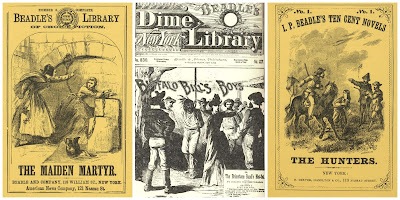
Initially published around the time of the Civil War, the first dime novels were immensely popular. These sensational stories were full of romance and adventure and became wildly popular in both the United States and in England, where they were dubbed "penny dreadfuls". 

Dime novels typically told the dramatic adventure stories of a single hero or heroine who often found himself or herself in the midst of a moral dilemma. They were ethically sound, endorsing good character, and strong moral values, with the hero/heroine choosing virtue over vice.

The storylines were simple and told in in language that brought to mind concrete pictures and people for the readers. The books were simple in appearance, bound in inexpensive paper with brightly illustrated covers, easy to carry, and easy to pass around. Though the subject matter of the novels included detectives, the military, chaste romance, and even early science fiction, it was the Western dime novel that dominated the market.

In the beginning, these stories were about the American Indians, but when the Indians were forced onto reservations, the public's fascination with them began to fade. Consequently, the novels focused on cowboys in the Wild West, outlaws and bandits, and train robbers. 

In Victorian England, "penny dreadfuls" were written in the macabre Gothic tradition to frighten and thrill readers.


Dime novel stories would often feature a recurring hero such as Buffalo Bill, Deadwood Dick, Buckskin Sam, or Roving Joe. The printing house could then establish a series and garner a following for these heroes. These heroes were, of course, packaged in a fast-paced adventure story often described as
"blood and thunder". 

First issued by the New York printing firm of Irwin and Erasmus Beadle and Robert Adams, the dime novels were an immediate success.  Between 1860 and 1865 alone, Beadle and Adams published more than five million dime novels. During this time, the Civil War made soldiers a prime audience for the publishers who produced books that catered to the men needing a light diversion during the boredom that often came with camp life.
Writing these stories was a lucrative business for many late 19th century authors. A well-established author could earn up to $1,000 per story; a lesser established author could expect close to $50 per story. One such author, Prentiss Ingraham achieved success and fame as an author of the "Buffalo Bill" series. By his own account he penned 600 novels by 1900.

Another major publishing house, Street and Smith, viewed fiction as a commodity, and editors had strict authority over the authors' works. Each author was allowed limited room for creativity and was required to follow a specific formula in the plot lines and writing style. No wonder authors like Horatio Alger, Upton Sinclair, and Jack London wrote for Street and Smith under pen names!


However, not all authors wrote under pen names to save their reputations. Many authors were writers who were often journalists, teachers, or clerks simply looking to make a bit more money to supplement their current occupations. With the invention of the typewriter, authors were able to churn out stories at an unbelievable rate. One author, Frederic Marmaduke Van Rensselaer Dey, the creator of street-savvy detective Nick Carter, was rumored to put out 25,000 words every week for almost twenty years!
 
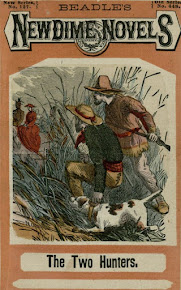
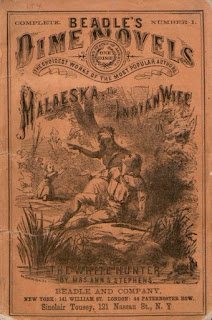
Although not as numerous as their male counterparts, female authors also found success in the dime novel market. The most notable among these was Ann S. Stephens. In 1860, she authored the very first Beadle's Dime Novel, "Malaeska: The Indian Wife of the White Hunter".


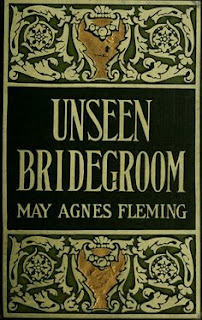
Bertha Clay, Geraldine Fleming, and Laura Libbey were among the most prominent female authors who penned stories about the pioneers, sensational murder mysteries, and society romances aimed at a young, working, middle-class audience. All for Love of a Fair Face, The Story of a Wedding Ring, A Charity Girl, The Unseen Bridegroom, and Only a Mechanic's Daughter were among the most popular romance novels enjoyed by girls and women, and surprisingly by many men.


The dime novel craze heavily influenced pulp fiction magazines introduced in the 1890s. Rising postal rates may have caused a decline in the publication of the dime novels, but the content material and sentiment behind the works continue to influence publications even today. 

Thursday, October 14, 2021

Omaha Laflesch: “You’re a Half-Breed” by Cora Leland


 Dr. Susan Laflesche

  Tonight, while I waited to check into a motel outside of Lincoln, the man waiting in front of me was listening to a beautiful Native American ceremony on his radio. Suddenly he ducked to the front of the motel, made a phone call, then returned to the line.

He resumed his place (without asking).  I said, “that was beautiful chanting.  What was it?”

He said, “That’s what we call the half-breed song.  Like you.”

 I was so amused that I didn’t flinch. 

He continued.  “The Omaha Nation’s dedicating a statue of my great-grandmother, Susan Laflesch, tomorrow morning at the capitol rotunda.  She was a half-breed like you.”

Did you ever feel that a person was egging you on? 

But I was terribly interested in what would come next.  Also, I was glad that Dr. Laflesch was being honored at the Nebraska State Capitol and I’d gladly overlook her great- grandson’s peculiar outlook.

The term ‘half-breed’ originated among American Indians when land was being divided by the federal government for various tribal uses.  Tribes in one region demanded a reservation set apart for the ‘half-breeds’ but the reservations themselves were to be open only to ‘pure-bloods’ or ‘bloods.’

I got checked in and went to my room, leaving the famous Dr. Susan Laflesch’s great- grandson making preparations in his.  Through the open door, I noticed a woman dividing up food as I walked by. 

I started thinking catty thoughts, wondering if he considered all Native American women like the braves of old supposedly did: women were property, fit for skinning hides and gathering berries, but nothing much beyond that.  The braves of old, though, supplied the tribe, including single females, with fresh meat.

The warriors also protected the women of their band.  All women would be safe from raids and attacks, when women could be stolen and enslaved.  (Stealing and enslaving, then selling, women from other tribes was common, especially among the Plains Indians.  European American -- non-tribal American -- slave dealers held auctions at local and larger markets, selling captive women as slaves.

Among the tribes, women were ranked, like every other member, with the young married women ranking ‘most,’ and the older, widowed or unwed women ranking ‘least.’   The women whom they’d captured, even those taken as captive wives, had no rank. I admitted to myself that the warriors of old might have felt insulted when any woman spoke to them as their equal.

Of course, the entire American Indian social structure was disrupted, first by the reservation system, then the attempts at ‘allotment’ (written into law by the Dawes Act).  Small parcels of land were given to individual Indians for their personal use only. 

Farming was encouraged, though tribal land was not uniformly suitable for growing crops and tools, like plows, and seed, were hard to come by, even by homesteaders and other settlers.  For example, the ancient inhabitants of the great southwestern deserts, like the Pueblo and Hopi Indians, lived where farming was impossible for anyone. 

In other regions, Indians were able to grow potatoes with success.  (Potatoes were considered by settlers and Indians alike as filled with nutrients, and were valued for keeping away scurvy.)  Other individual Indians worked hard and had good luck against the clouds of insects, the droughts, and the harsh weather that sent many homesteaders away. 

Some Indians were discouraged by life on reservations, then economically stopped by the decision that individuals must be farmers.  They’d grown up to expect nothing different from generations of their kinsmen.  From boyhood they’d learned skills for hunting large mammals like buffalo, which was – when you consider it – dangerous and life-threatening.  They learned how to ride their ponies and swing in front of charging buffaloes, or movements for confusing large animals while filling them with arrows or spears while riding. 

As children, they’d learned how to make bows, string them from the same materials as their ancestors, to carve arrows from rocks; certain types of arrows would kill small game; they made others suitable for hunting buffalo or other large game. 

The young warriors used certain wood for making the bows, and they learned to substitute other wood when their choice became too scarce.  (I do not offer these facts as excuses, but as tidbits of Western history.   I am unfit to judge anyone.)

The Dawes Act sought to enhance the federal government’s new project.  Allotments of small tracts of land to individual Indians were to replace the reservations, which they’d given to tribes. This was to reduce/remove tribal life and to create individual farmers.  It was written up as a charitable, humanitarian effort.  Hundreds of hard-working organizations endorsed this effort to help the native population.

The land that wasn’t used as allotments to Indians was sold to people settling the land; the federal government received the profits.  The effort toward creating individual allotments of land for Indians was discarded as a failure in the 20th century.

Then I remembered how truly great Dr. Susan Laflesch was.  As I’ve mentioned before in Sweethearts of the West, Susan Laflesch was the first Native American medical doctor.  She went to the University of Pennsylvania medical college during the post-civil war era. 

Doctors in America could – and did -- practice openly with no medical training.  Doctors abounded, opening clinics with no medical training whatsoever and no licensing. The University of Pennsylvania had one of the few accredited medical colleges.

Dr. Laflesch worked not only as a licensed medical doctor for the Omaha tribe.  She worked constantly for simple people.  For example, normal Indians who needed complicated paperwork filled out and sent through the government maze.  Like others in her family, she felt that she should take advantage of her many blessings – like being educated -- for helping others. Her medical practice consisted of high payment to no payment. 

*

It’s three o’clock in the morning. I’m glad that my experience this evening led to my sharing these ideas with you.  I’ll snap some photos of Dr. Laflesch’s statue and post them next month.  She was a strong-willed, admirable and very pretty woman.

I suspect that she’d been called a half-breed, too.  Only twice in my life have I been called a ‘half-breed.’  The first time, I was teaching at a university in Thailand.  One of the Thai teachers said innocently, ‘Oh! You must be a half-breed!”  I don’t remember what I said, but certainly nothing to hurt her. She spoke very little English, and I was sure she hadn’t meant this as a slur.

My encounter this evening?  The Oto tribe has never been one of the flashier, publicized tribes. The Oto is much smaller than the Omaha tribe, and has been since diseases and famines swept across the nation. The Otoes resisted attempts to unite with other tribes, but finally joined with the Missouria.  It had also been a larger, more powerful tribe, but numbers had simply decreased over the years.

My grandmother married an Irish merchant in Oklahoma.  Her son, my father, was a handsome wild Oto.  Like the strong hero in my last book – Thunder Hawk in Rescuing the Indian’s Bride -- it’s difficult to imagine a person ever calling him anything insulting.  

American Indian women, though, were slandered to their faces by being sneered at as ‘squaws.’  Like most racist slurs, the word stood for many other things.  Why should I feel slandered at being called ‘half-breed’ when I share the title with the great Dr. Susan Laflesch!

 First women Native American medial college graduates

I hope you’ve forgiven me for my very late Sweethearts of the West blog post.  I’d counted on internet in airports to send you my latest article; but as I learned, since the pandemic, airports simply don’t have that service. I spent hours waiting in airports, but without internet (or food or water).

 I’m finally in my new apartment, but there's no phone or internet, so sending you this from the city library!  I enjoyed looking at Dr. LaFlesch Picotte's statue.  It's very popular, with many people stopping and looking carefully.  Gardeners have planted sturdy Plains flowers and greenery as part of the arrangement.

Here's an article you might enjoy:  https://en.wikipedia.org/wiki/Susan_La_Flesche_Picotte


I’ll be on time in the future! Thank you again for your loyalty to me and to our great blog, Sweethearts of the West. 

Wednesday, October 13, 2021

The Haunted Fort Worth Stockyards by Bea Tifton

 Sorry for the repost, but this week is moving week. Bad movers, lots of car trips with loose stuff, and no sleep! 'Tis the season to be scary, so enjoy. 

A few years ago, I took the Cowtown Winery's Haunted Stockyards Tour. We had complimentary Wine a Ritas in our hands and a great tour guide in our midst. The event at the end really happened. It was the perfect ending to a fascinating glimpse into local history. In the time of Covid, I'd like to visit that wonderful evening again, so forgive the repost. 

The Stockyards actually have a branch of the Trinity River flowing under Exchange, the main street. Many people believe that water holds spiritual activity and heightens paranormal activity.

The Stockyards Hotel was built in 1910 and was a crown jewel of a hotel, attracting rich oil tycoons. Bonnie and Clyde reportedly stayed in room 305. That room now overlooks Merrick Fine Western Wear, which was then a jewelry store, and the nearby bank.  Two stories are told about their stay. One is
that they rented the room to stake out the two businesses, but they liked Fort Worth so much they decided not to rob either place. The other tale is that they told the owners of the bank and the jewelry store that they weren’t there to rob them or cause any trouble because, as  Bonnie and Clyde said, they were just hiding out from the law until things cooled down a bit.
The Stockyards Hotel has a full-bodied apparition named Jesse. He’s a cowboy who couldn’t have afforded to stay in the hotel at the time. People speculate that he just wanted to stay there in the afterlife.  Visitors hear his spurs jingling as he walks through the hall or see him. Jesse never interacts with anyone.
Many have felt the presence of a former employee, Jake. He was a messenger from the 1900’s and he loved his job of 30-40 years. Visitors feel hot and cold spots and some of his physical duties are still taken care of. If guests leave their room unlocked, it will be locked when they return. For the last 30 years, the phone rings after hours. No one is there and the call cannot be traced, put on hold, or transferred. 


The Rodeo Arena  has had an indoor  rodeo since 1908. This arena is a hotbed of paranormal activity. There is a phantom black horse that runs around the arena.
Apparitions are of deceased cowboys in old-time clothing.  The rodeo was very dangerous and many lost their lives during their performance.  EVP’s (electronic voice phenomenon; conversation not heard by the human ear) record hearing a voice saying, “Cow, cow, cow.” And “Pig, pig, pig.”
People have also reported seeing the spirit of Quanah Parker, who was the first Native American to ride in a rodeo.


The Exchange Building had two stories. One of the stories is that a man’s small child followed him to work in the early 1900’s. He wasn’t sure what to do with her, so he let her wander around. She went to play in the vault and an employee inadvertently locked her in. She wasn’t discovered in the airtight building until the next morning, and she had suffocated. Employees say they get an eerie feeling upstairs. They see a little girl running around playing and trying to get their attention. She looks out
windows at dawn. One early morning, the paranormal team from the Stockyards found two handprints on the inside of the door. 
The body of a prostitute was found inside years ago when prostitution was a licensed profession. She was probably murdered offsite and then dumped there. Her rose-scented perfume, for which she was known, can still be smelled on tours. 


The Armour Swift Corporate Building is quite an attractive building outside. Arson destroyed the building in the 1970s and, with all the residual animal fat, it took 1 month to put  the fire out completely. The Spaghetti Warehouse was there after the building was rebuilt, but they couldn’t keep staff. Silverware would fly, things would be moved, staff would hear strange noises and experience uneasy feelings.  The building currently houses business offices.


Riscky's Steakhouse
 is a popular restaurant in the Stockyards. A brothel was above this popular restaurant. This was a high class brothel that was more expensive than usual. The last member of the
Riscky family is very embarrassed about the brothel and won’t let people go up there. She threw everything away--but a red rocker once owned by the madame mysteriously reappeared in the building.The bells that signaled the men that their time was up are still there and working. The windows where the women would stand to attract customers have been covered up because people kept seeing apparitions of working women standing and posing in them.
                                                                                     
Saunders Park
 is a lovely part of the  Stockyards.When the nearby area of Fort Worth was known as part of  Hell’s Half Acre, however, people would take care of disputes by shooting at each other. The dead or dying were dumped into the river by the park. Historic reports from the time say that sometimes the water was red with blood. Divers report that there are too many human bones to count remaining on the bottom of that part of the Trinity River. The city decided not to dredge, leaving them out of respect.   
 
Miss Molly's B and B is a popular place to stay in the Stockyards. Molly is actually the name of the lead cow in the simulated cattle drive and the mascot of Fort Worth.
The actual Madame was Miss Josie. It was a speakeasy until the 1930’s, and then the site became a low end brothel. The girls were actually 11-15 years old. Most of the girls were orphans or runaways.  Miss Josie was abusive. She didn’t take any guff from the male customers and was known to throw them out on the street. She was morbidly obese and ill-tempered. The girls had huge quotas and, if they didn’t meet them or they talked back, Josie would lock them in the closet without food, water, or facilities as long as she felt the the discipline was required. 
Girls were very competitive and would poison each other’s food and lotion, resulting in some violent illnesses and deaths.  Miss Josie had a daughter, father unknown, who she abused terribly. When the little girl was 8 years old, she disappeared.  Everyone thought Josie had killed her, but it was never investigated.  One time a little girl on the ghost tour had her hair pulled and told her mother that “Mary was messing with her.” No one had told the little girl that Josie’s daughter was named Mary. The owner keeps toys for Mary that no one else is allowed to play with and the playthings move around.
Josie’s room and the Cowboy’s room are the most haunted. Men have their shoulders rubbed or their heads patted, but women report feeling very unwelcome and watched.
Miss Josie's Room


Cowboy's Room


The Longhorn Saloon 
is a popular watering hole.  Three cowboys stopped to drink, just boys between 15 and 17. They got drunk and got back on what they thought were their horses. The men whose horses they stole confronted them and the boys were hanged in the saloon.  Now women in the ladies bathroom report having their legs tugged and feeling like they are being watched. 

We ended up back at the Cowtown Winery. The paranormal team that works the Stockyards swept the building and found just as much activity as Miss Molly’s.  It used to be a Chinese Laundry with the family living above.  People feel the presence of a young boy. A medium said he was killed by an abusive parent, who kept him in a cupboard behind the bar. There is an old-fashioned sock monkey doll no one admits to having brought in.  It will disappear for days, then reappear in odd places.

Another presence is also felt. Wine is spilled during the night, crackers are spilled, and cases topple over. The motion detector is never tripped.  People hear glass break and rush in, but nothing is broken.

Photo: Jess Vide

While the guide was talking about the little boy, the street light in the alley was flickering. When she got to the story of the other presence, the light went out with a “Pop!” Everyone jumped, looked at the light, and then laughed at themselves. As the tour dispersed and the guide went back in, one of the remaining tourists said, “Wouldn’t it be funny if the light came back on?”

And it did!

www.fortworthstockyards.org

If you're ever in Fort Worth, Texas, you should really take the Haunted Stockyards Tour with the Cowtown Winery. I enjoyed it tremendously and the local history was fascinating. 

Do you believe in ghosts? Leave a comment below. 


Monday, October 4, 2021

FORT KEARNEY By Cheri Kay Clifton

 Writing about the historical Old West is in my blood!  Why? Because I was born near the Oregon Trail in Kearney, Nebraska.

As a young girl, I became interested in the history of nearby Fort Kearny after which my hometown was named and equally fascinated to read about the soldiers, pioneers, and Native Americans who helped create the history of America's growth westward.

Fort Kearny was founded in 1848 along the Platte River and named after then Colonel and later General Stephen W. Kearny.  As an interesting side note, the "e" was added to Kearny by postmen who consistently misspelled the town's name.  Also one should not confuse Fort Kearny with the historic Fort Phil Kearny located in Wyoming and named after Kearny's nephew, Maj. Gen. Philip Kearny.


General Stephen W. Kearny

 Despite its lack of fortifications, Ft. Kearny served as a way station, sentinel post, supply depot and message center for 49ers bound for California and emigrants traveling to California, Oregon and the Pacific Northwest.  Numbering in the hundreds of thousands, those brave pioneers crossed the continent searching for economic opportunity, and who associated land ownership and farming with freedom. 


Throughout most of its 23-year history, the outpost consisted mostly of wooden buildings surrounding a central parade ground without fortified walls.  Throughout the decades of its use until the completion of the transcontinental railroad, the buildings became slightly more permanent, changing from adobe and sod structures to the wooden frame buildings. 


   As the first U.S. Army post on the Oregon Trail, it grew rapidly into an important trail stop. The fort accumulated large stores of goods for travelers, with the directive of selling them at beneficial cost to the emigrants. The commander of the fort was authorized to sell goods at cost to emigrants, and in cases of hardship, to give goods to them for free.  In 1850, the fort acquired regular once-a-month mail service with the arrival of a stagecoach route between Independence, Missouri and Salt Lake City.  It was the first regular mail service established along the trail. By the 1860's the fort became a significant freighting station and home station of the Pony Express.

 Although it was in the heart of lands inhabited by Native Americans, and was near the center of hostile action in the 1860's, no direct attack was ever made on the fort.  However, in the summer of 1864, the irritation of the Native Americans at the encroachment by white settlers culminated in violent attacks on wagon trains along the Platte and the Little Blue River.  During this time, soldiers from Fort Kearny began escorting wagon trains and the fort became a center for refugees fleeing from attacks.

The construction of the Union Pacific Railroad across Nebraska starting in 1867 largely marked the end of the need for a fort to protect and supply wagon train emigrants. Following the completion of the transcontinental railroad in 1869, the U.S. Army issued an order for abandonment of the post in May, 1871.

Fort Kearny State Historical Park

In 1960, Nebraska designated the land where the outpost once stood as Fort Kearny State Historical Park.  Archeological exploration has located the building sites that are now marked with interpretive signs. Replicas of the palisade and blacksmith shop were built. An interpretive center presents audio-visual programs and museum displays. The park's 40 acres also acts as a recreational area, providing hiking trails, camping, picnicking and boating.

 Fort Kearny played a vital role in the settlement of the American West. I feel fortunate to have spent part of my childhood living nearby and thus, developing a love for our western heritage and more importantly a love of writing about it.

 The fort's history was the inspiration for writing Book 1 of the Wheels of Destiny Trilogy, Trail To Destiny, which takes place along the Oregon Trail.


Visit my Amazon Author Page CLICK HERE