Showing posts with label Cheri Kay Clifton. Show all posts

Friday, March 4, 2022

MORGAN HORSES By Cheri Kay Clifton


I'm going to make the bold statement that I bet all the Sweethearts of the West are horse lovers.  Many of you may be horse owners, of whom I am truly envious!  Actually, it would be nice to know how many of our authors are equestrians.  Although I've never owned a horse, over my lifetime I've had the joy of riding many horses.

 The two breeds of horses I've always admired are the Morgan (a genetic breed) and the Pinto (a color breed), both of which I chose for my two main characters, Laura and Grey Wolf, to ride in my first book, Trail To Destiny.

 I found out the Morgan was one of the earliest horse breeds developed in the United States and after reading that the United States Equestrian Federation stated, "a Morgan is distinctive for its stamina and vigor, personality and eagerness, and has a reputation for intelligence, courage and a good disposition, I knew he was the perfect choice for my heroine, Laura, to ride on her journey west.  I named him Sonny after a beautiful horse I'd enjoyed riding on scenic trails in the Smokey Mountains.

 All Morgans trace back to a single foundation sire, a stallion named Figure, who was born in West Springfield, Massachusetts in 1789.  At age three, he was given to a man named Justin Morgan as a debt payment.  As was the practice of the day, Figure became known by his owner's name, the Justin Morgan horse.  This colt was the founding sire of the Morgan breed.

 After Justin Morgan's death, Figure moved on to other owners and spent a life working on farms, hauling freight, and as a parade mount at militia trainings.  He spent his life working and died in 1821 from an untreated kick received from another horse.  His three most famous sons - Sherman, Bulrush and Woodbury - carried on his legacy to future generations of Morgan horses.  They come in a variety of colors although they are most commonly bay, black and chestnut.


These beautiful steeds were used as cavalry mounts by both sides in the American Civil War.  They were in much demand due to their endurance, weight carrying ability, strong short back, excellent feet and legs, and a calm and cheerful temperament with an abundance of natural style that appealed to the Cavalry officers.  

 While Morgan enthusiasts have stated that the horse Comanche, a survivor of the Custer regiment after the Battle of the Little Big Horn, was either a Morgan or a Mustang/Morgan mix, records of the U.S. Army and other early sources argue that claim, stating more likely he was of "Mustang lineage" with possibly "Spanish" blood.  Many also believed Custer rode Comanche, but in fact, Captain Myers Keogh owned and rode the bay horse into battle.

 Although Comanche was touted as the sole horse to survive the famous battle, many horses survived and were taken by Native Americans.  But they had no use for a horse that couldn't dodge a bullet.  Two days after the Custer defeat, a burial party investigating the site found the severely wounded horse and transported him by steamer to Fort Lincoln, 950 miles away, where he spent the next year recuperating. Comanche remained with the 7th Cavalry, never again to be ridden and under orders excusing him from all duties. Most of the time he freely roamed the Post and flower gardens. Only at formal regimental functions was he led, draped in black , stirrups and boots reversed, at the head of the Regiment.

 Comanche, aging but still in good health, continued to receive full honors as a symbol of the tragedy at Little Bighorn. Finally, on November 7, 1891, about 29 years old, Comanche died of colic.  The horse is currently on display in a humidity controlled glass case at the University of Kansas Museum of Natural History in Lawrence, Kansas.

Comanche taxidermy 

 I hope you enjoyed reading about the Morgan Horse, including many of the breed's faithful steeds and in addition, the truth about the famous horse, Comanche.

Happy Trails!


Friday, February 4, 2022

THE BEAUTIFUL PINTO HORSE By Cheri Kay Clifton

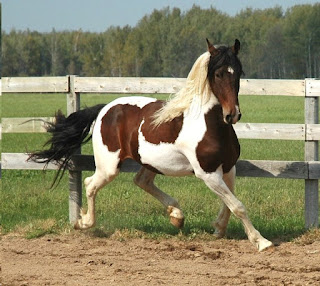
This month I'm writing about my favorite breed of horse, the Pinto which Grey Wolf rode in Trail To Destiny, Book 1 of my Wheels of Destiny Trilogy.


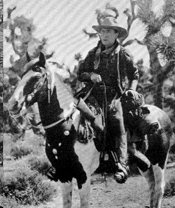
In my stories, I consider the hero or heroine's horse as much a secondary character as the people are!  Look back on lots of TV and movie westerns and you'll remember the names of so many horses the main characters rode.  One of the first Pintos in movie westerns dates back to the early 1920's with a horse named Fritz owned by William Hart.  He performed with Hart in multiple movies and remained a beloved companion into the actor's retirement.


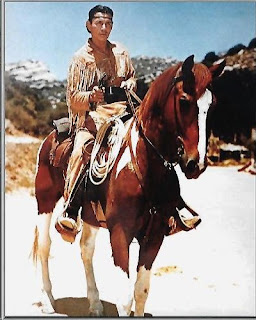
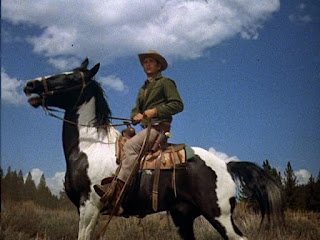
Another famous Pinto was Tonto's horse, Scout.  And can't forget to mention Bonanza and Little Joe's Pinto, Cochise.


Though commonly associated with the Native American for its legendary magical qualities in battle, the Pinto horse was actually introduced to North America by European explorers, chiefly those from Spain, bringing their Barb stock that had been crossed with native European stock years before.

It is believed that the Pinto patterns may have arrived in Europe via the Arabian strains, as Pinto markings appear in ancient art throughout the Middle East. However, evidence of the more dominant Tobiano pattern among the wild horses of the Russian Steppes suggests the introduction of Pinto coloring to Europe possibly as early as during the Roman Empire.


After the arrival of these European horses, great wild herds infused with the flashy color patterns we know today began to develop across America, eventually to be domesticated by the Native American. The white man continued to import many of the well-established and stylish European breeds as his foundation stock. Over time, however, with the civilization of the Native American and the white man's migration to the frontier, it often became necessary to cross these fancy, but less suitable breeds of the Eastern seaboard with the wild mustang stock to increase size and attractiveness as well as availability of a horse better suited to the strenuous working conditions of the day.

This Western-bred horse became a fixture of America, especially the uniquely marked Pinto whose colorful presence in parades and films always added a little extra glamour.

 What are the Pinto patterns and how do they differ? There are two recognized Pinto color patterns:

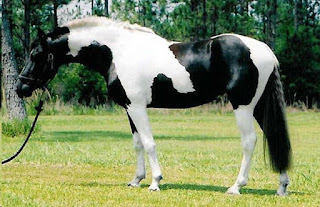
1) TOBIANO (Toe-bee-ah'-no) appears to be white with large spots of color, often overlapping on animals with a greater percentage of color than white. Spots of color typically originate from the head, chest, flank, and buttock, often including the tail. Legs are generally white, giving the appearance of a white horse with large or flowing spots of color. Generally, the white crosses the center of the back or topline of the horse. It is considered necessary to have a Tobiano parent to achieve a Tobiano foal.


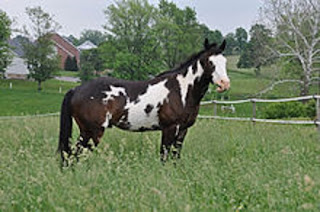
 2) OVERO(O-vair'-o) appears to be a colored horse with jagged white markings usually originating on the animal's side or belly, spreading toward the neck, tail, legs, and back. The color appears to frame the white spots. Thus, an Overo often has a dark tail, mane, legs, and backline. Bald or white faces often accompany the Overo pattern. Some Overos show white legs along with splashy white markings, seemingly comprised of round, lacy white spots. White almost never crosses the back or topline. A horse of Pinto coloration descendant from two solid colored parents of another typically solid colored pure breed is called a "crop-out" and is of the Overo pattern.


The Pinto Horse Association of America was formed in 1956 although the bloodlines of many Pintos trace three or four generations before that date. Choice, versatility and achievement for the breed that offers something for everyone is what the Pinto Horse Association has to offer.

The Pinto horse is a color breed in contrast to most other breeds which are defined by their genetic ancestry. In America, the Pinto is regarded as a proper breed. The Pinto coloration may occur in any breed or specific conformation. However, the Pinto Horse Association of America does not accept horses with Appaloosa, Draft, or mule breeding or characteristics.

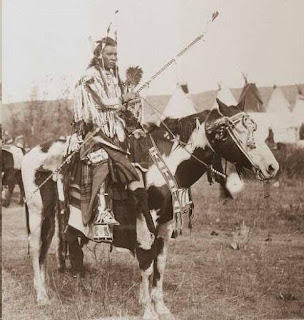
In the American west, the Pinto has traditionally been regarded as a horse the American Indian favored as a war horse since its coloring provided a natural camouflage.

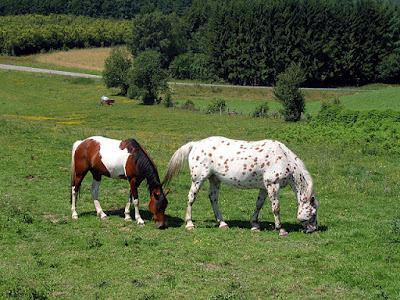
This photograph shows the difference between a Pinto

horse (left) and a leopard-spotted Appaloosa (right).

The Pinto does not have consistent conformation since it is bred for color. When the darker color is black, the horse is often described as Piebald. When the darker color is anything but black, the horse is described as Skewbald. Pintos may be from a variety of breeds, ranging from Thoroughbred to Miniatures.

What is the difference between Pintos and Paints? Of the questions posed to the PtHA, this is invariably the most frequently asked.  The short answer is the Paint Horse (registered by the APHA) is limited to horses of documented and registered Paint, Quarter Horse or Thoroughbred breeding.

I could go into more depth about the various Pinto colors, markings and categories, but anyone interested can learn more about these beautiful horses through the Pinto Horse Association of America (PtHA).

I learned a lot about Pintos as well as all types of horses for that matter, when my husband and I visited the Kentucky Horse Park in Lexington, KY.  We rode up there on our "steel horse," a Harley-Davidson Screamin' Eagle motorcycle.  They call that area the "Horse Capitol of the World," although believe it or not, Ocala, Florida staunchly contends it is.

But I tell you this, we rode over the most beautiful country roads, passing by unbelievably picturesque horse farms with their herds of horses grazing on that Kentucky Blue Grass!  I highly recommend visiting the state and in particular, taking a tour of the Horse Park and surrounding areas including Churchill Downs, the Keeneland Race Track and the Kentucky Bourbon Trail.  Yep, wouldn't have been complete if we didn't visit a couple of those Bourbon distilleries including a few tastings!

HAPPY TRAILS!


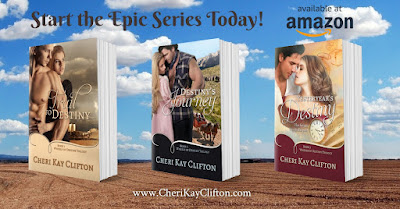
Book 1, Trail To Destiny - A turbulent cross-country journey of heated passion, bitter vengeance and a haunted past lead Grey Wolf & Laura Westbrook on their Trail To Destiny.

Book 2, Destiny's Journey - Family deception kept Jennifer O’Malley from marrying her first love ten years ago, West Point officer, Glen Herrington.  Now a Civil War widow, she leaves war-torn Richmond, determined to find her destiny.  She makes the long journey west in search of Glen, only to discover he is a notorious outlaw with a price on his head.

Book 3, Yesteryear’s Destiny - When Angela Moore skydives out of a plane and into the western frontier of yesteryear, she not only meets the love of her life, Ben Herrington, but discovers a fateful revelation that exceeds the boundaries of time and will control her destiny.


Tuesday, January 4, 2022

WILDLIFE IN THE AMERICAN WEST By Cheri Kay Clifton

As western authors, we know that settings are as important as our characters and plots. We want our readers to get a clear and vibrant sense of the western location in which our story takes place.

One way I use to engage my readers and enhance the believability of my fictional books is to be sure to include the sights and sounds of western wildlife common to the story’s location, be it in the prairies, great plains, mountains, or deserts.

For you reference, below is a compilation of commonly found wildlife in the Western United States.

 GREAT PLAINS & PRAIRIES:

American Bison
Pronghorn Antelope
Mule Deer
Black Tailed Jackrabbit
Whitetail Deer
Prairie Dog
Ferret
Coyote
Grey Wolf
Western Diamondback Rattlesnake
Badger
Golden Eagle
Prairie Falcon
Prairie Chicken
Western Meadowlark

MOUNTAINS ELEVATION 5000 & ABOVE

Elk (Wapiti – is a Native American word meaning “white rump)
Black Tailed Deer
Bighorn Sheep
Rocky Mountain Goat
Grizzly Bear
Black Bear
Mountain Lion
Bobcat
Wolf
Beaver
Porcupine
Tree Martin
Great Horned Owl
Peregrine Falcon
Moose
Mountain Chickadee
Downy Woodpecker
Mountain Jay
Western Bluebird

DESERTS:

Blacktail Deer
Pronghorn Antelope
Desert Bighorn
Antelope Jackrabbit
Coyote
Desert Woodrat
Mountain Lion
Jaguar
Desert Tortoise
Roadrunner
Trap Door Spider
Gila Monster
Harris Hawk
Common Raven
Quail
Desert Sidewinder Snake
Desert Iguana
Stink Bug

HAPPY NEW YEAR & THANKS FOR STOPPING BY!


My Author page: https://www.amazon.com/-/e/B002BLZOKC

Book 1, Trail To Destiny - A turbulent cross-country journey of heated passion, bitter vengeance and a haunted past lead Grey Wolf & Laura Westbrook on their Trail To Destiny.

Book 2, Destiny's Journey - Family deception kept Jennifer O’Malley from marrying her first love ten years ago, West Point officer, Glen Herrington.  Now a Civil War widow, she leaves war-torn Richmond, determined to find her destiny.  She makes the long journey west in search of Glen, only to discover he is a notorious outlaw with a price on his head.

Book 3, Yesteryear’s Destiny - When Angela Moore skydives out of a plane and into the western frontier of yesteryear, she not only meets the love of her life, Ben Herrington, but discovers a fateful revelation that exceeds the boundaries of time and will control her destiny.


Saturday, December 4, 2021

PUCKER UP AND KISS YOUR SWEETHEART UNDER THE MISTLETOE By Cheri Kay Clifton

Mistletoe … what kind of plant is it and where does it come from? And where did the holiday tradition of kissing under the mistletoe originate?

Other than seeing mistletoe for sale in the stores at Christmas time, I’d never known much about it until after I was married and my husband pointed out the plants growing in the tops of oak trees along the roadsides. He reminisced about how in his youth, he’d climb trees to cut down the mistletoe and sell it on the street corners for extra money during the holidays. Because of that bit of nostalgia, we’ve always had a sprig of mistletoe hanging over a doorway at Christmas time.

Mistletoe is commonly found growing as a parasitic plant. There are two types of mistletoe. The mistletoe that is commonly used as a Christmas decoration (Phoradendron flavescens) is native to North America and grows as a parasite on trees from New Jersey to Florida. The other type of mistletoe, (Viscum Album) is of European origin.

The use of Mistletoe goes back to the times of ancient Druids. They didn’t kiss under it, but they believed the plant, especially a rare species that grew on oak trees, to have sacred powers including the ability to heal illnesses, protect against nightmares, and even predict the future. The Druids would hang the plant in their houses hoping it would bring them good luck and ward off evil spirits.

 Mistletoe was also used as a sign of love and friendship in Norse mythology and that’s where it’s believed the custom of kissing under Mistletoe comes from. Mistletoe continued to be associated with fertility and vitality through the Middle Ages, and by the 18th century it had also become incorporated into Christmas celebrations around the world.

 Victorian England is credited with perpetuating the tradition of kissing under the mistletoe. The custom dictated that a man was allowed to kiss any woman standing underneath mistletoe and that bad luck would befall any woman who refused the kiss. One variation on the tradition was with each kiss a berry was to be plucked from the mistletoe and the kissing must stop after all the berries had been removed. Thus, the traditions which began with the European mistletoe were transferred to the similar American plant with the process of immigration and settlement.


So, how many of you decorate your homes with a sprig of mistletoe (real or artificial) and follow the romantic tradition of couples kissing when caught standing under it? Oh, by the way, I should mention that the plant is poisonous, so please, don’t eat it. Just Kiss!


Thursday, November 4, 2021

History of "AMERICA THE BEAUTIFUL" By Cheri Kay Clifton


A few weeks ago, my husband and I took a wonderful 10-day Trafalgar tour throughout the beautiful state of Colorado.  We not only saw unforgettable scenery, but just as enjoyable, we learned much more history about the state than if we’d traveled there on our own without our knowledgeable Trafalgar tour guide.

I’d like to share with you an interesting bit of history he told us about that many of you may not have known …. the origin of the patriotic song, “America the Beautiful.”


In 1893, at age 33, Katharine Lee Bates, long-time professor at Wellesley College in Massachusetts, was lecturing a summer session at Colorado College. During her visit she joined an expedition to the summit of Pikes Peak in a prairie wagon. Atop that 14,110 foot mountain, the words of a poem started to come to her and she wrote them down upon returning to her hotel room at the Antlers Hotel. (A beautiful historic hotel we had the pleasure of staying at while on our tour.)

Originally entitled “Pikes Peak,” the inspirational poem became lyrics for the song, ”America the Beautiful,” in 1910, with its melody composed by church organist and choirmaster, Samuel A. Ward at Grace Episcopal Church in Newark, New Jersey. Katharine Bates never met Ward. Ward died in 1903, not knowing the national stature his music would attain. However, the song’s popularity was well established by the time Bates died in 1929.

Commemorative plague atop Pikes Peak

July 1999

At various times in the more than one hundred years that have elapsed since the song was written, efforts to give "America the Beautiful" legal status either as a national hymn or as a national anthem equal to, or in place of, "The Star-Spangled Banner,” but so far this has not succeeded.

The song remains one of the most popular of the many U.S. patriotic songs.

AMERICA THE BEAUTIFUL - 1911 version
 
O beautiful for spacious skies,
For amber waves of grain,
For purple mountain majesties
Above the fruited plain!
America! America!
God shed His grace on thee
And crown thy good with brotherhood
From sea to shining sea!

O beautiful for pilgrim feet,
Whose stern, impassioned stress
A thoroughfare for freedom beat
Across the wilderness!
America! America!
God mend thine every flaw,
Confirm thy soul in self-control,
Thy liberty in law!

O beautiful for heroes proved
In liberating strife,
Who more than self their country loved
And mercy more than life!
America! America!
May God thy gold refine,
Till all success be nobleness,
And every gain divine!

O beautiful for patriot dream
That sees beyond the years
Thine alabaster cities gleam
Undimmed by human tears!
America! America!
God shed His grace on thee
And crown thy good with brotherhood
From sea to shining sea!


Visit my website: www.CheriKayClifton.com


Monday, October 4, 2021

FORT KEARNEY By Cheri Kay Clifton

 Writing about the historical Old West is in my blood!  Why? Because I was born near the Oregon Trail in Kearney, Nebraska.

As a young girl, I became interested in the history of nearby Fort Kearny after which my hometown was named and equally fascinated to read about the soldiers, pioneers, and Native Americans who helped create the history of America's growth westward.

Fort Kearny was founded in 1848 along the Platte River and named after then Colonel and later General Stephen W. Kearny.  As an interesting side note, the "e" was added to Kearny by postmen who consistently misspelled the town's name.  Also one should not confuse Fort Kearny with the historic Fort Phil Kearny located in Wyoming and named after Kearny's nephew, Maj. Gen. Philip Kearny.


General Stephen W. Kearny

 Despite its lack of fortifications, Ft. Kearny served as a way station, sentinel post, supply depot and message center for 49ers bound for California and emigrants traveling to California, Oregon and the Pacific Northwest.  Numbering in the hundreds of thousands, those brave pioneers crossed the continent searching for economic opportunity, and who associated land ownership and farming with freedom. 


Throughout most of its 23-year history, the outpost consisted mostly of wooden buildings surrounding a central parade ground without fortified walls.  Throughout the decades of its use until the completion of the transcontinental railroad, the buildings became slightly more permanent, changing from adobe and sod structures to the wooden frame buildings. 


   As the first U.S. Army post on the Oregon Trail, it grew rapidly into an important trail stop. The fort accumulated large stores of goods for travelers, with the directive of selling them at beneficial cost to the emigrants. The commander of the fort was authorized to sell goods at cost to emigrants, and in cases of hardship, to give goods to them for free.  In 1850, the fort acquired regular once-a-month mail service with the arrival of a stagecoach route between Independence, Missouri and Salt Lake City.  It was the first regular mail service established along the trail. By the 1860's the fort became a significant freighting station and home station of the Pony Express.

 Although it was in the heart of lands inhabited by Native Americans, and was near the center of hostile action in the 1860's, no direct attack was ever made on the fort.  However, in the summer of 1864, the irritation of the Native Americans at the encroachment by white settlers culminated in violent attacks on wagon trains along the Platte and the Little Blue River.  During this time, soldiers from Fort Kearny began escorting wagon trains and the fort became a center for refugees fleeing from attacks.

The construction of the Union Pacific Railroad across Nebraska starting in 1867 largely marked the end of the need for a fort to protect and supply wagon train emigrants. Following the completion of the transcontinental railroad in 1869, the U.S. Army issued an order for abandonment of the post in May, 1871.

Fort Kearny State Historical Park

In 1960, Nebraska designated the land where the outpost once stood as Fort Kearny State Historical Park.  Archeological exploration has located the building sites that are now marked with interpretive signs. Replicas of the palisade and blacksmith shop were built. An interpretive center presents audio-visual programs and museum displays. The park's 40 acres also acts as a recreational area, providing hiking trails, camping, picnicking and boating.

 Fort Kearny played a vital role in the settlement of the American West. I feel fortunate to have spent part of my childhood living nearby and thus, developing a love for our western heritage and more importantly a love of writing about it.

 The fort's history was the inspiration for writing Book 1 of the Wheels of Destiny Trilogy, Trail To Destiny, which takes place along the Oregon Trail.


Visit my Amazon Author Page CLICK HERE


Friday, September 3, 2021

THE COWBOY UNIFORM By Cheri Kay Clifton


     When it comes to our cowboy hero, we picture him wearing his most treasured possessions, his hat and his boots.
      But how about the other garments the cowboy wears?  Although less legendary, his other clothing was just as important, especially for their practical use.
      For instance, the neckerchief, also called the bandana.  The simple square of cotton was folded around the neck so that it could be pulled over the nose and mouth to mask trail dust.  Not only to protect his neck from the blazing sun, the kerchief also could be used as a bandage, a tourniquet or to wipe the sweat off his brow.


      The bandana originated in India and came from the Hindu word, bandhnu, describing a method of fabric dying. The 19th Century cowboy soon had made a fashion statement, the scarf worn in popular bright colors, preferably red and in printed designs of spots, calico and later, paisley.

       His long-sleeved shirts were collarless, made of neutral colors of cotton for summer, wool for winter.  Some had a heavier bib front panel for extra warmth.  Not until the Wild West shows became popular, did the cowboy start wearing fancier colored, embroidered shirts.


      An iconic piece that says “cowboy loud and clear,” is the vest. A cowboy spent much of his time in the saddle and found it difficult to reach into his pockets astride a horse.  The vest with deep pockets was convenient for holding small items such as a knife, money, tobacco or a pocket watch attached on a chain. 

      Most of us western writers already know the history of Levi Strauss and his patented canvas work pants that provided the cowboy with a much sturdier pair of pants than the baggy woolen pants he’d worn before, and of course, it wasn’t long before the cotton blue fabric, denim became the work pants of choice.


      Another addition to the working cowboy’s gear is the seatless leather pants called chaps, derived from the Spanish word, chaperejos, meaning leather breeches. They protected his legs while riding the range full of dense brush and cactus as well as providing another layer of warmth in the winter. In the northern states, some wore goat hair pants. Wide chaps protected the flanks of the horse and the cowboy could put them on without taking off his boots; other styles were narrow and tight around the rider’s legs and were sometimes called leggings or shotguns.  


      Also worn on the trail by cowpokes to protect their clothing from the dust of cattle drives was the loose-fitting long duster coat.  These duster coats usually had slits up the back for riding ease, but often had the capability to be buttoned closed.  Legs straps were included to help keep the flaps in place and later versions included a detachable cape or hood to help fight against the elements.  The improved fabric was usually light colored canvas or linen type cloth.  Eventually, the duster needed to be improved as a reliable raincoat, thus the oilskin duster or slicker was born.


      Spurs are one of the distinctive pieces of equipment that have been used by horsemen throughout the ages and certainly one of the most recognizable symbols of the western cowboy. 
      The very old word derives from Anglo-Saxon spura, to kick.  The generalized sense of “anything that urges on, stimulus” is recorded in English from circa 1390.


      In the days of chivalry, spurs and the metal from which they were made were a mark of rank.  Hence the expression “to earn your spurs.”  Today they are a standard piece of cowboy equipment and, as with most horse equipment, the design varied widely depending upon the region and the wearer.
      Spurs are designed to be worn in pairs on the heels of riding boots for the purpose of directing a horse to move forward or laterally while riding.  It is usually used to refine the riding aids (commands) and to back up the natural aids (the leg, seat, hands, and voice).
      In the U.S. spur styles have changed through the years. In colonial days, the English style was popular, the spurs were light and conservative with a slight curve and small rowel.  Straight shanked hunting spurs were also popular. 
      The regulation spur worn in the cavalry in 1882 was solid brass, slightly curved, with a small rowel, leather straps and brass buckle.  The same type was popular during the Civil War.  Early cavalry officer’s uniform required boots and spurs.  They had a standard version, a dress version that was lighter, and an extremely light dance spur for social functions.
      Many a cowboy liked wearing his spurs for show, adding “jingle bobs” near the rowel to create a jingling sound when he walked.


      Gauntlet gloves were a necessity on the trail and cowboys often wore wrist cuffs to protect the wrist, forearm and shirtsleeve from injury or damage by ropes, branding irons, brush, wire fencing and other hazards.  


      Last but certainly not least….one more necessary item worn under it all….
Long Johns.  Worn under the cowboy’s working clothing, long johns, or one piece underwear covered the body from neck to ankle and had a long buttoned opening down the front. 
            One may ask where such a garment got its name.  A British etymologist and writer, postulated that the “john” in the item of apparel may be a reference to the late 19th Century famous heavyweight boxer, John L. Sullivan, who wore a similar-looking garment in the ring. This explanation, however, is uncertain and the word’s origin is ultimately unknown.    
            So, there you have our handsome cowboy dressed from head to toe!

            Happy Trails To You!