Showing posts with label American Civil War. Show all posts

Saturday, April 16, 2022

Daughters of the Regiment - Vivandieres of the Civil War by Jo-Ann Roberts


Having just finished "Ainsley" my contribution to the Love Train series, I've turned my attention to Book Two in the Mended Heart series, "Winning the Widow's Heart".

In early July 1864, General Sherman ordered the arrest and deportation of the 400 women, children, and a few men from Roswell and Marietta, Georgia with treason for spinning yarn and weaving cloth for the Confederates. Then he shipped them north, from their homeland, through Tennessee and on to Louisville, Kentucky, ordering them to cross the Ohio River and support themselves in Indiana in whatever way they could.  

"Winning the Widow's Heart" follows the journey of Sofie Bishop of Roswell, Georgia from teacher to mill worker to alleged traitor and Union Captain Seth Ramsey, one of the officers charged with transporting the mill workers north.

While doing my research, I came across an article on vivandieres. Having never heard of these women who were part of a regiment, down the rabbit hole I went. Honestly, learning about these women was enlightening. I've never heard them mentioned in any history books, let alone a historical romance, either as the heroine or in a supporting role. There were the usual nurses, laundresses, cooks, and soiled doves who traveled with the armies. But vivandieres...no!

A vivandiere was a woman who filled several roles as needed: water bearer; a seller/distributor of food and creature comfort items like whiskey and tobacco; a nurse, a laundress, a mascot for shoring up morale; and many other incidental ones that came up as circumstances warranted. There were similar ladies called cantinieres, but at least early on there was a distinction between the two; vivandieres could accompany a unit onto the battlefield, while the cantinieres were to remain behind in camp. It has been noted that vivandieres did occasionally fight with their men.

Uniforms of vivandieres in the American Civil War varied from regiment to regiment. All had in common a knee-length skirt worn over full trousers, a tunic or jacket, and a hat. This style of costume was similar to bathing costumes depicted in fashion magazines of the period and was suitable for the outside exercise required of vivandieres who lived and marched with their regiments. There was a great deal of variation in trim and materials.
  
Mary Tepe

When the Civil War began, French-born Mary Tepe and her husband Bernard both joined the 27th Pennsylvania Volunteer Infantry Regiment, popularly known as Collis’ Zouaves. 
French Mary Tepe owed her nickname to her accent. In her role as a Zouave vivandiere, French Mary Tepe wore a blue jacket, red pants, and a blue skirt trimmed in red. She participated in the Battle of Fredericksburg (December 13, 1862), during which she received a bullet wound to one of her ankles. After a short hospitalization, Tepe rejoined her regiment. In July 1863, Mary and the 114th PA fought at the Battle of Gettysburg. When the battle was over, Mary volunteered her services as a nurse. A few weeks later, her nursing work at Gettysburg completed, she continued with her regiment and served throughout the remainder of the American Civil War.
Annie Etheridge
In April 1861, Annie Ethridge joined nineteen other women who enlisted as vivandieres with the Second Michigan Volunteer Regiment. Annie served throughout the rest of the war with the Third and Fifth Michigan Regiments. She became famous for her bravery under fire; after a battle, her skirt was always riddled with bullets. She carried pistols for her protection, saddlebags filled with medical supplies, and she frequently rode on horseback to the line of battle to aid wounded soldiers. She served at the First and Second Bull Run, Antietam, Gettysburg, and Fredericksburg. 
‘Gentle Annie,’ as she was called, worked for the Hospital Transport Service, which ferried wounded soldiers to military hospitals in the North aboard old paddle wheel boats that had been converted to be used for that purpose. Annie was used as a shield at one point -- some cowardly officer squeezed in behind Annie and her mare to shield himself from the fighting. Surprised, she turned to speak to him (and probably was going to tell him to get back into the fighting) when a stray minie ball struck him, killing him.


Kady Brownell 
 In the early 1860s, Kady McKenzie worked as a weaver in the mills of Providence, where she met and fell in love with Robert Brownell. With the outbreak of the Civil War in April 1861, Robert joined the 1st Rhode Island Infantry; Kady was determined to serve with him. 

 At the First Battle of Bull Run (July 1861), she held the regimental flag high as Confederate bullets were flying all around her. After enlisting in the 5th Rhode Island Infantry with her new husband, she served at the Battle of New Bern, North Carolina (1862). Brownell remained in New Bern after the battle, caring for her wounded husband. After his recovery he was deemed unfit for battle, and both were discharged.


                                                                                   Lavinia Williams of the 1st Louisiana Tigers


Calculating the exact number of women who served as vivandieres is nearly impossible. Neither North nor South recognized the service of vivandieres and they are rarely mentioned in official records. Their courage and brave deeds are recorded in personal accounts and post-war regimental histories. 

Armed with this fascinating information on those brave, intrepid women, a vivandiere or two will be featured in "Winning the Widow's Heart" coming late 2022/early 2023.


Pre-Order Available June 1st
Releases July 15th


Mended Hearts Series


Available on Kindle Unlimited and Amazon


Saturday, October 16, 2021

An Adventure for A Dime by Jo-Ann Roberts


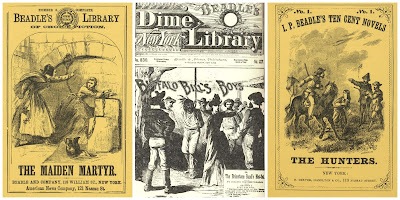
Initially published around the time of the Civil War, the first dime novels were immensely popular. These sensational stories were full of romance and adventure and became wildly popular in both the United States and in England, where they were dubbed "penny dreadfuls". 

Dime novels typically told the dramatic adventure stories of a single hero or heroine who often found himself or herself in the midst of a moral dilemma. They were ethically sound, endorsing good character, and strong moral values, with the hero/heroine choosing virtue over vice.

The storylines were simple and told in in language that brought to mind concrete pictures and people for the readers. The books were simple in appearance, bound in inexpensive paper with brightly illustrated covers, easy to carry, and easy to pass around. Though the subject matter of the novels included detectives, the military, chaste romance, and even early science fiction, it was the Western dime novel that dominated the market.

In the beginning, these stories were about the American Indians, but when the Indians were forced onto reservations, the public's fascination with them began to fade. Consequently, the novels focused on cowboys in the Wild West, outlaws and bandits, and train robbers. 

In Victorian England, "penny dreadfuls" were written in the macabre Gothic tradition to frighten and thrill readers.


Dime novel stories would often feature a recurring hero such as Buffalo Bill, Deadwood Dick, Buckskin Sam, or Roving Joe. The printing house could then establish a series and garner a following for these heroes. These heroes were, of course, packaged in a fast-paced adventure story often described as
"blood and thunder". 

First issued by the New York printing firm of Irwin and Erasmus Beadle and Robert Adams, the dime novels were an immediate success.  Between 1860 and 1865 alone, Beadle and Adams published more than five million dime novels. During this time, the Civil War made soldiers a prime audience for the publishers who produced books that catered to the men needing a light diversion during the boredom that often came with camp life.
Writing these stories was a lucrative business for many late 19th century authors. A well-established author could earn up to $1,000 per story; a lesser established author could expect close to $50 per story. One such author, Prentiss Ingraham achieved success and fame as an author of the "Buffalo Bill" series. By his own account he penned 600 novels by 1900.

Another major publishing house, Street and Smith, viewed fiction as a commodity, and editors had strict authority over the authors' works. Each author was allowed limited room for creativity and was required to follow a specific formula in the plot lines and writing style. No wonder authors like Horatio Alger, Upton Sinclair, and Jack London wrote for Street and Smith under pen names!


However, not all authors wrote under pen names to save their reputations. Many authors were writers who were often journalists, teachers, or clerks simply looking to make a bit more money to supplement their current occupations. With the invention of the typewriter, authors were able to churn out stories at an unbelievable rate. One author, Frederic Marmaduke Van Rensselaer Dey, the creator of street-savvy detective Nick Carter, was rumored to put out 25,000 words every week for almost twenty years!
 
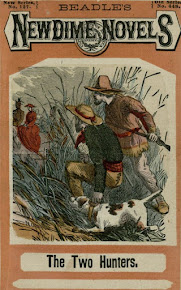
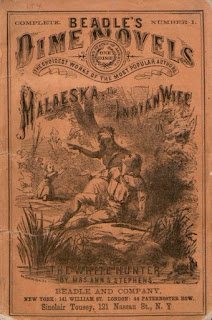
Although not as numerous as their male counterparts, female authors also found success in the dime novel market. The most notable among these was Ann S. Stephens. In 1860, she authored the very first Beadle's Dime Novel, "Malaeska: The Indian Wife of the White Hunter".


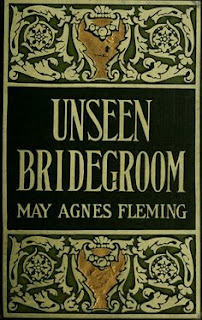
Bertha Clay, Geraldine Fleming, and Laura Libbey were among the most prominent female authors who penned stories about the pioneers, sensational murder mysteries, and society romances aimed at a young, working, middle-class audience. All for Love of a Fair Face, The Story of a Wedding Ring, A Charity Girl, The Unseen Bridegroom, and Only a Mechanic's Daughter were among the most popular romance novels enjoyed by girls and women, and surprisingly by many men.


The dime novel craze heavily influenced pulp fiction magazines introduced in the 1890s. Rising postal rates may have caused a decline in the publication of the dime novels, but the content material and sentiment behind the works continue to influence publications even today. 

Wednesday, April 28, 2021

Emancipation for All?

 By Julia Ridgmont

Recently, I was working on a project revolving around the game of baseball, and out of curiosity, I decided to look up the most expensive autographed baseball in history. Google pointed me to this article written by Jenny Chang in which she asserts that a brand new baseball signed by Babe Ruth sold for over $388,000 (though I’m not sure how the “brand new” part works since ol’ Babe lived . . . well, a long time ago). I found much more interesting—and ironic—autographed items listed in this article, however, such as a newspaper signed by John F. Kennedy right before he was assassinated and a photograph signed by Jesse James, which his granddaughter apparently gave up for hard cash. Wow, that’s harsh.


Among these anomalies, I also discovered an interesting fact about the Emancipation Proclamation that I suspect not many people know. President Abraham Lincoln didn’t sign just one copy of the famed document. He signed 48 copies, with 26 of them still in existence today. (The original draft, written by Lincoln’s hand, burned in the Chicago fire in 1871.) While most of the surviving copies reside in museums and other government collections now, a precious few are privately owned, with the record high for the purchase of one copy being $3.7 million.


What else do we know—or not know—about the proclamation? For starters, it was issued twice, first on September 22, 1862 as a warning to the Southern states who had seceded from the Union, which included Texas, Louisiana, Arkansas, Alabama, Mississippi, Georgia, Florida, South and North Carolina, and Virginia. President wasn’t wholly concerned about freeing the slaves, though it did bother him some and he wasn’t quite sure what to do about it. Rather, his main purpose for issuing the proclamation was to help the Union come together and he was prepared to use whatever means available to make it happen. Thus, this warning alerted the Confederate states they would be losing their slaves if they didn’t “cease their rebellion” by the first of January in the coming year. (Unfortunately, we all know what the Conferacy’s decision was.) The second issuing of the proclamation did, in fact, occur on January 1, 1863—and ironically, it did not free slaves that were within Union lines (for fear of those states erupting in ire as well). It only made provisions for those border states which were causing so much trouble. And by provisions, I really do mean that. Lincoln’s idea was to compensate the slave owners for their slaves. This idea didn’t go over too well, though. But this is something else I learned about the proclamation that I didn’t know before. Did you?


Lincoln had to use some fancy footwork to get this proclamation out to the people. First, he wasn’t technically within his rights to do so as President of the United States of America. Instead, he had to do it as the Commander in Chief of its army and navy. Also, his cabinet advised him to wait until the Union army secured a victory and the people would be more receptive to it. While the Battle at Antietam didn’t exactly result in the rout they wished for, it was enough of a victory to count, and Lincoln followed through on this course of action.


First Reading of the Emancipation Proclamation with Lincoln's Cabinet - Painting by Francis Bicknell Carpenter


If the Emancipation Proclamation didn’t free all of the 4 million people enslaved at that time, what good did it do?


First, the Emancipation Proclamation effectively cut off Southern negotiations with outsiders like France and England, who abhorred slavery, thereby negating any assistance that might have come to the Confederacy. Second, it allowed people of African-American descent to join the army, giving the Union a much-needed advantage with over 200,000 enlistments. And third, the proclamation changed the focus of the war. At first, the two sides were fighting over states’ rights which included the question of what to do with the institution of slavery as it pertained to westward expansion. Once the proclamation was issued, however, the cause of freedom for all quickly gained momentum and in one of the bloodiest conflicts to ever take place on American soil, that freedom was won.


And here’s one more fun fact for you: The Emancipation Proclamation was signed by President Lincoln in the Lincoln Bedroom of the White House. At the time, however, it wasn’t a bedroom but an office which Lincoln used for his cabinet members. The walls were lined with war maps.


President Lincoln considered the Emancipation Proclamation to be his greatest achievement while in the White House, and it is easy to see why.


Several of my Christian historical western romances take place right after the Civil War ended, including An Agent for Jessica in the Pinkerton Matchmaker series. Though I don’t go into a great amount of war details, I like to explore the way this great conflict must have affected people’s lives afterward. Another book of mine that mentions battle scars of the mental kind, even years after the war, is The Christmas Switch, one of my personal favorites. If you haven’t had a chance to check these titles out, I’d like to invite you to do so. In addition to these titles, I’ll have another book, Buck’s Resilient Bride, to share with you which also touches on this subject.


Cheers for now and keep reading those historical romances that leave you with a feeling of warmth and belonging.