In today’s
jet-setting world, we tend to forget how laborious and time-consuming travel
used to be. Sure, we occasionally think of the Oregon Trail and the people who
traversed the western United States along its continuous pathway. We even like
to read stories with characters that are struggling to cross those endless
plains and mighty mountains. However, I’ve noticed a trend in my own writing,
and a connecting one in some of my readers’ minds when they read my historical
western romances. You see, in my historical western romances, my characters are on the move. Since my stories take place long after the prime era of the Oregon Trail migration, railway travel is the mode my characters most often use. And, well, they use it a
lot. How exactly they manage to pay the expensive travel fare is something I
usually leave up to the reader's imagination.

In my first Pinkerton Matchmaker book, An Agent for Elizabeth, however, I had
18-year-old Elizabeth purchase a train ticket for $122 to travel from Kansas
City to Denver. I, along with a few of the authors in the series, made an
educated guess based on a travel log that one of the authors was able to pull
up online. Turns out that we were pretty close! Other sources I have since run
across mention that train fare cost 2-3 cents per mile, and in 1870, a trip from New
York to San Francisco cost around $136 if traveling first-class in a Pullman
car. That was quite
a lot of cash for the average person to hand over back then. It was Elizabeth's stepmother who provided her with the funds to make this trip. What neither of them
knew was that Elizabeth wasn’t just going to meet her beau—who didn’t know he
was her beau—she would need to become a Pinkerton agent in order to snag his
interest!
As for my
heroine, Susannah Eversoll, in my Brides of Hope Hollow story, Hope Springs Eternal, she migrated from Missouri, where she grew up, to Dakota Territory,
when her first husband took a job there, and then to Piedmont, Wyoming. I imagine, as the
general notion goes, most regular folks in those days didn’t travel more than
five to ten miles beyond their childhood homes is true. However, as Laura
Ingalls Wilder, along with other journals from people who lived back then have
proven, there were some brave souls who did step into the great unknown and
make long treks for the purpose of bettering their lives. My own ancestors were
some of these folks. I’m not sure how desirous they were for seeking riches or
seeing parts of the country they hadn’t seen before, but they were Mormons who
were being driven out of their homes and needed a place of refuge. They traveled
right alongside the folks who were going to Oregon or to the California gold
fields, only they stayed on one side of the Platte River while the rest of the
travelers stayed on their side, mainly for protection against anyone who might
hold strong sentiments against them and therefore cause more trouble than they’d
already faced back East.
Back to
Susannah, though. She and her husband wouldn’t have traveled by rail up to
Dakota Territory from Missouri. This was during the time of the Civil War. They
left that state because of the conflicts that were happening (and unbeknownst
to Susannah, her husband was deeply involved in them). Maps from that era show
there were no rail lines heading up that way. It would have been a long and
arduous journey, especially since their daughter, Melissa, was so young at the
time.
 |
Courtesy of Library of Congress
|
One reason
that I chose to place Susannah and her first husband in Dakota Territory, even
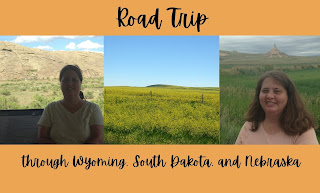
though it didn’t have a huge bearing on the story, was that in 2019, my family
and I traveled up from Arizona to Wyoming, stopping at Independence Rock. From
there, we went into Deadwood, South Dakota, and then down to western Nebraska,
visiting a few historic places there, and home through Colorado and New Mexico.
So it was one big loop for us—and an incredibly enlightening trip for me. In
South Dakota, I fell in love with the beautiful, fragrant blossoms there. I
never imagined the prairie land looking and smelling so vibrant and fresh. I
was amazed! Perhaps someday I’ll write a book that fully takes place there.
Here are a few pictures from that trip. It’s definitely time to take another
one!
As you can
also see from the map above, there were no rail lines going straight into southern Oregon
from Wyoming and Idaho in the 1880s, where the Brides of Hope Hollow series
takes place, so my brides have to travel through California and then up that
way. Ariana, the schoolteacher in my last BofHH story, On the Wings of Hope,
did some major traveling before finally settling in Hope Hollow. Her reason?
She was being chased by a strange man. She started teaching in western Nebraska
and then made her way to Rawlins, Wyomings, then to Carson City, Nevada, and a
fictional town in northern California. And still the man followed her! I don’t
know about you, but I would keep on the move if I were a lone woman in 1882 and
a man whom I didn’t know kept showing up in the places I moved to!
Incidentally, Ariana's story doesn't begin in Nebraska. She was a rider on an orphan train. As you can see from this map, at the time Ariana rode the rails to her new home, the Union Pacific Railroad only went a little ways past Omaha, and that's where she was adopted into a not-so-loving family.
So while the stories of these women traveling
such far distances, and many times on their own, might seem farfetched, there
were actually several brave females who did this in real life (check out the real life story of Charley Parkhurst here). And I want to pay homage to them. I
don’t know that I would have had the fortitude to do such a thing. Perhaps some
of them were escaping a bad situation at home. Perhaps they felt there were no
opportunities for them. I especially like the fact that they put their trust in
God to bring them to a place of prosperity. I am of the mindset that we shouldn’t
settle for less than happiness. Yes, the old adage to bloom where you’re
planted is a good one. But we can also plant ourselves where the soil is more
fertile.
I hope these
women and others in your life inspire you to take a leap of faith into the
unknown. No matter what, we must keep plowing ahead until we reach our goals.
One step at
a time.
To learn more about Julia’s books, visit her Amazon page.


.jpg)


