By Caroline Clemmons
In the book I just released earlier this month, CHARLOTTE’S
CHALLENGE, the hero is a devoted reader of (fictional) Missouri Kid dime
novels. These cheap publications were popular and accessible to most people. When
did they begin?
Much of the content of dime novels came from story papers, which
were weekly, eight-page newspaper-like publications, varying in size from
tabloid to full-size newspaper format and usually costing five or six cents.
They started in the mid-1850s and were immensely popular, some titles being
issued for over fifty years on a weekly schedule. Frank Leslie's Illustrated Newspaper, later renamed Leslie's Weekly, was an American
illustrated literary and news magazine founded in 1855 and published until
1922. It was one of several magazines started by publisher and illustrator Frank
Leslie.
Dime
novels and story papers are perhaps best
described as the television of their day, containing a variety of serial
stories and articles. Something was aimed at each member of the family, and
often illustrated profusely with woodcuts. Popular story papers included The
Saturday Journal, Young Men of America, Golden Weekly, Golden
Hours, Good News, and Happy Days.
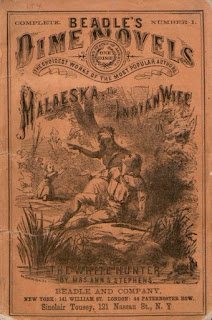
In 1860, the publishers Erastus and Irwin Beadle (What names!) released
a new series of cheap paperbacks, Beadle's Dime Novels. Dime
novel became a general term for similar paperbacks produced by various
publishers in the early twentieth century.
The first book in the Beadle series
was
Malaeska, the Indian Wife of the White Hunter, by Ann S.
Stephens dated June 9, 1860. The novel was essentially a reprint of
Stephens's earlier serial, which had appeared in the Ladies' Companion magazine
in February, March and April 1839. It sold more than 65,000 copies in the first
few months after its publication as a dime novel. I do hope she was well paid for her work but I suspect not. The first 28 were
published without a cover illustration, in a salmon-colored paper wrapper. A
woodblock print was added in issue 29, and the first 28 were reprinted with
illustrated covers. The books were priced, of course, at ten cents.
This series ran for 321 issues and established almost all the
conventions of the genre, from the lurid and outlandish story to the
melodramatic double titling used throughout the series, which ended in the
1920s. Most of the stories were frontier tales reprinted from the numerous
serials in the story papers and other sources, but many were original stories.
As the popularity of dime novels increased, original stories
came to be the norm. The books were reprinted many times, sometimes with
different covers, and the stories were often further reprinted in different
series and by different publishers.
The literacy rate increased around the time of the American
Civil War, and Beadle's Dime Novels were immediately popular
among young, working-class readers. By the end of the war, numerous
competitors, such as George Munro and Robert DeWitt, were crowding the field,
distinguishing their product only by title and the color of the paper wrappers.
Beadle & Adams had their own alternate "brands", such as the
Frank Starr line.
As a whole, the quality of the fiction was derided by
highbrow critics, and the term dime novel came to refer to any
form of cheap, sensational fiction, rather than the specific format. The English equivalents were generally called penny
dreadfuls or shilling shockers.
The pocket-sized sea, Western, railway, circus, gold-digger, and
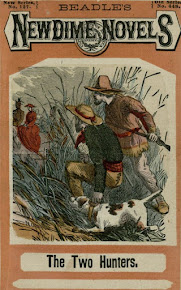
other adventures were an instant success. In 1874, Beadle & Adams added the
novelty of color to the covers when their New Dime Novels series
replaced the flagship title. Beadle's New Dime Novels ran for
321 issues, until 1885.
Most of the stories in dime novels stood alone, but in the late
1880s series characters began to appear and quickly grew in popularity. The
original Frank Reade stories first appeared in Boys of New
York. The Old Sleuth, appearing in The Fireside Companion story
paper beginning in 1872, was the first dime-novel detective and began the trend
away from the western and frontier stories that dominated the story papers and
dime novels up to that time. He was the first character to use the word sleuth to
denote a detective, the word's original definition being that of a bloodhound
trained to track. Nick Carter first appeared in 1886 in the New York
Weekly. Frank Reade, the Old Sleuth and Nick Carter had their own ten-cent
weekly titles within a few years.
In 1873, the house of Beadle & Adams introduced a new
ten-cent format, with only 32 pages and a black-and-white illustration on the
cover, under the title New and Old Friends. It was not a success,
but the format was so much cheaper to produce that they tried again in 1877
with The Fireside Library and Frank Starr's New York
Library. The first reprinted English love stories, the second contained
hardier material, but both titles caught on
Publishers were no less eager to follow a new trend then than now.
Frontier stories, evolving into westerns, were still popular, but the new vogue
tended to urban crime stories. One of the most successful titles, Frank Tousey’s New
York Detective Library eventually came to alternate stories of the
James Gang with stories of Old King Brady, detective, and (in a rare occurrence
in the dime novel) several stories which featured both, with Old King Brady
doggedly on the trail of the vicious gang.
As it is now, the competition was fierce. Publishers were always
looking for an edge. Sounds familiar, doesn't it? Once again, color came into play when Frank Tousey
introduced a weekly with brightly colored covers in 1896. Street & Smith
countered by issuing a weekly in a smaller format with muted colors. The price
was also dropped to five cents, making the magazines more accessible to
children. This would be the last major change before it evolved into pulp
magazines. Ironically, for many years it has been the nickel weeklies that most
people refer to when using the term dime novel.
The nickel weeklies were popular, and their numbers grew
quickly. Frank Tousey and Street & Smith dominated the field. Tousey had
his "big six": Work and Win (featuring Fred Fearnot,
a serious rival to the soon-to-be-popular Frank Merriwell), Secret
Service, Pluck and Luck, Wild West Weekly, Fame and
Fortune Weekly, and The Liberty Boys of '76, each of which issued
over a thousand copies weekly. Street & Smith had New Nick
Carter Weekly, Tip Top Weekly, Buffalo Bill Stories, Jesse
James Stories, Brave & Bold Weekly and many others.
The Tousey stories were generally the more lurid and sensational of the two.

Perhaps the most confusing of the various formats lumped
together under the term dime novel are the so-called
"thick-book" series, most of which were published by Street &
Smith, J. S. Ogilvie and Arthur Westbrook. These books were published in
series, contained roughly 150 to 200 pages, often with color covers on a
higher-grade stock. They reprinted multiple stories from the five- and ten-cent
weeklies, often slightly rewritten to tie them together.All dime-novel
publishers were canny about reusing and refashioning material, but Street &
Smith excelled at it. They developed the practice of publishing four
consecutive, related tales of, for example, Nick Carter, in the weekly
magazine, then combining the four stories into one edition of the related
thick-book series, in this instance, the New Magnet Library. This
reminds me of today’s authors taking several of a series and making them into a
box set.
The thick books were still in print as late as the 1930s but
carry the copyright date of the original story, often as early as the late
nineteenth century, leading some dealers and new collectors today to
erroneously assume they have original dime novels when the books are only
distantly related.
By the turn of the century, new
high-speed printing techniques combined with cheaper pulp paper allowed him to
drop the price of Argosy from twenty-five cents to ten cents, and sales of the magazine
took off.
In 1910, Street and Smith converted two of their nickel
weeklies, New Tip Top Weekly and Top Notch Magazine,
into pulps. In 1915, Nick Carter Stories, itself a replacement for
the New Nick Carter Weekly, became Detective Story Magazine. In 1919, New
Buffalo Bill Weekly became Western
Story Magazine. Harry Wolff, the successor in interest to the Frank Tousey
titles, continued to reprint many of them into the mid-1920s.
In the late 1940s and early 1950s, collecting dime novels became
popular, and prices soared. Even at that time, the cheap publications were
crumbling into dust and becoming hard to find. I had one of these from my
family from the early twentieth century but it eventually did just what you
read above—it crumbled to dust.
Sources:
https://en.wikipedia.org/wiki/Dime_novel
https://en.wikipedia.org/wiki/Frank_Leslie%27s_Illustrated_Newspaper
~~~~~~~~~~~~~~~~~~~~~~~~~~~~~~
Universal buy link is
https://mybook.to/Bret Available in e-book, print, and enrolled in Kindle Unlimited.A widow determined to save the
family ranch…
A man who inherited cursed
pirate gold…
They must combine efforts to
defeat an evil man.
Bret Craig is a
descendant of one of the crew of The
Golden Fleece. Over a century ago the merchant ship had prevailed
against pirates carrying a treasure of cursed Inca gold. The legacy promises
retribution against anyone who misuses the treasure. Bret has heard the story
all his life but he believes the tale is a myth and that he’s in no danger if
he spends the money selfishly. Ignoring his sister’s warning, he sets out for a
grand adventure heading west.
Widowed former mail-order
bride Charlotte Dunn is in danger of losing the family ranch. She lost her
husband to a rustler’s bullet when half the cattle were stolen and both ranch
hands were killed. When she and her stepsons rescue a man who fell from his
horse, they learn the man has amnesia. From his saddlebags, they determine his
name is Bret Craig. Charlotte nurses Bret, manages the ranch, and cares for her
three stepchildren she loves. No sooner does Bret regain his memory than they discover
the remainder of the ranch’s herd has been rustled.
Bret re-evaluates his
priorities in order to embrace the love blossoming between Charlotte and him.
Can they save the ranch and recover the stolen cattle?
Great reviews so far!


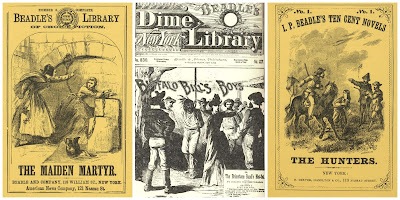


 First issued by the New York printing firm of Irwin and Erasmus Beadle and Robert Adams, the dime novels were an immediate success. Between 1860 and 1865 alone, Beadle and Adams published more than five million dime novels. During this time, the Civil War made soldiers a prime audience for the publishers who produced books that catered to the men needing a light diversion during the boredom that often came with camp life.