Showing posts with label Brides of New Hope. Show all posts

Sunday, October 16, 2022

Desperation Pie - by Jo-Ann Roberts


When I was plotting out my Christmas book slated for a Black Friday release, I knew my hero was an only child of a single mother who wasn't a very good cook. But she did make one dish for her son...Vinegar Pie!

I imagine some of you are already puckering your lips, making an "eww" sound! While many people today wince at the thought of a vinegar pie, our pioneer ancestors loved it. They used apple-cider vinegar to take the place of citrus juices to make this tart and sweet pie. The filling is similar to a Key Lime pie or a Lemon Meringue pie, except vinegar is substituted for the lemon or lime juice.


Today, buying lemons or limes is as easy as walking to the produce aisle at our local grocery store. However, the pioneers didn't have that luxury. Something as simple as a lemon, orange, or lime was a rare treat, very expensive, and difficult to find. The availability of citrus fruits wasn't as great as today's demand, let alone the means to distribute the fruits. But that didn't stop many pioneer women from improvising alternate solutions. Thus, the first vinegar pie recipe was born. The acid in the vinegar delivered the same taste and tartness as the citric acid in citrus fruits. 


In the mid- to late 1800's, every logging or mining camp had a cook shack where the loggers and miners gathered to eat. Much of the menu consisted of wild game and fish. But dessert was another story, and while cooks in these camps were very creative, the options were often limited. Since pie was extremely easy to make requiring only water, flour, vinegar, sugar, eggs, and dry spices..."Desperation Pie" was created and became a camp favorite. It was not only sweet and tart but was often topped with a meringue.


Vinegar pie is about old-fashioned as it gets. The ingredients are readily available, and the benefits of using vinegar are numerous. If you want to get a good dose, plus appreciate a bit about our past, give this vinegar pie a try!


e


 . 


Tuesday, August 16, 2022

"The One-Horse Open Sleigh" - The Origin of "Jingle Bells" by Jo-Ann Roberts


Perhaps no single piece of popular music is more universally recognized during the Christmas holiday season than "Jingle Bells", the jaunty tune about the joys of dashing through snow-covered fields while riding in a one-horse open sleigh.
In my current Christmas WIP (shh, I can't say much about it...yet!), the FMC is encouraging her children to practice the song to divert their attention. Further along in the story, the MMC sings it to the FMC when he takes her on a sleigh ride.
By adding accurate historical tidbits to my books, it gives a layer of richness and authenticity to the stories. Because the story's time frame is between Thanksgiving and Christmas, I researched holiday songs and carols. Much to my delight, I discovered that "The One-Horse Open Sleigh" (a.k.a. 'Jingle Bells") was composed in 1850, some twenty-one years before my story takes place.


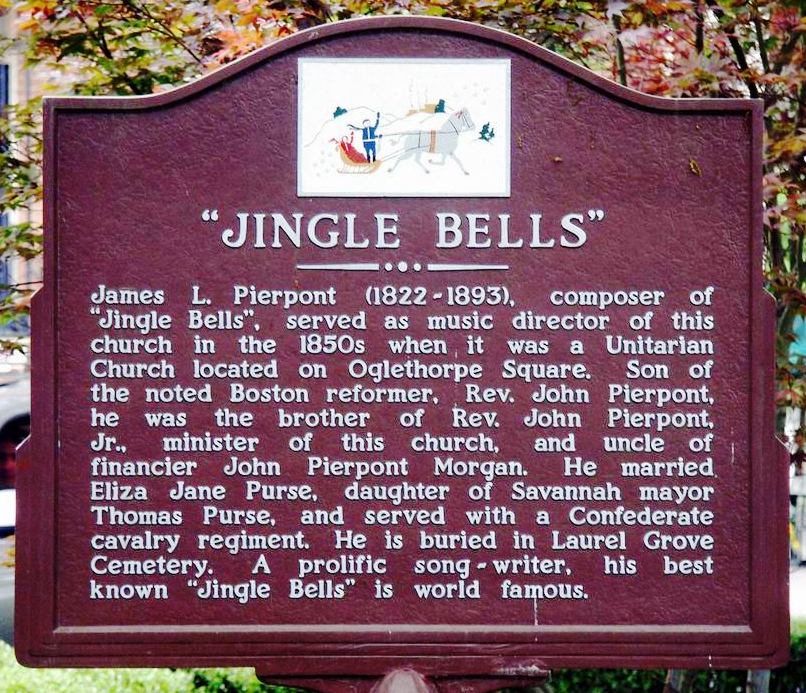
Although historians are still debating the when, where, and why of the song's composition, it is accepted the tune was written at the Simpson Tavern in Medford, Massachusetts in 1850 by James Lord Pierpont. A witness, Mrs. Otis Waterman, verified the location of the song's composition. While living in Savannah, Pierpont copyrighted "Jingle Bells." Many Savannah historians believe that Pierpont penned the song about sleigh rides in Medford while in Georgia experiencing his first snowless winter as an ode to his Massachusetts snowy upbringing.

The debate between Savannah and Medford began in 1985 when Savannah erected a historical marker across from the Unitarian Church Pierpont called home.
 A few years later the mayor of Medford sent a letter to the mayor of Savannah stating the song was composed in Medford in 1850. Yet, Savannahians contends that because the song was copyrighted in 1857 while Pierpont in their city, they proclaim Savannah as the home of "Jingle Bells".


Regardless of precisely where and when "Jingle Bells" might have been written, it was clear the tune was not intended as a Christmas song. Some local history narratives claim the song was inspired by Medford's popular sleigh races during the 19th century. Though the song only mentions snow--and not Christmas or December--many believe Pierpont wrote the song for a Thanksgiving program at his father's Sunday school. The song proved so popular the children were asked to sing the song again at Christmastime and has been tied to the latter holiday ever since.  

This version of the story has been disputed by some, however, who believe "Jingle Bells" would have been too racy for a Sunday school in the 1850s.

"The references to courting would not have been allowed in a Sunday school program of that time, such as 'Go it while you're young'".

Instead, it was just a sleighing song. Fast sleighs and pretty girls. Some things never change.


The song became so popular in the 1860s and 1870s it was featured in a variety of parlor songs and college anthologies in the 1880s. It was first record in 1889 on an Edison cylinder. This recording, believed to be the first Christmas record is lost, but an 1898 recording also from Edison Records survives.

The two first stanzas and chorus of the original 1857 lyrics differed slightly from those known today. It is unknown who replaced the words with those of the modern version. Underlined lyrics are the removed lyrics from the original version. Bold lyrics are the new lyrics in the current version.

Dashing thro' the snow,
In a one-horse open sleigh,
O'er the hills (fields) we go,
Laughing all the way.
Bells on bob tail ring,
Making spirits bright,
Oh, what sport (What fun it is) to ride and sing
A sleighing song tonight.

|: chorus :|
Jingle bells, jingle bells,
Jingle all the way;
Oh! what joy (fun) it is to ride
In a one-horse open sleigh.

A day or two ago
I tho't I'd take a ride
And soon Miss Fannie Bright
Was seated by my side.
The horse was lean and lank
Misfortune seemed his lot
He got into a drifted bank
And we— (then) we got upsot.


Click Here

Some people come into your life as lessons…
Unexpected fatherhood finds former bank detective, Lucas Harmon desperate for a woman to care for his orphaned nieces. A governess…perhaps? A housekeeper…maybe? A wife…definitely not! Six years ago, the wealthy Chicago socialite he planned to wed, publicly spurned his affections. Despite his determination to guard his feelings, a meddling matchmaking conductor and an encounter with a past acquaintance threatens to upend his heart.
…some come as blessings
Anxious to leave behind the whispers and stares of two jilted love affairs, Boston socialite, Ainsley MacKenzie hopes for solitude on her way to New Hope, Kansas. But when the kindly conductor enlists her help to care for two orphaned girls, she couldn’t say no. Little did she know their uncle and guardian was the one man she couldn’t forget… Lucas Harmon. Taking a chance, Ainsley offers Lucas an unusual (some might say, scandalous!) arrangement. She’ll look after the children, read them stories and cook their meals until Christmas, giving Lucas time to find a permanent replacement. Yet, the longer she cares for the family the more she longs to be part of it—whatever the risk to her heart.


Thursday, June 16, 2022

The Man Who Inspired Father's Day - by Jo-Ann Roberts


“I remember everything about him. He was both father and mother to me and my brothers and sisters.”

                                                                                                       Sonora Smart Dodd

Like Memorial Day, Labor Day, Veterans’ Day, and Mother’s Day, Father’s Day evolved from a concerted effort by a loved one to honor a group or individual for their selfless, and often times, unrecognized contribution to family and country.

Such is the case of Sonora Smart Dodd.


When Sonora was 16, her mother Ellen died, leaving William Jackson Smart as a single father to Sonora and her five younger brothers.

Sonora’s mother Ellen, herself a widow, had three children from a previous marriage. In addition, William had been married and widowed before he met Sonora’s mother. William had five children with his first wife who were already grown when he became a widower for the second time.

An unlikely inspiration for the Father’s Day movement, William Jackson Smart was born in Arkansas in 1842. Records there show that he enlisted as a Union soldier in 1862. That in itself is odd because Arkansas was a Confederate state.

However, records show that he fought for both sides in the war.

Driving a supply wagon for Confederate troops, William was captured in a decisive victory in Arkansas at the battle of Pea Ridge. Rather than languish in a Union prison, he opted to join the northern cause. As a result, Sonora was eligible to claim membership as a member of both the United Daughters of the Confederacy and the Daughters of Union Veterans.

William and his second wife Ellen were living on a “coal ranch” in Jenny Lind, Arkansas when Sonora was born in 1882. Instead of mining for coal, William and the family “farmed” it, collecting chunks of coal from the surface and carting it to town for sale. In 1887,  they sold the farm for $5000—a hefty sum at the time—and the family move to Spokane, Washington. 

Fun fact…the farm in Arkansas would turn out to be one of the most productive coal fields in the entire nation!

In 1898, William became a widower for the second time. In Sonora’s memories of this sad, difficult time, she recalls her father as a “great home person”, a man who exemplified fatherly love and protection.

It was this selfless devotion that prompted Sonora to action while attending one of the first official Mother’s Day services at her church in 1909.

If mothers deserved a day in honor of their loving service, why not fathers?

In 1910, Sonora brought a petition before the Spokane Ministerial Alliance to recognize the courage and devotion of all fathers on William’s birthday, June 5. Though the local clergy like the idea of a day devoted to fathers, they couldn’t pull something together in so short a time span. Instead, they settled on June 19th, the third Sunday in June.

On that first Father’s Day in 1910, churches sermons across Spokane were dedicated to fathers, red and white roses were handed out in honor of fathers both living and dead, and the governor and mayor issued proclamations...and Sonora found her calling.

With the support of her congressman, she began to lobby for the creation of a national holiday, determined to give fathers like hers the recognition they deserved.

But it wasn’t until 1972 that President Nixon finally signed a Congressional resolution declaring the third Sunday in June to be Father’s Day.

William Jackson Smart, no doubt, would have been proud of Sonora.


Happy Father's Day 

to all the special dads, step-dads, grandads, uncles, 

brothers, cousins, neighbors, teachers, and friends

who stepped up to show a child what it truly means to be a father.


Wednesday, March 16, 2022

Angel of the Battlefield - The Life and Times of Clara Barton by Jo-Ann Roberts


In celebration of the 2022 Women History Month theme “Providing Healing, Promoting Hope,” Clara Barton's gift of healing gave hope to the lives of others and reflects a belief in the unlimited possibilities of this and future generations.

Born into an abolitionist family in Oxford, Massachusetts in 1821, Clarissa Barton's love of nursing started when her oldest brother experienced a serious head injury and she nursed him for two years.


Here are some extraordinary facts about this remarkable woman...

As a child, Clara was painfully shy. Determined to overcome her shyness, she became a teacher at the age of 17, and sought to encourage her students without harsh discipline and was praised for it.

"Her compassion for other and her willingness to help them always won out over her shyness."                                                                   David Pierce 

While visiting a friend in New Jersey, Clara came across many poor, school-age boys on the streets. Determined to help them, she received permission to start a free public school. By the end of the year, the school had grown from six students to several hundreds. But when the school board voted to replace her with a man at twice her salary, she left in protest.

"I may sometimes be willing to teach for nothing, but if paid at all, I shall never do a man's work for less than a man's pay."        Clara Barton

     
In 1854, Clara took a job as a copyist for the U.S. Patent Office in Washington, D.C. Within a year, she was promoted to clerk, making her the first woman to receive a government appointment. She lobbied to receive $1,400, the same salary as her male counterparts, many of whom resented women in the workplace. Her promotion didn't last long. A new boss demoted her back to copyist, earning her ten cents for every one hundred words.

It was while she was working at the Patent Office that the Civil War broke out. A week later, soldiers of the 6th Massachusetts Infantry were attacked by southern sympathizers.  A makeshift hospital was created in the uncompleted Capitol Building. Though shy, Clara rushed to help the wounded, and was shocked to discover that some of the men were her former students.

"They were faithful to me in their boyhood, and in their manhood faithful to their country."                                                                           Clara Barton


As the need for care and medical provisions grew, she gathered provisions from her home, and organized a campaign to solicit relief items from her friends, neighbors and the public, earning her the name "Angel of the Battlefield".

More importantly, she spent hours with the wounded, homesick soldiers, nursing them back to health, writing letters, offering up prayers and words of care and comfort. Though she lacked formal training, she called upon common sense, courage, and compassion.


In 1862, she received permission to take bandages and other supplies to a battlefield hospital after the Battle of Cedar Mountain. From then on, she traveled with the Union Army.


While cradling the head of a wounded soldier at the Battle of Antietam, a bullet passed through the sleeve of her dress and into her patient.

"A ball has passed between my body and the right arm which supported him, cutting through his chest from shoulder to shoulder. There was no more to be done for him and I left him to his rest. I have never mended that hole in my sleeve. I wonder if a soldier ever does mend a bullet hole in his coat?"                                                                                                   Clara Barton                                                                                                                       
 
At the end of the war, tens of thousands of men were missing. With Lincoln's approval. she founded the Missing Soldiers Office to help families locate their loved ones. Of the 63,000 requests, Clara and her staff located 22,000 men, some of whom were still alive.

"You must never think of anything except the need and how to meet it."                                                                                                                        Clara Barton  


 In 1869, Clara traveled to Europe for a well-earned rest. After witnessing and joining the efforts of the International Red Cross to help wounded victims of war, she founded the American Red Cross in 1881. She led several relief efforts, including those of the Mississippi River and Ohio River floods, the Johnstown Flood in Pennsylvania, and the devastating hurricane in Galveston, Texas. Her work helped convince the International Red Cross to expand its mission to include helping those affected by natural disasters.

"The only reason we have a Red Cross today that responds to natural disasters and emergencies is because of Clara Barton and her determination to help her fellow man."                                                               David Price


Clara Barton served on sixteen battlefields during the Civil War. Whether working behind the scenes to procure supplies, prepare meals, arrange makeshift hospitals or tend the wounded during some of the bloodiest battles in American history, she earned the respect of countless soldiers, officers, surgeons and politicians. She almost singlehandedly changed the widely held viewpoint that women were too weak to help on the battlefield.

The American Red Cross wouldn't exist as it is today without her influence. She believed in equal rights and helped everyone regardless of race, gender or economic status. When she died in 1912, the New York Times wrote,

"She was a woman of remarkable executive skill, of unbounded enthusiasm, inspired by humane ideas...Her name became a household word, associated in the public mind with goodness and mercy."

A fearless humanitarian who helped revolutionize battlefield medicine, she is celebrated for her lifelong dedication to helping others. She was a teacher, nurse, an abolitionist, and a campaigner for women's rights, and remains one of the most honored women in American history.

Sources:

American Red Cross Founder Clara Barton. American Red Cross.
Biography: Clara Barton. Civil War Trust.
Clara Barton. Clara Barton Missing Soldiers Office Museum.
Clara Barton and the American Red Cross. Clara Barton Birthplace Museum.
Clara Barton at Antietam. National Park Service.

Sunday, January 16, 2022

Ring in the New Year - Past New Year's Traditions 1865-1920 by Jo-Ann Roberts


Happy New Year, Friends!

Since many of our holiday traditions in the United States came to our shores from immigrants looking for a better way of life for themselves and their families, New Year's was no exception. 

Following the Civil War, parties, dancing, and festive spirits were staples of New Year's celebrations, just like today. Yet, there were many other odd, quaint, and charming customs that, for the most part, are no longer practiced today. 

Matchmaking

Wealthy folks would hold "open houses", inviting all the local eligible bachelors into their homes to meet their unmarried daughters...similar to today's speed dating! The bachelors would spend about fifteen minutes chatting with the unmarried daughter, provide her with his calling card and move on to the next home. If interested, the daughter would call upon the bachelor for another visit to talk and to meet her family.


In New York City, young men would race around the city to visit (call on) as many young women as possible. By the 1890s, the custom had fallen out of fashion in in favor of more exclusive New Year's Eve parties.  

The calling card to the left is that of Mr. Augustus Rux (pictured on the card). Apparently, he was successful as he married Mary Beck in 1916. They had two children together.

New Clothes

While many people didn't have the means to purchase a new outfit to wear on New Year's Day, women and girls often tied ribbons in their hair. Pioneer men might sport a new kerchief to symbolize fresh beginnings, and leaving of all the past year's hardships.

The Threshold 

The threshold represented the crossing from one year to the next. At the stroke of midnight, the front door was flung open, and one greeted the new year with shouts of "Welcome!" The head of the household would take three bits of bread before throwing the loaf against the door while those gathered prayed "that cold, want or hunger might not enter" in the coming year. 

If the first visitor of the year to cross the threshold by stepping into the home (whether family or friend) had dark hair, it meant good fortune was ahead for the family. If the person had blonde hair, it meant troubles loomed.

Pigs and Clovers


Postcards were often sent to and from loved ones, a number of them containing pigs and clovers, as they were considered bearers of good fortune for the year ahead.

Cleaning the Hearth

Cleaning out the ashes from the hearth was completed on New Year's Eve as a sign of sweeping away all the past year's misfortunes and ushering in the new year with a clean slate.

Divination 

People would playfully predict one another's fortunes for the new year interpreting each other's tea leaves, and by engaging in opening the Bible to a random page. Known as "dipping", the player would, without looking, point to a particular passage. The selected excerpt was thought to predict the good or bad fortune of the person doing the dipping. 

Bell Ringing

Many towns and cities rang bells at midnight to chase away evil. This may have led to the present-day tradition of noisemakers and party horns. 

The tradition of ringing in the new year at Times Square in New York dates back to December 31, 1904.

In 1904, the New York Times newspaper moved their location to Longacre Square.  To mark the joint celebration of its move, a name change to Times Square, and the impending new year, thousands were invited to the festivities.

Shortly before midnight, dynamite exploded as a signal that fireworks were set to begin, and the giant numerals 1 - 9 - 0 - 5 were illuminated atop the New York Times building in the direction of theaters, hotels, and restaurants downtown. This annual celebration with fireworks continued for the next two years. 

In 1907, New York banned fireworks and a new way to ring in the new year was sought. It was decided a ball, constructed of wood and iron, and illuminated with 216 electric lamps would signal the new year. 


New Year's Eve, 1907. The streets were blocked off from traffic and the crowds kept back to ensure safety for all visitors, hence the scene seems bare.

The ball has changed locations through the years, its move to its current location at One Times Square in 2009. The dropping of the ball has been an annual tradition in Times Square since December 31, 1907, the only exceptions being 1942 and 1943 in observance of wartime blackouts.

Although many of these traditions are obsolete or have morphed into something different, opening one's home, along with special foods served and enjoyed on New Year's has lasted for generations. My wish for you is still the same as those who have gone before us...luck, good fortune, prosperity and health throughout the coming year.


Thursday, December 16, 2021

"O Tannenbaum" - How a German Tradition Transformed Christmas by Jo-Ann Roberts


In book three of my series, Grace - Brides of New Hope, I knew I wanted Christmas to be a big part of the plot. 

So, as I tumbled down the history rabbit hole, I came across German traditions in 1800s America...specifically, the German migration to Texas. As the granddaughter of immigrants, I often include ethnic characters in my plots, adding flavor to the melting pot that was, and still is, the United States. The more I read about the harrowing three-month ocean voyage from Germany to Galveston then traveling more than two hundred miles inland, the more the hero's-Tripp Walker-character and backstory emerged. 

Christmas Trees 

O Christmas Tree, O Christmas Tree,
How steadfast are your branches!
Your boughs are green in summer’s clime
And through the snows of wintertime.
O Christmas Tree, O Christmas Tree,
How steadfast are your branches!

In the early 19th century, the German government wanted to preserve the forest so cutting down trees was against the law. But what they did have were goose and swan feathers. To get the green color, they boiled the tops of tansy and sorrel plants. Once the feathers were dyed, they were split and then secured with twine (then later, wire) to form the branches.  These twine branches were then wrapped around a sturdy twig which acted as the trunk. The branches were widely spaced to keep the candles from starting a fire and allowed ample space for ornamentation.  


German immigrants brought feather trees with them when they sailed across the Atlantic to the New World. Their popularity was increased when President Theodore Roosevelt also responded to the diminishing supply of fresh evergreens in America. In an effort the save the trees, He ordered that no live trees be used in the White House holiday decorations.

Although the tradition of decorating churches and homes with evergreens at Christmas was already long established, it was the German-born Queen Charlotte, the consort of King George III, who was the first to have a Christmas tree in England, at a party she gave for children in 1800.
The custom did not at first spread much beyond the royal family, but Queen Victoria had a tree in her room at Kensington Palace every Christmas growing up — so she was happy to adopt her beloved husband’s custom wholeheartedly after their marriage.
When German-born Prince Albert married Queen Victoria, he brought his love of Christmas and Christmas trees to Windsor Castle. Decorated with roses made of colored paper, apples, wafers, tinsel, and special decorations made of pressed sugar, Albert and Victoria also lit their Christmas trees with the warm lights that flickered and gave a cozy glow to the entire room at that darkest time of year. Just one year after the royal marriage in 1840, the tradition of having Christmas trees had already become widespread, as wealthier middle-class families followed Court fashion.

Still, the connection to Germany led several American colonial towns where there were many German immigrants to claim the title of having the first Christmas tree in the country. Windsor Locks, Connecticut, maintains that a Hessian soldier put up a Christmas tree during the Revolutionary War in 1777 while he was imprisoned at a local home.
The title of having the first Christmas tree in America is also claimed by Easton, Pennsylvania, where German settlers were said to have erected a Christmas tree in 1816. In his diary, Matthew Zahm of Lancaster, Pennsylvania, recorded having a Christmas tree in 1821, leading Lancaster to also lay claim to be the home of the first Christmas tree in the US.
The Christmas tree came into its own in 1836.  The first mention of a Christmas tree was in a story, “New Year’s Day”, by Catherine Maria Sedgwick, in which she told the story of a German maid decorating her mistress’ tree. 

But it was the prestige of the British royal family that secured the Christmas tree’s place forever in the hearts of Americans. The engraving of the family with their Christmas tree at Windsor Castle which had been initially published in The Illustrated London News in 1848 was copied in the United States at Christmastime 1850, in the popular magazine Godey’s Lady’s Book.

Immediately, the Christmas tree became an essential part of the celebration of the holiday in the United States, and ultimately, around the world.

German Christmas Stars


As with most of America’s Christmas traditions, much of the history of Christmas ornaments stems from Europe and more accurately from the holiday traditions of Germany.

German Straw Christmas ornaments have been used in Germany for centuries. They are fairly easy and inexpensive to make, and since most people had some access to straw, they became quite common. But it’s more than that… straw is closely tied to the symbolism of the Christ Child being born into a bed of straw. In fact, the legend of the first straw ornament is related to the Christmas Story.

The Froebel star carries the name of the German educator Friedrich Froebel, founder of the kindergarten concept. He encouraged the use of paper folding in early education with the aim of conveying simple mathematical concepts to children. Froebel did encourage paper folding as an activity for young children, which is how his name, and the folding instructions might have become synonymous.


A side note here: When I was in elementary school, we had a winter play with the whole school participating. My mother, with the help of several mothers made hundreds of theses stars, dipped them in paraffin wax and sprinkled them with glitter. They hung from the ceiling of the stage during the Nativity scene. Admittedly, I do know how to make them, but haven't done so in years!

The Christmas Pickle


This tradition is commonly believed by Americans to come from Germany. It has been suggested that the origin of the Christmas pickle may have been developed for marketing purposes in the 1890s to coincide with the importation of glass Christmas tree decorations from Germany. Woolworths was the first company to import these types of decorations into the United States in 1890, and glass blown decorative vegetables were imported from France from 1892 to present day.


One suggested origin has been that the tradition came from Camp Sumter during the Civil War. The Bavarian-born Private John C. Lower had enlisted in the 103rd Pennsylvania Infantry but was captured in April 1864 and taken to the prison camp. As the story is told, on Christmas Eve he begged a guard for a pickle while starving. The guard provided the pickle, which Lower later credited for saving his life. After returning to his family, he began a tradition of hiding a pickle on their Christmas tree each year.

***

 May Peace, Hope, and Love
be yours this
 Holiday Season
and throughout the
New Year!