Showing posts with label vinegar pie. Show all posts

Friday, December 15, 2023

Away In A Manger-An American Carol by Zina Abbott


A 1966 Gallup Poll ranked "Away In A Manger" the second most popular Christmas carol in Britain. Yet, the origins of this hymn—both the music and words—are shrouded in mystery.

It was originally believed by many that the words for "Away In A Manger" were written by Martin Luther, the German religious reformer.

James R. Murray

James R. Murray titled the tune as “Luther’s Cradle Hymn” in 1887. He not only claimed Martin Luther wrote the song, but that he sang it to his children every night before they went to sleep. Due to Luther’s popularity, this story helped the song become even more beloved. 

German families of that time period found this claim to be surprising. They not only did not sing “Away In A Manger” to their children at bedtime, they had never even heard of the song until it arrived in Europe…from the United States. In fact, once the English words were translated into German, the meter of the words did not match that of the music. Although Martin Luther’s writings might have influenced the words of this carol, its origin was not Germany.

Instead, it appears that the hymn—words and music--originated in America. This was suggested by Methodist hymnologist Fred Gealy (1894-1976). The original two-stanza form probably originated in Pennsylvania in Little Children’s Book for Schools and Families, a Sunday school collection published in 1885 by the Evangelical Lutheran Church in North America. Although most likely written in the mid 1800’s in America but we have no one to legally attribute it to.

Jonathan E. Spilman

The Find-a-Grave listing for Jonathan E. Spilman identifies him as having written the first musical version. From Kentucky, he was lawyer, minister, and composer. An adaptation of the music from the song for which he was best known,
"Flow Gently, Sweet Afton," was used in earlier versions of this carol. More than 41 adaptations of Spilman's 1837 melody exist.

By Christmas of 1883, "Luther's Cradle Song" was already being performed as a recitation as part of a Sunday School celebration in a church in Nashville.

The most popular musical setting in the United States is commonly known as "Mueller". The melody was first published, under the title "Luther's Cradle Hymn", by James R. Murray in his 1887 collection Dainty Songs for Little Lads and Lasses.

https://www.youtube.com/watch?v=h4Jcl_ax2OE


In Britain, Ireland and Canada, the more popular version is "Cradle Song"—a slight variation of Spilman's original work.  This 1895 arrangement written by the American composer, William J. Kirkpatrick, was first published as part of the 1895 collection Around the World with Christmas. Kirkpatrick's melody was later published in numerous hymnbooks. Because of that, the words of the hymn were first carried beyond the United States. This music remains the most popular outside the United States.

https://www.youtube.com/watch?v=AnwO_0DrpCk&list=RDAnwO_0DrpCk&start_radio=1

The words for this hymn are taken from William J. Kirkpatrick’s 1895 publication:

Away in a manger, no crib for a bed,

William J. Kirkpatrick
The little Lord Jesus laid down his sweet head.
The stars in the bright sky looked down where he lay,
The little Lord Jesus asleep on the hay.

The cattle are lowing, the baby awakes,
But little Lord Jesus, no crying he makes.
I love thee, Lord Jesus! look down from the sky,
And stay by my cradle till morning is nigh.

Be near me, Lord Jesus; I ask thee to stay
Close by me forever, and love me I pray.
Bless all the dear children in thy tender care,
And take us to heaven to live with thee there.

The final stanza, added later, follows the pattern of many hymns by using the form of prayer, petitioning Jesus’ presence in the first part of the stanza and blessing of “all the dear children in thy tender care.” The final petition requests that Jesus would “fit us for heaven to live with thee there.”

To end, I encourage you to take a few minutes to rest and enjoy the peace of Christmas by listening to your favorite Christmas carols/hymns (not that “Jingle Bells”, Santa ho-ho stuff) and remember the reason for the season.


Beulah
was released last Friday and is now available as an ebook and at no additional cost with a Kindle Unlimited subscription. It will soon be available in paperback. To find the book description and current purchase options, 

please CLICK HERE


My other Christmas romance for 2023 is  


Vinegar Pie by Varinia

It is available as an ebook, including at no additional cost with a Kindle Unlimited subscription. It is also available in paperback. To find the book description and purchase options,

please CLICK HERE


Sources:

Kathleen Rice Adams writings

https://www.findagrave.com/memorial/18085431/jonathan-edward-spilman

https://en.wikipedia.org/wiki/Away_in_a_Manger

https://www.hopeinthehealing.com/2020/12/25/away-in-a-manger-history-and-a-mystery/

https://www.umcdiscipleship.org/resources/history-of-hymns-away-in-a-manger

https://bereketkelile.medium.com/the-story-behind-away-in-a-manger-dd459c0f05d3

Wednesday, November 16, 2022

Apple Pie - It's Not as American as You Think by Jo-Ann Roberts


With Thanksgiving less than ten days away, many of us are planning our holiday feast...or more specifically, planning the desserts to make for family and friends!

In our family it's no different. Thanksgiving wouldn't be complete with my daughter's Apple Crostata (an Italian version of an open-faced apple pie).

Growing up in a large, extended Italian family, I naturally equate food to family and love. While I'm an okay cook, I'm a much better baker. So, I usually mention food in my sweet historical romances...which leads me down the rabbit hole to find authentic foods the pioneers in the Old West might have eaten.

In my upcoming release, Noelle - Christmas Quilt Brides, the hero Coleman West recalls eating Vinegar Pie as a child. But that's a blog for another time.

Today, it's all about apple pie. 

 Photo Credit: Pinterest

Believe it or not, apple pie has a surprisingly un-American history. In fact, apples aren't even native to North America and didn't grow here until the arrival of European settlers. And cinnamon and nutmeg? Those came from as far away as the Far East (Sri Lanka and Indonesia)

According to food historians, apple pie originated in England. It arose from culinary influences in France, the Netherlands, and the Middle East as early as 1390--centuries before the Pilgrims landed at Plymouth Rock. When they landed, the only indigenous tree of the species they could find was the crab apple. They found it to be a far cry from the apples they usually had eaten back home, as crab apples were to0 sour to eat and were much smaller in size.

During colonial times, the European explorers did not eat apples but instead used them in making the alcoholic 'hard cider'. How did they remedy this situation? Transport apples from Europe through tree cuttings and seeds. The initial problem was pollination which made it difficult for the trees in North America to bear fruit. This problem was solved when European honeybees were introduced. After that, colonists began growing their domesticated apples in the country.

By 1800, some of those 14,000 varieties of apples were a good fit for apple pie. Around the same time, John Chapman planted so many apple trees in Pennsylvania, Ohio, and Indiana that he earned his nickname, "Johnny Appleseed."

Courtesy of Harper's Monthly, 1871

As the pioneers pushed westward, public interest in new fruit varieties of apples, pears, and peaches were discovered and introduced into their menus.

Easy and affordable, apple pie was a typical American cuisine by the 18th and 19th centuries. But it didn't become associated with our cultural identity until the 20th century, when advertising, news, and two world wars transformed the dish into a nationalist symbol.

Though the exact origin of the phrase "as American as apple pie" is unclear, a 1928 New York Times article used it to describe the homemaking abilities of First Lady Lou Henry Hoover. By World War II, it was a symbol of feminine love associated with home, warmth, and soldiers proudly proclaimed that they were fighting for "mom and apple pie." 

Interesting Facts About Apple Pie
 
The early English people didn't use sugar to sweeten the pies as it was very expensive. Rather, they used sweet fruits like figs, raisins, pears, and honey.

In the beginning, apple pies had a "take-off" crust. The apples were first baked in a crust, the Top crust was then removed, and sweeteners and spices were added. The pie was served with the top crust replaced.

                                                       Photo Credit:  Pinterest

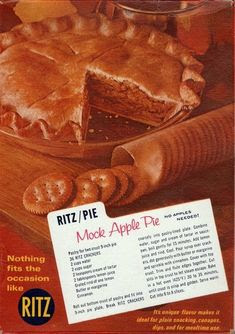
The American West settlers made mock apple pie because they didn't have apples, so they used crackers and special spices, and though it tasted like real apple pie. Some people still make it mock apple pie today. 

Maria Ann Smith was an inspiration for the name Granny Smith apple variety. Mrs. Smith was well-known for her fruit pies, and the Smiths were apple farmers. She accidentally crossed a wild European crab apple with a more commonly grown orchard apple to make a new kind of apple.

Symbolism aside, apple pie actually does represent America, but not for the reasons most people think. Apple pie is American because it illustrates how cultures worldwide can join together to create something new and altogether wonderful. Like apples, we're all transplants.


Sunday, October 16, 2022

Desperation Pie - by Jo-Ann Roberts


When I was plotting out my Christmas book slated for a Black Friday release, I knew my hero was an only child of a single mother who wasn't a very good cook. But she did make one dish for her son...Vinegar Pie!

I imagine some of you are already puckering your lips, making an "eww" sound! While many people today wince at the thought of a vinegar pie, our pioneer ancestors loved it. They used apple-cider vinegar to take the place of citrus juices to make this tart and sweet pie. The filling is similar to a Key Lime pie or a Lemon Meringue pie, except vinegar is substituted for the lemon or lime juice.


Today, buying lemons or limes is as easy as walking to the produce aisle at our local grocery store. However, the pioneers didn't have that luxury. Something as simple as a lemon, orange, or lime was a rare treat, very expensive, and difficult to find. The availability of citrus fruits wasn't as great as today's demand, let alone the means to distribute the fruits. But that didn't stop many pioneer women from improvising alternate solutions. Thus, the first vinegar pie recipe was born. The acid in the vinegar delivered the same taste and tartness as the citric acid in citrus fruits. 


In the mid- to late 1800's, every logging or mining camp had a cook shack where the loggers and miners gathered to eat. Much of the menu consisted of wild game and fish. But dessert was another story, and while cooks in these camps were very creative, the options were often limited. Since pie was extremely easy to make requiring only water, flour, vinegar, sugar, eggs, and dry spices..."Desperation Pie" was created and became a camp favorite. It was not only sweet and tart but was often topped with a meringue.


Vinegar pie is about old-fashioned as it gets. The ingredients are readily available, and the benefits of using vinegar are numerous. If you want to get a good dose, plus appreciate a bit about our past, give this vinegar pie a try!


e


 .