Showing posts with label Ainsley. Show all posts

Wednesday, March 16, 2022

Angel of the Battlefield - The Life and Times of Clara Barton by Jo-Ann Roberts


In celebration of the 2022 Women History Month theme “Providing Healing, Promoting Hope,” Clara Barton's gift of healing gave hope to the lives of others and reflects a belief in the unlimited possibilities of this and future generations.

Born into an abolitionist family in Oxford, Massachusetts in 1821, Clarissa Barton's love of nursing started when her oldest brother experienced a serious head injury and she nursed him for two years.


Here are some extraordinary facts about this remarkable woman...

As a child, Clara was painfully shy. Determined to overcome her shyness, she became a teacher at the age of 17, and sought to encourage her students without harsh discipline and was praised for it.

"Her compassion for other and her willingness to help them always won out over her shyness."                                                                   David Pierce 

While visiting a friend in New Jersey, Clara came across many poor, school-age boys on the streets. Determined to help them, she received permission to start a free public school. By the end of the year, the school had grown from six students to several hundreds. But when the school board voted to replace her with a man at twice her salary, she left in protest.

"I may sometimes be willing to teach for nothing, but if paid at all, I shall never do a man's work for less than a man's pay."        Clara Barton

     
In 1854, Clara took a job as a copyist for the U.S. Patent Office in Washington, D.C. Within a year, she was promoted to clerk, making her the first woman to receive a government appointment. She lobbied to receive $1,400, the same salary as her male counterparts, many of whom resented women in the workplace. Her promotion didn't last long. A new boss demoted her back to copyist, earning her ten cents for every one hundred words.

It was while she was working at the Patent Office that the Civil War broke out. A week later, soldiers of the 6th Massachusetts Infantry were attacked by southern sympathizers.  A makeshift hospital was created in the uncompleted Capitol Building. Though shy, Clara rushed to help the wounded, and was shocked to discover that some of the men were her former students.

"They were faithful to me in their boyhood, and in their manhood faithful to their country."                                                                           Clara Barton


As the need for care and medical provisions grew, she gathered provisions from her home, and organized a campaign to solicit relief items from her friends, neighbors and the public, earning her the name "Angel of the Battlefield".

More importantly, she spent hours with the wounded, homesick soldiers, nursing them back to health, writing letters, offering up prayers and words of care and comfort. Though she lacked formal training, she called upon common sense, courage, and compassion.


In 1862, she received permission to take bandages and other supplies to a battlefield hospital after the Battle of Cedar Mountain. From then on, she traveled with the Union Army.


While cradling the head of a wounded soldier at the Battle of Antietam, a bullet passed through the sleeve of her dress and into her patient.

"A ball has passed between my body and the right arm which supported him, cutting through his chest from shoulder to shoulder. There was no more to be done for him and I left him to his rest. I have never mended that hole in my sleeve. I wonder if a soldier ever does mend a bullet hole in his coat?"                                                                                                   Clara Barton                                                                                                                       
 
At the end of the war, tens of thousands of men were missing. With Lincoln's approval. she founded the Missing Soldiers Office to help families locate their loved ones. Of the 63,000 requests, Clara and her staff located 22,000 men, some of whom were still alive.

"You must never think of anything except the need and how to meet it."                                                                                                                        Clara Barton  


 In 1869, Clara traveled to Europe for a well-earned rest. After witnessing and joining the efforts of the International Red Cross to help wounded victims of war, she founded the American Red Cross in 1881. She led several relief efforts, including those of the Mississippi River and Ohio River floods, the Johnstown Flood in Pennsylvania, and the devastating hurricane in Galveston, Texas. Her work helped convince the International Red Cross to expand its mission to include helping those affected by natural disasters.

"The only reason we have a Red Cross today that responds to natural disasters and emergencies is because of Clara Barton and her determination to help her fellow man."                                                               David Price


Clara Barton served on sixteen battlefields during the Civil War. Whether working behind the scenes to procure supplies, prepare meals, arrange makeshift hospitals or tend the wounded during some of the bloodiest battles in American history, she earned the respect of countless soldiers, officers, surgeons and politicians. She almost singlehandedly changed the widely held viewpoint that women were too weak to help on the battlefield.

The American Red Cross wouldn't exist as it is today without her influence. She believed in equal rights and helped everyone regardless of race, gender or economic status. When she died in 1912, the New York Times wrote,

"She was a woman of remarkable executive skill, of unbounded enthusiasm, inspired by humane ideas...Her name became a household word, associated in the public mind with goodness and mercy."

A fearless humanitarian who helped revolutionize battlefield medicine, she is celebrated for her lifelong dedication to helping others. She was a teacher, nurse, an abolitionist, and a campaigner for women's rights, and remains one of the most honored women in American history.

Sources:

American Red Cross Founder Clara Barton. American Red Cross.
Biography: Clara Barton. Civil War Trust.
Clara Barton. Clara Barton Missing Soldiers Office Museum.
Clara Barton and the American Red Cross. Clara Barton Birthplace Museum.
Clara Barton at Antietam. National Park Service.

Wednesday, February 16, 2022

Into the Mouth of Babes - Short History of Baby Bottles by Jo-Ann Roberts


Some months ago, Author Pam Crooks asked me if I might be interested in a multi-author project, The Love Train series, with nine other authors. All the couples would meet on the Union Pacific, their fledging romance aided by a matchmaking conductor, a baggage handler, and a dog named Scruffy. Their stories would then move to a town, city, or ranch.


Never having been part of a project of this sort, I agreed...whole-heartedly! 

In short order I had my conflict. plot, characters, and setting. Yet, I needed a reason which would keep the hero and heroine in close proximity with one another once they got off the train. A random news segment on our local television station related the feel-good story of a soldier at Fort Bragg who was awarded custody of his two nieces after the sudden death of his sister. He and his fiancé then pushed up their wedding date so they could adopt the children before he left for overseas duty.

Bingo! I had my motive...Lucas Harmon needs a woman to care for his nieces, five-year old Lily, and 6-months old, June in his home.  Caring for a five-year old seemed pretty straightforward but how would he dress, change, and particularly, feed an infant? 

So, there I went, down the rabbit hole to gather information.

Baby Bottles

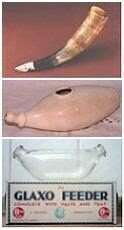
Before the baby bottle came into use, milk was spoon fed to infants or given via a cow's horn fitted with a chamois at the small end as a nipple. When baby bottles were adopted during the Industrial Revolution, many popular designs evolved. Some were submarine-shaped and made from metal, glass, or pottery. They had a circular opening in the top that could be plugged with a cork. The other end tapered to a hole with a rim for securing a nipple. Another popular design was a sprouted feeder, which resembled a teapot, with a handle and spout. The nipple opening of both types of bottles was covered with punctured chamois cloth, parchment or a sponge.


Charles Windship of Roxbury, Massachusetts patented the first glass nursing bottle in 1841. According to his patent on file...

...the formation of this remedy enables the child to think that it derives its nourishment 
directly from the mother, as it feeds in the natural position."

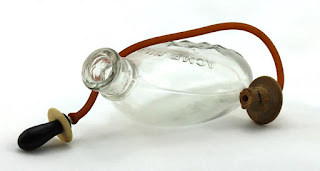
Another variant, a glass flask was introduced in 1860. These bottles were often in the shape of a banjo with a rubber straw which allowed children to feed themselves. These bottles were marketed with names like "The Alexandria", "Little Cherub", and "Mummy's Darling". 

However, the rubber tube that ran from the bottle to the nipple was a breeding ground for bacteria. And according to Mrs. Beeton (Mrs. Beeton's Household Management), she recommended only washing the bottles every 2-3 weeks!


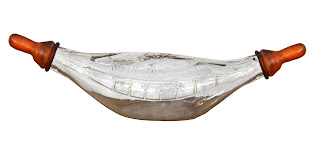
In 1894, the first "banana" shaped feeder appeared on the market. Produced in England by Allen and Hanburys, it was marketed as being "most easily cleaned". The bottle was made   


of clear molded glass and has a flat base to keep it stable on a surface. At one end of the bottle there is a hole for pouring in the milk or feeding mixture. A metal cap is put on after filling. At the other end a similar hole, covered by a rubber nipple, lets the baby suck out the milk

Infant Formula

While advancements were being made in bottle production, advancements were also being made in the field of infant formula.

 After an infant was weaned from breast, cow's or goat's milk, she was given a food called 'pap'.  The mixture which consisted of boiled milk or water was thickened with baked wheat flour and, sometimes, egg yolk. A more elaborate infant food, called panada, was made from bread, flour, and cereals cooked in a milk- or water-based broth.


With mother's milk as the ideal, many scientists tried to formulate nonhuman milk to resemble human milk. In 1865, a German scientist developed, patented, and marketed an infant food, first in a liquid form and then in a powdered form for better preservation. His formula---consisting of cow's milk, wheat and malt flour, and potassium bicarbonate--was considered the perfect infant food.

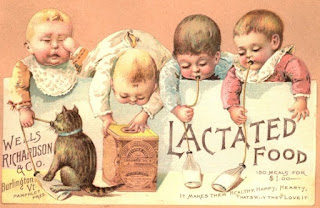
In 1835, William Newton patented evaporated milk.  And in 1853, Texan Gale Borden added sugar to the evaporated milk, canned the substance, and sold it as Eagle Brand Condensed Milk, which became a popular infant food.

By 1883, there were 27 patented brands of infant food. These products came in powdered form and consisted of sugars and starches that were to be added to milk. Name brands included Nestle's Food©, Horlick's Malted Milk©, Hill's Malted Biscuit Powder©, and Mellin's Food©. However, they were fattening but lacked valuable nutrients.  

Although it has taken hundreds of years, at least in the United States and in other developed countries, babies now have food that is sweet and clean. Mother’s milk is still recommended, but artificial infant feeding has come a very long way, indeed!

****************************************************
Love Train Series
Commencing on April 1st and releasing every two weeks through August 15th, these sweet historical romances are penned by some of the most talented authors in the romance genre, and their stories are filled with light, laughter, suspense, and most importantly, a forever kind of love.


Some people come into your life as lessons…

Unexpected fatherhood finds former bank detective, Lucas Harmon desperate for a woman to care for his orphaned nieces. A governess…perhaps? A housekeeper…maybe? A wife…definitely not! Six years ago, the wealthy Chicago socialite he planned to wed, publicly spurned his affections. Despite his determination to guard his feelings, a meddling matchmaking conductor and an encounter with a past acquaintance threatens to upend his heart.

…some come as blessings

Anxious to leave behind the whispers and stares of two failed engagements, Boston socialite, Ainsley MacKenzie hopes for solitude on her way to New Hope, Kansas. But when the kindly conductor enlists her help to care for two orphaned girls, she couldn’t say no. Little did she know their uncle and guardian was the one man she couldn’t forget… Lucas Harmon.

Taking a chance, Ainsley offers Lucas an unusual (some might say, scandalous!) arrangement. She’ll look after the children, read them stories and cook their meals until Christmas, giving Lucas time to find a permanent replacement. Yet, the longer she cares for the family the more she longs to be part of it—whatever the risk to her heart.

Here's a link to view the books, authors, and release dates.