Saturday, March 12, 2022

Ma Ferguson: The First Female Governor of Texas by Bea Tifton

Miriam Amanda "Ma" Ferguson was the first woman governor of Texas.  She was born in Bell County in Texas June 13, 1875. She attended Salado College and the Baylor Female College at a time when few colleges in the South would allow women to be students.  Miriam married James Ferguson in 1899 on New Year's Eve.   James Ferguson was a lawyer and a banker in Belton, Texas. The devoted couple had two daughters. 

Miriam's husband served as governor of Texas  from 1915 to 1917.  He was investigated and impeached during his second term for misappropriation of funds and embezzlement and prohibited from holding any state office in Texas.  

In 1924, Miriam ran for governor as a puppet candidate for her husband, whom she openly said she would consult for advice. At campaign rallies, Miriam would make an introductory speech and her husband would then take the platform to speak. One of the campaign slogans was "Me for Ma, and I Ain't Got a Durned Thing Against Pa." Another popular slogan was "Getting Two Governors for the Price of One." She won the election and became the first female governor of Texas and the second female governor in the United States, along with  Wyoming's Nellie Ross.


Ma was defeated by Dan Moody, the man who had investigated her husband while Pa was in office, in the 1926 gubernatorial election.  Ma ran and won a second term in 1932.  The Texas Rangers had endorsed Ma's opponent in the 1932 election. Soon after she was elected Ma discharged all Texas Rangers, making Texas a safe hideout for Depression era gangsters such as Bonnie and Clyde and Pretty Boy Floyd.  New Texas Rangers were quickly appointed , but they were unqualified and ineffective toward stopping the rising crime rate. 

Ma's platform was opposing the Ku Klux Klan and Prohibition.  Her slogan during the 1924 Democratic Primary against Klan- backed Felix Robertson was, "Make a Choice: The Bonnet or the Hood." After she was elected, Ma passed the "Anti Mask" law, aimed directly at the Klan. She pardoned almost 4,000 people during her combined terms, many of whom were people who broke prohibition laws. Rumors abounded that the pardons were the result of payments made to Pa Ferguson. Investigations were made as the rumors persisted, but no one was ever able to prove the allegations.  As a result, voters passed an amendment in 1936 that pardons would be made not by the governor, but by the Texas Board of Pardons and Paroles. 


Ma ran for governor again in 1940 but was defeated. She retired from politics. Pa died as the result of a stroke in 1944. Ma died from congestive heart failure in 1961 at age 86. She is buried the Texas State Cemetery in Austin. 


Ma is credited with the unfortunate quote that "English was good enough for Jesus Christ and it's good enough for the children of Texas." Historians agree that the quote is apocryphal and that Ma did not say it. Despite the shadows of suspected corruption during her terms, Ma Ferguson paved the way for future women in politics and made a positive contribution to Texas. 


Tuesday, March 8, 2022

Feasting on the Plains by Cora Leland

Building a sod house began here!

How long from constructing a house to cooking a meal varied.  It wasn't unheard of for  pioneers to bring a cast iron stove, kitchen shelves or even their dining room tables and chairs on their prairie schooners, but most folks were limited to basics.  

Mention is made throughout diaries about the  sweetener, molasses. (Maybe because I love molasses cookies, I seldom write a novel without a molasses cookie scene.)  The Post civil war South's kitchen code was largely to make-do and pretend, while staples like preserves were made with sorghum, and not with sugar.

Recipes for Pie Plant Pie always demand white sugar, even this one from a cowboy chuck wagon's cook: 3 cups of pie plant, washed but not peeled, 1 cup of sugar, 1 table spoon full  flour, 1 teaspoon full butter, top and bottom pastry. The recipe concludes, "cut the pie plant <rhubarb>into small pieces. Mix sugar and flour well with pie plant. Place in crust, dot with butter and cover with upper crust."

In her little house on the prairie series, Laura Ingalls Wilder tells about her the first large meal she cooked. She frantically prepared two different kinds of pie, and forgot the sugar in the pie plant pie.  (Knowing how sour rhubarb is, it's hard to imagine how her guests were as kind as she writes they were. But she was a young bride, and a lot was forgiven.)

It's interesting that corn was a basic in the South and also for ancient Indians .  A Southern staple, grits,  was Indian favorite as well.  Muscogee (Creek)Indians made grits by soaking corn kernels in hardwood ash then cooked the rinsed kernels in a ceramic vessel.  The gruel was then mixed with crushed hickory nuts of deer bone marrow and topped with an egg.

A Creek warrior by Frederic Remington, 1903

Several times a day I come across pioneers and settler groups I'd never imagined, and my thoughts have turned to migration from other parts of the huge continent. 

Southerners were required to cut back far from the opulence they'd known before the Rebellion. Their recipes show the cheerful, enthusiastic cooks continued to love their foods, but to adapt, like when they'd used sorghum (instead of sugar) in staples like preserves. They came to depend on eggs, fish and wild game instead of fresh meat.

Still earlier records from the Lewis and Clark Expedition show a willingness to get food out at record times.  Bills state that a vital emergency food was 'portable soup.'  It was also known as 'veal glue' and 'pocket soup.' The expedition bought 193 pounds in Philadelphia!  

The recipe calls for 10 pounds of veal, then  meaty bones, like calves feet. It was cooked in 'a sufficient quantity' of salted water and strained many times, the last time through flannel. Finally the glue was dried into 'tablets' that would last 4-5 years.  

Lewis and Clark

   Though cook stoves were easily available by the 1880's, this was far from the truth earlier in the 1800's.  Railroads made life a great deal easier.  From the beginning of the transcontinental railroad project in 1863 until its completion (1869) and throughout the century, cook stoves emerged in smaller communities throughout the West.

But life in wagon trains demanded that pioneers end breakfast by 4 am. Opinions vary, but some wrote that they made up their bread while riding in wagons.  At the end of the trail, they wrote that a vessel containing pancake batter stood ready in their kitchens.  Yeast was the starting levening agent, and the batter fermented. Even when it froze, the pancakes were tastier. 

As nomad  hunter-gatherers, Indians led a simple life, as well. During the various stages of transition, though, their diet changed.  By 1890 Indians were strictly confined to their reservations and not allowed to hunt, fish or forage as before.  Rations were to replace that and various agencies supplied them.


The Rosebud Agency was the reservation home for the Brule Lakota Sioux. It's an icon to many of us who read Western history and it was here that many tribes received their rations. Below is one photo of the Rosebud Agency beef distribution.

It seems that live cattle were also distributed to the Lakota.

All tribes received food rations of some sort, even after personal allotments of land had begun.  


Comanche receiving food distribution (the ladies with parasols were spectators)


A general tribal food distribution

But cooks continued to make holiday celebrations (though the very early colonies might not have).  The gifts were simple, and often non-existent, but the kitchens were bounteous. Laura Ingalls Wilder recalls her mother's cooking  for at least a full day before a celebration.  


An early hearth kitchen


Friday, March 4, 2022

MORGAN HORSES By Cheri Kay Clifton


I'm going to make the bold statement that I bet all the Sweethearts of the West are horse lovers.  Many of you may be horse owners, of whom I am truly envious!  Actually, it would be nice to know how many of our authors are equestrians.  Although I've never owned a horse, over my lifetime I've had the joy of riding many horses.

 The two breeds of horses I've always admired are the Morgan (a genetic breed) and the Pinto (a color breed), both of which I chose for my two main characters, Laura and Grey Wolf, to ride in my first book, Trail To Destiny.

 I found out the Morgan was one of the earliest horse breeds developed in the United States and after reading that the United States Equestrian Federation stated, "a Morgan is distinctive for its stamina and vigor, personality and eagerness, and has a reputation for intelligence, courage and a good disposition, I knew he was the perfect choice for my heroine, Laura, to ride on her journey west.  I named him Sonny after a beautiful horse I'd enjoyed riding on scenic trails in the Smokey Mountains.

 All Morgans trace back to a single foundation sire, a stallion named Figure, who was born in West Springfield, Massachusetts in 1789.  At age three, he was given to a man named Justin Morgan as a debt payment.  As was the practice of the day, Figure became known by his owner's name, the Justin Morgan horse.  This colt was the founding sire of the Morgan breed.

 After Justin Morgan's death, Figure moved on to other owners and spent a life working on farms, hauling freight, and as a parade mount at militia trainings.  He spent his life working and died in 1821 from an untreated kick received from another horse.  His three most famous sons - Sherman, Bulrush and Woodbury - carried on his legacy to future generations of Morgan horses.  They come in a variety of colors although they are most commonly bay, black and chestnut.


These beautiful steeds were used as cavalry mounts by both sides in the American Civil War.  They were in much demand due to their endurance, weight carrying ability, strong short back, excellent feet and legs, and a calm and cheerful temperament with an abundance of natural style that appealed to the Cavalry officers.  

 While Morgan enthusiasts have stated that the horse Comanche, a survivor of the Custer regiment after the Battle of the Little Big Horn, was either a Morgan or a Mustang/Morgan mix, records of the U.S. Army and other early sources argue that claim, stating more likely he was of "Mustang lineage" with possibly "Spanish" blood.  Many also believed Custer rode Comanche, but in fact, Captain Myers Keogh owned and rode the bay horse into battle.

 Although Comanche was touted as the sole horse to survive the famous battle, many horses survived and were taken by Native Americans.  But they had no use for a horse that couldn't dodge a bullet.  Two days after the Custer defeat, a burial party investigating the site found the severely wounded horse and transported him by steamer to Fort Lincoln, 950 miles away, where he spent the next year recuperating. Comanche remained with the 7th Cavalry, never again to be ridden and under orders excusing him from all duties. Most of the time he freely roamed the Post and flower gardens. Only at formal regimental functions was he led, draped in black , stirrups and boots reversed, at the head of the Regiment.

 Comanche, aging but still in good health, continued to receive full honors as a symbol of the tragedy at Little Bighorn. Finally, on November 7, 1891, about 29 years old, Comanche died of colic.  The horse is currently on display in a humidity controlled glass case at the University of Kansas Museum of Natural History in Lawrence, Kansas.

Comanche taxidermy 

 I hope you enjoyed reading about the Morgan Horse, including many of the breed's faithful steeds and in addition, the truth about the famous horse, Comanche.

Happy Trails!


Monday, February 28, 2022

The Spite Fence on Nob Hill

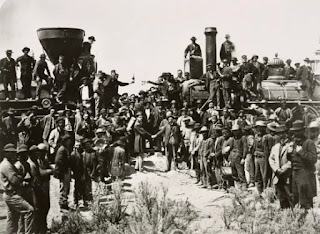
 Some twenty-plus years after selling hardware supplies to eager miners in California's Gold Rush, Collis Huntington and Mark Hopkins decided to enter the railroad business with Leland Stanford and Charles Crocker. Stanford served double duty as the newly elected governor of California in 1862 while he and his business associates oversaw the building of the western portion of the Transcontinental Railroad. (Later, Stanford would become a California senator, and he and his wife, Jane, would become the founders of Stanford University.)


Handshake shared by the Central Pacific and Union Pacific Railroad companies after Leland Stanford drove in the final "golden spike" on May 10, 1869 at Promontory Point in Utah.

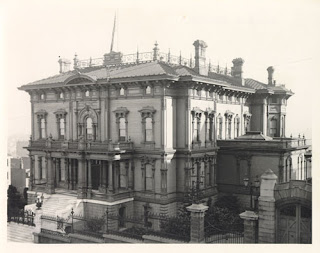
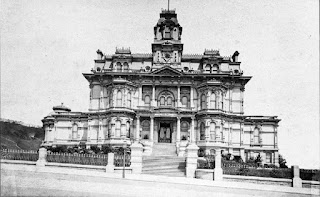
These four railroad magnates, otherwise known as "The Big Four," quickly became California--and especially San Francisco's--top dogs. Therefore, it was no surprise when they all built enormous mansions on California Hill in San Francisco, which later became known as Nob Hill, short for "nabob," a word historically associated with enormous wealth. 
 

Leland Stanford's mansion, circa 1880


Mark Hopkins' mansion on Nob Hill, circa 1885


Collis Huntington's mansion, circa 1882


Charles Crocker's mansion, circa 1880


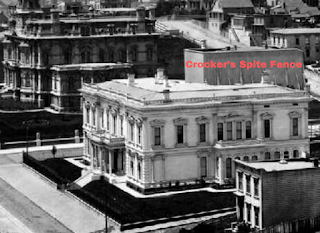
It is said that each of these mansions took the entire space of a city block. An interesting thing happened with Charles Crocker when he had his mansion built. He was able to buy out 12 of the 13 surrounding properties, but the last holdout, an undertaker named Nicholas Yung, whose residence was very modest compared to the other moguls indeed, refused to sell to Crocker. So Crocker had a 3-story-high fence built around Yung's residence so he wouldn't have to look at it, for one thing, but it also didn't bother him that the fence completely blocked out the sun for the Yungs. The Yungs reportedly considered leasing their property to a laundromat or selling advertising space on the fence, but ultimately decided not to retaliate. In the photo below, you can see the high fence behind Crocker's mansion, which covers the Yung residence on three sides.

A second view of Charles Crocker's mansion on Nob Hill, which also shows the 3-story-high "spite fence" he installed around the Nicholas Yung residence, which completely blocked out the sun. It stood there for more than twenty years before coming down in 1904.


So what happened to these rich-beyond-belief, powerful men? They each suffered personal tragedies. Stanton and his wife lost their only son to typhoid at the age of 15 and their mansion basically became a shrine. Mark Hopkins died before he and his wife could enjoy living in their mansion. She immediately moved back East. Collis Huntington's first wife, Elizabeth, died in 1883, at which time he married his second wife, Arabella, whose son, Archer, 14 years old at the time of their marriage, is believed by some to be Huntington's biological son. And Charles Crocker died in 1888, leaving his two sons squabbling over his mansion.


Ironically, the San Francisco Earthquake of 1906--and the subsequent fire--leveled all four of these once-magnificent mansions. Early in the 19th century, a series of apartments were built on the property where Leland Stanford's mansion first stood. Later, they were gutted and turned into a hotel, which stands today. Mark Hopkins, as we know, died before he could enjoy his legacy. After his death, his wife remarried and donated the mansion to the San Francisco Art Association, turning it into an art institute. After the earthquake, a 19-story hotel replaced it. Now the hotel features a restaurant called Top of the Mark. Yet another hotel, the Huntington Hotel, stands in the place where Collis Huntington's mansion once stood, along with a scenic park, the land of which Huntington's second wife donated for such a cause. As for Charles Crocker, he continued to dispute with Yung for several years, and his family continued even after his death until the Yungs finally gave way in 1904. Crocker and his family may have won the battle, however, but the earthquake ensured that it was a temporary celebration. A church named Grace Cathedral now stands in its place.


For myself, I've gleaned some interesting and valuable insights from learning more about these so-called "powerful" men, and I feel that the story of these four mansions can help us understand how important it is to keep a humble perspective on life and treat our fellow men with the respect they deserve. Money isn't the most important thing in the world, after all. Our relationships are.


Although I haven't published any books that take place in San Francisco (yet), I love to learn about places in the Old West that greatly influenced our lives today. Take a look at my Christian historical Western romance novels here.


Saturday, February 26, 2022

BILL PICKETT, CHAMPION COWBOY!

By Caroline Clemmons

This is still Black History month, and a western figure who comes to mind is the famed inventor of the sport of bull-dogging—Bill Pickett.


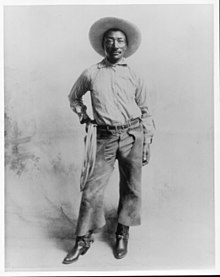
Willie M. Pickett was born December 5, 1870 in the Jenks Branch community of Wiliamson County in Central Texas. He was the second of 13 children born to Thomas Jefferson Pickett, a former slave, and Mary "Janie" Gilbert. Bill Pickett had four brothers and eight sisters. The family's ancestry was African American and Cherokee. By 1888, the family had moved to Taylor, Texas. Like many boys of his era, Bill Pickett left school in the 5th grade to become a ranch hand. He soon began to ride horses and watch the longhorn steers of his native Texas.

In 1890, Pickett married Maggie Turner, a former slave and daughter of a white southern plantation owner. The couple had nine children.

Courtesy North Fort Worth 
Historical District


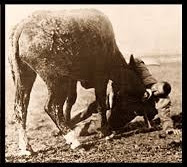
He invented the technique of bull-dogging, the skill of grabbing cattle by the horns and wrestling them to the ground. It was known among cattlemen that, with the help of a trained bulldog, a stray steer could be caught. Bill Pickett had seen this happen on many occasions. He also thought that if a bulldog could do this feat, so could he. Bill Pickett practiced his stunt by riding hard, springing from his horse, and wrestling the steer to the ground. Pickett's famous method for bull-dogging was biting a cow on the lip and then falling backward. He also helped other cowboys with bull-dogging. As you can imagine, his method eventually lost popularity as the sport grew into the steer wrestling that is practiced in rodeos today.

Bill Pickett biting steer on the lip

Bill Pickett soon became known for his tricks and stunts at local country fairs. With his four brothers, he established The Pickett Brothers Bronco Busters and Rough Riders Association. The name Bill Pickett soon became synonymous with successful rodeos. He did his bulldogging act, traveling about in Texas, Arizona, Wyoming, and Oklahoma.

In 1905, Pickett joined the 101 Ranch Wild West Show that featured others like Buffalo Bill, Will Rogers, and Tom Mix. He performed under the name "The Dusky Demon." Unfortunately, he was a victim of the times. Bill Pickett's ethnicity resulted in his not being able to appear at many rodeos, so he often was forced to claim that he was of Comanche heritage in order to perform. 

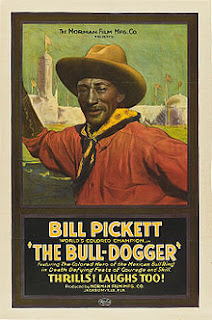
Bill Pickett was soon a popular performer who toured around the world and appeared in early motion pictures. In 1921, he appeared in the films The Bull-Dogger and The Crimson Skull.

In 1932, after having retired from Wild West shows, Bill Pickett was kicked in the head by a bronco. After a multi-day coma, he died on April 2, 1932.He was buried on the 101 Ranch on Monument Hill, less than a quarter of a mile to the northeast of Marland, Oklahoma.

His fame has lasted long after his death: 

In 1971, Pickett was inducted into the Rodeo Hall of Fame of the National Cowboy and Western Heritage Museum.

In 1989, Pickett was inducted into the ProRodeo Hall of Fame.

In 1987, a statue of Pickett performing his signature bull dogging maneuver, made by artist Lisa Perry, was presented to the city of Fort Worth, Texas. The statue is installed in the Fort Worth Stockyards Historic District.

In 2003, Bill Pickett was inducted into the National Multicultural Western Heritage Museum and Hall of Fame’

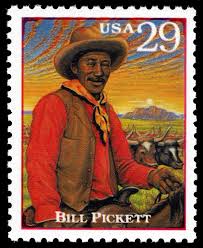
The United States Postal Service chose to include Bill Pickett in the Legends of the West commemorative sheet unveiled in December 1993. One month later, the Pickett family informed the Postal Service that the likeness was incorrect. Its source material was a misidentified photograph of Bill Pickett's brother and fellow cowboy star, Ben Pickett. In October 1994, the USPS released corrected stamps based on the poster for The Bull-Dogger.


In March 2015, the Taylor City Council announced that a street that leads to the rodeo arena will be renamed to honor Bill Pickett.

On June 2, 2017 a new statue of Bill Pickett was unveiled in his hometown of Taylor, Texas. It is prominently displayed at the intersection of 2nd and Main Streets in the downtown.]

On August 6, 2018, Bill Pickett was inducted into the Jim Thorpe Association's Oklahoma Sports Hall of Fame.

In They Die by Dawn (2013), Bill Pickett is portrayed by Bokeem Woodbine. In the 2021 film The Harder They Fall, his role was played by actor Edi Gathegi.

Pickett is referenced in season 4 episode 5 of Baywatch.

A You Tube video tribute to Bill Pickett is at https://www.youtube.com/watch?v=A1gvSEEXXk8

Source: https://en.wikipedia.org/wiki/Bill_Pickett  

Thursday, February 24, 2022

WEST OF THE MISSISSIPPI BUT CLOSER THAN YOU THINK by Marisa Masterson

 If I mention men claiming land in the 1850s, does it bring to mind Nebraska or even Wyoming? How about if I write West of the Mississippi? Do you think about the Great Plain or the Dakotas? 

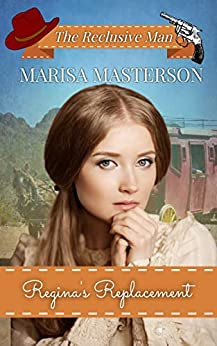
West of the Mississippi includes Minnesota. This very northern state might not be an author's first choice for a historical western novel, but Minnesota was being settled in the years just before the Civil War. Perhaps because of my family's history with that, I chose it as the setting for my next novel, Regina's Replacement.

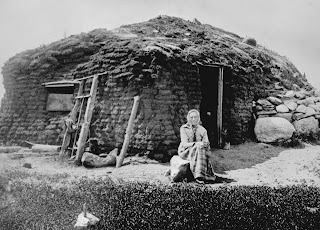
Example of a Minnesota Sod House
My great grandfather was born in soddy in Minnesota. His father died before the land was "proved up", but his mother stayed on. She lived there until the five years passed and she owned the claim. Then she sold it and moved back to Dodgeville, Wisconsin with her three children. 

My story has a much more romantic ending. But there are problems for a young widow. The woman, Regina, leaves Virginia soon after a battle is fought not far from her farm. She arrives by steamboat, but not a boat that traveled on the Mississippi.


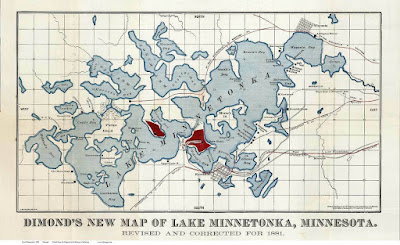
As I researched, I found an area about one hundred miles outside of Minneapolis. The land claimed by people there was around a very large lake, Lake Minnetonka. Steamboats traveled across the expansive body of water, bringing people and goods to spots around it. 

Governor Ramsay Steamboat
One such boat, the Governor Ramsey, sailed in and out of Excelsior, the first white settlement on Lake Minnetonka. Excelsior was settled by a group of pioneers from the East who formed the Excelsior Pioneer Association. They came together, ready to set up a town and bought land for around $1.25 per acre.

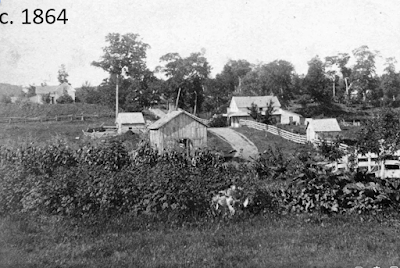
Farm near Excelsior, MN, 1864.
Excelsior in 1861-1862, about eight to nine years after it was settled, became the setting for my novel. Imagine the farms, mostly growing potatoes. With the Civil War, a few farmers listened to the call for northern farmers to grow typically southern crops like tobacco. That's what my heroine does in Regina's Replacement, though her husband thinks it's a crazy idea.

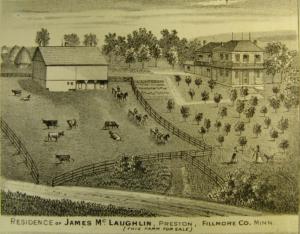
Lithograph created to sell a Minnesota farm in the 1800s.
 

Of course, with my heroine living in that area around 1862, a serious problem arises. The Dakotas had been moved to a reservation. There they were left to starve by an inhuman Indian agent. No wonder the Dakota War happens in 1862. Does it reach Excelsior? 

Read Regina's Replacement and find out...


Visit a time when Minnesota was land still being claimed and settled...

Joshua Gibson had enough courage to save his uncle. He’s not brave enough to show his face in town after being badly burned in the rescue.

Regina Richardson decided marriage to a stranger was better than living through a war that had nothing to do with her. After Union troops brought a battle near to her farm, she grabs at the chance to marry a man in Minnesota. Only, she discovers the man has never lived in the town where she’s told to go.

A desperate aunt and uncle see this as a God sent opportunity for their hermit nephew. Will Regina find the love of her life or will she end up with one more burden to bear?

And what about the man killed at Joshua’s farm the night that he was burned? How will the couple protect themselves when Joshua and Regina have no idea that revenge stalks them?


Tuesday, February 22, 2022

Mishmash & Thoughts

Post by Doris McCraw

writing as Angela Raines


Photo property of the author

According to Merriam-Webster the definition of mishmash is a confused mixture of things. It perfectly defines some of our lives right now. 

So what do I mean by life right now? Life is and always has been confusing. We learn as we go along, making mistakes and enjoying triumphs. We plan our journey, and do everything the way we think it should be, then…bam…some challenge gets thrown at us. The key to getting somewhere, go with the flow.


Photo property of the author

I always thought I would be a performer, and I have been. I decided at fifteen I would work with criminals. Been there, done that. I’ve always written but didn’t think non-fiction would be in the picture. *OOPS* Teach me to think life didn’t have another idea.

The thing is, life really is a mishmash, but it isn’t such a bad thing. Instead, I prefer to think of all the wonderful experiences I’ve had in my life as gifts. If I hadn’t started spending weekends in the research section of the library, I’d have missed out on some great friendships. I also probably would never have found the women doctors, and written scholarly papers on such diverse subjects as ancient volcanos, film commissioners, and, of course, those Colorado women doctors.


Photo property of the author

If my parents hadn’t encouraged me to take chances, to follow dreams, and not worry about how others viewed me, I wouldn’t have been an acting teacher, played music professionally, or been an actor. Because no one told me I couldn’t, I live a blessed life. 

I grew up about seventy miles from Mark Twain's (Samuel Clemens) home and lived right across the river from where his brother had a paper, where young Sam worked while living there. I grew up with his stories, his wit, and his wisdom. Below are some quotes that still resonate with me.

Hope you enjoy the mishmash.

You can’t depend on your eyes when your imagination is out of focus.

Courage is resistance to fear, mastery of fear, not absence of fear.

The fear of death follows from the fear of life. A man who lives fully is prepared to die at any time.

Don’t part with your illusions. When they are gone, you may still exist, but you have ceased to live.

 It is curious–curious that physical courage should be so common in the world, and moral courage so rare.

There are not enough morally brave men in stock. We are out of moral-courage material.

And my favorite:

Let us endeavor so to live so that when we come to die even the undertaker will be sorry.


Doris McCraw