Women
in the West (1867-1900)
Women
of Color, European-Americans, Indigenous and Asian Women
By
Cora Leland
After the Civil War, migration of
women settlers grew. The Homestead Acts promised
free land to all adults – or so it seemed.
But not all women reaped these
benefits. Many Asian women were strictly excluded, with
the Chinese Employment Act legally doing this.
Undeterred, Asian families facing starvation allowed their daughters to travel
to the American West and work in the rough, far-flung mining camps as cleaners
and laundresses.
Very sadly, Asian women were often
given no better choice than what kind of sex labor they’d accept. Dr. Margaret Chung’s mother was sold by her
starving parents in China. (This was
common, for girls to be sold to Western clearing houses.)
Dr. Chung was the
first American-Asian woman physician. Her
mother had been sold into prostitution, and Dr. Chung’s life, even as an
educated Asian-American, depended upon her willingness to portray herself as a motherly
Chinese woman, often ignoring her hard work as a physician. (She was known as “Mama” to 1,000 soldiers,
for example.)
Dr. Margaret Chung
A great deal of emphasis is placed
on splashy, entertaining figures like Elizabeth Custer, Poker Alice and Annie
Oakley. Mrs. Custer’s famous husband and
her own flamboyant personality made her famous.
Their behavior within the army camps was notorious.
But actually, Ms. Oakley was a
Mormon, who tried to keep her dress and behavior in line with her religious
beliefs. Belle Starr, on the other hand,
became a famous outlaw, often wearing men’s clothes and shooting, robbing,
drinking hard. Cigar-smoking Poker
Alice, from England, was a professional gambler from Colorado to California and
North and South Dakota and back to Oklahoma.
Crede, CO (Poker Alice's home for awhile) Women settlers in the West were not
as restricted as they had been in the areas east of the Mississippi, if they
were fortunate enough to come from middle class homes and/or to have some
savings when they arrived in the West. As mentioned above, Asian women,
especially Chinese, were not so fortunate; nor were Native American women.
In the case of Afro American women,
the ‘Western Myth’ seems to have been more accurate. In the eastern part of America, women were
not afforded such freedom to develop and expand. But Afro American women openly contributed to
such causes as basic economic development, charitable causes, health, education
and even the founding of towns.
Women such as Biddy Mason became
examples for us all. A former slave, Ms.
Mason was taken to California by her ‘owner.’ Because California was a free
state – and she knew it – Ms. Mason took the matter to court, and won. She was not allowed to testify on her own or
her children’s behalf. Still, the court
awarded them freedom. She became a nurse
and midwife in Los Angeles and continued to struggle for others’ freedom as
long as she lived.
Biddy Mason
European-American women were notable
for not only raising the children, but for keeping the family financially
solvent while the farm became established.
The European-American group of settlers was the largest, contributing settlers
in the Westward expansion from Ireland, Sweden, Norway, Denmark,
Germany and Britain.
There were two waves of European immigration,
from 1820-1890 and 1890 to 1920.
Internal migration of this very significant group happened when children
of the first immigrants, as I wrote about in my Mail Order Bride series of novels, moved from their parents’ farms
in Illinois and neighboring areas to the mid-west and further toward the
Pacific Ocean. From 1920-1899 (the ‘closing’
or complete settlement of the American frontier took place by 1899) the total of
European settlers was 17,261,374.
Altogether, the settling of the
vast American continent is a major achievement, made possible by courageous,
curious and creative women. They were largely
unrecognized for their sympathy for the population already in place, like the Native Americans (Indians and Latinos, among others). But women settlers were famous for the books and articles they wrote and
published. Many of these works are just
now being re-published as interest in the whole experience of westward
expansion develops.
The US Army was seen, by the
government, as keeper of the Wild West frontier. Historian Frederick Jackson Turner wrote, “The
frontier is the outer edge of the wave, the meeting-point between savagery and
civilization…the line of most rapid and effective Americanization.”
However, the hundreds of Army wives
who accompanied their husbands to these wild places were not always interested
in ‘civilizing’ the peoples of the West.
They did believe in the importance of providing good homes to their
families, no matter where they were. But
they also learned to respect and admire the indigenous people.
Army wives like all women who came
to the harsh Wild West before 1890, had read everything produced about the
indigenous people and the settlers, too.
Many changed their minds later -- they were shocked when they visited Native American women, saw the careful use of
everything that came from the land, and their expanding use of the limited life
on reservations. The reservations were
very different from the open country they’d known all their lives and been
trained to utilize as wives and mothers. The reservations were often places were
economic life was not just challenging, but stark. The army wives saw that Native wives were
shrewd in evaluating the ways they could make ends meet.
For example, the Choctaw and
Cherokee Indians were removed from their homelands to Oklahoma Territory on ‘the
trail of tears.’ The Trail of Tears was 2,200
miles long and crossed what is now 9 states.
Over 2,500 Choctaw Indians and 4,000 Cherokees died. Other groups were the Creek, Chickasaw, and
Seminole.
The Choctaw farmers among them were
not allowed to bring their livestock, including their valuable Choctaw ponies.
(Today, the number of Choctaw ponies alive is 200. Before the forced march to Oklahoma, there
were 2,300 Choctaw ponies, or horses, carefully bred and owned by the Choctaw Indians.)
The Cherokees were not allowed any time to plan.
Challenges like these, plus making up for their losses, were some of the responsibilities the Native American wives accepted. It is interesting to note that in 1870 a good
saddle horse in the western area of the country cost at least $250, a cow cost about
$30, a bull was approximately $100, and a wagon cost about $60. All such things
had to be bought again, after moving to the reservations, though much smaller things could be carried if the tribes were allowed to pack.
Another major influence on Native
American wives and their families was the Allotment Act of 1887. This complicated congressional act gave 160
acres of reservation land to the head of each household. Beyond this, the land
was sold by the government. Frequent
changes to life, such as the Dawes Act and legislation before and after it, influenced Native American women to find methods for survival. It’s worth noting that most women had been brought up to utilize the animals and open lands of the continent, and that now they lived in reservations under very different circumstances.
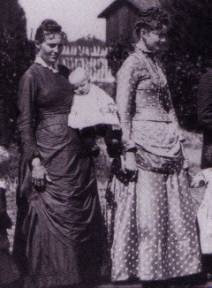
19th century army wivesThe Army wives chronicled and described
life in the American West carefully and accurately. Many members of the army left their wives and
families in the East, and the entire number of army members never was over
2,000. However, these women, sometimes educated world-travelers with their
husbands, had learned how to survive in many difficult locations. Most were
ordinary citizens, not at all the dazzling figures that sometimes traveled with
their husbands as earlier mentioned.
I feel that at New Year it’s well
worth mentioning that the writers of Western fiction continue this development: creating and nourishing interest in every
aspect of the Westward Expansion of America. Our novels are based in the
history of these women pioneers, which is often very hard to locate, then to
use.