Showing posts with label Caroline Clemmons; Sweethearts of the West. Show all posts

Wednesday, October 12, 2022

FOOD PRESERVATION IN THE OLD WEST

 By Caroline Clemmons

When I wrote GENTRY AND THE MAIL ORDER BRIDE, I had the heroine, Heidi Roth, purchase a basket of food from a restaurant to take with her on the stagecoach. The basket included bottles of water and apple cider as well as sandwiches. Someone asked me if there were really bottles of drinks in 1875. The answer is yes!

Stephen Martinelli started a soda water business in a lean-to by his brother Louis’ barn near Watsonville, California in 1862. They produced apple cider beginning in 1868. They’ve won numerous prizes for their products. (In my opinion, Martinelli’s is the best apple juice ever.)

You’ve probably read that there was canned food for soldiers in the Civil War. When we lived in a rural area, I canned what seemed like a gazillion jars of vegetables and jellies and jam and fruit. I loved having home-canned food through the year. Taking a jar or two out of the pantry to serve when the weather was cold was a great feeling. However, I learned that if there is a day when you have too much to do and absolutely can’t spare the time—you think—to process food that day, that’s the day it’s at its peak and must be canned or frozen. 

The absolute champion of home food canning, and someone I hold in awe, is author Peggy L. Henderson. She canned enough for the year. I’ve never canned meat, but she canned chickens she had raised and had to kill, pluck, yada yada. The woman is amazing!


Drying Meat


We’ve probably all read about American Indians drying food over a fire. When I write about ranchers of the Old West, I include a smokehouse. When visiting one of Hero’s distant relatives at the site of a home of the mid 1800’s, we saw a beautiful example of a smoke house. In fact, that was the only structure remaining of the original farm buildings. I would love to have brought it home piece by piece to reassemble it. The wood was hand hewn and beautifully fitted together.

Since then, I’ve seen other smokehouses from that era, which, by the way, if my favorite for writing and reading. Smoking is the process of exposing meats, fish, and cheese to wood smoke, which has been shown to have antimicrobial effects on food, meaning it removes the microbes that cause bacteria to grow. This process was probably discovered by early cavemen burning fires in their caves without chimneys, causing the cave to fill with smoke and thus exposing food to smoke and unknowingly preserving it. Must have been hard on the lungs! Over time, they began pre-treating the food with salt before smoking, making the smoking even more effective. Today, smoking is mainly used to flavor food rather than preserve it. Picture the smoker grill on the patio.

Smokehouse


There was also the salt-dried method. The reason why salt is such an effective preservative is that it draws moisture out of food. Dry foods are less likely to spoil as moisture is a key requirement for organisms that spoil food. Salt has been used as a preservative since ancient times and was, in fact, so valuable in part due to its preservative powers that it became one of the first ever commodities traded and even wars have been fought over salt. Before the days of refrigeration and the modern heat treatments that are used to prolong the shelf life of foods, salt was one of the main methods used to preserve food. Without it people were subject to having to consume food quickly before it would spoil. With salt, civilizations were able to store food and build up reserves that would last in times of scarcity.

Even into the late 20th century, my uncle salt-cured his pork. The ham was so salty I probably couldn’t eat it now. As a child, I thought it was delicious fried and served with mashed potatoes and red-eye gravy. Yikes, it’s a wonder people survived that diet, but they worked hard. 

Oliver Loving
It was in salt that Charles Goodnight packed Oliver Loving’s body in New Mexico to be bring him back to his family for burial in Weatherford, Texas.

Fermenting

Sauerkraut fermenting
My grandmother used a large 
crock with a lid. 

Supposedly, fermentation was discovered by accident and dates back to 10,000 B.C. It's a unique way of preserving food because it increases the nutritional properties of foods. Fermentation is achieved when natural chemical reactions happen within food, causing it to spoil, but creating a new, edible food that will spoil more slowly than the original ingredients. Cheese, the use of yeast in making bread, and making sauerkraut from cabbage are all examples of fermentation. Sauerkraut was popular for covered wagon travelers.

This is just a brief list of the methods for food preservation in the Old West.

If you’re looking for a book to read, try my two books of the Texas Hill Country Mail Order Brides.


GENTRY AND THE MAIL ORDER BRIDE, book 1, https://www.amazon.com/Gentry-Texas-Country-Order-Brides-ebook/dp/B0B6YN6QHK

JESSE AND THE MAIL ORDER BRIDE, book 2, https://www.amazon.com/dp/B0BD64JC1D

QUINN AND THE MAIL ORDER BRIDE, book 3, will be released in late November.


Sources:

https://en.wikipedia.org/wiki/Food_preservation

https://nchfp.uga.edu/publications/nchfp/factsheets/food_pres_hist.html

https://www.martinellis.com/about/history/

https://preserveandpickle.com/salt-preserve-food/   

Tuesday, July 12, 2022

OPEN RANGE -- DON'T FENCE ME IN!


By Caroline Clemmons

 Anyone who reads western romance or westerns has heard of open range. There’s even a popular movie titled “Open Range,” starring Kevin Costner and Annette Benning. Exactly what is it and what changed it?


 The essence of open range is free grazing on millions of acres of unfenced land. In United States history, the areas of public domain north of Texas, where from about 1866 to 1890 more than 5,000,000 cattle were driven to fatten and be shipped to slaughter, was open range. That’s right, that’s 5,000,000 cattle over 24 years. Imagine how that affected the landscape.

Men returning from the Civil War (1861-1865) found cattle had continued to breed and there were many unbranded cattle roaming on open range in Texas, Colorado, Wyoming, and other western states. Some men were able to found herds/ranches with the unbranded “mavericks.”

Because of open range policies, it was possible to become a wealthy cattleman without actually owning any land. Most owned at least a base for operation, however, and some owned millions of acres.

The open ranges of western Kansas, Nebraska, the Dakotas, Montana, Wyoming, and other western states and territories served as huge pasturelands for the herds of the Texas ranchmen. I’m from Texas, and I hate to see my state maligned, but facts are facts—and I haven’t even mentioned the Texas ticks that attached to Texas cattle and spread to infect cattle in other states through which they passed.

The trails went from western Texas northward, through Indian territory and into the vast stretches of public domain lands in the Central and Northern Great Plains. During the 24 years of open range cattle grazing, these areas were largely free of farmers or sheep.

In the 1880s, large amounts of British capital went to the United States for investment in open range ranching. Foreign enthusiasm infected American financiers and businessmen, who formed cattle companies to reap the big profits of raising beef for domestic consumption or overseas shipment. The U.S. cooperated by banning the fencing of lands on either the public domain or Indian reservations and awarding beef contracts to the cattle companies. Beef purchased by the government was distributed among the western Indians, who were left without a food supply when the buffalo herds were destroyed.

The cattlemen sometimes joined together and made up vast herds, sometimes numbering 5,000 with a small crew of cowboys. For instance, a herd of 2,000 required only 10 cowboys. (More than are shown in western movies.) Driving the cattle to market in Kansas was cheaper than shipping them by rail from Texas. Drovers used the Chisholm Trail, blazed by Jesse Chisholm, a Cherokee. The Chisholm Trail ran along the 98th meridian from deep in Texas to Caldwell, Kansas, then branched off to Abilene, and later Dodge. For a time, a steer which would sell for $2.00 in Texas would bring $20.00 in Kansas. Cowboys made $10 a month whether on the ranch or on a drive. You can understand how great fortunes were made.


"Chinook" by Charles M. Russell
The Great Die Off


The disastrously cold winter of 1886-87 called the Great Die Off meant the death knell of the open range cattle industry. (See my article on the Great Die Off https://sweetheartsofthewest.blogspot.com/2016/11/the-winter-that-changed-cattle-ranching.html?m=1 ) Many investors were ruined as hundreds of thousands of cattle perished in the thick snow and ice. As cattle ranching dwindled, farmers moved in and fenced their land. Although it flourished for only a few decades, open range's influence on the Armerican character and self-image continues to the present day  

Open Range sign on 
Arizona 2014

Areas of open range still exist. For instance in Arizona, cattle must be fenced in if in an incorporated area. In unincorporated areas, the cattle have the right of way. Many other states have similar laws. If a motorist hits a cow in an open range state, the driver must pay for the cow. 

Next month, I’ll write on the barbed wire that fenced us in. I’ll leave you with this:

https://www.youtube.com/watch?v=8Z_SOobHOw4


Sources:

LONE STAR: A HISTORY OF TEXAS AND THE TEXANS, T. R. Fehrenbach, American Legacy Press, NY, 1983 edition, one of my favorite references..

https://www.britannica.com/place/Open-Range

https://en.wikipedia.org/wiki/Open_range


Sunday, June 12, 2022

SAVE THE EAGLES -- ROSALIE BARROW EDGE

By Caroline Clemmons

This article might be cheating, because Ms Edge lived in New York. However, the things she did made a huge difference for those of us West of the Mississippi. She was called to action when she learned of the slaughter of bald eagles in Alaska.

I have read a number of books by C. J. Box in his Joe Pickett series. Joe is a Wyoming game warden whose best friend is a falconer. Until I started reading this series, I hadn’t taken time to realize how important raptors are in the scheme of nature. I also hadn’t known how they can be utilized to help farmers, ranchers, and other businesses who are harassed by starlings.

Rosalie Barrow Edge was such a ferocious advocate for the protection of wildlife that The New Yorker once called her “the only honest, unselfish, indomitable hellcat in the history of conservation.”

On November 3, 1877, Mabel Rosalie Barrow was born in New York City, the youngest of five surviving children of John Wylie Barrow and Harriet Bowen Woodward Barrow. She was a descendant of the prominent New York Dutch American Evertson family. In addition, Rosalie’s father was a wealthy British importer and accountant who was a first cousin to Charles Dickens. I’m sure you guessed her early life was as a socialite.

Young Rosalie Barrow


In May 1909, 32-year-old Mabel Rosalie went to Yokohama, Japan, to marry Charles Noel Edge, a British civil engineer. After traveling in Asia for about three years in connection with Charles's employment, the Edges returned to New York permanently. Their children, Peter and Margaret, were born in New York..

In 1921, Charles Edge fell in love with another woman. Rosalie found solace in long walks in Central Park and soon fell in with the city’s avid birding community. Edge was a birder for the rest of her life, eventually logging 804 species in the park.


At the age of 52, Rosalie Edge dedicated her life to the preservation of American wildlife. Utilizing the skills she acquired during the suffrage movement, she took to writing pamphlets on wildlife facts in an attempt to dispel myths leading to the mass killing of many species of wildlife. After developing an interest in bird watching in the 1920s, Edge was horrified to discover that 70,000 bald eagles were being slaughtered in the Alaskan Territory, but that existing conservation groups didn’t care because bald eagles weren’t rare at the time. 

A bald eagle in Yellowstone.


She battled with the predominately male-run conservation organizations, including Audubon, for conspiring with hunters, developers, and ranchers. She berated them for supporting bounties on bald eagles in Alaska, and not honoring their commitment to conservation. This inspired her to create the Emergency Conservation Committee in 1929 which emphasized the need ‘to protect all species while they were common so that they did not become rare’. This was a very different viewpoint than the standard thinking in conservation at the time of only preserving species that had an economic value.

She also ended decades of hawk and eagle shootings on a ridge in the Appalachian Mountains—by buying the property! In 1934, she purchased the land and turned it into the world’s first refuge for birds of prey. It was called The Hawk Mountain Sanctuary. Willard Gibbs Van Name, the American Museum of Natural History zoologist who advised her and secretly wrote her earliest ECC pamphlets, lent her $500 to obtain a lease-buy option on about 1,340 acres. In time, the Hawk Mountain Sanctuary Association grew to about 2,500 acres. An average of 20,000 eagles, hawks, and falcons migrate through each year. The research and bird counts done at Hawk Mountain have proven to be invaluable in bird of prey conservation.

Rosalie and a hawk


Her legacy also helped another pioneering environmentalist. In 1960, the sanctuary provided scientific data to Rachel Carson, helping her link the decline in the juvenile raptor population to the unregulated spraying of DDT. Perhaps you’ve read SILENT SPRING, Ms Carson’s most well-known book.

Leaders of the Sierra Club, Nature Conservancy, and National Audubon Society learned from and made organizational reforms as a result of her activism. Rosalie Barrow Edge was an inspiration to environmental activists of her day and continues to be an inspiration to all ages working to save wild things and wild places. Rosalie Barrow Edge died of cancer on 1962, but her legacy endures.

Sources:

https://cbop.audubon.org/news/rosalie-barrow-edge-feminist-naturalist-and-conservationist

https://en.wikipedia.org/wiki/Rosalie_Edge

https://www.adventure-journal.com/2019/11/how-rosalie-edge-became-the-firebrand-conscience-of-american-conservation/ https://www.audubon.org/news/getting-over-rosalie


Saturday, February 26, 2022

BILL PICKETT, CHAMPION COWBOY!

By Caroline Clemmons

This is still Black History month, and a western figure who comes to mind is the famed inventor of the sport of bull-dogging—Bill Pickett.


Willie M. Pickett was born December 5, 1870 in the Jenks Branch community of Wiliamson County in Central Texas. He was the second of 13 children born to Thomas Jefferson Pickett, a former slave, and Mary "Janie" Gilbert. Bill Pickett had four brothers and eight sisters. The family's ancestry was African American and Cherokee. By 1888, the family had moved to Taylor, Texas. Like many boys of his era, Bill Pickett left school in the 5th grade to become a ranch hand. He soon began to ride horses and watch the longhorn steers of his native Texas.

In 1890, Pickett married Maggie Turner, a former slave and daughter of a white southern plantation owner. The couple had nine children.

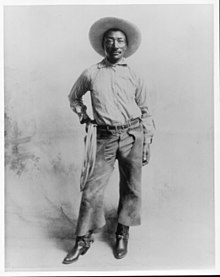
Courtesy North Fort Worth 
Historical District


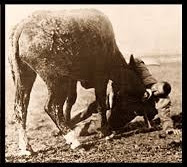
He invented the technique of bull-dogging, the skill of grabbing cattle by the horns and wrestling them to the ground. It was known among cattlemen that, with the help of a trained bulldog, a stray steer could be caught. Bill Pickett had seen this happen on many occasions. He also thought that if a bulldog could do this feat, so could he. Bill Pickett practiced his stunt by riding hard, springing from his horse, and wrestling the steer to the ground. Pickett's famous method for bull-dogging was biting a cow on the lip and then falling backward. He also helped other cowboys with bull-dogging. As you can imagine, his method eventually lost popularity as the sport grew into the steer wrestling that is practiced in rodeos today.

Bill Pickett biting steer on the lip

Bill Pickett soon became known for his tricks and stunts at local country fairs. With his four brothers, he established The Pickett Brothers Bronco Busters and Rough Riders Association. The name Bill Pickett soon became synonymous with successful rodeos. He did his bulldogging act, traveling about in Texas, Arizona, Wyoming, and Oklahoma.

In 1905, Pickett joined the 101 Ranch Wild West Show that featured others like Buffalo Bill, Will Rogers, and Tom Mix. He performed under the name "The Dusky Demon." Unfortunately, he was a victim of the times. Bill Pickett's ethnicity resulted in his not being able to appear at many rodeos, so he often was forced to claim that he was of Comanche heritage in order to perform. 

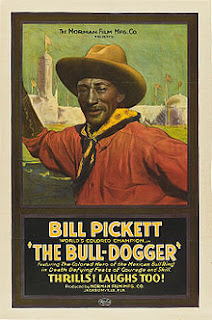
Bill Pickett was soon a popular performer who toured around the world and appeared in early motion pictures. In 1921, he appeared in the films The Bull-Dogger and The Crimson Skull.

In 1932, after having retired from Wild West shows, Bill Pickett was kicked in the head by a bronco. After a multi-day coma, he died on April 2, 1932.He was buried on the 101 Ranch on Monument Hill, less than a quarter of a mile to the northeast of Marland, Oklahoma.

His fame has lasted long after his death: 

In 1971, Pickett was inducted into the Rodeo Hall of Fame of the National Cowboy and Western Heritage Museum.

In 1989, Pickett was inducted into the ProRodeo Hall of Fame.

In 1987, a statue of Pickett performing his signature bull dogging maneuver, made by artist Lisa Perry, was presented to the city of Fort Worth, Texas. The statue is installed in the Fort Worth Stockyards Historic District.

In 2003, Bill Pickett was inducted into the National Multicultural Western Heritage Museum and Hall of Fame’

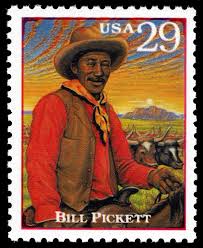
The United States Postal Service chose to include Bill Pickett in the Legends of the West commemorative sheet unveiled in December 1993. One month later, the Pickett family informed the Postal Service that the likeness was incorrect. Its source material was a misidentified photograph of Bill Pickett's brother and fellow cowboy star, Ben Pickett. In October 1994, the USPS released corrected stamps based on the poster for The Bull-Dogger.


In March 2015, the Taylor City Council announced that a street that leads to the rodeo arena will be renamed to honor Bill Pickett.

On June 2, 2017 a new statue of Bill Pickett was unveiled in his hometown of Taylor, Texas. It is prominently displayed at the intersection of 2nd and Main Streets in the downtown.]

On August 6, 2018, Bill Pickett was inducted into the Jim Thorpe Association's Oklahoma Sports Hall of Fame.

In They Die by Dawn (2013), Bill Pickett is portrayed by Bokeem Woodbine. In the 2021 film The Harder They Fall, his role was played by actor Edi Gathegi.

Pickett is referenced in season 4 episode 5 of Baywatch.

A You Tube video tribute to Bill Pickett is at https://www.youtube.com/watch?v=A1gvSEEXXk8

Source: https://en.wikipedia.org/wiki/Bill_Pickett  

Thursday, August 26, 2021

LIFE IN A SOD HOUSE

By Caroline Clemmons

Researching for the books I write leads me down interesting rabbit holes. I can’t resist learning more about the Old West. Sod homes fascinate me, even as the idea is repugnant. Without trees or stone to build with, settlers had to rely on the only available building material — prairie sod. Sod is the top layer of earth that includes grass, its roots, and the dirt clinging to the roots. Building a sod house might take weeks.

Imagine the moldy scent and the impossibility of preventing bugs and other pests. Yet a sod home is better than living in a covered wagon, a tent, or camping in the elements. Probably.

In 1862 the U.S. Congress passed the Homestead Act. This law permitted any 21-year-old citizen or immigrant with the intention of becoming a citizen to lay claim to 160 acres of land in what was known as the Great American Prairie. People came from all over the world to take advantage of this opportunity. By 1900 over 600,000 claims had been filed.

The homesteaders faced many challenges. Everything about the prairie was extreme. The land was flat and treeless and the sky seemed to go on forever. Can you imagine looking at a tall-grass prairie where the grass sometimes grew to be more than 6 feet tall? It is said that riders on horseback could pick wildflowers without dismounting. Women worried about their children getting hopelessly lost in the grass. I can’t visualize cutting through that grass to build a sod house.

Summer brought endless days of heat, periods of drought, rainstorms, tornadoes, swarms of grasshoppers that could destroy fields of crops, and never-ending wind.

Some things about modern houses are consistent: indoor plumbing, electricity, air-conditioning, central heating, plus windows and doors that seal. This list is of things that are important to me and probably to you. Consider pioneers who moved west and made a home from whatever the land offered.

Paintings of pioneers usually show early settlers living in a log cabin. Growing up, I lived in the high plains of West Texas. Although the plains look flat, there are ravines and canyons carving through them. Cottonwood and other trees grew in varying numbers in the canyons where they had access to water. In general, though, there were no trees for building homes.  

Family in front of their home,
horses and wagon on top


The first Anglos to settle in America’s massive Great Plains would have had to live in tents, covered wagons, or sod houses. I’ve seen sod houses, or soddies, in living history museums like the impressive Ranching Heritage Museum at Texas Tech University in Lubbock. Yet, I’ve never seen a sod home in which someone was living. From what I’ve researched, there were numerous problems. Imagine eating dinner and having a snake drop onto the table.

Let’s suppose you’re a newly arrived settler looking for land. You’d search for a stream or creek and small rolling hills which served as windbreaks. Access to planned railroad lines was also an asset because it made it easier to ship goods and livestock to market. As an immigrant, you might not speak English well enough to discover information about railroads. Once you selected your land, you’d go to the Land Office to make sure no one else had filed on the site and to file your claim.

You’d be told (although you’d probably already know) a requirements for fulfilling the claim was building a dwelling to live in within six months. The land wouldn’t be yours for five years. Choosing the right site for a house was nearly as important as choosing the right claim. Building next to a small hill provided some protection from the constant wind. Being near a stream meant easy access to water, but building too close made flooding a danger.


Texas soddie - I love this photo. 


There are several types of sod houses. Because tents or the top of a covered wagon provided little comfort or shelter from the prairie's wild weather, many settlers began by building dugouts—the fastest choice. A family might dig into the side of a hill so that the hill formed the roof and part of three sides. This type dugout produced a small, dark space that could be made quickly and was warmer and drier than a tent.  Many people then built a sod house right in front of the dugout and used the dugout as another room.

A second soddie type was the half-dugout. A family might excavate down about four feet and build four feet up from that to form the half-dugout. This required support for the roof, a difficult problem to solve. Various solutions involved brush and twigs over cedar poles—which would leak in wet weather. Tin provided a better solution if there was a way to obtain the tin and fasten it to the soddie.    

Less frequently, the entire home could be built of sod bricks, but with all four sides in the open. Again, this presented the problem of support for the roof.


Inside with a whitewashed interior


Think about the difficulty of cutting sod. Farmers in the 1800s used mules, oxen or horses, and special plows equipped with curved steel blades to cut through the sod’s tough roots. Supposedly, the roots were so tough that as the plow cut through the sod, a loud tearing sound was created.

Farmers soon learned that they should only cut as much sod as they planned to use in one day. Sod quickly dried, cracked, and crumbled if not used immediately. Most farmers cut sod from the area where they planned to build their house. Doing so provided a flat surface on which to build and helped protect the house from prairie fires. Removing the grass from the area also helped keep insects, snakes, and vermin from burrowing into the house.


Interior of sod house with a window.
Imagine how dark it would be without
that window.


Freshly cut sod bricks were laid root-side up in order for the roots to continue to grow into the brick above it. Over time, the bricks in fact grew together to form a very strong wall. Amazing, isn't it?

Most modern houses in the United States are built straight up and down, with angled roofs, and brick or wooden exterior walls that keep out the rain and other elements. Sod houses, however, required a thick, wide foundation. The walls sloped down on the outside of the house so that as the walls settled, they would not collapse. The top of the house looked smaller than the bottom.

Some soddies were lined with cheesecloth to prevent uninvited guests from literally dropping in. I’ve read tales of people watching bugs crawl inside the cheesecloth. Even if the settlers were tolerant of what shared their home, I suspect there were many events of this type that today’s dwellers would find unbearable. (Like a snake dropping out of the ceiling.)

Folks occasionally whitewashed the inside of the soddie to limit falling dust and brighten the interior. The whitewash was made primarily of slaked lime and chalk. Many people (like me) were allergic to the substance. 

People with allergies probably didn’t last long in that environment. One of the stories from my ancestors includes that of an asthmatic boy who developed pneumonia from the soddie’s interior smells of mold, smoke, and other irritants. His parents had to move him into a tent just outside the sod house. He survived in spite of his illness and the winter weather. Before the next winter, the father built a frame home and united the family under one roof. There's a theory that Laura Ingalls Wilder and her husband were victims of mold.


Weather permitting, you'd likely spend a lot of
time outside the dugout or soddie.

The elaborateness of the sod home varied due to the builders. Some were made of sod formed into precise bricks and constructed into a stable structure. Others were slap-dash to create shelter. I think of sod homes as a product of the American west, but one photo showed a more elaborate sod home in Europe. Other photos indicated poor Dutch and Belgium residents lived in houses made of sod. 

Note the sloping sides for stability.


In spite of my personal bias against them, I have read accounts stating they were cool in summer and snug in winter. Compared to hastily thrown up wooden homes, perhaps they were more comfortable, especially in winter. They were good shelter from the wild prairie weather. The fact that they were basically made of dirt made them virtually fireproof. Walls of many rapidly constructed buildings consisted of only a thin wooden wall with no weatherproofing and poorly crafted joints.  

A friend told of her great-grandmother Jane living in a sod home cut into the side of a rise. While Jane’s sons and husband were working in the field, two bulls got into a fight on the roof. Dust drifted down into the home and she feared the animals would fall through. They didn’t, but that must have been a terrifying event for a woman with two small girls to protect. In fact, being an early settler must have been an ordeal that required grit and resourcefulness every day.

A family in front of their part dugout home.


The requirement for fulfilling the terms of the claim agreement varied for different types of claims. Whether it meant building a structure to live in within six months; raising successful crops and staying for five years; planting a certain number of acres of trees; or purchasing the land from the government - less than 50% of the homesteaders succeeded. Bad weather, illness, an accident, or loneliness could bring a homesteader's dream of land ownership to a bitter end. Those who failed went back home or continued moving west.

I don’t know how you feel, but I’m grateful for my home. The weather outside is hot today, but here at the computer in my office, I’m cool and comfortable. Electricity provides for the climate controlled interior, the computer, and the music playing while I write. Hero brought me a Cherry Dr Pepper in my favorite glass (you see one of the reasons I call him Hero). I positively love writing and reading about the Old West, but I’m glad I live today instead of then.

Sources:

https://amhistory.si.edu/ourstory/activities/sodhouse/more.html

Kansas State Historical Society

Texas State Historical Society


Caroline Clemmons is an award winning bestselling author. Her latest release is THEODOSIA, A Proxy Mail-Order Bride, available here from Amazon and enrolled in Kindle Unlimited. Check out her Amazon author page and her website at http://www.carolineclemmons.com Sign up for her newsletter here and receive a FREE western historical romance novella, HAPPY IS THE BRIDE.


Monday, April 26, 2021

TRAVEL ON THE CONCORD STAGECOACH

By Caroline Clemmons

When my husband and I lived in Parker County, Texas, we sometimes went to events at the Doss Heritage Center in Weatherford. There, a skillful reproduction of a stagecoach was on exhibit, donated by the late Mr. Brown, a man who painstakingly built them for Hollywood and other customers. It’s a beautiful stage with red body and yellow wheels.

The only stage in which I’ve actually ridden was a less impressive reproduction with only two seats. It was fun, but the ride lasted no longer than five or ten minutes. Traveling for very long in such a vehicle would be uncomfortable and onerous.


The stagecoach I use most in my writing is the nine-person Concord stage. Actually, these varied from six-person to special twelve-person models. Another six passengers could ride on top. If you think this would be a heavy vehicle, you’re correct. They could weigh over 2500 pounds and could stand over nine feet tall. The passengers on the back and front seats had the advantage of a backrest, but contended with a sloping roof overhead. The center seat had no backrest. Passengers kept their balance by grasping a wide leather harness suspended across the interior ceiling. Don’t you know that was tiring on a long journey? If the stage was full, passengers were forced to sit with knees touching or interwoven those of the person across from them. In case there was a steep hill or mountain pass, the passengers could be required to walk to the top.

So far in my books, the stage is empty enough that the heroine can bring her trunks—or at least one trunk. In reality, this is where I’ve taken poetic license. Most times, the only luggage space is in the boot on the back of the stage (no room for trunks) and a box under the driver’s seat for valuables. You can imagine with nine interior passengers and six on top of the coach, there was little room for anyone’s luggage. Trunks would have to be shipped via a freighter.

A reproduction used by a private venue.


We’re familiar with weight limits in modern air travel. That’s n
ot new—stage travel had similar rules. Each stagecoach passenger was allowed a maximum of twenty-five pounds of baggage, which rode in the large rear pouch boot. The U.S. mail typically rode in the front or rear boot, although, as Mark Twain recalled from personal experience in Roughing It (1872), a large load of mail might be shoved among the feet of passengers.  The stage line depended on funds for transporting the mail.

Mark Twain, the author and humorist, described his coach trip west in the 1870 book ROUGHING IT:

Our coach was a great swinging and swaying stage, of the most sumptuous description – an imposing cradle on wheels. It was drawn by six handsome horses, and by the side of the driver sat the ‘conductor,’ the legitimate captain of the craft; for it was his business to take charge and care of the mails, baggage, express matter, and passengers. We sat on the back seat, inside. About all the rest of the coach was full of mail bags – for we had three days’ delayed mails with us… We changed horses every ten miles, all day long, and fairly flew over the hard, level road.”

The cost was between $1,000 and $1,500 apiece, a lavish sum when a worker considered a dollar a day a good wage. Think about a bachelor sending for a mail order bride at these fares! Abbot-Downing’s biggest customer was Wells, Fargo & Co., although institutions such as hotels would buy a coach to carry guests back and forth from a railroad station.

Concord coaches’ style of suspension and construction was particularly suited to North America’s nineteenth century roads. They were first developed by coachbuilder J. Stephen Abbot and wheelwright Lewis Downing of Concord, New Hampshire. Their high-end expense was justified by their long service life.

The reason a Concord coach was more comfortable was the suspension system. Leather thoroughbraces suspended passengers who were in constant motion while the coach was moving. The swaying was accepted by passengers for the shock absorbing action of the leather straps and for the way the special motion eases the coach over rough patches of roadway. That doesn’t mean they were comfortable, just not as uncomfortable as other types. The swaying caused motion sickness for some.


The back wheels have brake blocks acting on the iron tires. The driver controls them with a foot lever to his right at the side of his footboard.

The familiar egg-shaped body of the Concord coach was renowned for its great strength and its ability to keep passengers dry while floating them across flood-swollen streams. Because the inevitable twisting of the coach body on the rough terrain could easily shatter glass windows, it had only adjustable leather curtains to keep out the dust, wind, and rain. 

Wish you could go back in time? 

Picture yourself riding in a stage across the rough roads that existed in, for example, 1870. You’re sitting with your knees pressed against those of the person facing you. If that person is tall, you may have to weave your knees indelicately. If you’re unlucky enough to be on the middle seat, you’re hanging onto the leather strap connected to the roof. Your feet are resting on a pile of mail as you sway back and forth with the coach’s movements. You’re traveling the 2795 miles from St. Louis to San Francisco over three weeks in these conditions. Food isn’t included, so you have the cost of sixty-three meals to add to your fare--if the opportunity to eat presents itself. Doesn't sound like fun, does it?

Louis McLane, onetime head of Wells, Fargo and Company, wrote to his wife in 1865 about artistic depictions of travel by coach, "I thought staging looked very well to the lithographer, but was the devil in reality." 

A great video on stagecoaches is at https://www.youtube.com/watch?v=KYgo2FsZdFU

Next month my post will be about other types of stagecoaches, especially the celerity. 

Have a great month! 


Sources:

https://en.wikipedia.org/wiki/Stagecoach

https://concordhistoricalsociety.org/the-concord-coach/  

https://www.encyclopedia.com/science-and-technology/technology/technology-terms-and-concepts/stagecoach

https://concordhistoricalsociety.org/the-concord-coach/