Showing posts with label transcontinental railroad. Show all posts

Monday, February 28, 2022

The Spite Fence on Nob Hill

 Some twenty-plus years after selling hardware supplies to eager miners in California's Gold Rush, Collis Huntington and Mark Hopkins decided to enter the railroad business with Leland Stanford and Charles Crocker. Stanford served double duty as the newly elected governor of California in 1862 while he and his business associates oversaw the building of the western portion of the Transcontinental Railroad. (Later, Stanford would become a California senator, and he and his wife, Jane, would become the founders of Stanford University.)
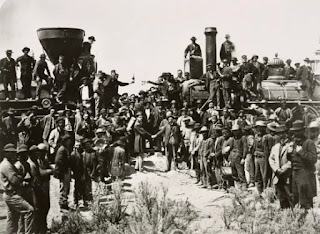

Handshake shared by the Central Pacific and Union Pacific Railroad companies after Leland Stanford drove in the final "golden spike" on May 10, 1869 at Promontory Point in Utah.

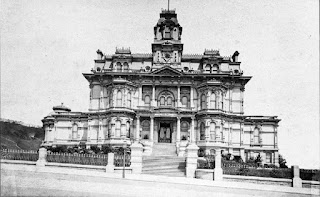
These four railroad magnates, otherwise known as "The Big Four," quickly became California--and especially San Francisco's--top dogs. Therefore, it was no surprise when they all built enormous mansions on California Hill in San Francisco, which later became known as Nob Hill, short for "nabob," a word historically associated with enormous wealth. 
 

Leland Stanford's mansion, circa 1880


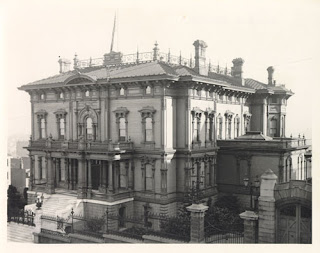
Mark Hopkins' mansion on Nob Hill, circa 1885


Collis Huntington's mansion, circa 1882


Charles Crocker's mansion, circa 1880


It is said that each of these mansions took the entire space of a city block. An interesting thing happened with Charles Crocker when he had his mansion built. He was able to buy out 12 of the 13 surrounding properties, but the last holdout, an undertaker named Nicholas Yung, whose residence was very modest compared to the other moguls indeed, refused to sell to Crocker. So Crocker had a 3-story-high fence built around Yung's residence so he wouldn't have to look at it, for one thing, but it also didn't bother him that the fence completely blocked out the sun for the Yungs. The Yungs reportedly considered leasing their property to a laundromat or selling advertising space on the fence, but ultimately decided not to retaliate. In the photo below, you can see the high fence behind Crocker's mansion, which covers the Yung residence on three sides.
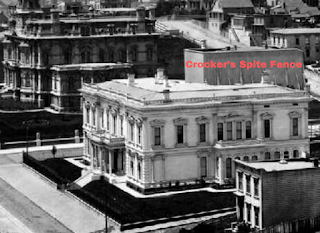

A second view of Charles Crocker's mansion on Nob Hill, which also shows the 3-story-high "spite fence" he installed around the Nicholas Yung residence, which completely blocked out the sun. It stood there for more than twenty years before coming down in 1904.


So what happened to these rich-beyond-belief, powerful men? They each suffered personal tragedies. Stanton and his wife lost their only son to typhoid at the age of 15 and their mansion basically became a shrine. Mark Hopkins died before he and his wife could enjoy living in their mansion. She immediately moved back East. Collis Huntington's first wife, Elizabeth, died in 1883, at which time he married his second wife, Arabella, whose son, Archer, 14 years old at the time of their marriage, is believed by some to be Huntington's biological son. And Charles Crocker died in 1888, leaving his two sons squabbling over his mansion.


Ironically, the San Francisco Earthquake of 1906--and the subsequent fire--leveled all four of these once-magnificent mansions. Early in the 19th century, a series of apartments were built on the property where Leland Stanford's mansion first stood. Later, they were gutted and turned into a hotel, which stands today. Mark Hopkins, as we know, died before he could enjoy his legacy. After his death, his wife remarried and donated the mansion to the San Francisco Art Association, turning it into an art institute. After the earthquake, a 19-story hotel replaced it. Now the hotel features a restaurant called Top of the Mark. Yet another hotel, the Huntington Hotel, stands in the place where Collis Huntington's mansion once stood, along with a scenic park, the land of which Huntington's second wife donated for such a cause. As for Charles Crocker, he continued to dispute with Yung for several years, and his family continued even after his death until the Yungs finally gave way in 1904. Crocker and his family may have won the battle, however, but the earthquake ensured that it was a temporary celebration. A church named Grace Cathedral now stands in its place.


For myself, I've gleaned some interesting and valuable insights from learning more about these so-called "powerful" men, and I feel that the story of these four mansions can help us understand how important it is to keep a humble perspective on life and treat our fellow men with the respect they deserve. Money isn't the most important thing in the world, after all. Our relationships are.


Although I haven't published any books that take place in San Francisco (yet), I love to learn about places in the Old West that greatly influenced our lives today. Take a look at my Christian historical Western romance novels here.



Monday, September 30, 2019

TEN MILES OF TRACK IN ONE DAY by Zina Abbott


During six years, the builders of the Central Pacific, at times numbering 14,000 men, had pierced the snow covered, granite walls of the high Sierra and extended their trail of iron over the barren plains 675 miles eastward. For more than five years the Union Pacific had been building westward. Officers of both roads were fully aware of the future advantages that would accrue to the company having the longest mileage. This rivalry extended through the ranks—from the presidents to the track laborers. There followed some marvelous feats of track-laying.

Irish Rail Workers -- UPRR
The Irish tract layers average 2.3 miles a day. Considering they had the Sierra Nevada Mountains to cross, plus stretches of the Rocky Mountains, the average track laid per day by the Central Pacific was less. Once the men had everything they needed at their disposal, they could lay down track rather quickly. Engineers estimated that, if all conditions were perfect, it was possible to lay ten miles of track in one day.

Delays in obtaining and moving men, supplies and equipment forward caused the daily average to be far less. However, in an effort to prove who were the best rail builders, competitiveness drove the two railroads to contests in laying track. First, the Union Pacific broke the record with six miles of track in one day. When Charles Crocker and his crew made up primarily of Chinese workers were challenged to beat that, they did so by a mile. The competition escalated. Crocker bragged that his men could lay ten miles in one day. Vice President Durant of the Union Pacific took him up and wagered $10,000 it could not be done, and that his money was "covered."

For several days Crocker and his construction superintendent, J. H. Strobridge, marshaled their forces and laid their plans. Ties were hauled ahead by two horse teams and distributed along the right-of-way. For some distance the ties were spaced on the already graded road bed. Rails and track materials were moved up from the rear and held in trains ready to advance. More than four thousand men and hundreds of horses and wagons were on the spot. Every man knew his particular job, taught by many months of track work. No one would get in the other fellow's way. In the Central Pacific camp, the patient and methodical Chinese were stirred to a pitch of excitement never shown before, and shared with the few hundred whites the anxiety to "get at the job."

Chinese Rail Workers - CPRR
The original date set to meet that challenge was April 27th. However, a mishap with one of the engines delayed the event by one day. The Union Pacific scoffed, but starting at 7:00a.m. the morning of April 28th, the Central Pacific crew of eight Irishmen and hundreds of Chinese set about to prove their skill.

The following is from the book, Museum Memories, Volume 1:

By the time Promontory was selected as the meeting point, Central Pacific tracks had reached Monument Point, just north of the lake shore [Great Salt Lake]. Three sprawling grading camps with about 275 tents were located there. Although the Transcontinental line was not yet completed, increasing numbers of immigrants were moving westward by rail rather than by wagon train. They took the Union Pacific from Omaha to the terminus just beyond Corrine and hired stagecoaches from there to Monument Point. Then they boarded a Central Pacific train and arrived in California just a little more than a week after leaving Omaha.

Both railroads were benefiting from the increased ticket sales, but competition between the companies had become a habit, and officials pressed their contractors were more speed. A great rivalry as to which company could lay the most track in one day had commenced early in 1868. UP made six miles, and the CP laid seven mile soon afterward. The UP topped that feat with 8 and 1/2 miles. Charles Crocker then announced that the Central Pacific could lay ten miles in one day. Thomas Durant, vice president of the Union Pacific, wagered $10,000 that it could not be done.

Consequently on April 29 [sic], 1869, only fourteen miles from Promontory Summit, the work commenced. Several prominent men from the East and the West came to see the phenomena, and a committee from the Union Pacific arrived to document the progress. Crocker had planned the operation with exact precision. Ties have been placed on the roadbed the previous night, and five locomotives, each pulling 16 cars with enough supplies for two miles of track, were in position. A large diverse crew was on hand. There were Caucasians born in the United States, former slaves with African ancestry, European immigrants, Mexicans, French Indians, a few Native Americans, and more than 3,000 Chinese.


At the first light of dawn, the men were ready to go. The Chinese workers leaped onto the flat cars and began throwing down kegs of bolts and spikes, bundles of fishplates (metal plates used to join the rails), and the iron rails. The flat cars had rollers along their outer edges to make it easier to slide the rails off. As this operation was being mounted, three “pioneers” moved out along the grade, aligning the ties that had been placed the night before. Next, the foreman shouted “Down!” and a team of eight Irish workers (two at the front of each rail and two at the back on each side of the bed) grabbed the 560 pound rails with tongs and dropped them into position. Two men followed and aligned the rails with a portable track gauge to maintain the correct with. Chinese workers came right behind and placed spikes in the proper places atop the rails. Others carried the bolts and fishplates in buckets. Teams of ten (five for each rail) then drove the spikes. Each worker would drive his assigned spike and then walk forward to the same spot on the next rail without passing another man, allowing the worker to proceed at a walking pace.


The next team of “straighteners” repaired any defects. Then came one crew to ballast the rails and another crew of fillers. These were followed by a group of four hundred tampers. Empty cars were moved to sidings to make room for the ones next in line, and the entire process was repeated over and over. The string of 1,000 workers advanced at the rate of a mile an hour. Chinese with pails strung over their shoulders moved among the men with water and tea. The telegraph construction party kept pace with the railroad crews, digging holes, putting in the polls, and stringing the wire.
 
Railroad camp near Victory, Utah, where stopped for lunch during ten mile day.
By the time the whistle announced the noon meal at 1:30 p.m., the workers had laid six miles of track. They named the site “Victory” (later Rozel, Utah) because they knew by then that they would be successful. The workers and several distinguished guests took an hour for lunch, and another hour was used to bend rails for the curves that lay ahead. Construction engineer J. H. Strobridge had a reserve crew standing by, but the first crew was intent on completing their unprecedented feat, and they forged ahead.

By 7:00 p.m. the Central Pacific was ten miles and fifty-six feet farther than it had been at dawn, an achievement that had never been done before and has never been matched since. The eight Irish track-layers had put down 3,520 rails. They had lifted 125 tons of iron rails plus the weight of the tongs, and amazing eleven tons per man per hour! The spikers drove 28,160 ties that have been put into place by the Chinese, and the bolt crews put 14,480 bolts into place. To demonstrate the quality of the new track, engineer Jim Campbell ran a train over it at forty-two miles per hour. Then the last of the five construction trains was backed down the long grade to the construction camp at Monument Point. Twelve hundred men piled onto the flatcars for the ride, smiling, cheering, and congratulating each other.

You can also read an excellent article about this event on the Central Pacific Railroad museum site by CLICKING HERE.


Did UP vice president Thomas Durant ever pay Charles Crocker of the Central Pacific the $10,000 that he lost on the bet? There is no evidence he ever did.


There is a replica of the sign that marks the end of the ten miles and fifty-six feet of track laid that day about two weeks before the Golden Spike ceremony that joined the two railroads. The original sign, most of the paint worn off, was donated to the Daughters of Utah Pioneers museum in Salt Lake City. In commemoration of the sesquicentennial of the completion of the first transcontinental railroad that took place in Utah, the museum has commemorative pins of the Ten Mile Day available in their book store and gift shop.


Escape from Gold Mountain is now offered digitally exclusively on Amazon and in the Kindle Unlimited program.  The book is also available in print format on both Amazon and Barnes & Noble. Here are the purchase links:


Sources:
Museum Memories, Volume 1 (Salt Lake City, Utah: International Daughters of Utah Pioneers, 2009), Pgs. 425-27.
http://cprr.org/Museum/Southern_Pacific_Bulletin/Ten_Mile_Day.html (May 1928 issue of the Southern Pacific Bulletin)

Tuesday, July 30, 2019

Chinese Railroad Workers & the Sierra Nevada Mountains by Zina Abbott


Charles Crocker took charge of the Central Pacific Railroad operation with fearless optimism. He was merchant, not a railroad man, so he learned railroad construction by doing it. Getting laborers proved to be difficult. Most of the men who were hired worked for a grubstake for gold mining, then walked off the job as soon as they got paid. Crocker then considered hiring Chinese laborers, although his partners and foremen were skeptical. The Chinese men were small—about four feet, 10 inches tall and weighing only about 120 pounds—and it was believed they were not strong enough to do the work.

At that time there were about sixty thousand Chinese in California. Most were young single men who had come to America for economic opportunity. Many had emigrated in response to pamphlets put out by Chinese merchants residing in San Francisco. The merchant companies paid the men's passage and were repaid with a percentage of each man's earnings. The company honored its contract to send the immigrants home free of charge if they became ill. In case of death, they sent the person's bones home for burial.
 
Ravine Bridge near Colfax photo by Alfred A. Hart, ctsy Stanford Special Collections
By the end of 1866, Crocker had eight thousand Orientals and about two thousand Caucasians in his employ. The Central Pacific paid $30 per month to the Chinese, which was considered a good wage even though the men had to buy their own food. The Chinese proved to be outstanding workers. They excelled at teamwork, took few breaks, and became skilled at blasting. Caucasians monopolized the skilled work such as trestling, masonry, and laying rails; and they held the supervisory positions. The Chinese did the grading, made cuts and fills, felled trees, and did the arduous and dangerous work of blasting.
 
Cape Horn overlooking the American River by Alfred A. Hart, ctsy Stanford Special Collections
Beginning in the early summer of 1865, the Chinese workers began construction on one of the most feared stretches of the route. Nicknamed “Cape Horn,” it ran three miles along the precipitous gorge on the North Fork of the American River. The slope was at an angle of seventy-five degrees, and the tracks were to be laid along the mountainside between twelve and twenty-two hundred feet above the river. There was not even a mountain goat path for the workers to stand on while they blasted rock cuts on the sheer cliffs. Many engineers did not think it could be done.

Workers were lowered over the rim in chairs to place the black powder, and then fix and light the fuses. They then yelled do the men above to pull them up to relative safety. The Chinese workers informed their foreman that they had learned a better way from their ancestors who had built the fortresses in the Yangtze gorges. They wove waist-high baskets with 4 eyelets at the top, similar to the ones that their progenitors had used. Ropes ran from the eyelets to a central cable.
 
Locomotive on finished Cape Horn track by Alfred A. Hart, ctsy Stanford Special Collections
The Chinese workmen, hanging in their baskets, were much safer than they had been while perched in those precarious chairs. Due to the skill and dedication, the roadbed and track around Cape Horn were completed in the spring of 1866, much sooner than had been anticipated. But hundreds of barrels of black powder were ignited daily, and there were accidents. The Central Pacific did not record Chinese casualties, so the number of deaths is not known. From this dangerous operation came the phrase, “not a Chinaman's chance.”

Donner Pass terrain, typical of the Sierra Nevada Mountains
Clearing the roadbed was almost as bad as blasting on Cape Horn. Huge trees and other obstructions had to be removed from a twenty-five-foot path on each side of the road bed. One gang of three hundred men spent ten full workdays clearing a single mile of right-of-way. After the trees were hauled to the sawmills, the stumps had to be blasted from the soil. Ten barrels of blasting powder were often required to remove a single stump.

At Donner Summit, it took more than a year to cut the 1,659-foot tunnel—more than a quarter mile—through solid granite and then bring the track down the steep escarpment of the east slope in a meandering route past Donner Lake. From there, getting the line from Truckee to present-day Reno would be relatively easy since the line essentially followed the Truckee River and continued into the Nevada desert with its comparatively flat topography.

 
The east portal of Tunnel 6 and wagon road from Tunnel 7, photo by Alfred A. Hart, courtesy Department of Special Collections/Stanford University Libraries

However, Tunnel 6 proved be extremely difficult. It was one of 15 tunnels the Central Pacific used to conquer the Sierra and was by far the most challenging. It was all done by hand. The Chinese worked in teams of three, with one man holding the drill, while the other two workers swung hammers. Once a sufficiently sized hole was augered out, a man would fill it with blasting powder, light a fuse and hope for the best.


Tunnel 6 through Donner Summit, photo by Alfred A. Hart, courtesy Department of Special Collections/Stanford University Libraries

 
Snow on Donner Summit May 31, 2019
Progress was so slow that the executives decided to try using nitroglycerin, which was more powerful and less expensive than blasting powder. They found it to be safe if a fresh amount was manufactured each day. Two thousand blasts were made in the summit tunnel within less than two months, and not a single accident occurred.

 Summer snow drifts on Donner Summit during railroad construction, photo by Alfred A. Hart, courtesy Department of Special Collections/Stanford University Libraries

The severe winter of 1865-66 and 1866-67 called for superhuman courage to keep things going. There were forty-four separate storms during the winter of 1866-67. The snowpack was eighteen feet deep at the summit, and the only work possible was in the tunnels. There were accidents of all kinds, mainly from blasting powder. Sometimes the heavy explosions started avalanches, and entire camps of workmen were buried alive. In order to travel to and from the granite tunnels, the Chinese laborers dug snow tunnels from fifty to five hundred feet long. Windows and air shafts were bored through the snow walls, and the men lived in these labyrinths all winter.

Railroad tracks next to Truckee River, May 31, 2019
There was only light snow over the summit in Truckee Canyon, and Crocker was anxious to keep his men working throughout the winter. From there they could grade up the eastern face of the Sierra and also westward toward Nevada. There was only one major problem. How would they transport the necessary rolling stock and equipment over the summit? Crocker conceived and directed the tremendous undertaking of sledding three locomotive, forty cars, and enough material for forty miles of track on torturous mountain trails up over the summit and down into Truckee Canyon. This extraordinary feat was accomplished by Chinese workers and ox teams.


A locomotive over the Truckee River, photo by Alfred A. Hart, courtesy Department of Special Collections/Stanford University Libraries

The first locomotive from Truckee crossed the California and Nevada state line on December 13, 1867. By the end of the year, only one difficult section near the summit remained to be built. The tough work in solid rock above Donner Lake was completed on June 15, 1868, which ended the difficult work in the Sierra Nevada Mountains.


Emigrant Gap Tunnel and Snow Shed, photo by Alfred A. Hart, courtesy Department of Special Collections/Stanford University Libraries

Because of the problems the builders encountered while building the railroad, they knew the problem of heavy snows must be solved before trains could be operated year-round. They built forty miles of sheds, forming nearly a solid covering over the tracks. One railroader remarked, “I've railroaded all over the world, but this is the first time I've ever railroaded in a barn.” Gradually, as powerful rotary snow plows and improved snow fighting methods were developed, the snow-shed mileage was reduced. In 1955, less than six miles remained.

Snow Sheds still visible on railroad tracks today

Although my novel, Escape from Gold Mountain, does not take place during the building of the Transcontinental Railroad, it is set on the eastern side of the Sierra Nevada Mountains and does have a Chinese heroine. Inspired by true events that took place in 1884-85, I hope you will enjoy reading this story about a woman from an American immigrant group that is often overlooked. Her situation was typical of many of the Chinese women to came to the United States in the nineteenth century.

Escapefrom Gold Mountain is currently on pre-order at a special sale price that will end the day after the book is released. PLEASE CLICK HERE for the book description and purchase link.


Sources:
Museum Memories, Volume 1 (Salt Lake City, Utah: International Daughters of Utah Pioneers, 2009), Pgs. 404-407.
http://tahoequarterly.com/summer-2019/surmounting-the-sierra
https://www.wbur.org/onpoint/2019/05/07/chinese-transcontinental-railroad-ghosts-of-gold-mountain-gordon-chang