Sunday, May 26, 2019

THE VILLAGE BLACKSMITH IN THE OLD WEST


Under the spreading chestnut tree, the village smithy stands…. Did you have to memorize that in school? Do they even memorize poetry now days? My impression of a blacksmith formed from that poem and the print my parents had hanging in their living room. The print of the painting by Paul Detlefson came first, so when I had to learn the poem, I visualized red barn as being the village smithy. The painting is actually titled "Horse and Buggy Days" but I didn't know that then.
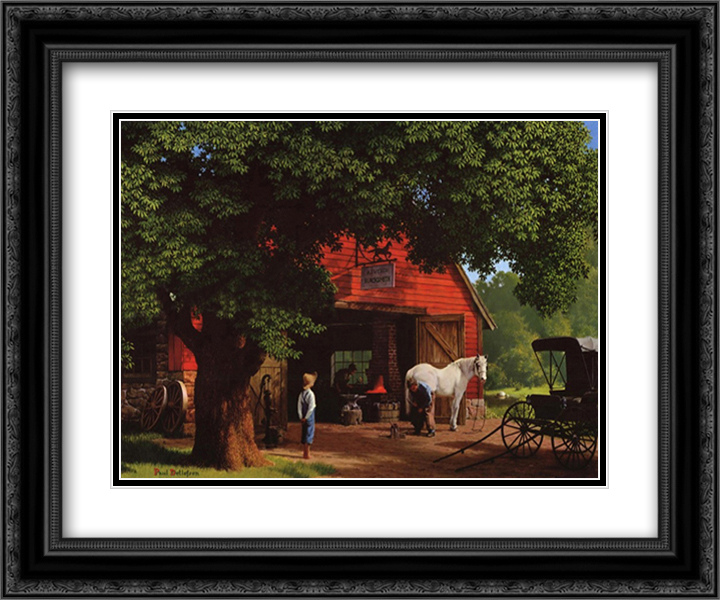
I have no idea if the large tree
is a chestnut but to me it was.

I’ve seen a fair number of historic western blacksmith shops. My husband lets me drag him through living history museums wherever we find them. Actually, he’s very interested in history but I don’t think he needs as much first-hand frontier information as I require for research.

For the purpose of this article, let me define that a blacksmith is a metalsmith who creates objects from wrought iron or steel. He forges the metal by using tools to hammer, bend, and cut. Blacksmiths produce objects such as gates, grilles, railings, furniture, tools, agricultural implements, nails, chains, and weapons. In many Old West towns, the blacksmith was also a gunsmith.

The term “blacksmith” comes from the black firescale, a layer of oxides that forms on the metal surface during heating. Some sources state the word “smith” may come from the old English word “Smythe”, meaning to strike. Other sources say the word may have originated from the Proto-German “smithaz” meaning “skilled worker”.
Prior to the industrial revolution, a "village smithy" was a staple of every town. Factories and mass-production reduced the demand for blacksmith-made tools and hardware.
The original fuel for forge fires was charcoal. Coal did not begin to replace charcoal until the forests of first Britain (during the 17th century), and then the eastern United States of America (during the 19th century) were largely depleted. Coal can be an inferior fuel for blacksmithing, because much of the world's coal is contaminated with sulfur. Sulfur contamination of iron and steel make them "red short", so that at red heat they become "crumbly" instead of "plastic". Coal sold and purchased for blacksmithing should be largely free of sulfur.
I’ve looked online for a photo that matches the image in my head for the blacksmith/gun repair shop in my latest release, A BRIDE FOR GIDEON, but I can’t find one. Sadly, I don’t draw well enough to illustrate what the concept in my mind.  Here is the closest I could find.


During the first half of the nineteenth century, the US government included in their treaties with many Native tribes, that the US would employ blacksmiths and strikers at Army forts, with the expressed purpose of providing Native Americans with iron tools and repair services. I have to admit this fact came as a surprise. By the way, a blacksmith's striker is an assistant (frequently an apprentice), whose job it is to swing a large sledgehammer in heavy forging operations, as directed by the blacksmith. In practice, the blacksmith holds the hot iron at the anvil (with tongs) in one hand, and indicates where to strike the iron by tapping it with a small hammer in the other hand. The striker then delivers a heavy blow to the indicated spot with a sledgehammer. Let's hope he didn't miss.
During the early to mid-nineteenth century, European armies as well as both the U. S. Federal and Confederate armies employed blacksmiths to shoe horses and repair equipment such as wagons, horse tack, and artillery equipment. These smiths primarily worked at a traveling forge that comprised wagons specifically designed and constructed as blacksmith shops on wheels to carry the essential equipment necessary for their work.
In frontier/Old West towns, a blacksmith was an important person. Movement by horse or wagon depended on him being able to shoe horses and repair wagons. Building depended on him. He also made nails, hinges, locks, gates, and other metal objects needed for everyday life.

That's my ancestor standing at the far right.
Maybe he had to
repair that wagon on the left.
One of my ancestors on my father’s side, pictured above, was a farmer/rancher who worked as a blacksmith at his home near Duke, Oklahoma. Looks more as if they're having a party with so many people, doesn't it? To his wife’s annoyance, he didn’t charge his neighbors and spent a lot of time working for free. Supposedly, she (pictured below) was very pleased when they moved into town.
His wife, who is working with the cows.
Blacksmiths work by heating pieces of wrought iron or steel until the metal becomes soft enough for shaping with hand tools, such as a hammer, an anvil and a chisel. Heating generally took place in a forge fueled by coal or charcoal.
Color is important for indicating the temperature and workability of the metal. As iron heats to higher temperatures, it first glows red, then orange, yellow, and finally white. The ideal heat for most forging is the bright yellow-orange color that indicates forging heat. Because they must be able to see the glowing color of the metal, some blacksmiths work in dim, low-light conditions, but most work in well-lit conditions. The key is to have consistent lighting, but not too bright. Direct sunlight obscures the colors.

Modern blacksmith at work
The techniques of smithing can be roughly divided into forging (sometimes called "sculpting"), welding, heat-treating, and finishing. Forging is the process smiths use to shape metal by hammering the iron into shape. Even punching and cutting operations (except when trimming waste) by smiths usually re-arrange metal around the hole, rather than drilling it out.
The five basic forging processes are often combined to produce and refine the shapes necessary for finished products. For example, to fashion a cross-peen hammer head, a smith would start with a bar roughly the diameter of the hammer face. The handle hole would be punched and drifted (widened by inserting or passing a larger tool through it), the head would be cut (punched, but with a wedge), the peen would be drawn to a wedge, and the face would be dressed by upsetting.
Welding is the joining of the same or similar kind of metal. This is not the acetylene torch of today. In forge welding, the pieces to join are heated to what is generally referred to as welding heat. For mild steel most smiths judge this temperature by color—the metal glows an intense yellow or white. At this temperature the steel is near molten.
Depending on the intended use of a piece, a blacksmith may finish it in a number of ways: a simple jig (a tool) that the smith might only use a few times in the shop may get the minimum of finishing—a rap on the anvil to break off scale and a brushing with a wire brush. Files bring a piece to final shape, removing burrs and sharp edges, and smoothing the surface. Heat treatment and case-hardening achieve the desired hardness. The wire brush can further smooth, brighten, and polish surfaces. Grinding stones, abrasive paper, and emery wheels can further shape, smooth, and polish the surface.
A range of treatments and finishes can inhibit oxidation and enhance or change the appearance of the piece. An experienced smith selects the finish based on the metal and on the intended use of the item. Finishes include (among others) paint, varnish, bluing, browning, oil, and wax.
As demand for their products declined, many more blacksmiths augmented their incomes by taking in work shoeing horses. A shoer-of-horses was historically known as a farrier in English. 
With the introduction of automobiles, the number of blacksmiths continued to decrease. Many former blacksmiths became the initial generation of automobile mechanics. That’s what happened in my ancestry. The son of the blacksmith pictured near Duke, Oklahoma above became a mechanic in Tulare, California.
Auto Mechanics - What happened to a lot of blacksmiths.
The low point of blacksmithing in the United States was reached during the 1960s, when most of the former blacksmiths had left the trade, and few if any new people were entering the trade. By this time, most of the working blacksmiths were those performing farrier work, so the term blacksmith was effectively co-opted by the farrier trade.


Caroline Clemmons writes historical and contemporary western romance. Her latest, A BRIDE FOR GIDEON, is #16 of the popular, multi-author Proxy Bride Series, is a historical romance. The gorgeous cover was designed by Virginia McKevitt.


Keira desperately wants to belong somewhere
Gideon is haunted by a secret too horrible to share
Fate conspires against them…    

Keira Cameron came to Boston from Scotland after the death of her parents. She wanted a job, a husband, and eventually a family. She feels rejected because at almost six feet she’s too tall, Her Scottish burr makes her appear too foreign. She is too pretty for any wife to want Keira working near the woman’s husband. Were her expectations unreasonable? Her cousin convinces her to enter a proxy marriage to his friend, Gideon Ross, who lives in Montana Territory. Out of options, she agrees and hopes her goals will be realized.

Gideon Ross is a large man at five inches over six feet. His business is a smithy and gun repair shop. The war left him with a terrible scar on his face. He wears a beard to try to conceal the scar but still hears people whisper he’s a monster and a giant. Do they think he has no feelings? He’s haunted by the war and has terrible nightmares. Reluctantly, he agrees to wed Keira by proxy.

Outside forces work against the couple. Keira and Gideon must find the key to the attack on their lives. Can they defeat the enemy before they’re too late?

A BRIDE FOR GIDEON is free in KU and available in e-book and print at the Universal Amazon link http://mybook.to/Keira 
Reviews include:

"I enjoyed reading this captivating story that is fantastically written with charismatic characters. Their story has a wonderful HEA."
Sharon H


"In depth writing, a complete story tying everything together. No loose ends hanging to wonder what about...? Great work! Great writing, great story." Serene Susan 

Friday, May 24, 2019

A SHORT HISTORY OF CREEDE, COLORADO AND ITS ‘GREAT FIRE’ by Marisa Masterson


In the last two years, I have read so many wonderful historical western romances set in Creede, Colorado. When I was asked to write for the Proxy Bride series, I decided that Creede would be a wonderful spot to set my book. This began my search for interesting tidbits about the town.

Early into my online search, I happened on an entry in the Colorado Encyclopedia about the Creede Museum (https://coloradoencyclopedia.org/article/creede-railroad-depotmuseum). After reading that article, my mind was set on the time and place. I wanted to set my book in 1893.

Why that year, you might ask? The fire!

According to Creede’s website, (https://www.creede.com/discover-creede/history.html), before 1890, the area around Creede drew tourists. It was a popular fishing area as well as being a spa. People came to bathe in the hot springs as well as to drink that water. Ugh! By 1883, the Denver & Rio Grande Railroad transported these tourists. It must have been popular to have the railroad extended to it.

At first called Jimtown, the town changed quickly after silver was found in 1890. Its population boomed and, by the time the name was changed to Creede, the town had an estimated population of 10,000. That’s the Creede I wanted to imagine in my book.

But back to the fire…

One cold night a fire started in rooms above a barbershop. This spread quickly through the wooden buildings and destroyed much of the town. Because of the speed of the fire business owners weren’t able to even rescue their tills. Cash burned and the coins melted together. A great description of the fire was written twelve years later in an article for the Creede Candle (https://www.coloradohistoricnewspapers.org/?a=d&d=TCC19040604&e=-------en-20--1--txt-txIN-creede+fire+1892-------0-).


This photo of Creede was taken in 1893, one year after a fire destroyed much of the mining town. The Denver & Rio Grande Railroad depot, which currently serves as a museum, is the wood frame building under construction in the center of the photo. Boxcars are lined up to its right, and Main Street is in the foreground. (taken from the Colorado Encyclopedia)


After researching the fire, I imagined my hero as a business owner struggling to reestablish himself after the fire. Once I started writing the book, the size of the town of Creede was beyond what I wanted to depict in A Bride for Darrell. The great thing about being an author is the freedom to invite towns. So, I created Silver Town. I used the railroad history of Creede and even set Silver Town on the same branch line.


About Marisa Masterson


Marisa Masterson and her husband of thirty years reside in Saginaw, Michigan. They have two grown children, one son-in-law, and two old and lazy dogs. 

She is a retired high school English teacher and oversaw a high school writing center in partnership with the local university. In addition, she is a National Writing Project fellow.

Focusing on her home state of Wisconsin, she writes sweet historical romance. Growing up, she loved hearing stories about her family pioneering in that state. Those stories, in part, are what inspired her to begin writing.


Wednesday, May 22, 2019

MAY 14, 18??


Post by Doris McCraw
writing as Angela Raines

USGS photo of early Colorado
For this post I thought it might be interesting to look back over events on May 14 in the history of Colorado.

As you can see, in 1859 as the area was just being settled, the language and sensibilities were flowery and formal, even for a story of horse thieves. It appear this was a problem in the Cherry Creek area.  You will note, they talk about pursuing them to the 'states'. Colorado was still part of many Western territories at this time. It did not become its own territory until February 18, 1861.


Block image
May 14, 1859
Rocky Mountain News Weekly


Photo Property of the Author
For those who don't know Grace Greenwood, she was an author, speaker and traveler on the early days of the Colorado Territory. She, Isabella Bird and Helen (Hunt) Jackson all traveled in the area in the early 1870s. Grace's real name was Sara Jane Lippencott. For a quick overview of her life, here is a link to the Wikipedia page Grace Greenwood  Below is the beginning of an article she wrote about President Grant.

User clipping image
May 14, 1870
Rocky Mountain News


Lest we forget that many came to Colorado for their health. Colorado was one of the states that had a reputation for the curative powers of its climate and mineral waters, both the hot springs and those you drank. Because of that reputation, Colorado from almost the beginning tried to devlope a medical society. The Colorado Medical Society had its beginnings in 1871.

User clipping image
May 14, 1879
Leadville Daily/Evening Chronicle


Of course, most know Colorado was a magnet for women's suffrage. Some of the early female physicians, such as Dr. Alida Avery, came to the region for their chosen profession and to support the cause of women's rights. The article below is from one of the early publications that promoted women's equality.
User clipping image
May 14, 1890
Queen Bee- Denver CO
So May 14, over the early years of Colorado's history is full on interesting facts. In addition it gives us a look at the thoughts, the people and the change in language as more and more people arrived. Sometimes it is good to look back at what was and know that is the foundation of the history we now live.

In my latest novel, "The Outlaw's Letter", I made use of events, and history of Colorado in 1880. It was exciting to have my characters be a part of Colorado's history.

Doris Gardner-McCraw -
Author, Speaker, Historian-specializing in
Colorado and Women's History
Angela Raines - author: Where Love & History Meet
For a list of Angela Raines Books: Here 
Photo and Poem: Click Here 
Angela Raines FaceBook: Click Here

Monday, May 20, 2019

A Texas Plantation


I am in the middle of boxing up books in my home office because we are going to have the room's old carpet replaced. Not a fun job! I've collected hundreds of research books over the years from library book sales, used book stores, historical places hubby and I toured, or from online sources, mainly Amazon. In many cases I'd forgotten I even had the book.

One such example is Plantation Life In Texas by Elizabeth Silverthorne.
https://www.amazon.com/Plantation-Texas-Clayton-Wheat-Williams/dp/089096288X

Published in 1986 as part of a Texas life series, this fascinating volume is based on earlier books, articles and first-hand accounts from former slaves collected during the 1930s by interviewers employed by the Works Progress Administration (WPA). The text is liberally illustrated with scenes of plantation life drawn and painted by noted Texas artist Charles Shaw.

Ms. Silverthorne grew up in Brazoria County on Texas's Gulf coast, where cotton and sugar plantations flourished in antebellum days. She opens her book with a history of how planters came to Texas in the early 1800s when it was still part of Mexico. "Along with slaves and seeds, they carried ideas and ideals about the kind of life they wanted to create for themselves."

One of these "would-be empire builders" was Jared E. Groce. Born on a Virginia plantation, he moved west, managing plantations in Georgia and Alabama. Then, in January 1822, Groce became one of Stephen F. Austin's Old Three Hundred settlers. He and his son Leonard, along with an overseer, led fifty covered wagons to Texas. They brought pontoons to ferry the wagons across rivers. Included were his family, over ninety slaves, furniture, spinning wheels, looms, clothing, farming equipment, and enough food to see them to their destination. A train of livestock followed the wagons.

Groce chose to settle on a high bluff overlooking the Brazos River. Some of his slaves set to work building a small cabin (for his family presumably) while others cleared ground for planting seed corn and cottonseed. He named his plantation Bernardo.

Bernardo Plantation; https://www.thcfriends.org/special-projects/bernardo-plantation

Due to a severe drought, the corn crop failed, leaving Groce, his family and slaves to subsist on wild game until the following year when a corn crop was grown successfully. However, the dry weather and rich soil produced more cotton than Groce had imagined. The first few crops were carried by pack mules into Mexico, with Groce leading accompanied by his body servant Edom, who performed many servised for his master, whose arms were crippled.

One slave managed ten or twelve mules, walking or riding behind them, yelling at them to move on. Each animal carried two bales of cotton, weighing seventy-five to eighty pounds a piece, plus a sack of feed. Strong little critters!

Groce eventually built a river landing near his plantation, allowing him to float his cotton on homemade flatboats down the Brazos and transfer it to a schooner bound for New Orleans. Other plantation owners and travelers also used his landing, calling it Groce's Ferry.

In 1825 Groce's son, Leonarrd, brought the first cotton gin to that part of Texas. The family's empire grew, building more plantations. When Groce's only daughter, Sarah Ann, and her husband William H. Wharton moved to Nashville, Tennessee, he enticed them to return by promising to build them their own plantation. They returned and he built for them the Eagle Island plantation on Oyster Creek, where Sarah became a famous hostess and political influencer for her husband.

Bernardo Plantation played a large part in the War for Texas Independence. The plantation provided a strategic location for Sam Houston and his Texian soldiers before the Battle of San Jacinto, which ended the conflict. The Twin Sisters cannon supplied by Ohio sympathizers arrived at the plantation and soldiers were ferried across the Brazos by steamboat prior to the battle. Additionally, Bernardo is considered the South's last major cotton plantation and the nation's farthest west cotton plantation.

I can't go into how slaves lived, worked and died to provide their masters an opulent lifestyle, not without writing another book about it. Or how everything changed after the Civil War, forcing plantation owners to free their slaves, thereby losing their cheap labor. For that, I suggest you get hold of Elizabeth Silverthorne's amazing book. The wonderful illustrations, alone, are worth the cost.

Saturday, May 18, 2019

Author Headaches

I read somewhere that General Grant (later President Grant) suffered from debilitating migraines. The thought of conducting a battle with cannon-fire, guns barking, men and horses screaming with a migraine makes me shudder. Also makes me respect the man's intestinal fortitude because when I have a migraine, even the sound of my own breathing is too loud.

Headaches--I got 'em. Headaches from allergies, tension headaches, and if I eat the wrong foods or have a sudden upheaval in my life, I have crippling migraines. The migraines are the worst, because as my doctor said some years ago, mine are (his words, not mine) "Bass-ackwards." Cold applied to the head and neck usually offers some relief for migraine suffers. Cold applied to my head and neck during a migraine intensifies the pain and if I wasn't vomiting before from the pain, I immediately will be. I lose sight in my right eye. It feels as if an ice pick has been slammed through my head above my right eye and emerges out the back of my skull just above the first neck vertebrae and someone is hitting that ice pick to make it vibrate.

Prior to a migraine, I do get the "warnings"--I smell what can only be described as copper wires burning (Ever have an electrical fire somewhere and smell those overheated wires? That's what I smell.); I see halos around lights and if I close my eyes, I see bright flashing lights; and oddly enough, I have a completely detached, disjointed sensation in my whole body, as if nothing is properly connected. If I can take my meds soon enough when I get the warnings, I can avert the worst of a migraine.

That didn't happen yesterday afternoon. I sat down to write my blog post, booted up trusty ol' Red (my lap is a bright, shiny, metallic red color), and smelled burning copper wires. My heart sank. I thought Red was giving up the ghost. And, then the migraine hit. I didn't get all the warnings. My body betrayed me. I couldn't get the migraine meds onboard because this one was a "puking until I was certain I saw my socks come out of my mouth" migraine. (Sorry about the graphic mental image there.)  

I crawled into bed and prayed I could fall asleep so maybe--just maybe--this one wouldn't be long in duration. So much for that hope. I'm writing this blog post through a migraine. I'll have a better post next month.


Thursday, May 16, 2019

Miraculous Staircase - Loretto Chapel Santa Fe New Mexico by Kaye Spencer #sweetheartsofthewest #lorettochapel #oldwest

Loretto Chapel front view
At the end of the Old Santa Fe Trail stands the Loretto Chapel. Inside the Gothic structure is the staircase referred to as miraculous, inexplicable, marvelous and is sometimes called St. Joseph’s Staircase. The stairway confounds architects, engineers and master craftsmen. It makes over two complete 360-degree turns, stands 20’ tall and has no center support. It rests solely on its base and against the choir loft. The risers of the 33 steps are all of the same height. Made of an apparently extinct wood species, it was constructed with only square wooden pegs without glue or nails…**

Within the well-preserved and quiet walls of Loretto Chapel in Santa Fé, New Mexico, is a staircase steeped in two mysteries that, for many people, have yet to be solved:

1. Who built the staircase?
2. How is its construction possible?

The Miraculous Staircase, as it is called, was built during a six-month period sometime between 1877 and 1881. To understand the story of the staircase, we must understand a little about the chapel’s history; the vision of its founding; the courage and determination of the people dedicated to its success; and the unwavering faith of these pioneering spirits.

Loretto Chapel’s story begins in 1853 and ends in 1971 when it became a private museum for the primary reason of preserving the Miraculous Staircase and the chapel.

Here is the truncated version of the chapel’s history from the chapel’s website**:

1850
*Bishop Jean Baptiste Lamy appointed to Church in Santa Fe, New Mexico Territory.
*Bishop Lamy begins letter writing plea for priests, brothers and nuns to come out and help him.

1852
*Sisters of Loretto send seven sisters from Kentucky.
*Sisters leave St. Louis and travel to Independence, Missouri.
*Encounter cholera epidemic, Mother Superior dies, and one nun is too ill to continue and returns.

1853 - 1873
*Sisters open Academy of Our Lady of Light (Loretto).
*From small school numbers to 300 students (girls) in a short period of time.
*Tuition, donations, and from the sisters own inheritances ($30,000) fund the school and chapel.
*Property is purchased, work on Loretto Chapel begins.
*School facilities cover a square block with 10 buildings.
*Architects from Paris design Loretto Chapel in the gothic style of King Louis IX's Sainte-Chapelle.

Loretto Chapel choir loft
1876
*Stained glass is purchased in Paris, arrives by ship in New Orleans, goes by paddle boat to St. Louis, and then travels by covered wagon via Old Santa Fe Trail.
Loretto Chapel altar
1878
*Chapel is completed.
*No access to the choir loft twenty-two feet above the main floor except by ladder.
*Due to limited space within the chapel, there isn’t room for a staircase.
Loretto Chapel staircase and confessional


[1877-1881]
*Staircase is built – without a railing.
Loretto Chapel before the railing
(picture of a picture)

1887*Staircase railing is added.
Loretto Chapel staircase - Did I capture an orb?
Loretto Chapel staircase close-up
Loretto Chapel staircase from below

1880s & 1890s
*Chapel undergoes additions, renovations, such as the introduction of the Stations of the Cross, Gothic altar, frescos.

Loretto Chapel back view - Stations of the Cross on right side

Now, back to the mysteries of the story of the staircase…

According to the history on the Loretto Chapel website, the Miraculous Staircase is believed to have been constructed by St. Joseph, patron saint of carpenters, who answered the sisters' prayers for a solution to the access problem to the choir loft, when he arrived at the chapel with a donkey and a toolbox, and said he was looking for work. When he finished the staircase, he disappeared, vanished, without payment or thanks.

Is the Miraculous Staircase a miracle or a hoax? This is an ongoing topic of interest and discussion. For the architects out there, there is no miracle involved. For others... 

To quote a line from 'The Man Who Shot Liberty Valance'… When the legend becomes fact, print the legend.

The 1998, made-for-television movie, 'The Staircase', stars Barbara Hershey as the mother superior and William Peterson as the mysterious carpenter. Yes, there's the Hollywood spin that fiddles with the facts, and the story is a little slow, but it’s still worth watching, even if you only watch it once.
Special Note: If I don't respond to comments, it is because Blogger has been persnickety lately, and I have troubles leaving comments. If that happens for this article, I will comment here:

>>>> 


Until next time
Kaye Spencer

As I don’t send a newsletter, you might consider following me on these platforms:


Resources:
**http://www.lorettochapel.com/history.html
http://www.csicop.org/si/show/helix_to_heaven/
http://www.washingtonpost.com/wp-dyn/content/article/2010/01/15/AR2010011501810.html


All of the images are from my collection.