Showing posts with label #newrelease. Show all posts

Friday, December 22, 2023

Well, I did it!

Post by Doris McCraw

aka Angela Raines


Photo (C) Doris McCraw

Well, I did it! I finished the short novel and today is the release date. It's a story that's been waiting to be told since 2017 when these characters showed up in my novel "Josie's Dream". I've enjoyed the ride and hope people will enjoy their story.

With that finished, I've spent some time looking at what 2024 will look like. That I plan to devote time to making this blog a place for writers and their work and research. I would appreciate feedback and ideas. 

In the meantime, keep writing, researching, and thinking of others who might be a good fit and can use the exposure. As for me, I'm tired. I will be working between Christmas and New Year. So, this post is short on purpose. 

Wishing everyone the best Holiday Season possible. Enjoy the work of your fellow writers, and leave comments and reviews. Oh and by the way, "Amos" is now live in ebook format. The plan is to release a paperback in February. 

Amazon

Until Next Time: Stay safe, Stay happy, and Stay healthy. 

Doris


Thursday, June 17, 2021

COOKING IN THE OLD WEST!

 By Jo-Ann Roberts

Cooking was much more complicated in the 1800s than it is in our modern world. Many people take for granted the conveniences that are in their kitchens. It is easy to feel superior when thinking about days gone by.


Nineteenth Century Western Kitchen


History shows us that in the past it took a lot of work and a lot of time to put a meal on the table. But if a modern-day family was transported back in time to a pioneer kitchen, they might be surprised to see some of the wonders that kitchens contained.

In my soon-to-be-release, Grace-Brides of New Hope Book Three, Grace Donegan is the baker at Caroline's Cafe in New Hope. Turning out pastries, pies, and desserts keeps her busy, especially working with some of the modern gadgets of the day.

Sugar and Sugar Snips

Sugar was brought to the grocer in cone shapes called "loaves".  The woman of the house or proprietor of an establishment would cut up the loaf using sugar nippers to break the hard substance into smaller, usable parts for the table. The loaf was such a common sight until the later 19th century that everyone knew what it looked like. Even the paper it was wrapped in played a part in domestic life. Loaves from the Americas were wrapped in blue indigo paper which was recycled as a source of dye for yarn or cloth.


Sugar Snips

   
Sugar Loaf

The nips were tongs with a flat surface at the end suitable for lifting pieces of sugar. But they were also sturdy and tough. Nips used for cutting sugar were often made from steel. However,  decorative tongs for table use by wealthy families were often made from silver with elaborate engravings matching the family's silver service.

When powdered sugar was called for in a recipe, the cook had to use a mortar and pestle. Some sugar boxes had compartments for powdered sugar as well as lumps. Tongs, boxes, and casters (sugar sprinklers) were fashioned in silver for the wealthy, but there were many wooden sugar boxes, too.

Silver Sugar Box

 
Wooden Sugar Box

Rotary Egg Beater

Invented by tinner Ralph Collier of Baltimore, in partnership with A.S. Reip, a tin and iron war manufacturer, the first U.S. patent for a rotary egg-beater was submitted in 1856. But at that time it wasn't yet clear what the best design for the job would be. This patent describes how useful the new invention would be for hotels and restaurants as well as for ordinary households hoping to speed up a "laborious and fatiguing operation".

Rotary beaters with a handle worked best, but they came in different forms. Some early ones were fixed inside a pot, and couldn't be used with the cook's choice of mixing bowl. Some were developed by the same inventors who designed small hand-cranked butter churns.


Egg beater in a bowl

However, in 1873 the Dover egg beater emerged on the scene and even the most skeptical of cooks was quite taken with it. This invention did pave the path for easier cooking.

"The Dover egg-beater saves much time and trouble in beating eggs and will bend the yolks into as stiff a froth as the whites."  The Northeastern Reporter, 1879.


Dover Egg Beater

In the early 1870s, the cost of an egg beater could run a family $1.50. Less than ten years later the Dover could be purchased for $1.25. As time went on and egg beaters became more common, the price came down and by 1912 a housewife could pick one up for $.05!!


Spurtle

Scottish in origin, the first documentation of use in cooking was noted in 1528. The word, spartle was a Northern English word meaning "stirrer".  In the Germanic languages. a spurtle refers to a flat-bladed tool or utensil.

Spurtle

Made from the straightest tree branch which could be found, the utensil was peeled and used for flipping oatcakes on a griddle, and not for porridge, stews, or soups which is common today. Traditional Scottish spurtles have a thistle end, in homage to the national emblem of Scotland, whereas contemporary spurtles have a smooth tapered end. There are some tall tales about the spurtle which is not surprising given that it is in the shape of a magic wand. The most famous of the customs is when using a spurtle you must always stir clockwise and always with your right hand..."Lest you invoke the devil".

I first came across a spurtle when I was doing research for Lessie-Brides of New Hope Book One. Eli MacKenzie, the MMC (male main character), presents Lessie with several gifts following their wedding, one of which is a spurtle. Bearing a Scottish heritage, this fits in perfectly with his backstory.  Here's a brief excerpt:

He placed his hands on her waist after setting the gift in front of her.

“Eli, you’ve already given me so much. I really don’t need anything more.” Lessie brushed away a tear that remained. After she untied the strip of rawhide, the burlap fell away to reveal a long-handled wooden stick, resembling a spoon, that flared out at the bottom. Something similar to a cornstalk was carved at the narrowed top. “Thank you, Eli.” She tilted her head and inquired, “Is this your way of asking me to cook something for you?”

He ran his hand down the stick. “This is called a spurtle. In Scottish families, it is a traditional gift given to the bride with the hope that it will bring her good luck cooking for her new husband.” He indicated the top portion. “Burt Davis made it in his shop and carved a thistle on the top. The thistle is the national emblem of Scotland. In many ways, it reminds me of you.”

Lessie arched an eyebrow. “That’s not a particularly flattering comparison, Eli. I am not prickly.”

Eli chuckled. “That isn’t my interpretation at all. I see you as a thistle because, like that bloom, you symbolize bravery and courage in the face of adversity. And those spiky painful thorns suggest endurance and fortitude. I don’t know a single woman who would have carved out a life for herself after enduring a bloody war, traveled to an unknown town with nothing but a scrap of paper from a stranger who disappeared after marrying her, with a baby and a few trinkets wrapped in a quilt. Nor do I know of any woman who had the foresight to chart her own path as a midwife and transform a neglected farm into a place to be proud of.”

Sieves and Strainers

The word "sift" is derived from "sieve".  In cooking terms, a sieve or sifter is used to separate and break up flour and dry goods, as well as to aerate and combine them. A ladle with draining holes or a strainer is a form of a sieve used to separate suspended solids from a liquid...think an egg separator.  

Early wooden sieves used tin or horsehair for the sieving. The widths of a wooden sieve were made from fir or willow, American elm being the best choice. The rims would be made of fir, oak, or beech.


Miscellaneous Gadgets


Cake Separator


This tool was widely used for cutting angel food cakes and other soft cakes, as the delicate tines wouldn’t crush or compress the cake under pressure. Cake breakers were so popular that you could even find one in your silver pattern.

Herb Cutter

Herb cutters came in different styles than this one. For example, some herb cutters had a handle on both sides of the blade for each hand.


Herb Cutter


Coffee Grinder


By the mid-1800s, various coffee grinders were present in almost every home. Most grinders had a grinding handle on the top of a box that was set inside a bowl-shaped holder of roasted coffee beans. The bottom of the box had a drawer that held the coffee beans after being ground.

 Molds

While most pioneer cooks had all they could do to put three meals a day on the table, some


cooks experimented with tin molds. In Mrs. Beaton's Book of Household Management (1861) recipes for jellied delights and other molded foods meant that many people aspired to have devices with which to make ordinary dishes extraordinary. Cooks back then would have also had several pitting, chopping, and peeling tools available since they had to process all their foods by hand.


 ******************************

July 7th Release

Preorder Now!


https://www.amazon.com/Grace-Brides-New-Hope-Book-ebook/dp/B096PKGC96


Friday, August 28, 2020

Ten Things You May Not Know About Blacksmithing


The blacksmithing trade has been around since the beginning of time and involves the forging or shaping of metal into useful or decorative objects. Heating iron to a certain temperature and then pounding it into shape before quenching it in water to cool is common practice. When I first decided to write the third book in my Brides of Hope Hollow series, that was about the extent of my knowledge on the subject. I knew that because my main character, Jake Mahoney, was a blacksmith, there was lots of work ahead of me! Below, I’ve listed several things I learned from researching more extensively:


1. Each town or village had a blacksmith. The blacksmith was what we would today call an “essential worker” and wasn’t only used for shoeing horses. A blacksmith was a true craftsman and could make anything from gardening tools like plows and spades to gates to decorative pieces. A blacksmith spent as much time repairing tools as he did making them. Blacksmithing, by nature, was hot and dirty work, but a profession that smiths took pride in nonetheless. The Industrial Revolution brought about the slow decline of this profession, though it is still a popular hobby today. One only has to type “blacksmithing” into YouTube’s search bar to bring up a plethora of interesting videos on how to make this or that. Modern-day blacksmiths are blessed with more advanced machines and tools with which to make beautiful objects.


2. Most blacksmiths made their own hand tools, which means that they were unique to them. And their set of tools were many. It would be impossible for me to name them all, but a blacksmith’s main tools are a forge, anvil, hardy/hardie (a sharp-pointed piece that can be placed into the hardie hole on the anvil to cut through metal when pounding), hammers of all kinds, including cross peen hammers and rounding hammers, a swage block, tongs, chisels, punches, and of course, a leather apron and gloves for safety.


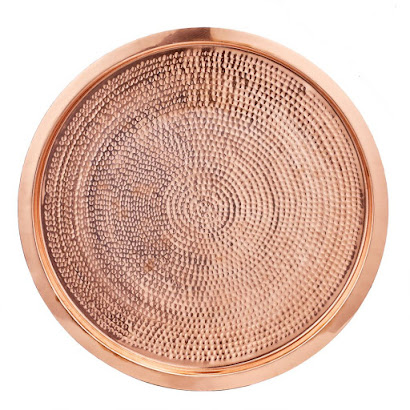
3. Like hammers, chisels and punches come in a variety of sizes. They belong to a group of tools called “gravers” which are used to engrave metal. Engravings can range from basic to extremely intricate designs. As you can see from these pictures, various methods of engraving were used on these pieces. A variety of chisels and techniques were used to create the design in the center of the first tray, which you can find on this website for antique sellers and buyers. A punch was used to create the decorative holes around the edge. Punches could either punch completely through the metal, as it did with this piece, or it could be used to create indentations, as in the second piece below, which is found at Home Depot
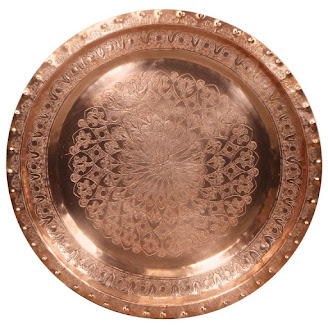


     4. Before these were made, however, mined copper had to be purified and rolled into plates or sheets. You probably know that Paul Revere, who is most noted for his brave ride into Lexington to warn John Hancock and Samuel Adams of a British invasion, was a silversmith. He taught his sons the trade and employed several journeymen. He also printed (engraved) money for the new republic after the war. One lesser known fact about him, however, is that he later started the first copper-rolling mill in the U.S. as well a foundry. The copper he rolled was then used to plate the bottoms of ships. According to paulreverehouse.org, he firmly believed that copper sheeting should not have to be imported, and his endeavors added much-needed strength to the economy of his fledgling new country.


5. A blacksmith often employed a “striker” whose job it was to strike a piece of metal that the blacksmith was holding in the exact spot that the blacksmith indicated by tapping lightly with his own hammer there. These strikers were most often apprentices. 


6. As you might imagine, blacksmiths develop their own rhythms when working. Oftentimes, a blacksmith will hammer a piece of metal for four or five beats and then tap the forge lightly as a way to give his or her arm a short break without losing momentum.


7. Several techniques are used to shape metal, including, but not limited to, drawing out (thinning and elongating it), bending, and upsetting it (pounding on one end of a piece to make it thicker). Swaging, in which metal can be shaped into certain widths and shapes from the swage block, is similar to casting in that regard, but it is done with cold metal rather than pouring hot, molten material into a cast.


8. Historically, armies employed a traveling blacksmith, who used a forge that had been fashioned on wheels. That way, they always had someone on hand who could repair saddles, spurs, guns, and other important equipment.


9. Perhaps the most important object that a blacksmith created was the common nail. It’s something we don’t think about these days, with the convenience we have of going to the hardware store to pick up a box of nails, but one hundred years ago, nearly everything was made locally, including nails. A small section of an iron rod was drawn out and then tapered at the end. The blacksmith then cut almost all the way through the piece with his hardie before twisting the piece off completely with a vise. A nail header was then used to thread the almost completed nail into before the blacksmith could pound the end of the nail to finish it off.


10. As you might imagine, female blacksmiths were rare one hundred years ago. According to workingtheflame.com, two noteworthy female blacksmiths were Elizabeth Bennett (not the one you’re thinking of, but just imagine if she had been one, hehe) and Betsy Hager. The most common reasons for a woman to pursue blacksmithing was either because she was trained by her father or she needed to continue working her husband’s forge after he died.


Even with just these ten facts about blacksmithing, it is such a wide and interesting subject! Understandably, I felt quite overwhelmed with the idea of writing a story with not one blacksmith in it, but three: Jake, my male protagonist, who was taught the trade by Alexandra Carter’s father, Oscar; Oscar himself; and, interestingly (I hope for readers), Alexandra. As part of my research, I, along with my daughter, also visited a local farrier and we were able to ask him several questions as he was shoeing his horse. It was a really cool experience! In addition, I stumbled across this wonderful poem by famous poet Henry Wadsworth Longfellow, entitled “The Village Blacksmith”, parts of which I included in my story since it’s found in the public domain.

Under a spreading chestnut-tree
⁠The village smithy stands;
The smith, a mighty man is he,
With large and sinewy hands,
And the muscles of his brawny arms
Are strong as iron bands.

His hair is crisp, and black, and long;
His face is like the tan;
His brow is wet with honest sweat,
He earns whate'er he can,
And looks the whole world in the face,
For he owes not any man.

Week in, week out, from morn till night,
You can hear his bellows blow;
You can hear him swing his heavy sledge,
With measured beat and slow,
Like a sexton ringing the village bell,
When the evening sun is low.

And children coming home from school
Look in at the open door;
They love to see the flaming forge,
And hear the bellows roar,
And catch the burning sparks that fly
Like chaff from a threshing-floor.

He goes on Sunday to the church,
And sits among his boys;
He hears the parson pray and preach,
He hears his daughter's voice
Singing in the village choir,
And it makes his heart rejoice.

It sounds to him like her mother's voice
Singing in Paradise!
He needs must think of her once more,
How in the grave she lies;
And with his hard, rough hand he wipes
A tear out of his eyes.

Toiling,—rejoicing,—sorrowing,
Onward through life he goes;
Each morning sees some task begin,
Each evening sees it close;
Something attempted, something done,
Has earned a night's repose.

Thanks, thanks to thee, my worthy friend,
For the lesson thou hast taught!
Thus at the flaming forge of life
Our fortunes must be wrought;
Thus on its sounding anvil shaped
Each burning deed and thought.


In Her Only Hope, when Jake left Oscar’s employ to work as a blacksmith on his own in a different town, Oscar decided to train Alexandra as he still needed an assistant. After Oscar is murdered by a man seeking revenge on his estranged son, Alexandra must find Jake. She knows the killer is after her, so she disguises herself as a man and goes to the Carters’ last known location for Jake, Hope Hollow. There she discovers that he’s been in a serious accident and that both of his wrists are broken. He needs a temporary assistant. Provident timing, right? Except that Jake is irritated by the fact that he’s in this position and needs her help. What’s a girl to do?
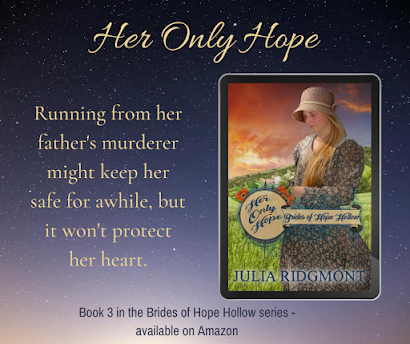


Find out in my book, Her Only Hope, which releases today! I’m really excited that this book is finally available for readers. Its original release date was postponed due to the world situation we find ourselves in and it was good to finally revisit this wonderful town and its interesting characters! I hope you will enjoy visiting there again as well.