Showing posts with label Old West. Show all posts

Monday, August 8, 2022

DID PIONEERS WEAR UNDERWEAR? by Cora Leland

 DID PIONEERS WEAR UNDERWEAR? Fashion in the Old West by Cora Leland

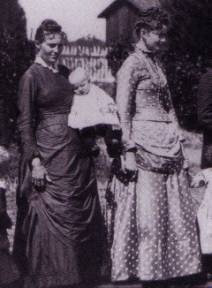
    The short answer is yes. Both women and men wore underwear, though on a wagon train, not pajamas. Throughout the nineteenth century, women dressed in layers: the minimum would have been a chemise (a kind of slip), a short or longer corset, a corset cover, petticoats and an overskirt.
  
    In the West, this was reduced, for women in the rural areas, to chemise, petticoats and overdress, and sometimes a corset;  but in 'civilization,' it was a different matter altogether. In the photo, it's hard to say where the models lived.

    People who dressed 'fashionably' followed a wild pace of changes as to what constituted the latest look.

The pointed bodice (with guns)
Also notice the tight sleeves.  

Toward the close of the 1880's sleeves became looser.

Quite a bit more comfortable!

    Various designs of a well-dressed woman's skirts were a cutaway skirt, a lifted top skirt (swooped skirt) and several others. Formal dresses could have more revealing necklines, but the rule for most women was a high, tight collar; as the century progressed, collars became still higher.

A cutaway skirt


Swooped skirts

Alas, the bustle's importance emerged, then disappeared throughout the 1800's.  Here is one medium-sized bustle (1880) for those times, when bustles were much smaller.  Also, please notice her hairstyle: a gentle upswept style. 

A bustle but a softer hair style (1880)

    Although women were still expected to have very long hair, it was seldom worn down. When it was it was for art or illustrations.  Girls were taught to wear their hair up when they were no older than eleven.  The following hairstyles don't look as easy-going as the one with the bustle. Bangs were popular; late in the 1800's bangs were parted in the middle.


    Also during the 1800's, hats were important.
 

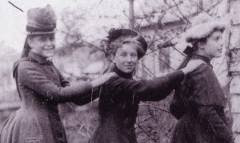
Even a riding habit (left) had a matching hat (and the ladies on each side wore their hair down)

Toward the end of the century, the tall felt hat appeared for women.

    But for pioneer women and women settlers and on wagon trains, hats were much simpler, if their lives dictated that:  bonnets were pragmatic, for shading eyes and face from the blistering sun.  Their frames were constructed from wood or wire.

    And here we've come to the topic of dust. 

Lots of dust in this logging town

    A young woman who journeyed across the country cried out, as probably many others did as they trekked and rode in wagons on tracks that were ankle-deep in dust, "Oh, the dust, the dust! ... it was knee-deep in places. We came twenty miles without stopping.. the boys' faces were covered with all the dust...and I saw just the eyes, nose and mouth through the dust...How glad we all are to have clear cold water to wash away the dust."

    One woman cried when she reached the end of her ten-day trip that she never enjoyed a bath so much as she did then. 
 
    Others complained that in this dusty world, their sun bonnets were useless for keeping them safe. As happy as the traveler was about the clear cold water, authorities seem to be unanimous that bathing and even hand-washing didn't become accepted until the turn of the century.  

    From the Sun King Louis XIV to a San Francisco card-sharp, bathing was avoided for several reasons, including the ideas that bathing opened the skin to disease and underclothes made the body hygienic by absorbing perspiration and dirt.  (Men often wore long underwear.) 

    People were, when they could afford it, careful of their outer garments: shirts, for example, which had high, tight collars among the fashionable.  For everyone, body odor was considered perfectly normal.

    Writing about cleanliness among plains residents, one authority stated that homesteaders grew so poor that they had one set of clothes at a time and simply never changed them until they'd become so ragged that the garments fell to pieces.  

    This expert claimed that deciding to come West was dangerous for one's health: no sewers, outhouses (until laws passed by towns) tipped to drain into the streets, mud streets with horses, no refrigeration and a poor, grease-laden diet --  and more.  He did mention that Omaha, Nebraska, though no different from other places, was the healthiest city in the US.

    Regarding soap:  cowboys had been exposed to Mexican soap, which was made from a part of the yucca.  That soap was gentle and sweet-smelling.  Settlers, however, made soap and candles from animal fat, which was harsh and strong of scent.


                                        Please notice the mud!

Deadwood, Dakota Territory, 1800's

    In any case, it's difficult not to be sympathetic when people lived in these conditions.

    As you'd think, people going across country in wagon trains simply had no place to store more than three pieces of clothing for each person.  They carried food and all supplies they'd need for months, some water, any furniture or possessions they'd need for setting up their new lives.

  Even in those days, then, ladies sewed the family's clothes, for some, even their husband's shirts, and often they had to do without sewing machines. Some fabrics were imported from India, like cottons, so pioneers were accustomed to wear simpler fabrics. A popular one was linsey-woolsey. Laura Ingalls Wilder wrote in detail about a dress her heroine made of several yards cashmere, tucked and decorated.

    Native Americans (known in those days simply as 'Indians') dressed in clothes hand-designed and sewed by women of the particular tribe they were born to and each traibe's designs varied. 

     Below is one drawing (by the Oglala holy man Black Road in 1880) titled 'Woman in a Red Wool Dress with Tepee."  Next is a contemporary set of tribal 'dolls' showing the traditional clothes of the artist's tribe, including a parfleche (buffalo hide bag) and baby carrier.


Native American 'dolls' wearing traditional clothes


Wednesday, January 12, 2022

A Few Western Terms by Bea Tifton

Not too far from me is one of the greatest places on earth. It’s a big used (and some new) bookstore just perfect for finding interesting books. It’s a great way to find specific books, but my favorite thing is just to wander. Upon one recent expedition, I found something perfect for a book/word nerd. The Dictionary of the American West by Will Blevins can provide you with many useful terms to fit in if you are magically teleported to the Old West or if you just want to learn and use a few more colorful phrases. Some of  the definitions in the book are for more modern cowboys, as well. 

Here’s a sampling to get you started: 


Back East: The reverse of out West. For some, it had the implication of being ‘back in civilization.’ For others, it meant “back where everything is messed up.’ 

Belly Gun: A short-barreled pistol stuck naked into the waistband of your pants instead of holstered

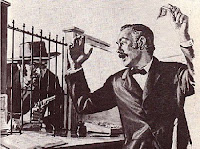
Cash in His Six-Shooter: What an outlaw was said to do when he used his pistol to withdraw money from a bank 


Hen Fruit: A logger’s name for eggs 


Last Roundup: Death

Leaky Mouth: Someone who is too talkative

Like Getting Money from Home: Easy and pleasant

Mail-Order Cowboy: A tenderfoot decked out too fancily in what he hopes is cowboy clothing

On the Dodge: On the run from the law

Pie Buggy: A wagon sent to town for supplies 


Rust the Boiler: To drink alkali water 

There’s a One-Eyed Man in the Game: someone is cheating at poker 


Whomper-jawed: a sideways, crooked, or roundabout way 


So put on your bat wings (chaps), saddle your horse,  and go out and use a few new expressions today. 


Sunday, November 28, 2021

FEW PROSPECTS FOR WOMEN IN THE OLD WEST

 We often romanticize the Old West, or any era of time, even though we know living in a certain day and age wasn't anywhere as glamorous as we want to believe. Why is that, I wonder? Because sometimes we need a break from our own reality? Or is it a "grass is greener on the other side" kind of thing?


I'll leave the philosophizing to you, but one I know for sure - for a woman, living in the 1800s wasn't nearly as wonderful as we kid ourselves into thinking. First and foremost, women had few choices. They couldn't own property except in special circumstances like homesteading, etc., they couldn't vote, sometimes they had their fathers arrange marriages for them to a man not of their choosing, and then once they did marry, their work pile doubled, then quickly quadrupled when babies came along, as they inevitably did.


That isn't to say this way of life wasn't a welcome one. The women were used to these situations, and being the nurturers that God made them, they found joy in starting families of their own and caring for their loved ones. But because of the societal rules of the day, women who didn't find husbands right away were faced with bleak futures. Yes, there were exceptions such as suffragettes, or women who decided to pursue academic interests, but most single young ladies during this time were quickly labeled as "spinsters" if the men of their station didn't show an interest in them. And if a single woman's father died, her care fell on the her brother's shoulders until she found a husband. Of course, other less favorable scenarios existed, but I don't like to think of those.


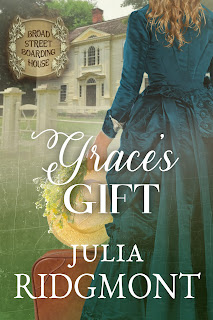
The heroine in a sweet romance I'm writing in the Broad Street Boarding House multi-author series is faced with such a dilemma. In Grace's Gift, Grace Lancaster's parents have left her older brother, Howard, to finish raising her after they die from illness. Grace loves her brother and appreciates what he's done for her, but living with him and caring for him, cooking and cleaning, etc., have become routine. She doesn't even realize that it is time for her to think beyond the little house they live in, or consider the possibility that Howard might want to find a bride of his own--until she accidentally interrupts a bit of courting Howard and a woman in town are engaging in.


That's when Grace decides to find a husband for herself. Which leads her to Denver, Colorado, where spinster sisters Sophia and Sybil Cartwright own a boarding house. (Their father, first a sea captain and then an entrepreneur in the West, left them enough money when he died for them to start a business venture of their own.) It isn't just any boarding house, however. It's rumored that females who stay in the Cartwright sisters' establishment (there are no male boarders allowed) become brides, usually to a man who is staying at the Palmers' boarding house next door. Many a couple have courted at the gate that connects the two lots. Grace, however, won't find her husband at the Palmers' establishment. Her future husband is hiding in the shadows of his more flamboyant cousin--the man whom Grace has already agreed to marry.


Grace's Gift releases on January 11, 2022. I'm enjoying writing this story so much! The characters are fun, and there's a fair amount of intrigue on the part of Grace's betrothed, Phineas Northcott. Can Ephraim Kempton help Grace to see the truth about Phineas before it's too late, or will she resent him interfering in what should be the happiest event in her life?


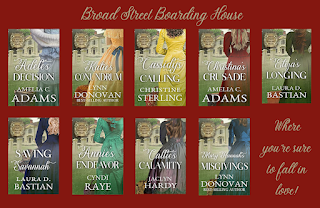
Although this book isn't available as a pre-order, I'd like to invite you to take a look at the other books in this series. Here is the series link, and two more books, Callie's Calamity and Mary Hannah's Misgivings, released yesterday. I'm grateful to have been asked to contribute to this wonderful series and be able to work with such talented authors!


Tuesday, February 16, 2021

Valentine's Day in the 1800s by Jo-Ann Roberts


Valentine's Day, also called St. Valentine's Day or the Feast of St. Valentine, is celebrated annually on February 14th. It originated as a Western Christian feast day honoring one or two early Christian martyrs named St. Valentine and is recognized as a significant cultural, religious, and commercial celebration of romance and love in many regions of the world.


Formal messages or valentines, appeared in the 1500s, and by the late 1700s commercially printed cards were being used. The first commercial valentines in the United States were printed in the mid-1800s. Valentines commonly depict Cupid, the Roman god of love, along with hearts, traditionally the seat of emotion. Because it was thought that the bird mating season begins in mid-February, birds also became a symbol of the day.

By the 1840s, the notion of Valentine’s Day as a holiday to celebrate romantic love had taken over most of the English-speaking world. The Victorians adored the notion of courtly love and showered each other with cards and gifts. Into this love-crazed fray came Richard Cadbury, scion of a British chocolate manufacturing family.

Cadbury used to produce many more varieties of what was then called “eating chocolate.” Richard recognized a great marketing opportunity for the new chocolates and started selling them in beautifully decorated boxes that he himself designed.

Cadbury marketed the boxes as having a dual purpose: When the chocolates had all been eaten, the box itself was so pretty that it could be used again and again to store mementos, from locks of hair to love letters.


Valentine cards have been a popular way to send affectionate greetings for many years. These examples date from the Civil War.

The switch from handmade to manufactured Valentine's cards began during the 1840s. By the start of the Civil War in 1861, many manufacturers were marketing the cards to soldiers far away from their loved ones.         

Once the war was over and the disillusioned soldiers left their war-torn homes for a new life in the West, many were determined to marry and raise families.  One obstacle stood in their way…the lack of females!

If a man was lucky enough to have a wife or sweetheart in the far reaches of the frontier, he needed to come up with a plan how to woo them…especially on Valentine’s Day.

Enter the railroads. By 1869, the transcontinental railroad had laid track to the west from the rest of the country.  Those men who could have afforded trinkets, books of poetry, tins of candy, a piece of jewelry, or toilet water needed only to order them through the local mercantile, if the items weren’t already stocked on their shelves.

Knowing ladies liked lace and ribbons, the suitor could easily fashion a handmade greeting card.


By the last decade of the 1800s, access to a mail-order catalog (Sears & Roebucks, Montgomery Ward, and Eaton’s in Canada) offered jewelry, hat-pins, parasols, and rings to the man who had hard cash and the desire to impress his lady.


However, in lieu of tangible gifts, the suitor might present his lady with something of himself. A carefully handwritten love letter in his best penmanship was a gift many a lady would highly cherish.         


Carving out a life in the West, many men acquired skills which came in handy when crafting a gift for his intended. Whether it was a hand-tooled leather sewing box,  a wooden blanket chest, or a poem of his own creation, men in the West were determined to show their affection on Valentine’s Day by manufacturing something hewed by his own hands.


Today, Valentine’s Day celebrations are as varied and creative (in the Covid-19 world!) as the people planning them.  But in 1873, this advertisement in the Matrimonial Times actually occurred in San Francisco. What woman could resist an invitation so eloquently stated!!!   

“Any gal that got a bed, calico dress, coffee pot and skillet, knows how to cut out britches and can make a hunting shirt, knows how to take care of children can have my services till death do us part.”       

Wednesday, December 16, 2020

QUILTING THE PAST- Part Two by Jo-Ann Roberts


QUILTING THE PAST- Part Two by Jo-Ann Roberts

“Our lives are like quilts, bits and pieces, joy and sorrows stitched with love."

“The best kind of sleep beneath Heaven above, is under a quilt, handmade with love.”

The first known quilt pattern published in an American periodical was the honeycomb or hexagon pattern published by the Godey’s Lady’s Book in 1835. While we know that some early periodicals like Godey’s, featured patterns for quilt making they seldom gave names to these patterns .

In the 1850’s Godey’s continued to publish quilt patterns for American quilt makers with a series of numbered but unnamed quilt patterns. Other mid-century periodicals published patterns occasionally, and references to quilts and patterns appeared with increased  frequency with the popularity of the periodical.


Quilt pattern names reflected all aspects of life on the trail West.  While Biblical names reflected the belief and conviction of the importance of a spiritual life so valued as the pioneers walked and rode into an unknown land, more down to earth names like Hole in the Barn Door, Broken Dishes, Cake Stand, Basket, Baby Blocks, Rail Fence, Churn Dash, and Log Cabin echoed the environment that the quilt maker lived in.

    
                                          Log Cabin                       Hole in the Barn Door
 

Quilt pattern names that reflected patriotic emotions and political views are proof that women were interested in these issues, and that they were knowledgeable of current social events. While their voices may not have been heard at the time, their words speak out from their work and remain for us to see today.  Abe Lincoln’s Log Cabin, Railroad Crossing, President’s Wreath,  Martha Washington Star, Fifty-Four Forty or Fight were popular choices.


Martha Washington Star 


But by far, the patterns created  from what pioneers saw, heard and experienced on the trek to their new homes are still some of the most popular quilts today. 

The Crazy Quilt

The Crazy Quilt is one of the oldest quilt patterns. Early quilters used an scrap, regardless of its color, design, or fabric type. Children’s worn clothing, women’s calico dresses, men’s canvas pants and coarse shirts, and household linens were cut, fitted and stitched together, resulting in a hodgepodge of color as well as a story behind each scrap.


The Road to California


The discovery of gold at Sutter’s mill, near Sacramento, triggered the great migration westward in 1849. Soon it was not just men but families on the road to California. Many of the Road to California patterns involve triangles. Many patterns created during the trek used triangles to represent the flight of birds and their movement. The Flying Geese pattern involved a series of triangles going in the same direction representing the migration of geese. So, it’s not surprising the triangles were used to represent the migration of pioneers as well. Sometimes  the pattern is known as Road to California or at other times The Underground Railroad or Jacob’s Ladder.


The Rose of Sharon


It was no secret that the trip west would be filled with danger.  Holding on to their faith and devotion to The Lord was, in many cases, all that kept them going. A quilt made with blocks named from the Bible would be a source of comfort.

One of the oldest applique quilt patterns is the Rose of Sharon. The Rose of Sharon, mentioned in the Bible, might actually refer to a wild tulip that grows today on the plains of Sharon in Palestine. When the Bible was translated into English, the word rose was used in place of the word tulip.

During the 1800s, there was a custom for a young girl to make a baker's dozen of quilt tops before she became engaged. This collection consisted of 12 utility quilts, and one great quilt, which was pieced or appliqued, as a show piece for a bed. The Rose of Sharon was often used for the great quilt. Many young women traveled West as brides, their great quilt folded safely in a trunk.

Many times the quilt maker deliberately sewed a mistake somewhere in the quilt. It is thought, by some, that this reflected the maker's faith in God; for only God can make a perfect thing.

The Schoolhouse Quilt 

In many cases, settlers went West for a better life, and part of that better life was education. It was natural then, that the schoolhouse was often one of the first public buildings constructed in many communities.  

The Schoolhouse block was often a variation of a house or church pattern. Most featured a side view of the building and were either pieced or appliqued. Depending on the skill of the quilter and time available to her, crosses in the windowpanes and outlines of the doors could be added. 


Anvil

Not only did quilts reflect the daily work of the women who helped to homestead the prairie, they told the story of the challenging work of the men.

The Anvil pattern represented one of the necessary and important activities of the early settlers-blacksmithing.


By 1890, catalogue sales included quilt patterns. If a woman ordered her yard goods from Sears or Wards, she could purchase any of 800 designs for just a dime.

The Friendship Quilt


The quilts the homesteaders brought with them were a comfort to these women who traded their home, family and friends in the East, for the uncertainty of traveling through vast prairies in the West. A quilt that held special value to the pioneer women was the Friendship Quilt.

Putting a Friendship quilt on the bed, gave a woman a sense of connection with her former way of life. It kept alive the memory of family and friends, providing comfort and company during the difficult days of homesteading.

One woman homesteader said, "When I get lonely, I read the names on my quilt. "

Through the years, quilts have become documents of history. They are the products of their society, influenced by the culture, and the environment of the people who made them. The history of America can be seen in the history of quilts. Stitched into these quilts is the rich heritage of thrifty self-sufficient women who helped homestead the land, the history of families sewn into quilts one patch or one stitch at a time, and the legacy of the art of quilting, passed on from generation to generation.


​Sources:

Barbara Brackman, “Encyclopedia of Pieced Quilt Pattern Names,” 1993. American Quilters Society.

Barbara Brackman, “Encyclopedia of Applique,” 1993, EPM Publications, Inc.

Maggie Malone, "5,500 Quilt Block Designs", 2003, Sterling Publishing Co. Inc. 

Jenny Beyer, "The Quilter's Album of Patchwork Patterns," 2009, Breckling Press.

Judy Rehmel, “The Quilt I.D. Book,”  1986, Prentice Hall Books. 
​
Yvonne M. Khin, “The Collector’s Dictionary of Quilt Names and Patterns,” 1980, Portland House.

Cross, Mary Bywater, Treasures in The Trunk, Rutledge Hill Press, 1993

Dallas, Sandra, Simonds, Nanette, The Quilt That Walked to Golden, Breckling Press, 2004

Ferrero,Pat, Hearts and Hands, The Influence of Women and Quilts on American Society, The Quilt Digest Press, 1987.

Finley, Ruth E., Old Patchwork Quilts and The Women Who Made Them, Charles T.Branford Company, 1929.

Martin, Nancy J., Pieces of the Past, That Patchwork Place, Inc., 1986.

Regan, Jennifer, American Quilts: A Sampler of Quilts and Their Stories, Gallery Books, 1989


Thursday, November 12, 2020

The Doss Heritage and Culture Center by Bea Tifton

 The town of Weatherford, Texas, is located in Parker County, Texas. Parker County was created in 1855 and named for the pioneer Isaac Parker, who was the uncle of Cynthia Ann Parker, the woman famous for being stolen by the Comanches and eventually becoming the mother of Comanche Chief Quanah Parker.  Weatherford was named for the Texas state senator Thomas Jefferson Weatherford (1811-1867). Weatherford is located 30 miles west of the city of Fort Worth. It's in West Texas and is still ranching and cattle country, rich with the history of cowboys and ranching. 

The Doss Heritage and Culture Center's website reads that it is a "Texas and Parker County History museum dedicated to bringing history to life for all generations to experience and enjoy."  Three years ago, my friends and I did just that. 

The first exhibit is the original chuckwagon, created in 1866 by legendary cattleman Charles Goodnight. I've heard of chuckwagons and seen pictures, but it was fascinating to see the first one.


The museum has a covered wagon. What struck me is that it wasn't as big as I had would have thought. Just imagine having to pack all your worldly goods in this vehicle to ride across an undeveloped country to a fierce, new land.

 In addition to the covered wagon, there's a reproduction of a stagecoach with an exhibit board that includes a video showing the process by which the man built it and some samples of the things he used. I love museums that have videos and I never fail to punch any available buttons. 


My favorite exhibit is Gracie, an almost complete 6,000 year old baby bison skeleton, unearthed when Weatherford residents were adding a water line for their cattle pen. Fortunately, they contacted experts at the University of North Texas who did a careful excavation. The archeologists also found some rudimentary tools and a fire pit. Seeing the actual skeleton was a heady experience for me as I am very interested in paleontology and archeology.

Museums with interactive displays have a special place in my heart. The Doss Heritage didn't disappoint with one room full of things for children with which to play and explore. Oh, and it's also open to those who are young at heart, like my friend Terri. 


The Doss is a treasure for Weatherford, Parker County, and Texas and would be appreciated by anyone who loves western history. It has educational programs and revolving exhibits as well as the interesting regular exhibits I've highlighted. Since I've been, the museum has relocated five cabins that were located in various places in Parker County, so I'll have to go back. Admission is free, but donations are always appreciated (and needed!). If you're ever in the Weatherford area, stop by the museum and spend an enjoyable few hours reliving the history of the Old West.


For more information, visit the website: http://dosscenter.org/home/about/

Sunday, June 16, 2019

Ice Cream and a recipe by Kaye Spencer #sweetheartsofthewest #icecream


Ice cream and summertime go together like kids and puppies.


'Cute Puppies' courtesy openclipart.com


According to this Wikipedia article (https://en.wikipedia.org/wiki/Ice_cream), ice cream showed up in the Archaemenid Empire around 500 BCE. The Persians came up with their version of ice cream as a chilled concoction of rose water and vermicelli (for royalty). Ancient Greeks ate snow mixed with honey and fruit. Frozen milk and rice was the sweet treat in China. The Roman Emperor Nero ordered ice from the mountains brought to him and he ate it with fruit toppings. From there, ice cream became a popular dessert of the European aristocracy, including Catherine de' Medici and Charles 1 of England.

Ice cream recipes became increasingly popular in England in the 18th century. This is a recipe for making ice cream that was published in 'Mrs. Mary Eales's Receipt' (London, 1718)

Take Tin Ice-Pots, fill them with any Sort of Cream you like, either plain or sweeten’d, or Fruit in it; shut your Pots very close; to six Pots you must allow eighteen or twenty Pound of Ice, breaking the Ice very small; there will be some great Pieces, which lay at the Bottom and Top: You must have a Pail, and lay some Straw at the Bottom; then lay in your Ice, and put in amongst it a Pound of Bay-Salt; set in your Pots of Cream, and lay Ice and Salt between every Pot, that they may not touch; but the Ice must lie round them on every Side; lay a good deal of Ice on the Top, cover the Pail with Straw, set it in a Cellar where no Sun or Light comes, it will be froze in four Hours, but it may stand longer; then take it out just as you use it; hold it in your Hand and it will slip out. When you wou’d freeze any Sort of Fruit, either Cherries, Raspberries, Currants, or Strawberries, fill your Tin-Pots with the Fruit, but as hollow as you can; put to them Lemmonade, made with Spring-Water and Lemmon-Juice sweeten’d; put enough in the Pots to make the Fruit hang together, and put them in Ice as you do Cream.

Quaker colonist who 'introduced ice cream to America'...Confectioners sold ice cream at their shops in New York... Ben Franklin, George Washington, and Thomas Jefferson were known to have regularly eaten and served ice cream."

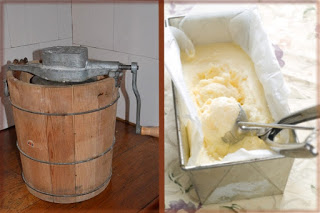
Ice cream's popularity moved westward with the settling of the West. We're probably all familiar with the stories, television shows, movies set in the Old West era that included a church social scene with the men standing around the hand-crank ice cream machine and children hovering nearby, anticipating filling their bowls with the cold treat on a hot summer day.

Nellie Oleson (screen capture - Kaye Spencer)


In my novelette A PERMANENT WOMAN, the community celebrates Colorado Day (August 1st) with games, a parade, and tables and tables of food. And what summer celebration would be complete without homemade ice cream?

images via creative commons


Here is my hand-me-down family recipe for homemade ice cream that I like to think could have been the exact recipe someone at that celebration used. *wink*


Click to enlarge - also available on my Pinterest board


For more of my Hand-Me-Down Family Recipes, click here >
PINTEREST

Until next time,
Kaye Spencer


I don't send a newsletter, consider staying in touch with me on these venues: