Showing posts with label women's suffrage. Show all posts

Tuesday, January 24, 2023

WHO CARES ABOUT WOMEN VOTING: Colorado in 1893 by Marisa Masterson

 Women in Wyoming already had the vote. The ladies in Colorado wanted their state to be the next to gain that right. 


They'd tried in 1890 and been disappointed. Men voted not to allow women that right. After all, it was a short step from granting them the right to vote and the ladies using it to outlaw alcohol. Many men saw women's suffrage and the Temperance Movement as hand in hand.


The defeat in 1890 was such a disappointment that many of the national suffrage organizations didn't come to Colorado in 1893 to help rally people to the cause. Truly, this was a grassroots effort with local chapters champaigning hard for the female vote.

In fact this is where my hero and heroine first meet, at a local suffrage rally in Sylvia's Secret.

Scooting to the middle of the row, Sylvia worked to slow her ragged breathing. As she lifted the netting, nervous fingers made sure her glasses were still in place. Not that she needed them. No, they were only a part of her disguise, as was the tight bun that pulled at the skin of her face to give her a pinched look.

Women on each side of her flashed welcoming smiles before returning their attention to the speaker. Needing to blend in, Sylvia did the same. She expected to hear about foreign missions. That was a common topic for ladies’ meetings.

The speaker’s voice rose as she raised one fist. “Tyranny does not belong in our democracy. Women are as much a part of ‘We the People’ as are men. Those first words that begin the Constitution guarantee that we are members of this democracy.”

Sylvia nearly gasped. She raised a hand to her lips and coughed to cover it. Oh, she’d done it now. She was surrounded by suffragettes! If her father had discovered her secret in China Alley, she’d planned to argue that at least she hadn’t joined the suffragist movement. He hated that more than he despised the Chinese.

At that moment, the speaker spoke that very word. Chinese. “So, we fight not simply for the right to make our own future, but also for the Chinese women’s rights.”

That was a new thought for Sylvia. Her father and aunt both ranted about the unnatural suffragettes. “The Good Book’s already told us where woman belongs. In the home, that’s where,” her aunt had growled out more than once.

Try as she might, Sylvia couldn’t remember a bible verse that said this. Each time Aunt Clarice made the statement, Sylvia’s father only nodded and growled out, “Want the man to raise the children, they do, so they can run the government.”

In the end, it was almost a non-issue, sadly. The vote turn out was low. This meant that there was an edge for those who truly cared and wanted to see their wives, mothers, and daughters gain their democatic right to vote. Because of the low turn out at the polls, Colorado became the second state to give women the vote.
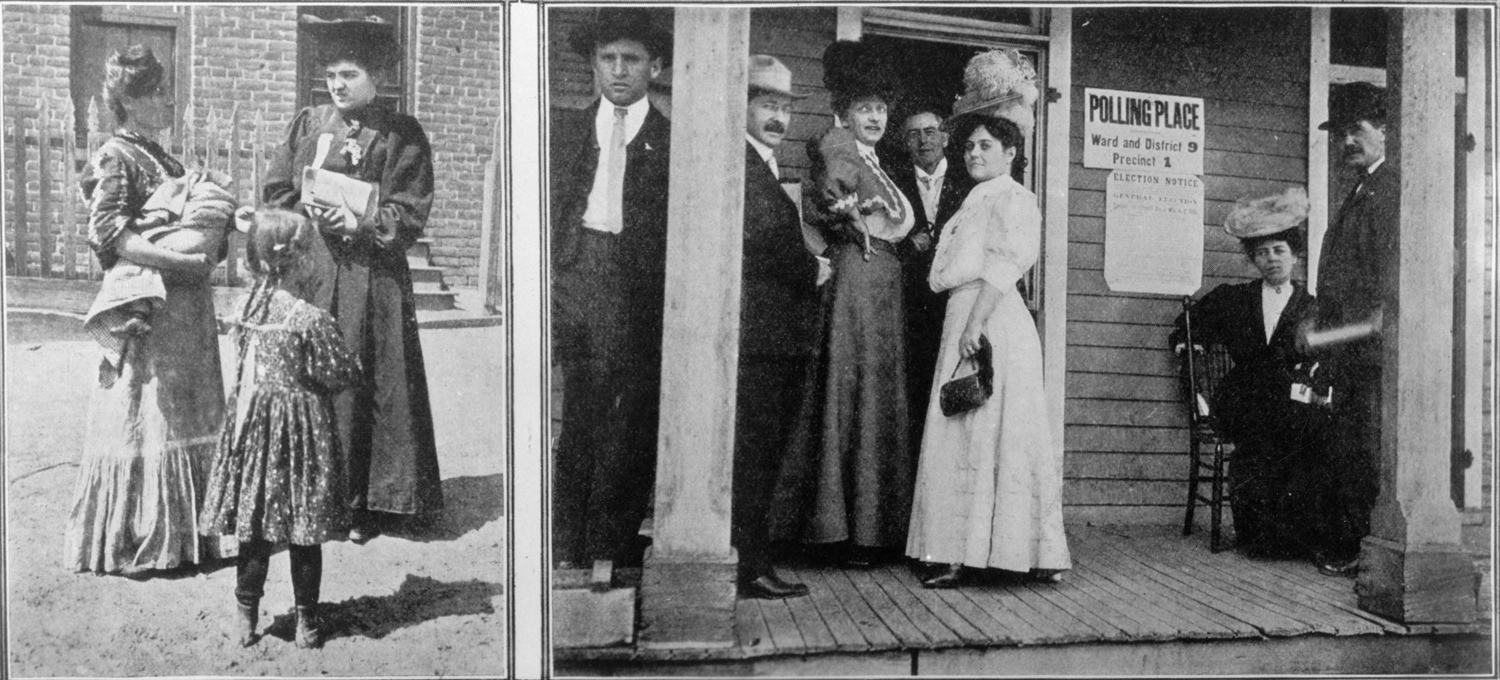
Men and women outside a polling station in Colorado, 1893.

Here's how I celebrate that historical win in my novel:

“It passed! The referendum is law!”

Lydia Frasier waved a telegram in one hand and a newspaper in the other. She ran to the head table where her son sat with his wife. If it had been anyone else yelling like that, shocked murmurs might have started. This was Lydia, and the guests at her son’s wedding reception understood.

“Fifty-five percent, Ernie! Take a look!” She handed him the telegram.

He scanned the small paper with a growing grin. Raising his head, Ernest held up a hand. “May I have your attention. Sylvia and I thank you for coming out to celebrate with us. Seems we have more to be thankful for today. Women now have the right to, and I quote, ‘vote in the same manner in all respects as male persons are.’”

Lydia shouted, “It’s official.”

But why such a low turn out? If men really felt strongly about stopping women's suffrage, wouldn't they have come out to the polls? The answer is yes, they would have. By this point, people were apathetic toward the issue. They wouldn't vote for or against. Many seemed to no longer care. 


Colorado Governor Granting Women's Suffrage, 1893.

For further reading, I encourage you to go to https://www.historycolorado.org/story/womens-history/2019/11/07/road-vote. This Colorado source is excellent for retelling the history of suffrage in that state.


Sylvia makes up her mind to no longer be the "good daughter". Not when Chinese children couldn’t attend school. Besides, she's nearly thirty-years-old, already a spinster! She was old enough to make decisions.

Her secret teaching leads her into danger. That danger sends her running for safety. Dodging into a hall to escape her pursuer, she finds that safety at a suffragette meeting.

What an odd place to fall instantly in love! Who would expect to meet a handsome man in a women’s rally?

A quick marriage and threats to her new husband’s life make Sylvia realize that some secrets have to come out into the open.

If you enjoy sweet romance with a historical flavor, then sink into a chair and start reading Sylvia's Secret.

https://www.amazon.com/dp/B0B6D4PQMF

Thursday, April 22, 2021

150 YEARS OF HISTORY?

Post by Doris McCraw

writing as Angela Raines

Photo property of the author

2021 marks the sesquicentennial of Colorado Springs. While most will still not be traveling this year, thanks to the internet, Zoom, and other media outlets, others can join in on some of what is happening. 

Besides sharing various stories from the city's history, I am sharing some links to information you might be interested in. 

The town itself was set up as a resort town. Its founders envisioned a place where those from the East and Europe to come and enjoy the clean air and the plethora of natural beauty. The additional benefit they found; the clear air also helped those show suffered from consumption. Note, that consumption during this time was considered any wasting disease which included tuberculous, asthma, cancer among others. For that reason, the area was a magnet for doctors who not only were searching for a cure for themselves but for others also.

Photo property of the author

When you think about it, the kind of people it takes to create a new town, especially one of this type, they had to believe and dream big. 

Here are a few links that you may find interesting concerning this rich history.

The history through quilts: https://youtu.be/6VhV12vzzUs

Holiday Baking at Rock Ledge Ranch: https://youtu.be/BrGiMsmtJcQ

Horsing Around Rock Ledge Ranch: https://youtu.be/2fgN98qAnEM

Women's Suffrage, Jail is not a Pleasant Experience: https://youtu.be/teyM_0CeAUo

History on the Go: https://mobile.cspmstoryofus.com/

Photo property of the author

I hope you all enjoy some of the local histories and find them useful.


Until next time and I share more history. 


Doris Gardner-McCraw -
Author, Speaker, Historian-specializing in
Colorado and Women's History
Western Writers of America,
Colorado Author League,
Women Writing the West
Angela Raines - author: Telling Stories Where Love & History Meet

Post (c) Doris McCraw


Sunday, March 22, 2020

WOMEN DOCTORS & SUFFRAGE

Post by Doris McCraw
writing as Angela Raines

There is a lot in 2020 that reflects back in the history of this country and additionally, March is National Women's History Month. One hundred years ago, women across the country were given back the right to vote. Research from another source pointed out that when the country first started women were included in the voting process, but as time and development occurred, that inclusion was slowly eroded away.

This post will focus on Colorado and three of the women doctors who not only practiced medicine but also put time and effort into winning women the right to vote.

Alida Avery- Born 1833 in Sherburne, NewYork, began teaching school at sixteen. At the age of twenty-four, she began studying to become a physician. She was on the original staff at Vassar, where she taught physiology & hygiene along with being the resident physician. It was said in the nine years she was at the college she did not lose one student to illness. In 1874 at the age of forty, she moved to Denver where she set up a private practice. There is some indication she made around $10,000 a year. While in Denver, in addition to her medical duties, she also was active in working for women's suffrage. Newspaper articles of the time show her as president of the movement and in that capacity, she traveled. After retiring in 1887 at the age of fifty-four, she retired to California and increased her work on behalf of the movement.

Alida Avery.jpg
Dr. Alida Avery
photo from Wikipedia
Mary Helen Barker Bates - Born 1845 in Hannibal, New York, the daughter of Dr. Ezra Barker. She graduated from medical school in 1873 and spent time in Utah, where family history says she was a physician to Brigham Young's family. In 1878 she and her husband, attorney George Bates moved to Leadville, Colorado where she was probably the only woman doctor in the town at that time. In 1881 the couple moved to Denver, Colorado where Dr. Bates in 1885 joined the staff of the Women's and Children's Hospital in that town. Her husband died in 1886 and she did not remarry. Her career was a stellar one, and in 1893 she along with Dr. Mary Elizabeth Bates worked for the passage of the amendment to the Colorado constitution giving women the right to vote in that state.

Mary Barker Bates.jpg
Dr. Mary Helen Barker Bates
photo from Wikipedia
Dr. Caroline Spencer - Born in 1861 in Philadelphia, Pennsylvania, she taught history after graduation from the Philadelphia Normal School for girls in 1880. She received her medical degree in 1892 and returned to Colorado where she had visited in 1889 in the hopes of helping cure her bronchitis/asthma. She continued her practice of medicine while working for the national campaign for the passage of what became the 19th amendment. During her work on the national level, she was arrested on a least three different occasions. She was one of five women who stood silently during President Wilson's speech to congress in unfurling a banner from the balcony which read "Mr. President, what will you do for women's suffrage?".

Photograph of Caroline E. Spencer
Dr. Caroline Spencer
photo from Wikipedia
From the beginning of the suffrage movement in Colorado through the passage of the 19th amendment to the constitution of the United States, women doctors have been at the forefront of that fight. In this anniversary year let us not forget them. Two were unmarried, one was, yet they felt it important not only to heal the ill but also better the conditions of women and others.

The stories of these women and the focus of a lot of my non-fiction writing also inspire the women who inhabit my novels and short stories. My latest: "The Outlaw's Letter" and the story 'Duty' in the anthology "Hot Western Nights" from Prairie Rose Publications.

Purchase Here

Purchase Here
Doris Gardner-McCraw -
Author, Speaker, Historian-specializing in
Colorado and Women's History
Angela Raines - author: Where Love & History Meet
Angela Raines FaceBook: Click Here

Saturday, February 22, 2020

MAKING LIFE BETTER FOR OTHERS

Post by Doris McCraw
writing as Angela Raines

Photo property of the author

I've been focusing on women who banded together to improve the status of all women in the West and the Country. The year 2020 is the centennial of women receiving the right to vote, but the journey began long before that. For this post, I'll be focusing on Colorado. I hope you enjoy this short exploration.

Image result for alida avery
Dr. Alida Avery
en-wikipedia
Women Doctors were one of the first groups of women in Colorado who not only strove to help the sick but were also involved with the suffrage movement along with the Women's Christian Temperance Union. Even while still a territory, there were discussions about women's suffrage. Dr. Alida Avery left her position as a physician and professor at Vassar College to move to Colorado in 1874. One here, she was involved in the Colorado and National suffrage movement, traveling and speaking on behalf of women. She also was an early proponent of women being a part of the medical association, requesting membership within two years of her arrival.

On a side note, Dr. Quinn, Medicine Woman was a fictional show that may have been based in part on the life of Dr. Susan Anderson and her work in Fraser, Colorado after she moved there in 1907 over thirty years after the first female doctor, who graduated from a medical school, arrived in Colorado.

By 1881, Colorado was licensing physicians, and women were licensed the same as men if they met the state's qualifications. A look at those who were licensed included a number of women.

It was no just women who were pushing for suffrage. Men were also involved. In 1876 the head of the Colorado Medical Society made waves when he advocated that women be included not only in organizations, but they should attend medical schools on an equal basis.

Image result for early women's suffrage photos colorado
1893 Referendum - Colorado
en-wikipedia
By the early 1890s, the women regrouped to finish the push for suffrage in Colorado. One of those who helped in that final effort was Dr. Mary Helen Barker Bates. She arrived in Colorado in 1879-80 with her husband and settled in Leadville where she was the lone female doctor for a brief while. Moving to Denver because of her husband's ill health, Dr. Bates was active not only on behalf of children in the schools, but also working for the right for women to vote and be a part of the voice making policy for all. The effort paid off. In 1893 the state of Colorado was the first state to make women's suffrage a part of the constitution.

I confess to being in awe of these early women and their commitment to making life better for not only themselves but for others. These histories, while not always explicit in my fiction writing, play a big part in the development of my female characters. What are your 'role models' for your characters? I'd love to know.

I confess the first novel I wrote had a female doctor as the heroine. She was fun to write and has a special place in my heart. Below is an excerpt from that book:


Will didn’t know who he was, where he came from, despite being told his name was Will Murphy. All he knew was this doctor, a woman at that, was an irritant. Since the Haneys, father and son, had brought him in, she had been ordering him about. He was tired of lying in bed. His head felt better, and the cuts and scrapes were healing nicely. It was time to get up and get going. Blasted woman, doctor or not, he figured he knew what was best for himself.
He was going to get up out of the bed. Now that his decision was made, Will swung his legs out from under the covers, only to gasp as the doctor walked in.
Will quickly covered himself with the sheet, for no woman should see a man in his altogether.
“What do you think you’re doing?” The soft voice asked. “And don’t be embarrassed, after all, I am a doctor. You have nothing I’ve not seen before,” the voice continued, with a hint of laughter.
That soft voice, so enticing, almost had Will returning to his bed. The doctor’s green eyes were daring him to continue.
Very well, Will thought, I’ll show you. Will continued his journey from the bed. Dropping the sheet, Will moved until his feet touched the floor. With the aid of his arms, Will slowly raised his body up to his feet, precariously balancing on legs that were more feeble than he’d hoped.
Glancing at the doctor, sweat trickling down his nose and cheeks, he braced himself for a scolding, while praying that he could remain upright.
The scolding never came. Instead the doctor, Josie he thought they called her, stood watching him, hands on hips, compressed lips, but with the hint of a smile and admiration in her eyes.
If he believed in love, Will thought, he would fall head over heels right now. That fact that he was wavering probably would have made it a fact, if the good doctor hadn’t spoiled it by asking, “Do you feel better now, or should I help you back into bed before you fall?”
Amazon
Doris Gardner-McCraw -

Author, Speaker, Historian-specializing in
Colorado and Women's History

Angela Raines - author: Where Love & History Meet

Wednesday, January 22, 2020

SO WHAT WILL YOU READ AND WRITE?

Post by Doris McCraw
writing as Angela Raines

Pikes Peak as seen heading East - Photo property of the author
January is moving quickly in this year of 2020. Already it's January 22. Did you make resolutions, a list of intentions or goals? Although I didn't write them down, January has been a month of looking at where I want to go and what I want to do. To that end, I've been working on achieving a least a working list for the year.

1. Write. It seems obvious, but if I don't put it down then it becomes something I can let slide. As I work to finish this year's novel, I've taken to tracking word count. Enough of the story and characters are there to start the real work.

2. Seek out workshops and classes that will help me continue to grow as an author and connect with readers who would enjoy my work. So far, I've done a social media workshop and a writing children's books and website use for name recognition.

3. Make readers aware of the difference between the non-fiction writing I do as Doris McCraw and the fiction as Angela Raines.

4. Read, read, read, read. I've always loved to read, and this year I've decided to continue to study other authors, delve into history with a greater purpose and re-read those books that impacted me as a reader.

5. Enjoy life!

There are probably many additional resolutions, goals or intentions I could add to this list, but I don't believe in overwhelming myself.

In addition, 2020 is a big year for celebrating women's suffrage. Many of the women doctors who came to Colorado were involved in that struggle from Alida Avery who arrived in 1874 after leaving her position at Vassar to establish a medical practice in Denver. Her time here was also spent helping to guide the cause of suffrage. It was in the research of this woman along with Harriet Leonard, Julia E. Loomis, Clara Rowe and Esther B. Holmes that led me to write the character of Josephine Forrester in my first novel, "Josie's Dream". Now the dream is to tell the real story of these amazing women.

Amazon

So as you continue your journey through 2020, what will you read and write?

Please consider offering a testimonial if you have enjoyed my or any other author's work. It is greatly appreciated.


Doris Gardner-McCraw, writing as Angela Raines
Author, Speaker, Historian-specializing in
Colorado and Women's History
Angela Raines - author: Where Love & History Meet
Angela Raines FaceBook: Click Here

Wednesday, May 22, 2019

MAY 14, 18??


Post by Doris McCraw
writing as Angela Raines

USGS photo of early Colorado
For this post I thought it might be interesting to look back over events on May 14 in the history of Colorado.

As you can see, in 1859 as the area was just being settled, the language and sensibilities were flowery and formal, even for a story of horse thieves. It appear this was a problem in the Cherry Creek area.  You will note, they talk about pursuing them to the 'states'. Colorado was still part of many Western territories at this time. It did not become its own territory until February 18, 1861.


Block image
May 14, 1859
Rocky Mountain News Weekly


Photo Property of the Author
For those who don't know Grace Greenwood, she was an author, speaker and traveler on the early days of the Colorado Territory. She, Isabella Bird and Helen (Hunt) Jackson all traveled in the area in the early 1870s. Grace's real name was Sara Jane Lippencott. For a quick overview of her life, here is a link to the Wikipedia page Grace Greenwood  Below is the beginning of an article she wrote about President Grant.

User clipping image
May 14, 1870
Rocky Mountain News


Lest we forget that many came to Colorado for their health. Colorado was one of the states that had a reputation for the curative powers of its climate and mineral waters, both the hot springs and those you drank. Because of that reputation, Colorado from almost the beginning tried to devlope a medical society. The Colorado Medical Society had its beginnings in 1871.

User clipping image
May 14, 1879
Leadville Daily/Evening Chronicle


Of course, most know Colorado was a magnet for women's suffrage. Some of the early female physicians, such as Dr. Alida Avery, came to the region for their chosen profession and to support the cause of women's rights. The article below is from one of the early publications that promoted women's equality.
User clipping image
May 14, 1890
Queen Bee- Denver CO
So May 14, over the early years of Colorado's history is full on interesting facts. In addition it gives us a look at the thoughts, the people and the change in language as more and more people arrived. Sometimes it is good to look back at what was and know that is the foundation of the history we now live.

In my latest novel, "The Outlaw's Letter", I made use of events, and history of Colorado in 1880. It was exciting to have my characters be a part of Colorado's history.

Doris Gardner-McCraw -
Author, Speaker, Historian-specializing in
Colorado and Women's History
Angela Raines - author: Where Love & History Meet
For a list of Angela Raines Books: Here 
Photo and Poem: Click Here 
Angela Raines FaceBook: Click Here

Saturday, June 18, 2016

Esther Morris, First Woman Judge in the United States by Sarah McNeal


Quite naturally, Esther Morris was a judge in the beautiful state of Wyoming back in 1870. But hers is not the story of a female looking to make a name for herself as an advocate for women’s suffrage. Nope, Esther spent 55 years of her life living the tame life in New York state and then Illinois as a milliner and a housewife. I know. It’s just not what one might think a woman who will be judge would be doing with her life, but these are the facts, ma’am. She and her second husband (don’t know what happened to the first one) moved to Wyoming Territory where her husband opened up a saloon in a gold mining camp in South Pass City in 1869. Doesn’t seem like the expected beginnings of a lady judge, does it? Well, hang on because I’m about to tell you the way it all came about.


Esther Morris 

(You'd think a milliner would wear a hat everywhere-just sayin')

Just so happens, that year a territorial representative from South Pass introduced a bill giving women the right to vote and hold public office. Now there’s a little hidden agenda in this move due to the fact that Wyoming needed some women. The Wyoming’s all male legislature approved the bill to attract women to the state. It was like putting out sugar water to attract humming birds. Wyoming was the first territory (eventually, state) in American history to empower women. The territorial governor, John Campbell, was one of the strongest backer of the new law. He was eager to take more actions toward the political power of women, so in 1870, Campbell began to search for women qualified and willing to be appointed as justices of the peace. Low and behold, Esther Morris became Campbell’s first and only successful appointment.

Though hailed by American suffragists because of her appointment as the first female judge, not only in America, but in the world, Esther didn’t seem to have been all that dedicated as an activist for women’s rights. She just happened to be in the right place at the right time, or so it seems. She was appointed to serve out the term of a man who resigned, and served only nine months as justice of the peace. She tried 26 cases with competence during her time as judge, but retired from her post in November 1870 and never sought public office again.

Later, when asked about the issue of women’s suffrage, Esther replied that women would do well to leave the matter in the hands of men. Though she supported women’s rights, she advocated a more gradual approach would be more successful. Like some of you, I was stunned to learn this little tidbit about her. You’d think she would’ve stood on a soap box after such an accomplishment encouraging other women to seek office. Disappointing, to say the least.


Esther Morris's Bronze Statue at the Capitol Building

Even so, regardless of her reluctance to be revered as an activist, Esther Morris has often been celebrated as an important symbol of women’s rights. I guess you have to start somewhere. In 1890, one of her sons began calling her the “mother of woman suffrage” in his Cheyenne newspaper. That just goes to show you the power of the pen—and suggestion. About twenty years after her death in 1902, a witness claimed that Morris had pushed for the introduction of the original bill granting women the right to vote, but of course, that was not what the evidence supports. But in the twists and turns of historical fact, the title of “first woman judge” has continued to be a symbol in the long battle of women’s rights in America. It’s a near fact anyway. Bronze statues at the United States Capitol and in Cheyenne still honor her memory. 

So if anyone ever asks you to take a position that would be a first in history, just say “yes.” And that’s the end of my lesson in how to make a political statement. Stay tuned for more adventures and historical markers.

All my Wilding family stories are based in the fictional town of Hazard, Wyoming--a state I fell in love with, but have only seen once when I went on a trip with my friends.  


Sarah J. McNeal is a multi-published author of several genres including time travel, paranormal, western and historical fiction. She is a retired ER and Critical Care nurse who lives in North Carolina with her four-legged children, Lily, the Golden Retriever and Liberty, the cat. Besides her devotion to writing, she also has a great love of music and plays several instruments including violin, bagpipes, guitar and harmonica. Her books and short stories may be found at Prairie Rose Publications and its imprints Painted Pony Books, and Fire Star Press. Some of her fantasy and paranormal books may also be found at Publishing by Rebecca Vickery and Victory Tales Press. She welcomes you to her website and social media: