Showing posts with label Windmills. Show all posts

Tuesday, April 26, 2022

HOW WINDMILLS CHANGED THE WEST

By Caroline Clemmons

I love both windmills and sunsets. Although they’re difficult to find now, I love the old wooden frame style best. I love the song the windmill sings during a breezy day or evening. With the windows open, the sound is a lullaby at bedtime. Don’t get me wrong, I love modern conveniences, but they’re a trade-off. We lose something with each part of our past that disappears.


Over 80,000 windmills are estimated to be working now in Texas, the state in which I live. You can’t drive on any road without seeing them in the distance. They are of particular service to ranchers in the arid regions. Land that once was almost useless to ranchers became valuable once windmills were erected. The windmill has come to be one of the symbols of ranching and cowboys. Once I started researching them, I was surprised the type I have come to love was not as old as I’d suspected.

Before the introduction of windmills to the West, inhabitable land was confined to areas where a constant water supply was available. There was no way for vast areas to be settled without a life-giving supply of water. The coming of the windmill made it possible to pump water from beneath the ground, and soon whole new areas were opened up to settlers. The first windmills were of the European style, built by Dutch and German immigrants for grinding meal and powering light industry. What settlers needed most, however, was a windmill that pumped water.

Because of its bulk and need for constant attention, the European windmill was impractical for this purpose. The solution to this problem came in 1854, when Daniel Halladay (Halady or Halliday) built the first American windmill in Ellington, Connecticut. He added to his mill a vane, or "tail," as it was called by cowhands, that functioned to direct the wheel into the wind. The wheel was a circle of wood slats radiating from a horizontal shaft and set at angles to the wind, designed so that centrifugal force would slow it in high winds; thus, the machine was self-regulating and operated unattended. Its simple direct-stroke energy converter consisted of only a shaft and a small fly wheel to which the sucker rod was pinned. This compact mechanism was mounted on a four-legged wooden tower that could be constructed over a well in one day.

Railroad companies immediately recognized windmills as an inexpensive means of providing water for steam engines and for attracting settlers to semi-arid regions through which they planned to lay track. By 1873 the windmill had become an important supplier of water for railways, small towns where there were no public water systems, and small farms. Are you old enough to remember that old television show, Petticoat Junction?


Many of the very early mills were crude, inefficient, homemade contraptions. One of the popular makeshift mills was a wagon wheel with slats nailed around it to catch the wind, mounted on half an axle. The axle was fastened securely to a post erected beside the well. A sucker rod was pinned to the edge of the hub. It was stationary and worked only when the wind blew in the right direction. The windmills used later on the big ranches were the more dependable factory-made windmills.

Windmills moved to ranches with the use of barbed wire in the late 1870s. At first the water holes, springs, creeks, and rivers were fenced, so that the back lands had no access to water. In the midst of the fence cutting and fighting, some ranchers began drilling wells and experimenting with windmills. Most of these experiments were unsuccessful, however, due to lack of knowledge concerning the proper size of the windmill in relation to the depth and diameter of the well. One of the earliest successful experiments was made eight miles north of Eldorado, in Schleicher County, Texas by Christopher C. Doty, a nomadic sheepman. Doty moved his flock into that area and found abundant water in shallow wells. By 1882, however, a drought had dried his wells; he ordered a drilling rig from Fort Scott, Arkansas, bored a fifty-two-foot well, and erected a Star windmill, which successfully supplied water for his 4,000 head of stock.


 Watering stock with windmills spread rapidly. Eastern land speculators began buying, fencing, and running stock on the land until it became ripe for colonization. The largest of the Eastern land speculators, the Capitol Syndicate, began using windmills on its XIT in 1887. One of their windmills was believed to be the world's tallest. It was made of wood and was a total height of 132 feet. A historical marker at Littlefield, Texas, marks the site of a replica. The original windmill blew over in 1926. By 1900 the XIT had 335 windmills in operation.

Not until the King Ranch began extensive use of the windmill in 1890 did that the practice begin to spread rapidly over that area. By 1900, windmills were a common sight in the West. Inhabitable land was no longer limited to regions with a natural water supply. The windmill made the most remote areas habitable.

The use of windmills brought about two of the most colorful characters of the West, the driller and the windmiller, and altered the lifestyle of another, the range rider. The driller was usually a loner and seldom seen by anyone except the range rider and windmiller. He followed the fence crews and guessed at where he might find water, then bored wells with his horse-powered drilling rig. When the driller was successful the windmiller followed and set up a mill. Owners of the larger ranches usually employed several windmillers to make continuous rounds, checking and repairing windmills. The windmillers lived in covered wagons and only saw headquarters once or twice a month. The early mills had to be greased twice a week, and this was the range rider's job. He kept a can (or beer bottle) containing grease tied to his saddle. When he rode up to a mill that was squeaking, he would climb it, hold the wheel with a pole until he could mount the platform, and then let the wheel turn while he poured grease over it.

The range rider was always in danger of attacks from swarms of wasps, which hung their clustered cells beneath the windmill's platform; there was the added danger of falling from the tower when such attacks occurred. The windmill industry's shift in 1888 to the back-geared, all-steel mill caused heated debates in livestock and farming circles. Most ranchers and farmers welcomed the new steel windmill because its galvanized wheel and tower held up better in harsh weather; also, its gear system was better able to take advantage of the wind, thus enabling the windmill to run more hours per day. The back-geared mill could also pump deeper and larger-diameter wells. Those who favored the old wood mill argued that the steel mill was more likely to break because of its high speed, that it was not as easily repaired as the wood mill, and that when parts had to be ordered the steel mill might be inoperative for days. Though sales of wood mills continued, they declined steadily, so that by 1912 few were being sold.


The last major development in the windmill came in 1915. A housing that needed to be filled with oil only once a year was built around the mill's gears. This relieved the range rider of his biweekly greasing chores and somewhat diminished the windmiller's job. Because of the dependability of this improved windmill, worries over water shortages were eased for the rancher, farmer, and rural dweller. This mill was the prime supplier of water in rural Texas until 1930, when electric and gasoline pumps began to be widely used.

The Aermotor Windmill Company, which commenced operations in Chicago in 1888, is the nation’s sole remaining full-time manufacturer of water-pumping machines. Windmills remain an important supplier of water for cattlemen. Texas’ King Ranch in the late 1960s kept 262 mills running continuously and 100 complete spares in stock. Stocking spare mills is a common practice among ranchers who depend on the windmill to supply water for cattle in remote pastures. One important ranch worker is the man who rides—or drives—from windmill to windmill lubricating the gears and making repairs.

Because the windmill has been confined for the most part to remote areas, it has become a symbol of a lonely and primitive life, fitting for the pioneers it first served and the cowboys about whom we love to read.


Friday, January 10, 2020

DOWSING, WISHING, WITCHING AND MORE by E. Ayers


 Dowsing, sometimes called divining, wishing, or witching has been around since the beginning of time. Evidence of its use has been found on every continent throughout civilization. They claim there is no scientific proof that it really works and many times it doesn’t. Some people can do it and some can’t. Some swear it’s the result of electromagnetic activity, others say that’s got nothing to do with it. It’s been used to find all sorts of things from water to graves to car keys or other lost objects.
Teams of geologists and dowsers have worked together to find water in the driest of places and 96% of the time the dowsers found water. It was exactly the number of feet down that they predicted. For every attempt to discredit dowsing, there’s another scientific study that says dowsing works, but they don’t know how or why. They just can’t prove it does or doesn’t. But it is known that almost everywhere on this planet you will find water under the ground. So the odds are with the dowsers.
Using a forked or "Y" shaped branch usually from a willow tree, a fruit tree, or shrub is all it takes. Even wire coat hangers have been used. I’ve seen people use what looks like two zip ties hooked together.

                                Traite De La Physique Occulte/Bettmann Archive
 
If using a branch, there seems to be a fairly consistent suggestion to have the three parts of the rod about 12 inches or a 1/3 of a meter. The two branches (the “V” section of the "Y") are held loosely in palms-up hands, leaving the protruding end or the pointed baseof the “Y ”of the branch facing away from the body. Slender branches with no twiggy bits hanging off of it, apparently work best. Two rods or wires bent into an “L” shape also work. Hold the rods so that the shorter end is in each hand and the rods are free to move.
When the rod starts to move, you can count and when you reach the maximum movement, there should be water in that spot and the count should tell you how far down you will find water. No idea how fast to count or if counting tells you the depth in feet or yards. Dowsers are a little protective of their craft.
The next problem once you think you’ve found the right spot to drop a well is how to dig a well. Historically, they dug a hole with picks and shovels. It was dangerous especially as they dug deeper. Enter metal pipes. Many of our early settlers in the west were not hand digging their wells. Well digging equipment could be bought. Think of a screw point attached to a pipe and to that they would attach another pipe with holes in it. They would put a third pipe horizontally through the holes and use that pipe to turn the pipe with the screw point. Then they would just screw it into the ground. As the first section of pipe begins to vanish into the ground, a new pipe is added to the one being sunk, And the pipe with holes was placed on top of the new section. Drilling works better if you have two people to do it but the pipe could also be turned using animals. When drilling, they could go down 40 or 100 feet without hitting water or slam into rock and be forced to stop. It’s a frustrating job. (Even today with high-powered equipment that can cut through rock, it’s still not easy.) Then when they hit water it usually gushed out the top of the pipe, soaking the drillers. They had to get a cap on it. Most of the time, the cap was a hand pump that was attached. If they were lucky, they could buy a windmill.

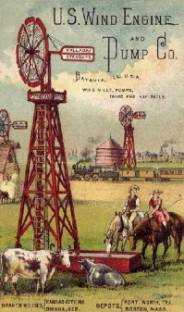
In 1850 Daniel Halladay and John Burnham started a company called U.S. Wind Engine Company. Their invention of the Halladay windmill changed everything. It was bought as a kit and assembled when it arrived. It was the means of moving water through pipes into the house and it could be used to turn equipment such as saws and mills. The first windmills were wooden and Daniel kept making improvements and eventually he was using galvanized steel. 

In my book, A Rancher’s Dream, I wrote about the men drilling a well. It was fun for me to write, but not fun for them. They worked hard and didn’t hit water after several tries. They enlisted the help of another man, an American Indian, who didn’t do any dowsing, but he merely looked at the way the land flowed and said try here. Okay, maybe that was a bit of a spoiler but not really. In A Rancher’s Woman, Mark got a used windmill. In a Rancher’s Request, they had real problems with their windmill when a storm took it down on a bitter cold night.
Even today some old windmills still dot the land, but new technology that allows for living off the grid, means windmills are sprouting across America especially in rural areas. Windmill farms are springing up and supplying electricity to residents in the area. Where my daughter lives, her local energy company is using windmills. Her water is from a community well. Something old is new again. 


Thursday, January 26, 2017

HOW WINDMILLS CHANGED THE WEST


When I began watercolor lessons, the first scene I painted was of a windmill at sunset. Not original nor very good, but I love both windmills and sunsets. Although they’re difficult to find now, I love the old wooden frame style best. I also love the song the windmill sings during a breezy day or evening. With the windows open, the sound is a lullaby at bedtime. Don’t get me wrong, I love modern conveniences, but they’re a trade-off. We lose something with each part of our past that disappears.

Windmill with wooden tower

Over 80,000 working windmills are estimated to be working now in Texas. You can’t drive on any road without seeing them in the distance. They are of particular service to ranchers in the arid regions. Land that once was almost useless to ranchers became valuable once windmills were erected. The windmill has come to be one of the symbols of ranching and cowboys. Once I started researching them, I was surprised the type I have come to love was not as old as I’d suspected.

Before the introduction of windmills to Texas and the West, inhabitable land was confined to areas where a constant water supply was available. There was no way for vast areas to be settled without a life-giving supply of water. The coming of the windmill made it possible to pump water from beneath the ground, and soon whole new areas were opened up to settlers. The first windmills were of the European style, built by Dutch and German immigrants for grinding meal and powering light industry. What settlers needed most, however, was a windmill that pumped water.

European-style windmill
for grinding grain

Because of its bulk and need for constant attention, the European windmill was impractical for this purpose. The solution to this problem came in 1854, when Daniel Halladay (Halady or Halliday) built the first American windmill in Ellington, Connecticut. He added to his mill a vane, or "tail," as it was called by cowhands, that functioned to direct the wheel into the wind. The wheel was a circle of wood slats radiating from a horizontal shaft and set at angles to the wind, designed so that centrifugal force would slow it in high winds; thus, the machine was self-regulating and operated unattended. Its simple direct-stroke energy converter consisted of only a shaft and a small fly wheel to which the sucker rod was pinned. This compact mechanism was mounted on a four-legged wood tower that could be constructed over a well in one day.

Railroad companies immediately recognized windmills as an inexpensive means of providing water for steam engines and for attracting settlers to semi-arid regions through which they planned to lay track. By 1873 the windmill had become an important supplier of water for railways, small towns where there were no public water systems, and small farms. Many of the very early mills were crude, inefficient, homemade contraptions. One of the popular makeshift mills was a wagon wheel with slats nailed around it to catch the wind, mounted on half an axle. The axle was fastened securely to a post erected beside the well. A sucker rod was pinned to the edge of the hub. It was stationary and worked only when the wind blew in the right direction. The windmills used later on the big ranches were the more dependable factory-made windmills.

Windmill, Pawnee National Grasslands, OK

Windmills moved to the ranches with the use of barbed wire in the late 1870s. At first the water holes, springs, creeks, and rivers were fenced, so that the back lands had no access to water. In the midst of the fence cutting and fighting, some ranchers began drilling wells and experimenting with windmills. Most of these experiments were unsuccessful, however, due to lack of knowledge concerning the proper size of the windmill in relation to the depth and diameter of the well. One of the earliest successful experiments was made eight miles north of Eldorado, in Schleicher County, Texas by Christopher C. Doty, a nomadic sheepman. Doty moved his flock into that area and found abundant water in shallow wells. By 1882, however, a drought had dried his wells; he ordered a drilling rig from Fort Scott, Arkansas, bored a fifty-two-foot well, and erected a Star windmill, which successfully supplied water for his 4,000 head of stock.


Watering stock with windmills spread rapidly. Eastern land speculators began buying, fencing, and running stock on the land until it became ripe for colonization. Among the first of these speculators to indirectly bring windmills to North Texas was the Magnolia Cattle and Land Company, organized by Maj. Willa V. Johnson, In 1884 the company bought two-thirds of the state-owned land in Borden County, land which had natural water resources and had long been unofficially claimed for grazing by Christopher Columbus Slaughter. Once Johnson fenced the land, Slaughter was forced into the use of windmills to supply water for his cattle. By 1886 the Matador Land and Cattle Company (where years later my husband’s uncle worked) began using windmills to water stock.

The largest of the Eastern land speculators, the Capitol Syndicate, began using windmills on its XIT in 1887. One of their windmills was believed to be the world's tallest; it was made of wood and was a total height of 132 feet. A Texas historical marker at Littlefield marks the site of a replica of the world's tallest windmill built on the XIT Ranch. The original windmill blew over in 1926. By 1900 the XIT had 335 windmills in operation.

Not until the King Ranch began extensive use of the windmill in 1890 did that the practice began to spread rapidly over that area. By 1900 windmills were a common sight in the Texas and the West. Inhabitable land was no longer limited to regions with a natural water supply. The windmill made the most remote areas habitable.

Windmill on the Ranching Heritage Center
at Texas Tech University, Lubbock


The use of windmills brought about two of the most colorful characters of the West, the driller and the windmiller, and altered the lifestyle of another, the range rider. The driller was usually a loner and seldom seen by anyone except the range rider and windmiller. He followed the fence crews and guessed at where he might find water, then bored wells with his horse-powered drilling rig. When the driller was successful the windmiller followed and set up a mill. Owners of the larger ranches usually employed several windmillers to make continuous rounds, checking and repairing windmills. The windmillers lived in covered wagons and only saw headquarters once or twice a month. The early mills had to be greased twice a week, and this was the range rider's job. He kept a can (or beer bottle) containing grease tied to his saddle. When he rode up to a mill that was squeaking, he would climb it, hold the wheel with a pole until he could mount the platform, and then let the wheel turn while he poured grease over it.

The range rider was always in danger of attacks from swarms of wasps, which hung their clustered cells beneath the windmill's platform; there was the added danger of falling from the tower when such attacks occurred. The windmill industry's shift in 1888 to the backgeared, all-steel mill caused heated debates in Texas livestock and farming circles. Most ranchers and farmers welcomed the new steel windmill because its galvanized wheel and tower held up better in harsh weather; also, its gear system was better able to take advantage of the wind, thus enabling the windmill to run more hours per day. The backgeared mill could also pump deeper and larger-diameter wells. Those who favored the old wood mill argued that the steel mill was more likely to break because of its high speed, that it was not as easily repaired as the wood mill, and that when parts had to be ordered the steel mill might be inoperative for days. Though sales of wood mills continued, they declined steadily, so that by 1912 few were being sold.

The last major development in the windmill came in 1915. A housing that needed to be filled with oil only once a year was built around the mill's gears. This relieved the range rider of his biweekly greasing chores and somewhat diminished the windmiller's job. Because of the dependability of this improved windmill, worries over water shortages were eased for the rancher, farmer, and rural dweller. This mill was the prime supplier of water in rural Texas until 1930, when electric and gasoline pumps began to be widely used.

Home with water furnished
by a windmill
Though Texas became the largest user of windmills in the United States, there were never more than three active manufacturers of windmills in Texas at one time. Windmills remain an important supplier of water for Texas cattlemen. The King Ranch in the late 1960s kept 262 mills running continuously and 100 complete spares in stock. Stocking spare mills is a common practice among ranchers who depend on the windmill to supply water for cattle in remote pastures. One important ranch worker is the man who rides—or drives—from windmill to windmill lubricating the gears and making repairs.

Because the windmill has been confined for the most part to remote areas, it has become a symbol of a lonely and primitive life, fitting for the pioneer Texans it first served and the cowboys about whom we love to read.


Caroline Clemmons is an award-winning and bestselling author of contemporary and historical western romance. Find her at www.carolineclemmons.com. Sign up for her newsletter here and receive a free western historical novella, HAPPY IS THE BRIDE. Her latest releases are RACHEL and MURDOCH'S BRIDE. 

Monday, November 26, 2012

WINDMILLS AND THE COWBOY LIFE


By Caroline Clemmons

When I started painting lessons, the first scene I created was of a windmill at sunset. No, not original, but I love both windmills and sunsets. Although they’re difficult to find now, I love the old wooden frame style structures best. The land on which we live had a metal windmill, now down for repair due to a rude tornado that tore through the orchard. That part of our land has been sold to a neighbor, so it’s no longer our problem. I definitely miss looking out the window and seeing the windmill, though.

Nope, not the one I painted
Photo from Kozzi

Over 80,000 working windmills are estimated to be working now in Texas. You can’t drive on any road without seeing them in the distance. They are of particular service to ranchers in the arid regions. Land that once was almost useless to ranchers became valuable once windmills were erected. The windmill has come to be one of the symbols of ranching and cowboys. Once I started researching them, I was surprised the type I have come to love was not as old as I’d suspected.

Before the introduction of windmills to Texas and the West, inhabitable land was confined to areas where a constant water supply was available. There was no way for vast areas to be settled without a life-giving supply of water. The coming of the windmill made it possible to pump water from beneath the ground, and soon whole new areas were opened up to settlers. The first windmills were of the European style, built by Dutch and German immigrants for grinding meal and powering light industry. What settlers needed most, however, was a windmill that pumped water.

Because of its bulk and need for constant attention, the European windmill was impractical for this purpose. The solution to this problem came in 1854, when Daniel Halladay (Hallady or Halliday) built the first American windmill in Ellington, Connecticut. He added to his mill a vane, or "tail," as it was called by cowhands, that functioned to direct the wheel into the wind. The wheel was a circle of wood slats radiating from a horizontal shaft and set at angles to the wind, designed so that centrifugal force would slow it in high winds; thus, the machine was self-regulating and operated unattended. Its simple direct-stroke energy converter consisted of only a shaft and a small fly wheel to which the sucker rod was pinned. This compact mechanism was mounted on a four-legged wood tower that could be constructed over a well in one day.

Railroad companies immediately recognized windmills as an inexpensive means of providing water for steam engines and for attracting settlers to semi-arid regions through which they planned to lay track. By 1873 the windmill had become an important supplier of water for railways, small towns where there were no public water systems, and small farms. Many of the very early mills were crude, inefficient, homemade contraptions. One of the popular makeshift mills was a wagon wheel with slats nailed around it to catch the wind, mounted on half an axle. The axle was fastened securely to a post erected beside the well. A sucker rod was pinned to the edge of the hub. It was stationary and worked only when the wind blew in the right direction. The windmills used later on the big ranches were the more dependable factory-made windmills.

Windmills provide water for cattle and people
Photo from Kozzie

Windmills moved to the ranches when the use of barbed wire began in the late 1870s. At first the water holes, springs, creeks, and rivers were fenced, so that the back lands had no access to water. In the midst of the ensuing fence cutting and fighting, some ranchers began drilling wells and experimenting with windmills. Most of these experiments were unsuccessful, however, due to lack of knowledge concerning the proper size of the windmill in relation to the depth and diameter of the well. One of the earliest successful experiments was made eight miles north of Eldorado, in Schleicher County, Texas by Christopher C. Doty, a nomadic sheepman. Doty moved his flock into that area and found abundant water in shallow wells. By 1882, however, a drought had dried his wells; he ordered a drilling rig from Fort Scott, Arkansas, bored a fifty-two-foot well, and erected a Star windmill, which successfully supplied water for his 4,000 head of stock.

Which reminds me that my uncle was a dowser, or water witch. According to my mother, Uncle Ray was never wrong and could always locate the best place to drill a well. And that's a good thing, because he farmed in West Texas. Dowsing is an innate talent, but supposedly can be learned by sensitive people. Dowsers are still around and the late husband of a friend was able to dowse for water.  Neither my uncle nor my friend's late husband charged for their service because they believed dowsing ability was a God-given gift.

Watering stock with windmills spread rapidly. Eastern land speculators began buying, fencing, and running stock on the land until it became ripe for colonization. Among the first of these speculators to indirectly bring windmills to North Texas was the Magnolia Cattle and Land Company, organized by Maj. Willa V. Johnson. In 1884 the company bought two-thirds of the state-owned land in Borden County, land which had natural water resources and had long been unofficially claimed for grazing by Christopher Columbus Slaughter. When Johnson fenced the land, Slaughter was forced into the use of windmills to supply water for his cattle. By 1886 the Matador Land and Cattle Company began using windmills to water stock.

Line Shack from Masterson Ranch, where
my husband's uncle worked. This is now
part of the National Ranching Heritage Museum
at Texas Tech University in Lubbock TX but
is labeled as a bunkhouse.


The largest of the Eastern land speculators, the Capitol Syndicate, began using windmills on its XIT Ranch in 1887. One of their windmills was believed to be the world's tallest; it was made of wood and was a total height of 132 feet. A Texas historical marker at Littlefield marks the site of a replica of the world's tallest windmill built on the XIT Ranch. The original windmill blew over in 1926. By 1900 the XIT had 335 windmills in operation.

Not until the King Ranch began extensive use of the windmill in 1890 did that the practice began to spread rapidly over that area. By 1900 windmills were a common sight in the Texas and the West. Inhabitable land was no longer limited to regions with a natural water supply. The windmill made the most remote areas habitable.

The use of windmills brought about two of the most colorful characters of the West, the driller and the windmiller, and altered the lifestyle of another, the range rider. The driller was usually a loner and seldom seen by anyone except the range rider and windmiller. He followed the fence crews and guessed at where he might find water, then bored wells with his horse-powered drilling rig. When the driller was successful the windmiller followed and set up a mill. Owners of the larger ranches usually employed several windmillers to make continuous rounds, checking and repairing windmills. The windmillers lived in covered wagons and only saw headquarters once or twice a month. The early mills had to be greased twice a week, and this was the range rider's job. He kept a can (or beer bottle) containing grease tied to his saddle. When he rode up to a mill that was squeaking, he would climb it, hold the wheel with a pole until he could mount the platform, and then let the wheel turn while he poured grease over it.

The range rider was always in danger of attacks from swarms of wasps, which hung their clustered cells beneath the windmill's platform; there was the added danger of falling from the tower when such attacks occurred. The windmill industry's shift in 1888 to the backgeared, all-steel mill caused heated debates in Texas livestock and farming circles. Most ranchers and farmers welcomed the new steel windmill because its galvanized wheel and tower held up better in harsh weather; also, its gear system was better able to take advantage of the wind, thus enabling the windmill to run more hours per day. The backgeared mill could also pump deeper and larger-diameter wells. Those who favored the old wood mill argued that the steel mill was more likely to break because of its high speed, that it was not as easily repaired as the wood mill, and that when parts had to be ordered the steel mill might be inoperative for days. Though sales of wood mills continued, they declined steadily, so that by 1912 few were being sold.

Lone Range Rider
IStock photo


The last major development in the windmill came in 1915. A housing that needed to be filled with oil only once a year was built around the mill's gears. This relieved the range rider of his biweekly greasing chores and somewhat diminished the windmiller's job. Because of the dependability of this improved windmill, worries over water shortages were eased for the rancher, farmer, and rural dweller. This mill was the prime supplier of water in rural Texas until 1930, when electric and gasoline pumps began to be widely used.

Texas became the largest user of windmills in the United States.Windmills remain an important supplier of water for Texas cattlemen, as well as throughout the Western rangelands. The King Ranch in the late 1960s kept 262 mills running continuously and 100 complete spares in stock. Stocking spare mills is a common practice among ranchers who depend on the windmill to supply water for cattle in remote pastures.

Because the windmill has been confined for the most part to remote areas, it has become a symbol of a lonely and primitive life, fitting for the pioneer Texans it first served and the cowboys about whom we love to read.

Sources: Online Handbook of Texas, Wikipedia, Ranching Heritage Museum

And here's my Giveaway. One subscriber to my CAROLINE'S OCCASIONAL NEWSLETTER will win a KINDLE FIRE 3G on December 15th. You can sign up at my website at www.carolineclemmons.com or at my personal blog http://carolineclemmons.blogspot.com. I'll repeat similar giveaways every few months plus have news of releases and other pertinent information.

Please follow me on Facebook, Twitter, Pinterest, WattPad and Goodreads.

Thanks for stopping by!