Showing posts with label cowboys. Show all posts

Wednesday, January 12, 2022

A Few Western Terms by Bea Tifton

Not too far from me is one of the greatest places on earth. It’s a big used (and some new) bookstore just perfect for finding interesting books. It’s a great way to find specific books, but my favorite thing is just to wander. Upon one recent expedition, I found something perfect for a book/word nerd. The Dictionary of the American West by Will Blevins can provide you with many useful terms to fit in if you are magically teleported to the Old West or if you just want to learn and use a few more colorful phrases. Some of  the definitions in the book are for more modern cowboys, as well. 

Here’s a sampling to get you started: 


Back East: The reverse of out West. For some, it had the implication of being ‘back in civilization.’ For others, it meant “back where everything is messed up.’ 

Belly Gun: A short-barreled pistol stuck naked into the waistband of your pants instead of holstered

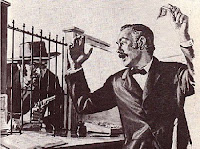
Cash in His Six-Shooter: What an outlaw was said to do when he used his pistol to withdraw money from a bank 


Hen Fruit: A logger’s name for eggs 


Last Roundup: Death

Leaky Mouth: Someone who is too talkative

Like Getting Money from Home: Easy and pleasant

Mail-Order Cowboy: A tenderfoot decked out too fancily in what he hopes is cowboy clothing

On the Dodge: On the run from the law

Pie Buggy: A wagon sent to town for supplies 


Rust the Boiler: To drink alkali water 

There’s a One-Eyed Man in the Game: someone is cheating at poker 


Whomper-jawed: a sideways, crooked, or roundabout way 


So put on your bat wings (chaps), saddle your horse,  and go out and use a few new expressions today. 


Friday, May 18, 2018

WHAT’S A COWBOY WITHOUT A COWBOY HAT? By Sarah J. McNeal #YouAintNoCowboyWithoutAHat #Sweethearts-of-the-West-blog

Pawnee Bill and Zack Miller Ranch 101


I love to wear hats so it’s mighty disappointing to me that women just don’t wear hats like they used to. Somewhere in the 1960’s hats became extinct—or just about anyway.

But cowboy hats are still out there, in fact, maybe even stronger than ever. I guess the reason for their popularity is practicality. Baseball caps which have become so popular these days, are not enough for a real cowpoke’s needs. For one thing, baseball caps may keep the sun out of a cowboy’s eyes, but does little else to protect them from the elements. Personally, another advantage in a cowboy hat is that they are just plain sexy. C’mon, you know there is nothing quite as manly as a man in a Stetson
Just so we’re all clear on exactly what a cowboy hat is, here are some facts:
         

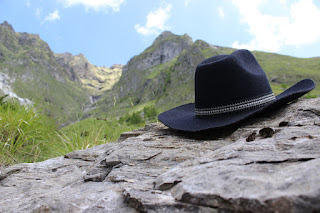
A cowboy hat is a high-crowned, wide-brimmed hat which grew from the 19th century Mexican culture and has been redefined over time and even by certain individuals because the shape of the hat’s crown and brim are often modified by the wearer depending on taste, fashion, and the weather.
Although cowboy hats may be worn on every continent around the world, it is recognized immediately as part of the American old west and its cowboy culture. From northern Mexico, through western United States, and up into western Canada, the cowboy hat is the iconic gear of a ranch worker, country-western singers, rodeo circuit participants, and movies depicting the west.

The first western cowboy hat was called “Boss of the Plains.” The front-creased “Carlsbad” followed soon after, until the high-crowned, wide-brimmed, soft felt western hats arrived on the scene and became the image we associate with the cowboy today.

A Stetson circa 1920's

The modern renditions of  cowboy hats are made from fur-based (mostly beaver) felt or straw, and sometimes leather. They are sold with a high rounded crown and a wide, flat brim. A simple sweat band on the inside of the crown just before the brim stabilizes the fit of the head. After the initial hat is purchased it can be customized with creases in the crown and a rounded or winged brim according to the owner’s wishes. Often a decorative band fits around the crown on the outside of the hat according to the taste of the individual wearer. Ornamentation such as buckles, bows, and so on are traditionally attached to the left side for an historically practical purpose. Most people are right handed, in the absence of a broad brim, decorative feathers or bows on the right side would interfere with the use of weapons.

Most often the colors are in shades of beige, brown, black, and gray. In the 1940’s pastel colors were introduced and seen on hats worn by movie cowboys and rodeo riders. The most famous and popular design and structure for a cowboy hat was created by J.B. Stetson since it was first introduced back in 1865.

Stetson focused on expensive, high quality hats that were a real investment for working cowboys. The water resistance and durability of the original Stetson gained publicity in 1912 when the USS Maine was raised from the Havana harbor where it had sunk in 1898. They found a Stetson hat in the wreckage which had been exposed to seawater, ooze, mud, and plant growth for 14 years. Amazingly, when that hat was cleaned off it was undamaged. You couldn’t create a better sales pitch than that for a durable, tough cowboy hat.


A Fedora

Just a little side info here about the difference between a fedora and a cowboy hat because of the many variations in a cowboy hat the difference can be a little obscure. So, here are the guidelines to separate and clarify fedoras from cowboy hats:

Fedoras have smaller brims from cowboy hats. They also have a stylish front pinch or dip in the front. Most fedoras have a wide grosgrain hatband. Think about that Frank Sinatra look. There is a wide variety of options in fedoras even though not as many as a cowboy hat. The top of the crown may vary in shape from an open crown, center dent, oval or teardrop shape.

Man in a Fedora

A fedora also has something called a “snap brim” so the brim can be worn up on every side much like a bowler hat. The snap feature on the fedora allows the wearer to snap the front brim down into place like a cool hipster. When the hat is to be stored, the brim can be snapped back into place to maintain its structure.

Indiana Jones’s hat looks like a mixed breed between the two, but it is a fedora and NOT a cowboy hat. It has the wide hatband and the pinched down dip in the front.

There are many famous movie stars, singers, and even a president who wore cowboy hats.

Bill Picket, a Famous Rodeo "Bull Dogger"

Frankie Laine Western Singer

Tim McGraw Country Singer

Tom Mix Silent Film Cowboy (and Friend of Wyatt Earp)

William S. Hart Silent Film Cowboy

Ronald Reagon, Actor and President of the United States

Here is a little scene with Hank Wilding and his Stetson in my book, HOME FOR THE HEART:


Excerpt:
Smoothing her hands over her lavender shirtwaist dress, Lucy took a deep breath. Hank is never going to be interested in a plain woman like me. She turned from the mirror just as she heard the knock on the front door downstairs.

Her mother called up the stairs. “Lucy, honey, Hank is here.”

A thrill rippled through Lucy’s core. Hank. Handsome, unattainable, Hank Wilding. A reminder flashed through her mind. Even if she was beautiful, it wouldn’t matter. Hank was a self-proclaimed bachelor. Guard your heart, Lucille Thoroughgood. It will only get broken.

The sight of Hank standing with his hat held politely in his hands at the bottom of the stairs caused her heart to leap into her throat and beat so fast she could barely breathe. Her hands shook from the surge of adrenaline. No man should be that beautiful. A lock of his bronzed hair had an enticing way of falling over his brow. She wanted so much to touch it and sweep it back just so she could feel its texture. Hank gazed up the stairs at her with his dark brown eyes and seemed to hold her in his spell. And if that wasn’t enough, he grinned at her in that charming, crooked way she found so endearing. It wasn’t often Hank smiled. He frowned most of the time. It was a good thing, too, because, if he did smile often, women all over town would be swooning at his feet.


Diverse stories filled with heart

Sunday, February 14, 2016

Savvy Sayin’s: True Wisdom from The Real Wes

By Anna Kathryn Lanier

I found this treasure trove of cowboy wisdom a few years ago.  Savvy Sayin’s: True Wisdom from The Real West was collected by Ken Alstad and as the quote by American West Magazine says, they are “entertaining, pithy advice on how to get along in cowboy and Indian country.”  Here’s a few to amuse you.


  • ·         Skill throws more weight than strength.
  • ·         Second-hand gold is as good as new.
  • ·         Teeth and memory weaken with age.
  • ·         Set your pace by your distance
  • ·         If you don’t buy what you only want, you’ll have money to buy what you really need.
  • ·         Out west, every prairie dog hole is a gold mine, every hill is a mountain, every creek is a river, and every prospector is a liar.
  • ·         A stone stops rollin’ when it finds the kind of moss it wants to gather.
  • ·         If you live to be 29 and have made no enemies, you’re a failure.
  • ·         Some men never reach a marriageable age.
  • ·         Never approach a bull from the front, a horse from the rear or a fool from any direction.


I consider this book one of my ‘research books'.  If nothing else, it’s a fun a read.


Anna Kathryn Lanier
Romance Author, SALVATION BRIDE
http://aklanier.com/
Never let your memories be greater than your dreams. ~Doug Ivester 

Monday, November 2, 2015

The Historic Cary House Hotel

By Paisley Kirkpatrick
Built in 1857, the Cary House Hotel still stands in Placerville, CA, and is still a functioning hotel. This jewel, built when the gold rush town was prospering, still treats its guests to an interesting night’s sleep. During the five years I worked in the Chablis Art Gallery located across the street from the hotel, I made friends with the manager, who graciously let me take photos inside and out, and meet one of the two most active resident ghosts. I found it interesting to learn that the hotel featured such luxuries as hot and cold running water (a novelty in its time), an elegant grand staircase, and a lobby handcrafted in mahogany and cherry woods.
Echoes from a colorful history still linger in the halls of this elegant place of lodging. Early days provided a regular stop for stage lines that brought travelers to the gold country. In some instances the stages returned to the San Francisco mint with millions of dollars in bullion. Its wrought-iron trimmed balcony not only added to its grace, but also lent a great space for Horace Greely to give a speech. The world-renowned “Hangtown Fry” (consisting of oysters and scrambled eggs) was created at the Cary House cook at the request of a miner who'd struck it rich in the nearby gold fields.
As I mentioned before, the hotel is inhabited by two ghosts. Stan is the ghost I tangled with. He lives mostly in the lobby of the hotel. In the gold rush heyday, he worked as the clerk at the check-in counter. He loved the place. He has stuck around all these years since his death. In the beginning of his employment, Stan checked patrons in and out of the Cary House. He had a great love of liquor, especially brandy and whiskey. When he wasn’t working, he would head down to Rivendell’s Book Store where he could socialize. Back then, the store was a great place to visit with fellow patrons, and to get a drink, especially on the cold damp days of winter. Stan would sneak out during his workday when no one was around, grab a drink, and hurry back to the hotel.
Stan loved women, but was ignored by them. He was a short, stocky man with reddish brown hair, balding on the top and not what most people would consider a 'ladies man'. Truth be known, he also liked men somewhat. He was not really in demand by either. So, he did his job, was polite until the alcohol took affect, loved gossip and checking people out, and was known to be a bit 'mouthy' and insulting. Apparently he made a pass at a man, the fellow stabbed him twice, and Stan fell down the stairs to his death.
My encounter with Stan happened the day I wanted to go upstairs by riding on the elevator. It's kept inside a room not much bigger than a closet. The wrought-iron door wouldn’t open. I tried, but to no avail. So did the manager. It was no big deal as the staircase was grand and fun to walk up to the second and third floors. I was disappointed because it looked like a fun ride. However, on the way back down to the lobby the door opened and worked perfectly.
Maybe old Stan was so happy to see me leave the hotel that he gladly let me take the ride. Some of the patrons have said they've seen their doorknobs turn when they retire for the night. Some believe Stan checks the door to each room with a lady guest just to make sure they are safely locked inside their rooms.
A television show that traveled around the country doing spots on the most haunted buildings did a twenty minute show on the ghosts in residence at Cary House. I took many photos the day I encountered Stan. I used the hotel in my Paradise Pines Series: Night Angel. Having the pictures reminded me of its elegance and made it easy for me to add the building as a large part of my story. The hero, Declan Grainger, was the hotel owner and since he was a Scot, he named it Chaumers Hotel, which means a house with many bedrooms.
Lily Fox craves attention. Her amazing voice and ability to mesmerize the miners and lumberjacks in a mountain community saloon brings her more than the notoriety she needs. She draws the attention of the town's hotel owner. If she plays her cards close to her chest and becomes his queen of hearts, the wealthy Scot could give her more than she dreamed.
The day Lily Fox sauntered into his hotel with the poise of a self-assured woman, Declan Grainger knew trouble wasn't far behind. Stealing his heart was only the beginning...
Declan realizes that underneath Lily's flamboyant behavior is a frightened, insecure woman searching for stability and a proper place in society.
Declan aches for Lily's love. He can't ask for her heart without revealing his secret life. If he unmasked himself as Paradise Pines' allusive Night Angel, how would she react?
Link: http://amzn.com/1612527957

Sunday, July 26, 2015

COWBOY WISDOM


Saturday was the Facebook party for the National Cowboy Day. Great bits of cowboy wisdom were shared and it reminded me of a collection I have by Texas Bix Bender titled DON’T SQUAT WITH YER SPURS ON! A Cowboy’s Guide to Life http://amzn.com/B00V5ML7F4

Here are some of the pearls from that book:

Don’t never interfere with somethin’ that ain’t botherin’ you none.

Talk low, talk slow, and don’t say too much.

Don’t worry about bitin’ off more ‘n you can chew. Your mouth is probably a whole lot bigger than you think.

Makin’ it in life is kinda like bustin’ broncs: you’re gonna get thrown a lot. The simple secret is to keep getting’ back on.

You can just about always stand more ‘n you think you can.

There’s two theories to arguin’ with a woman. Neither one works.


A woman’s heart is like a campfire. If you don’t tend to it regular, you’ll soon lose it.

Control your generosity when you’re dealin’ with a chronic borrower.

Too much debt doubles the weight on your horse and puts another in control of the reins.


Don’t let so much reality into your life that there’s no room left for dreamin’.

Never miss a good chance to shut up.

Nobody ever drowned himself in his own sweat.

Honesty is not something you should flirt with—you should be married to it.


Cowboys are always a welcome subject, aren’t they? In fact, I love reading anything about the West, which is why I write and read western romances. My latest release is the historical romance, McCLINTOCK’S RELUCTANT BRIDE, book three of the McClintock series. Didn't Skhye Moncrief do a fabulous job designing the cover?


Here’s the blurb:

Nettie Clayton’s well-planned life is stolen in a few moments. All she wants is a better life for her family in McClintock Falls, Texas where her father can recover from years spent coal mining. Her teacher’s salary is slated toward saving for her younger brother to attend medical school. Her dreams are dashed when Josh McClintock mistakes her window for that of her neighbor. She wants to resist her parents’ decree, but there’s no way to win.

Josh McClintock’s free-wheeling life comes to an abrupt end after his birthday celebration. He works hard by day on the family ranch; he plays just as hard on weekends. He loves being single to play the field of willing females and has no plan to marry for five or six years. One drunken mistake alters his life and Nettie’s forever.

While Nettie and Josh struggle to deal with an unwanted marriage, a crazed villain planning his revenge against the McClintock family targets Josh and Nettie.  What happens when the villain attacks?

Here are buy links:
Amazon in Deutschland  http://www.amazon.de/dp/B011LGDP8U


And why not sign up for my newsletter to stay informed of new releases, contests, and events? Here’s the link: http://carolineclemmons.us5.list-manage.com/subscribe?u=0a24664c906875718d975ad7b&id=7c2e488a51


Saturday, May 16, 2015

Cattle Drives to Ellsworth, Kansas in 1873 by Linda Hubalek

The setting of my Brides with Grit series is Ellsworth County, Kansas in 1873. Although I created the fiction town of Clear Creek for the story, there really is a "Clear Creek" running through the county. 
I picked this specific year because of the information I found on Ellsworth when it was a major cattle shipping town from 1872 to 1875.
In 1867, Abilene, Kansas became a shipping facility for cattle driven up from Texas, loading over 36,000 head of cattle in its first year. By 1871, the area was settled and the huge herds of cattle were no longer welcome because they trampled farmer's crops and spread Texas Cattle Fever to local cattle.
Cattle drives coming up the Chisholm Trail veered west to Ellsworth in 1872. The area was still native grassland and able to accommodate the grazing herds.
Ellsworth businessman anticipated the shift in the cattle trade from Abilene to their town, adding merchandise that the cowboys would need, or want, when they were done with the drive. It was reported that the Big Boot Company sold more than one hundred pairs of boots in the first months of 1874.
The Drovers Cottage, once owned by Joseph McCoy in Abilene, was moved to Ellsworth in 1872 to take advantage of the people coming into town. This hotel could accommodate 175 guests and its stable could hold fifty carriages and a hundred horses. 

Most drovers arrived in town in June and completed shipping by early fall. In the 1873 season, more than 150,000 cattle were trailed into Ellsworth. Over 30,000 of those cattle were shipped east, and the rest driven on to stock ranches further west. 
You could imagine how many cowboys were in town when each 2,500 to 3,000 head of cattle coming in, had a trail boss, ten cowboys, a cook and at least one horse wrangler with the herd. And you usually had three horses along for each cowboy.
So for a rough count, there were 150,000 head of cattle, 700 cowboys and 2000 horses coming into the little town of Ellsworth, although not all at the same time. What a gold mine for stores and saloons, although the trade lasted only a few years.
I'd love to have been in Ellsworth in 1873, but I'll research and write about it instead!

Thursday, March 12, 2015

Wild West Words: Food and Drink


Round Up on the Musselshell, Charles M. Russell, 1919
The last three decades of the 19th Century — 1870 to 1900 — compose the period most people think of when they hear the term “Wild West.” Prior to the Civil War, westward expansion in the U.S. was a pioneering movement, and the period around the turn of the 20th Century was dominated by the Industrial Revolution. But in a scant thirty years, the American cowboy raised enough hell to leave a permanent mark on history.

Cowboys also left a permanent mark on American English. A whole lexicon of new words and phrases entered the language. Some were borrowed from other cultures. Others embodied inventive new uses for words that once meant something else. Still others slid into the vernacular sideways from Lord only knows where.

One of the best ways to imbue a western with a sense of authenticity is to toss in a few bits of period-appropriate jargon or dialect. That’s more difficult than one might imagine. I’m constantly surprised to discover words and phrases are either much younger or much older than I expected. Sometimes the stories behind the terms are even better than the terms themselves.

I keep an ever-expanding cowboy-to-English dictionary on my website — mostly so I know where to look when I need a word or phrase, but also because others sometimes find the material amusing or helpful. Below are a few of the entries related to food and drink.


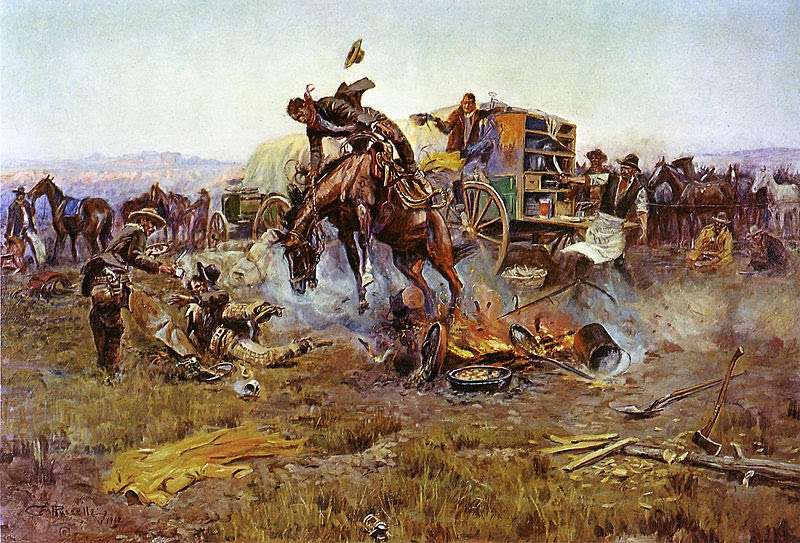
Camp Cook's Troubles, Charles M. Russell
Ball: a shot of liquor. Originated in the American West c. 1821; most commonly heard in the phrase “a beer and a ball,” used in saloons to order a beer and a shot of whiskey. “Ball of fire” meant a glass of brandy.

Barrel: cheap saloon, often with a brothel attached. American English; arose c. 1875 as a reference to the barrels of beer or booze typically stacked along the walls.

Bear sign: donuts. Origin obscure, but the word was common on trail drives. Any chuckwagon cook who could — and would — make bear sign was a keeper.

Bend an elbow: have a drink.

Benzene: cheap liquor, so called because it set a man’s innards on fire from his gullet to his gut.

Bottom of the barrel: of very low quality. Cicero is credited with coining the phrase, which he used as a metaphor comparing the basest elements of Roman society to the sediment left by wine.

Budge: liquor. Origin unknown, but in common use by the latter half of the 1800s. A related term, budgy, meant drunk.

Cantina: barroom or saloon. Texas and southwestern U.S. dialect from 1892; borrowed from Spanish canteen.

Chuck: food. Arose 1840-50 in the American West; antecedents uncertain.

Dead soldier: empty liquor bottle. Although the term first appeared in print in 1913, common usage is much older. Both “dead man” and “dead marine” were recorded in the context before 1892. All of the phrases most likely arose as a pun: “the spirits have departed.”

Laugh Kills Lonesome, Charles M. Russell
Dive: disreputable bar. American English c. 1871, probably as a figurative and literal reference to the location of the worst: beneath more reputable, mainstream establishments.

Goobers or goober peas: peanuts. American English c. 1833, likely of African origin.

Grub up: eat. The word “grub” became slang for food in the 1650s, possibly as a reference to birds eating grubs or perhaps as a rhyme for “bub,” which was slang for drink during the period. 19th Century American cowboys added “up” to any number of slang nouns and verbs to create corresponding vernacular terms (i.e., “heeled up” meant armed, c. 1866 from the 1560s usage of “heel” to mean attaching spurs to a gamecock’s feet).

Gun wadding: white bread. Origin unknown, although visual similarity is likely.

Jigger: 1.5-ounce shot glass; also, the volume of liquor itself. American English, 1836, from the earlier (1824) use of jigger to mean an illicit distillery. Origin unknown, but may be an alteration of “chigger” (c. 1756), a tiny mite or flea.

Kerosene: cheap liquor. (See benzene.)

Mescal: a member of the agave family found in the deserts of Mexico and the southwestern U.S., as well as an intoxicating liquor fermented from its juice. The word migrated to English from Aztec via Mexican Spanish before 1828. From 1885, mescal also referred to the peyote cactus found in northern Mexico and southern Texas. Dried disks containing psychoactive ingredients, often used in Native American spiritual rituals, were called “mescal buttons.”

Mexican strawberries: dried beans.

Red-eye: inferior whiskey. American slang; arose c. 1819, most likely as a reference to the physical appearance of people who drank the stuff. The meaning “overnight commercial airline flight that arrives early in the morning” arose 1965-70.

The Herd Quitter, Charles M. Russell
Roostered: drunk, apparently from an over-imbiber’s tendency to get his tail feathers in an uproar over little to nothing, much like a male chicken guarding a henhouse. The word “rooster” is an Americanism from 1772, derived from “roost cock.” Colonial Puritans took offense when “cock” became vulgar slang for a part of the human male anatomy, so they shortened the phrase.

Sop: gravy. Another trail-drive word, probably carried over from Old English “sopp,” or bread soaked in liquid. Among cowboys, using the word “gravy” marked the speaker as a tenderfoot.

Stodgy: of a thick, semi-solid consistency; primarily applied to food. Arose c. 1823-1825 from stodge (“to stuff,” 1670s). The noun form, meaning “dull or heavy,” arose c. 1874.

Tiswin (also tizwin): a fermented beverage made by the Apache. The original term probably was Aztecan for “pounding heart,” filtered through Spanish before entering American English c. 1875-80.

Tonsil varnish: whiskey

Tornado juice: whiskey