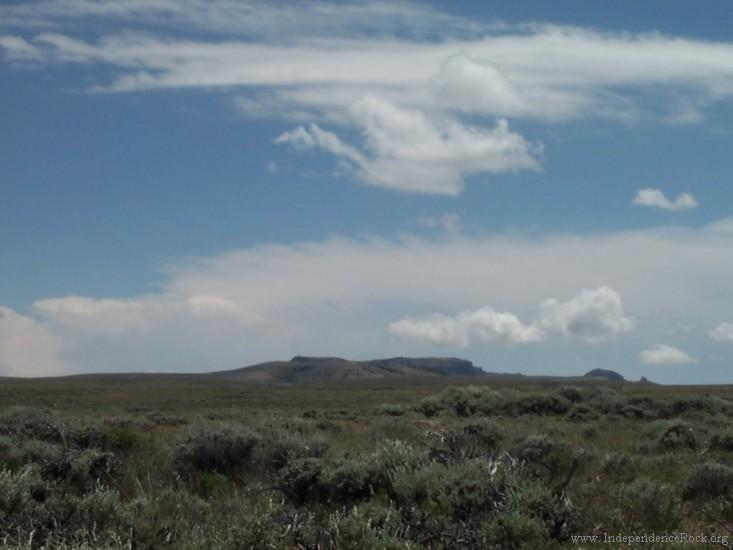
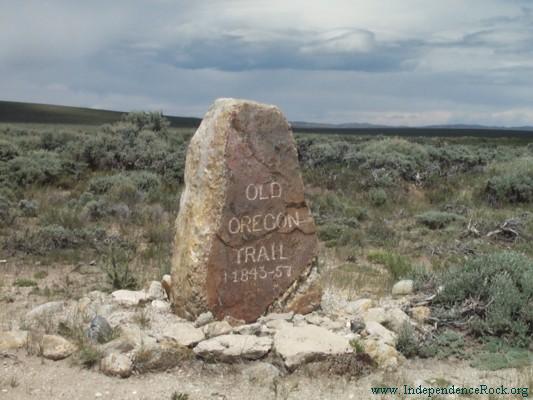
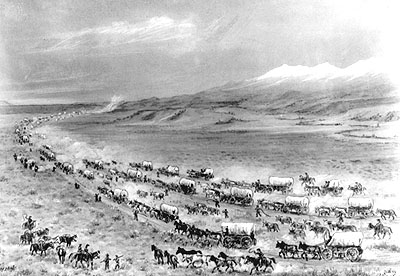
There's a little ghost town...well it does boast ten people, four cats, two dogs, nestled in the Wind River Mountains in Wyoming. A visit to South Pass is a visit to the past. Join me on a little journey to its history.
 |
| Me hanging out at Esther Hobart Morris' Newspaper getting the latest gossip |
Long before the first trappers set foot in the Rockies, or thousands
upon thousands of emigrants set across the country in search of gold, or
land, or escape from a war torn North and South, humans used a natural
gateway through the Rocky Mountains. This pass is known today as South
Pass, and has been used for trade and travel for thousands of years.
Paleolithic hunters camped in the area for at least ten thousand years,
and the entire area is rich in Plains Archaic and Late Prehistoric
artifacts.
The earliest descriptions of this elevated plain depict
a paradise for bison on both sides of the pass, and the large herds
represented a great prize for hunters whose lives depended upon the
shaggy beasts. The most successful of these people of the buffalo were
the Absarokas, better known as the Crow, who battled for control of this
rich country with their ancient enemies the Blackfeet and Shoshones.
As white traders introduced firearms and horses, however, the balance of
power shifted, and by the time the bison disappeared from the Green
River Valley, the Shoshones controlled all the country west of South
Pass.
Later travelers on the Oregon-California Trail told of
meeting Crow, Arapahoes, Bannocks, Cheyennes, Nez Perce, Lakotas, and
Utes in or near South Pass. During the golden age of the overland
trails, the Shoshones dominated the region and used the pass most
heavily.
In 1812, one of the American Indian tribes who used this
pass mentioned the natural corridor to an American fur trader, Robert
Stuart. Though French and American fur traders wandered the northern
Rockies before the return of the Lewis and Clark Expedition, and Indian
nations used the corridor for centuries, no one of European extraction
appears to have so much as heard a rumor of the pass’ existence before
August 1812. The history of this great pass and that of the United
States was set on a course of change from that moment.

Stuart’s
“discovery” of South Pass in 1812, was recognized by some as the
momentous breakthrough it was. The “Missouri Gazette” quickly announced
the news and published a full description of the Astorian’s harrowing
journey. A brief report printed on 8 May 1813 predicted this showed “the
world that a journey to the Western Sea will not be considered of much
greater importance than a trip to New York.” But, remarkably, South Pass
was quickly forgotten. Some speculated John Jacob Astor suppressed the
news of South Pass, hoping to keep it a trade secret. Stuart’s journal
remained unpublished for more than a century after his historic journey.
More likely, it was the fact the news arrived in the middle of the War
of 1812. This war drove Americans from the upper Missouri River and
halted the nation’s western trade and exploration activities for ten
years.
In 1822, with the reawakening of the American fur trade an
ambitious Missouri entrepreneur, William Ashley, advertised he and his
partner, Major Andrew Henry, were looking for one hundred “Enterprising
Young Men” willing to spend as many as three years risking their lives
in the fur trade. Among those who answered his call were Jedediah Smith,
the four Sublette brothers, Thomas Fitzpatrick, John H. Weber, David
Jackson, Daniel T. Potts, Louis Vasquez, and Mike Fink.

The first two years were marked with repeated failures as Indian tribes employed all they had
to keep the trappers out of their country. Finally, William Sublette,
Jedediah Smith, and Thomas Fitzpatrick led a party of some sixteen men
up the White River hoping to reach the beaver rich country along the
Spanish River (today’s Green River). The Great Plains, Badlands, and
Rocky Mountains stood between the fur traders and their goal. On top of
all that, it was already late in the year, October, when they set out on
their trek. After an arduous trek “crossing several steep and high
ridges that “in any other country would be called mountains,” the
exhausted men sought shelter at the Crows’ main camp high on the Wind
River, probably near today’s Dubois, Wyoming, but perhaps farther
downstream at Riverton.
During their ten week stay, a Crow told
Thomas Fitzpatrick about a pass that existed in the Wind River
Mountains, through which he could easily take his whole band “upon the
streams on the other side.” In late February eleven men left the safety
of the Crow village to find this passage.
Bitter cold and Wyoming
wind made the search for the passage a grueling journey. After several
days of travel, the party moved over a low ridge, likely the Beaver
Divide, and struck the Sweetwater River where they camped. One of the
men, James Clyman, recorded that after holding up for three weeks near
what became Independence Rock the trappers struck out in a Southwesterly
direction. After another week of travel and another bitter night in
sagebrush fighting high winds, Clyman said the next day the trappers
realized they “had crossed the man ridge” of the Rocky Mountains. This
simple announcement marked the first east-to-west crossing of South
Pass.

It
was the first crossing, but it opened the door for thousands of
crossings to come. In the wake of the Rocky Mountain fur trade, the
knowledge that wagons could cross the continent to Oregon, and that
women (Narcissa Whitman and Eliza Spalding) had successfully completed
the journey altered the way American people thought about the Far West.
While there was not an immediate flood of emigrants to the West, by
1843, South Pass was “already traversed by several different roads,”
according to John C. Fremont. The number of roads across the open plain
increased with the intense traffic that arrived with the California
gold rush as travelers sought out campsites that had not been stripped
of grass. Jim Bridger told one Forty-niner, “he could make fifty roads
through South Pass.” By 1848, about 18, 847 Americans had crossed South
Pass on their way to new homes in the West.

The
discovery of gold at Sutter’s Mill in California, would transform South
Pass and the nation, as the steady flow over the pass turned to a
river. By 1860, trail historian John Unruh, calculated almost 300,000
men, women, and children had crossed South Pass.

California
wasn’t the only place experiencing a rush due to the finding of gold.
In 1864, officers and men from the Eleventh Ohio Volunteers, sent west
to guard the telegraph during the Civil War, became convinced that there
was enough gold on the upper Sweetwater to make them rich. By the end
of the Civil War the West was overrun with experienced prospectors. Fort
Bridger commandant Major Noyes Baldwin and Captain John F. Skelton
grubstaked John A. James and D.C. Moreland to spend six months surveying
the mineral prospects of South Pass. Along with miners they found
already operating in the area, the men organized the region’s first
mining district, the Lincoln, on November 11, 1864 on a tributary of
Beaver Creek. The men found all types of gold, ranging from very fine
quality flour gold to course gold. Moreland, James, and their associates
began mining on the Willow Creek, where South Pass City eventually
grew. This mine was abandoned when the miners were run off by Indians,
but others returned to the area to take up where these men left off.

In July 1867, the “Chicago Times” reported, “Salt Lake papers of July 1, received here, give accounts
of rich gold discoveries in the mines are located in Green river [sic]
country…” Reports stated the road to the Green River was crowded with
citizens from Salt Lake, and the new gold mines “set the people wild in
this locality.” Papers and reports from the area and the East kept up
the steady drumbeat and Wyoming’s gold rush was on.
What was
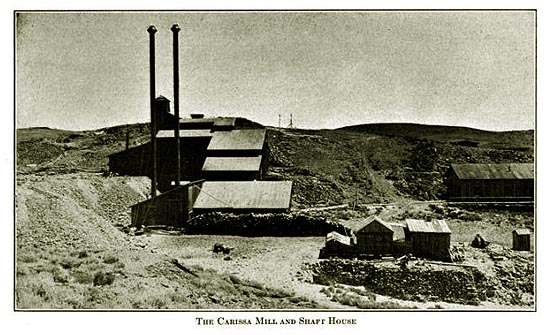
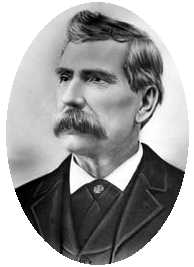
discovered by grizzled mountain man, Lewis Robinson, in June 1867, was
the Carriso ledge, which soon became the Carissa Mine. By late July
there were already several other prospects that looked as good if not
better, including the Morning Star, Melrose, Copperopolis, and Last
Chance. Half a mile below the Carissa Mine, prospectors soon began
building South Pass City. By early November, the settlement boasted
fifty houses and several stamping mills. At year’s end, the Dakota
Territorial Legislature made the boomtown the seat of Carter County,
after the formation of Wyoming Territory, the county was renamed
Sweetwater County.
In an entreaty for a post office, it was
reported that by March of 1868, the population of South pass was 1,000
and it was anticipated that within one or two months, the town would
have 3,000. A postal agent from Salt Lake City estimated that within a
few months the City would attain a population of 10,000. Regardless,
there was a need for a post office. It cost $1.00 to send a letter by
private express. The road from Sweetwater to South Pass City passed over
75 miles through land “destitute of water. George W.B. Dixson was named
as postmaster. However he absconded with some of the government’s
money, allegedly to the newly found Cape Colony where he remained until
his wife died. He ultimately returned to the United States and died in
Chicago.

Despite
the postmaster’s less than honorable behavior, South Pass City retained
a post office along with a newspaper, five hotels, and some fifteen
saloons including: the “49’er,” “Keg,” “Magnolia,” “Elephant,” and the
“Occidental.” By 1868, the town had stage service south to Bryan on the
Union Pacific. By 1869, Iliff & Co. had opened the Exchange Bank
and a toll road to Atlantic City 2 and half miles away opened.

If
the growth of South Pass City was rapid, its decline was equally as
fast. By 1870 the bank closed and in 1871 there was a disastrous fire.
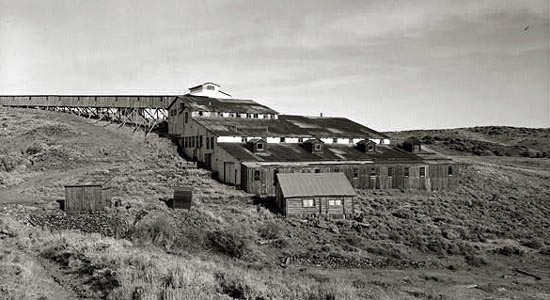
The Carissa Mine remained the chief mine at South Pass City, and by
1868 some $15,000.00 of gold had been mined, but by 1873 the mine was
idled, the gold rush over. Governor J.W. Hoyt reported in 1878 that
“South Pass is a scene of vacant dwellings, saloons, shops, and
abandoned gulches.” For some who came and left, the big strike and
fortune was just over the next hill, and when the government opened the
Black Hills they followed the scent of gold.

Despite its short boom, South Pass City, is noted not only for the gold mines, and as a stop
on the Oregon Trail, but as the home of women’s suffrage. In 1869,
William H. Bright, South Pass mine and saloon owner, was elected to the
First Territorial Assembly. He introduced a bill providing for woman’s
suffrage which was passed by the legislature and approved by Governor
John A. Campbell. There are various versions regarding Bright’s
motivation for introducing the bill. One is that Bright was persuaded to
do so by a promise made to Esther Hobart Morris, later the first woman
justice of the peace in the United States. Another is that Bright was
influenced by his wife, Julia, to introduce the act. Another theory is
the Democrat controlled legislature thought women would vote Democrat to
offset the Black community that tended to vote Republican. However, if
this was the case it backfired, since this was in the days before the
“Australian” or secret ballot, and it was soon discovered women tended
to vote Republican. In any case, two years later the Democratically
controlled legislature attempted to repeal woman’s suffrage, but the act
to repeal was vetoed by the Republican Governor, and enough Republicans
had been elected (thanks to women) to sustain the veto.

The
mine that started it all, the Carissa, was reopened in 1901 and the
size increased, but was closed again in 1906. In 1946, the mine was
again reopened and quickly closed. The three towns that boomed in
Wyoming’s short gold rush, South Pass City, Atlantic City, and Miner’s
Delight, have faded to ghost towns.
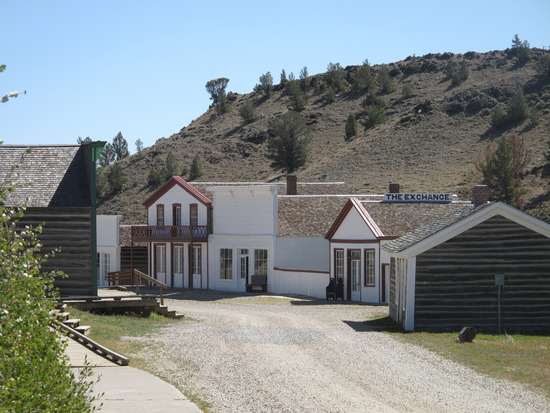
But turn yer wagons into South
Pass and y’all will still receive a big WYO welcome. You can see the
home of Mrs. Esther Morris (a topic for a blog in the very near future),
the Carissa Saloon, The Sherlock Store and the Sherlock Motel
(originally the Idaho House), the Exchange Bank and other remains of a
city that saw more history in its short boom than some see in a hundred
years, and a pass that has served as a gateway for thousands of years.
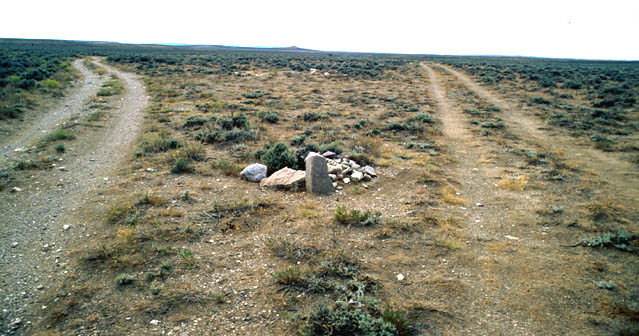
Just a few miles from South
Pass is what they call the Parting of the Ways where those early
pioneers chose one path to California or the other to Oregon. As for me, well I don’t veer left or right anymore, but stay right here in this
part of the West. So, I’ll let y’all choose the path that fits yer fancy as we say so long to
the trails!!
SOURCES:
http://wyoshpo.state.wyo.us/
http://historicwyoming.org/
www.wyomingtalesandtrails.com
Kirsten Lynn is a Western and Military Historian. She worked six years
with a Navy non-profit and continues to contract with the Marine Corps
History Division for certain projects. Making her home where her roots
were sewn in Wyoming, Kirsten also works as a local historian. She loves
to use the history she has learned and add it to a great love story.
She writes stories about men of uncommon valor...women with undaunted
courage...love of unwavering devotion ...and romance with unending
sizzle. When she's not writing, she finds inspiration in day trips
through the Bighorn Mountains, binge reading and watching sappy old
movies, or sappy new movies. Housework can always wait.


.jpg)