
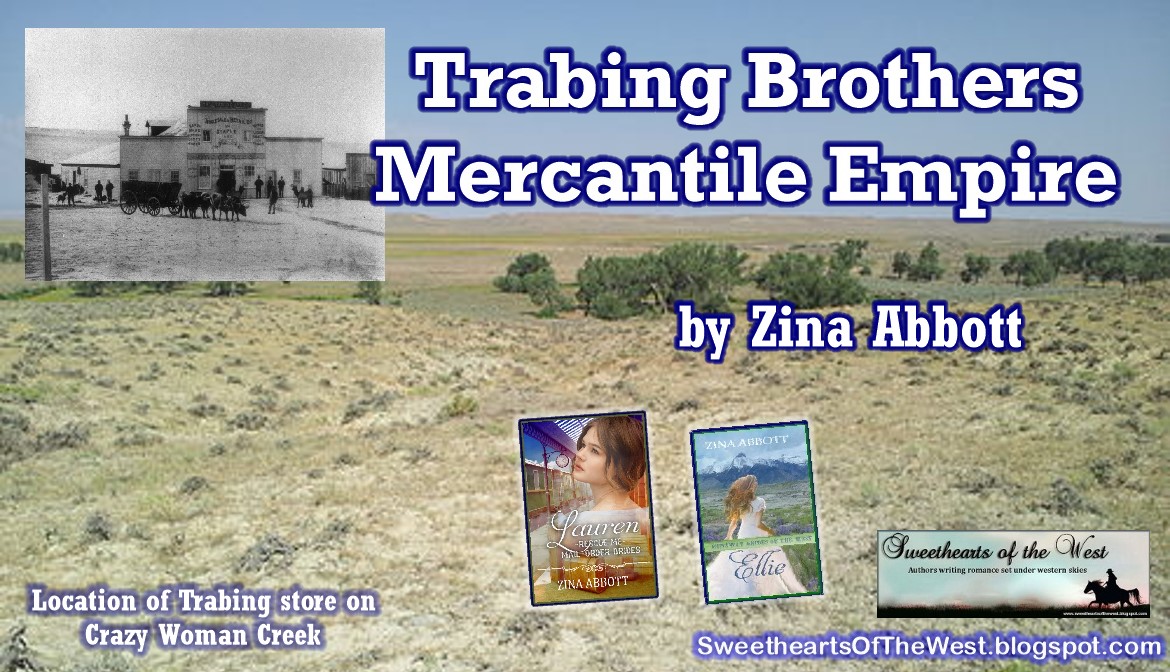
Among the most successful and prosperous freighters and merchants that supplied early Wyoming Territory were the Trabing Brothers.
Born in Allendorf, Hesse-Cassel, Germany, along with their blacksmith father, they arrived in America in August 1853. Augustus J. "Gus" was eleven years of age and Charles was eight. They settled near Washington D.C. where the boys worked from that early age with their father in a wagon factory. They both learned the smithing trade.
In June 1863, August went to Washington D. C. and enlisted with the U.S, Army’s Quartermaster Department. He served on guard duty at the Civil War forts around Washington D. C. and as a blacksmith until 1865.

On Aug. 28, 1865, both brothers departed for the West, working for the Army as blacksmiths and wagon repairers. Under Captain Gillis, they traveled with a quartermaster’s train of 258 six-mule-team government wagons headed to Fort McPherson near present-day North Platte, Nebraska. This expedition, led by Col. Brown of the 12th Missouri, was to drive the Sioux and Cheyenne from the valley of the Republican River. During this time the Trabing brothers also acquired retail experience, ordering and dispensing at the sutler store. The campaigns lasted about five months.
After Army service, they ranched near the fort and started a trading post in North Platte, Nebraska. During a Sioux uprising, the store was burned down. Although warriors ransacked and burned the store and ranch, according to August’s Indian depredation claim filed decades later with the federal government, the brothers rebuilt. On April 21, 1868 they were burned out a second time and some of their men were killed, including a cousin who worked for them. They suffered heavy losses in horses and cattle.

Selling everything that was left, the brothers and Ulrike, August’s first wife, bought some condemned government horses and wagons and moved west to Laramie, Wyoming Territory, arriving on June 18, 1868, five weeks after the arrival of the transcontinental railroad. They soon met J. C. Walters and the three went into business. They began bidding for and getting freight contracts from Col. Benton of the Union Pacific Railroad to supply cordwood and ties for the UP at Cooper Lake Station west of Laramie and at Medicine Bow Station.
By 1869 the brothers had several stores and contracts for supplying the railroad with wood. Starting in July, they advertised for twenty-five or more teams and established a freighting business between Rock Creek, Medicine Bow, and the Powder River country.
On July 28 and 29, 1869, Ulrika and August Trabing bought vacant property and buildings on First Street in Laramie from W. B. Bent, land agent for the Union Pacific Railroad. The purchase included The National Theater which stood on parts of two lots. This one-story wooden structure was located in the three-hundred block, across from the Union Pacific freight depot and about two blocks south of the passenger station. August was a singer and may have performed with some of the groups from time to time. The retail and wholesale store was located at the corner of Garfield and South Second Street. They ventured opening a saloon and theater for traveling vaudeville troupes coming in on the railroad. Eventually, the complex grew to include three buildings: the warehouse, the store, and the stables.
The theater, refurbished and painted blue, became known as “The Old Blue Front—” a place that would figure in their story for the next thirty-seven years. Ulrika would try running the business while August was filling the tie and wood contract at Cooper Lake but she wasn’t successful.
Near this time, coal was discovered at Carbon, Wyoming Territory, west of Medicine Bow. The railroad no longer needed cordwood. That meant the Trabings had to find other work. They decided to expand their Medicine Bow way station. They built a more substantial store and started a freighting business from there as well.

On Dec. 6, 1869, the Trabings leased their “Blue Front” building to their employee, George Weiske. In March 1870 their building would be sub-leased to Albany County as a temporary courthouse, since one had not yet been built. The Blue Front building served as the courtroom for the first jury in the world impaneling both men and women.
In late December 1869, the Trabings left Laramie on the railroad for Medicine Bow, which was sixty miles to the northwest. They brought $35 worth of groceries—two wagons full—which they bought from Edward Ivinson. This began their mercantile and freighting career. At that time, Medicine Bow had a freight depot. Large quantities of military supplies were shipped in by train. From there, they were freighted north to Fort Fetterman on the North Platte near present Douglas, Wyo., and later, to other forts farther north. Troops were also stationed at Medicine Bow along with tie cutters and UP employees.
The road to Fort Fetterman ran 83.5 miles through the Laramie Mountains and was often closed by snow and flooding creeks in winter and spring. There were four hazardous river crossings. Floods often washed out bridges, making travel unpredictable.
In 1874, weather and flooded crossings delayed freighting until July. That month, one newspaper noted the government had begun the season’s freighting to Fort Fetterman from Medicine Bow, and guessed that “Trabings are doing more business and making more money than any other house in the territory.”
By this time, the Trabing businesses were growing steadily. They were freighting to Fort Fetterman using their own teams and men, operating a growing grocery store at Medicine Bow and remodeling part of their Laramie warehouse. Local newspapers published their store advertisements frequently. A March 26, 1875, Laramie newspaper describes their Medicine Bow operation “.. as one of the largest store-rooms with warehouses, corrals, stables, blacksmith-shop and emigrant houses attached to be found in Wyoming Territory. Sales last year exceeded $50,000.” That would be more than $1.1 million in today’s dollars.
The Trabing Brothers continued expanding, buying a ranch 17 miles north of Medicine Bow on Shirley Rim. This cattle operation became the TB Ranch.
At Medicine Bow and Cooper Lake Station, they opened small stores, supplying whatever their freighters and tie cutters needed. Outlaws robbed them at Cooper Lake Station in 1869, and were soon captured and jailed by Albany County Sheriff, Nathan K. Boswell.
Starting in 1876, General Crook’s military campaigns to push the Sioux and Cheyenne tribes onto reservations and open their land to settlers began a series of intense series battles with the tribes, later called the Great Sioux War. The conflicts created more business for the Trabings and their freighters. They supplied the military forts and soldiers with tons of food, hay, cordwood, rifles and ammunition. Around that time, Trabing freighters were also hauling supplies to mining camps and settlers near Medicine Bow.
Charles maintained the store in Medicine Bow. At the time, the location was a strategic place for moving large quantities of merchandise from the rail head over the hill to Fort Laramie, and to the southwest to “Medicine Bow Crossings near Fort Halleck. They also transported goods north to Fort Fetterman. It is possible this is the store, run by Charles, that, at the end of May 1877, thieves broke into the store and robbed them of $2,000 to $3,000 worth of goods. Some reports say it was also burned. ground.
I wrote a post of the Bloomer women on another blog, which you may read HERE.
The daughter, Mary Jane Bloomer Stimpson, and her husband, William Stimpson, bought out the old Overland Trail Stage Station at “The Crossings” on the Medicine Bow River. After her husband’s death in 1876, the Trabing Brothers, who already owned a store in Rock Creek, a Union Pacific Railroad town to the south, bought the store from the widow.
In 1877, the Trabing brothers expanded their Laramie store on First Street. It was front-page Boomerang news when, in 1883, they built a brand-new building on Second Street. Both brothers had homes befitting prosperous entrepreneurs.
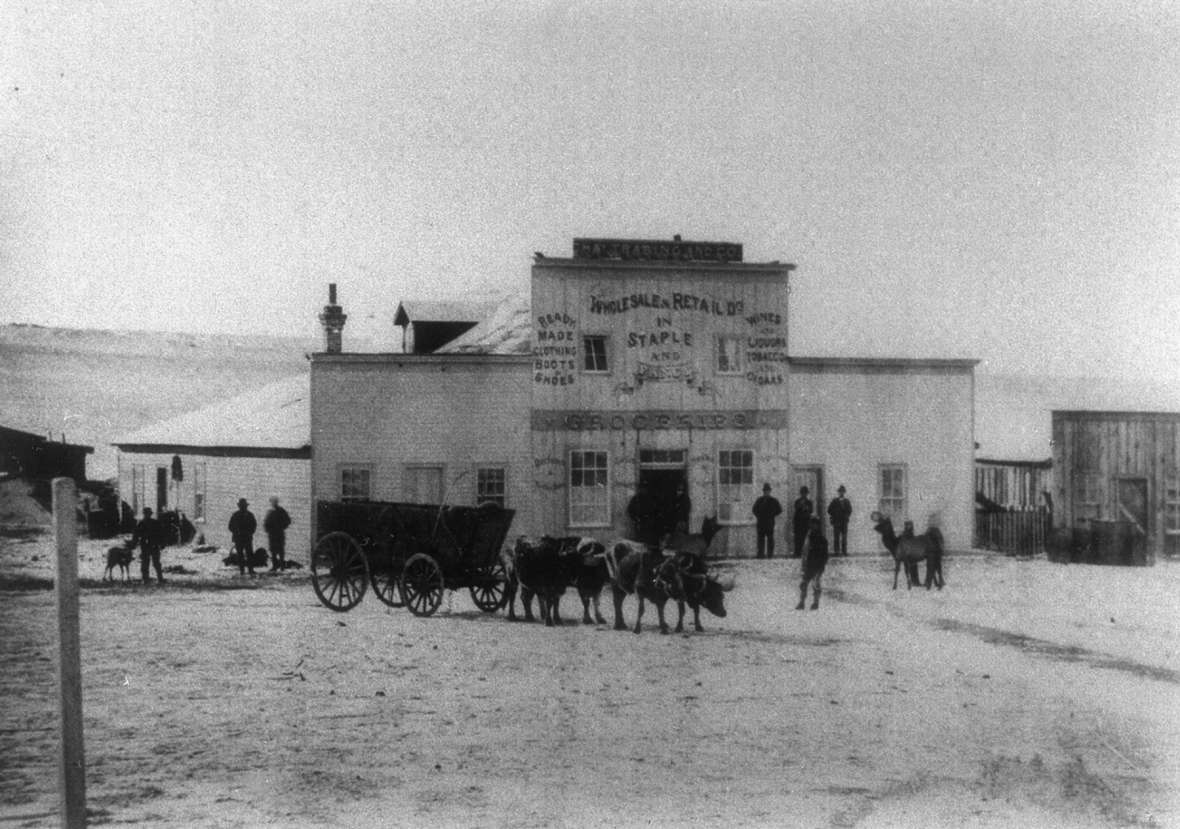
Charles built another store in what is now Johnson County at the Crazy Woman Crossing of the Bozeman Trail. The store was optimistically called "Trabing City." They chose this location for water, a change of horses, and a source of supplies halfway between Fort Reno to the south and the site of the former Fort Phil Kearny to the north. It was a day’s ride from each.

August Trabing hired the young widow, Mary Jane Stimpson, to manage this new store. She, along with her five-year-old daughter, arrived with two wagons of goods while it was still being built. She operated the store from early 1878 until late 1879. According to Frank Grouard, the robbers were the Big Nose George gang. They might have committed the crime as he fled to Montana after the failed train derailment and murders of Deputy Sheriff Robert Widdowfield and UPRR Special Detective “Tip” Vincents in August, 1878.
Due to its remote location, that store was robbed multiple times by outlaw gangs. After Fort McKinney moved to its second location, on Clear Creek near the future site of Buffalo, Trabings decided to build a store closer to the protection of that fort. Then, at the urging of Chares Buell, who started building the first Occidental Hotel in 1880, August moved the Trabing store to his new location where Clear Creek crosses the Bozeman Trail, which was not far from Fort McKinney.
They leased their Crazy Woman location to two families, Deacon and Walker, who later purchased that store. Because the boundary of the original military reservation around the fort allowed civilian establishments no closer than six miles, the place was called Six Mile ranch.
When the size of the reservation was reduced to where civilians could settle just two miles from the fort, the Trabings freighted their buildings piece by piece into what would become town of Buffalo, on Clear Creek, and built the first store in that location. A bill of lading from that time shows the three Trabing stores operating during that time, Laramie, Medicine Bow and "on Clear Creek near Ft. McKinney." They sold their Buffalo store in 1882.
They opened a business in Rawlins, where they had leased the old courthouse as a warehouse. They obtained large freight contracts north to Fort Washakie and south to White River in Colorado. During 1880 one such contract was sublet to J. W. Hugus and Company of Rawlins, which failed to fulfill its contract due to weather. In November 1883, the U.S. government sued August and Charles Trabing for $76,000 for the failure. The jury ruled in favor of the Trabing Brothers. Headlines read, "Uncle Sam Beaten." Other contracts during this period included hauling mining supplies to North Park, Colo., Cummins City (later Jelm), W.T., Douglas Creek in southern Carbon County and other locations.
The ranch August and Charles Trabing developed, and the string of stores in Buffalo, Rawlins, Medicine Bow, Crazy Woman, and Laramie led to a successful freighting operation to supply the large Trabing Brothers stores. At one time they had as many as one hundred freighters in their employ. Trabing Brothers and the Trabing Commercial Company became a prominent business in Laramie, Wyoming Territory.

Besides freighting and the mercantile business, the brothers engaged in growing livestock on their ranch.
 |
| Charles Trabing |
In 1885, Charles was shipping cattle on the Union Pacific to Omaha. At Sherman Hill, he injured his finger in attempting to move one of the steers wedged in a car. By the time he arrived in Omaha, the finger was swollen and painful. A physician cleaned and dressed the injury. The infection grew worse, and on a public street he dropped dead from apoplexy brought about by blood poisoning.
The size of the Laramie store was doubled in 1891 when a second building to the north was added. Those two buildings covered four lots at the NW corner of Second and Garfield. The basement had a boiler, storerooms, and a reservoir for the gas. Since the Trabing store was the only building with gas lights in Laramie, it had to store the fuel for the lights. Most of the new addition remained empty for a year.
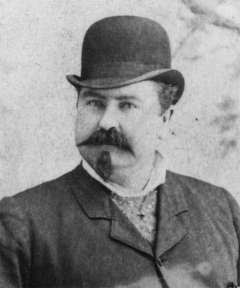 |
| Augustus Trabing |
August Trabing moved to a penthouse atop the store in 1884. He was Laramie’s mayor for two terms: 1886-1887 and 1889-90. He was elected to the Territorial Legislature in 1888. After Wyoming became a state, he became a Wyoming Senator in 1895.
In 1892, August Trabing cut a connection in the firewall between his two buildings so the retail operation now covered both. Wares included grain, wagons, housewares, furniture, hardware, and groceries.
A recession in 1893 forced Trabing to go to an all cash basis, closing out all credit accounts. The north building was rented to William Myers Dry Goods. The Odd Fellows Hall rented the space above, while Trabing’s store continued in the remaining building at 320 S. Second.
In the evening of March 13, 1895, a fire started in the basement of the Trabing store. It consumed both buildings, also their stable and warehouse behind on the alley, resulting in losses of $50,000. One volunteer who tried to help put the fire out, UW student, George Cordiner, then seventeen, died in the blaze when a wall collapsed. The Trabings' two dogs died and their personal possessions were lost. August Trablin was required to make an assignment for the benefit of creditors. The business, however, recovered.

August and his second wife, Hannah Trabing, stayed in Laramie and continued to invest on a smaller scale in freighting, retail stores, and land development including the Pioneer Canal.
In 1891, Congress passed the Indian Depredations Act, which provided for recompense for losses sustained from Indian Depredations. As authorized by the Act, Trabing applied for compensation for his losses in Nebraska in 1868. At first, the Government did not oppose his claim. After its approval by the Court of Claims, the Attorney General, in a motion for rehearing, claimed that the court had no jurisdiction to grant the claim. Claims were only available to citizens of the United States. It was claimed by the Attorney General that Trabing's father had not become a citizen of the United States prior to Trabing turning 18. Therefore, the government argued that Trabing was not a citizen of the United States and was ineligible for compensation.
Rather than following the "liberal rule" applied by the Supreme Court, the Court of Claims rejected Trabing's claim, ruling that Trabing's averment that his father had voted for President Lincoln should be rejected as "hearsay;" that Trabing's service in Nebraska was before it became a state and thus he did not become a citizen until after the Indian depredation. The court additionally suggested that Trabing's service as mayor and as a legislator was "wrongful." The Court seemingly ignored that he had multiple time taken an oath of allegiance to the United States and instead held that Trabing "apparently chose to remain a subject of a foreign power." See Trabing v. The United States, 32 Ct. Cl. 440 (1897). The wheels of righting an injustice grind slowly. On January 26, 1907, Congress with the support of Senator Warren and Representative Mondell finally corrected the injustice and directed that allowed Trabing to prosecute his claim.
Unfortunately, the ruling came too late. In 1906, Trabing was residing on his ranch, "Wayside," about twenty miles north of Laramie near the headwaters of the Upper Chug. The ranch today is remembered in the name of Wayside Ranch Road. On the evening of October 26 while crossing the Laramie Mountains, his team became stuck in a snowdrift. Unable to free the wagon, he cut the horses loose and spent the night bedding in the snow beneath the wagon. The next morning, he trudged a mile and a half to the F. S. King's ranch. Several weeks later, he took his wife to Wisconsin for the winter. Upon his return later in the month, he spent several days in his room in Laramie before returning to Wayside.
On November 28, 1906, August Trabing became quite ill. His son-in-law, William Bridger, rode about 4 1/2 miles to the King Ranch, which had the closest telephone. He called Dr. Stevens and his brother-in-law, George Trabing. Dr. Stevens and George started right away to August Trabing’s ranch. When they arrived at 2:00 a.m., the second of the Trabing brothers had died.

At the time of his death, August Trabing owned the Trabing Commercial Company and Wayside, the Laramie-Walden, Laramie-Centennial, and Laramie-Sibylee stage lines.
I have two books set in the region of Rock Creek and Medicine Bow. take place.

Lauren, Book 2 in the Rescue Me (Mail-order Brides) series is largely set in Rock Creek, Wyoming Territory. There are two mercantiles listed among Rock Creek’s 1878 businesses, one of them would have been a Trabing Brothers store. Also, the scenes involving Big Nose George and his gang attempting to derail the train just outside of Medicine Bow and the ambush of Deputy Sheriff Robert Widdowfield and UPRR Special Agent Tip Vincents are featured in chapters in this book. To read the book description and find the purchase options, please CLICK HERE.

My Runaway Brides of the West series book, Ellie, the scene in a Medicine Bow mercantile where Ellie meets Rand for the first time in person was probably the Trabing Brothers store. To read the book description and find the purchase options, please CLICK HERE.
Sources:
http://www.wyomingtalesandtrails.com/laramietrab.html
http://wyomingsteakhouse.com/the-trabing-fire/
https://www.wyoachs.com/people/2018/3/17/pioneer-trabing-brothers-build-a-wyoming-empire
https://sites.rootsweb.com/~wylaratp/html/_ox_cart_trip.html
https://www.wyohistory.org/encyclopedia/territorial-empire-trabings-and-their-freight


