Showing posts with label Dakota Territory. Show all posts

Wednesday, June 8, 2022

THE BONANZA FARM by Cora Leland

 Though dates vary, the Bonanza Farm Boom was short-lived, from 1870-90, when rainfall was more than plentiful, crops did better than anyone had dared to dream of and the grain market was excellent.  From 1878-1890 Dakota's population swelled from 16,000 to 191,000!


This long stretch of plows and horses are part of Big Ag, or the Bonanza Farm boom. This bonanza farm belonged to Amenia and the Sharon Land Company. 

From one point of view, the Bonanza Farm Boom was an important part of a decades-long population drive in Dakota Territory. Looked at closely, the Bonanza Farm developed suddenly, because railroads were granted huge land concessions, and they promoted immigration without stopping until 1930. 

The Homestead Act of 1862, of course, plus more local homesteading acts, giveaways and almost-free, cheap land enticed immigrants by the thousand. Railroads even traded shares of their companies for the land they owned, and sometimes the largest blocks of farmland went to financiers in the East -- who, in turn, began Bonanza Farms.


The Bagg Farm


But the largest Bonanza Farm, owned by the Dalrymple Family, was 11,000 acres.
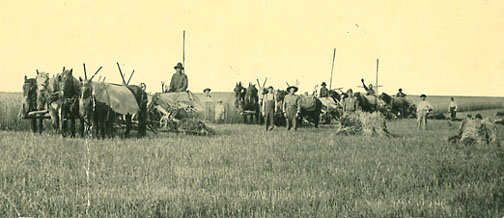


Although different sources say that Bonanza Farms were 25,000 to 75,000 acres.  All vouch for the fact that for many years, wheat was the only crop.

The reasoning for this is, to me, pretty complicated, involving world economics of the time. The short version boils down to milling. 

The wheat grown prior to Dakota's Bonanza Farms was unsuitable for the milling technology of the times. Dakota Territory set about matching a milling process to the wondrous nature of Dakota's Hard Wheat, and they were successful. 

Even during the height of Bonanza Farm prosperity, life for people who farmed the normal number of acres in Dakota -- 200-300 -- was hard work:  subsistence farming.  Houses in Dakota were not much more varied than in other Plains areas: tar paper shacks, sod houses,  dugouts and cabins if a person's land was close to a creek. 


  Sod House and Owner

Native Americans

Despite Big Ag and Bonanza Farms, Indians continued to live simpler lives, as drawn by a Lakota Ledger artist in "Meets His Squaw."


During the Reservation Era, from 1850-1887, Indian life was simpler still because  the buffalo had become extinct, making men’s roles change considerably. The tribe no longer relied on them to provide most of the food (buffalo or other large mammals like deer for meat) and their roles as protectors were gone.  (Local hunting for small game was also illegal for Natives.)  Warfare had almost stopped between tribes and rations were contingent on good behavior, so the once-revered warrior societies changed.

Women no longer tanned hides or sewed clothes and shelters for the same reasons. 


Brule Lakota Chief Spotted Tail and his wife


Squaw Dance, Rosebud Agency

The few sources from those times state that women were resourceful, switching to sales and production of crafts.  And artists, too, were resourceful.  They'd once used buffalo hides, but because discarded account books were plentiful, artists used them for paper. Also, the local trading shops had good art supplies. 


Indian families removed from the Great Plains as prisoners to Ft. Marion 

In some cases, as with Dr. Susan La Flesch’s  far-seeing father, Chief Iron Eye, the farming situation went better. After teaching himself, he taught his tribe of Omaha Indians how to plow and farm,  giving away his crops to those who'd tried and failed. 


Chief Iron Eye (Joseph La Flesche)

His daughters, incidentally, and other relations became famous for similar reasons. Dr. Susan La Flesche is standing in this photo


Other tribes had always grown staples like squash and beans; others, who’d relied entirely on hunting, experienced illness from government rations.  It’s best to read for oneself about this situation!

The facts are interesting, though difficult. Indians who lived in or near a town and blended into the community were termed as taxed, and they were counted in the census.  Those who lived on reservations or ‘roamed freely’ were not counted in the census and were termed un-taxed. All records, but for a very few, were part of a huge fire in the 1920's. The federal government has created estimates.

Cattle Ranching

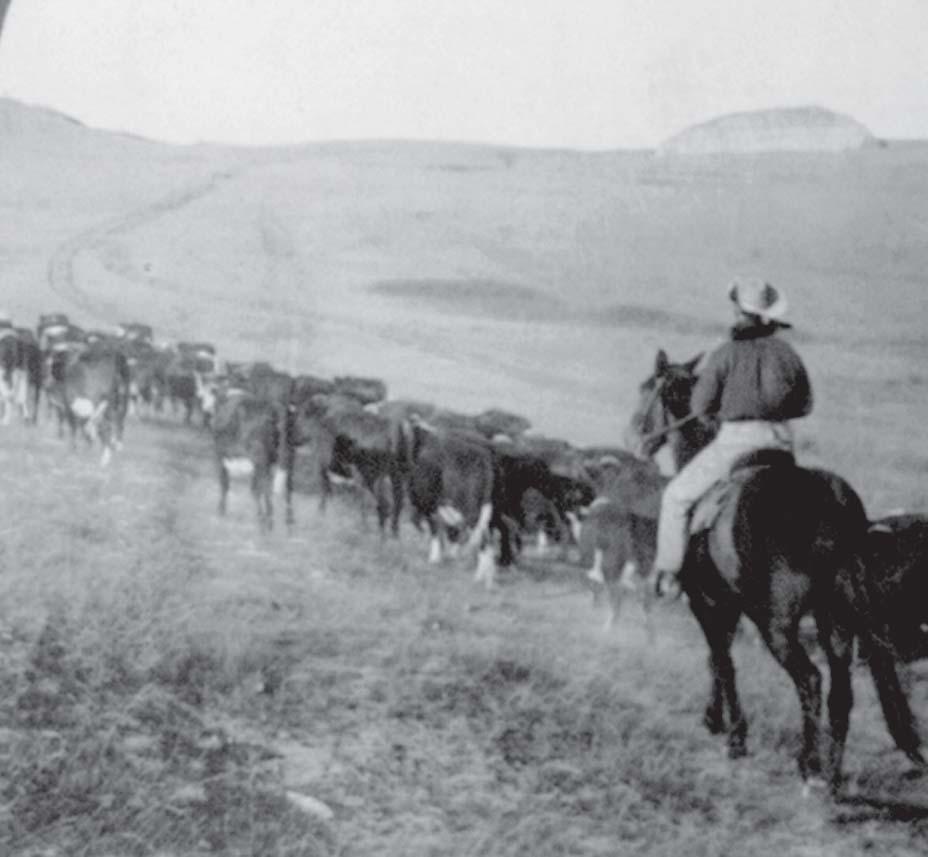
Cattle were herded into the territory during the '70's.  During the first half of the 1880's, cattle brought about yet another Big Ag  boom. (I wrote about this situation in my Mail Order Bride series on Amazon. Growing up on a ranch, it seemed natural to write about these huge changes.)

Ranches were established, mostly in the western part of the Territory, the people ranching as if they were still located in Texas. Theodore Roosevelt and Marquis de Mores (from France)both had prosperous ranches.  Roosevelt ran cattle for awhile in the badlands; de Mores had refrigerated cars on trains for his meat and a packing plant on site.


Cowboy camp, Badlands

The winter of 1887 broke even the most prosperous. Cattle ranching survived, but ranchers changed their tactics, running smaller herds and alternating grazing with feeding, based on the season.

The bottom fell out of the Dakota Booms when the abundance of wheat coincided with low prices for grains, serious drought, and grasshoppers flying in clouds that descended on all farms. 


References include 

The Reservation Era (1850 - 1887) - A Brief History of Civil ...


Sunday, May 8, 2022

THE GREAT DAKOTA BOOMS

When my most recent heroine protests to the Dakota settler who wants to marry her,  "but will you respect me and my beliefs?" he protests that he will.  He explains the cruel experiences his family endured elsewhere finding work. (They arrived, like many others, starving and without experience, from Galway, Ireland.)  He, though, had persevered, proved up his land, and was now able offer her a good home. 


Jake, my hero, in need of a wife

The population of Dakota (from the official census in 1860) was 4,837, but immigrants going West sometimes came northward, swelling the population of Dakota to 11,776 in 1870.

If Jake's family had settled in Dakota, the boys would have found work as  miners, even as waves of immigrants poured into the Black Hills (1874).  Suddenly, Deadwood changed to a large, bustling city, one of the largest in the area.


The Black Hills


90% of immigrants to Dakota were English-speakers, though they'd had little work in Ireland, or even in England. Once relocated to Dakota, their experience grew and their skills were honored.  Cornish and Irish miners, especially, were sought after.

 Miners were often chosen for top-ranking jobs when they spoke English, being able to direct other workers underground.  The British had a different situation in Dakota, with sympathetic help coming from a wealthy independent family.  The concept was to help other British people become prosperous 'Gentlemen farmers', and the aid included Dakota farmers and hands-on experts working with newcomers.

But Scandinavian immigrants were the largest numbers to Dakota, often coming in groups.  The census of these early 'waves' of Northern European immigration began in 1890, with  Norwegians listed as bringing the most people:  19,275.  Germans and others from the areas near Germany brought a slightly fewer number of people, with 18,188.  During the Dakota Boom, one European family was so enchanted with Dakota that they relocated!


Medora, Marquise de Mora

The Dakota Booms lasted roughly from 1873 -- after the Panic of 1873  had abated -- to 1890, and the boom suddenly stopped, when a great drought hit the plains. 


People with farming skills found work in the Dakotas as sheep herders and cowboys when Dakota was 'discovered' as cattle country.

The Homestead Act of 1862 had little influence.


Cowboys and hands camp in the Badlands

But the boom was cemented by the railroads.  First, the eastern areas were drenched with trains, then the smaller communities were reached.  Sources say that the railroad companies were tremendously rich, and had knowledge of where depots would be located.  Nonetheless, many people found jobs laying and maintaining those tracks.

Bismark rails across the Missouri

285 towns were platted during those years, and 135 had railroad a railroad terminus.


Prosperous Deadwood 1876


The Drought of 1890 that ended the Dakota Boom

One North Dakota college states that booms have continued since then, encouraging the population to swell (it's close to 700,000 now). 


Sunday, February 28, 2021

On the Move

 In today’s jet-setting world, we tend to forget how laborious and time-consuming travel used to be. Sure, we occasionally think of the Oregon Trail and the people who traversed the western United States along its continuous pathway. We even like to read stories with characters that are struggling to cross those endless plains and mighty mountains. However, I’ve noticed a trend in my own writing, and a connecting one in some of my readers’ minds when they read my historical western romances. You see, in my historical western romances, my characters are on the move. Since my stories take place long after the prime era of the Oregon Trail migration, railway travel is the mode my characters most often use. And, well, they use it a lot. How exactly they manage to pay the expensive travel fare is something I usually leave up to the reader's imagination.


In my first Pinkerton Matchmaker book, An Agent for Elizabeth, however, I had 18-year-old Elizabeth purchase a train ticket for $122 to travel from Kansas City to Denver. I, along with a few of the authors in the series, made an educated guess based on a travel log that one of the authors was able to pull up online. Turns out that we were pretty close! Other sources I have since run across mention that train fare cost 2-3 cents per mile, and in 1870, a trip from New York to San Francisco cost around $136 if traveling first-class in a Pullman car. That was quite a lot of cash for the average person to hand over back then. It was Elizabeth's stepmother who provided her with the funds to make this trip. What neither of them knew was that Elizabeth wasn’t just going to meet her beau—who didn’t know he was her beau—she would need to become a Pinkerton agent in order to snag his interest!


As for my heroine, Susannah Eversoll, in my Brides of Hope Hollow story, Hope Springs Eternal, she migrated from Missouri, where she grew up, to Dakota Territory, when her first husband took a job there, and then to Piedmont, Wyoming. I imagine, as the general notion goes, most regular folks in those days didn’t travel more than five to ten miles beyond their childhood homes is true. However, as Laura Ingalls Wilder, along with other journals from people who lived back then have proven, there were some brave souls who did step into the great unknown and make long treks for the purpose of bettering their lives. My own ancestors were some of these folks. I’m not sure how desirous they were for seeking riches or seeing parts of the country they hadn’t seen before, but they were Mormons who were being driven out of their homes and needed a place of refuge. They traveled right alongside the folks who were going to Oregon or to the California gold fields, only they stayed on one side of the Platte River while the rest of the travelers stayed on their side, mainly for protection against anyone who might hold strong sentiments against them and therefore cause more trouble than they’d already faced back East.


Back to Susannah, though. She and her husband wouldn’t have traveled by rail up to Dakota Territory from Missouri. This was during the time of the Civil War. They left that state because of the conflicts that were happening (and unbeknownst to Susannah, her husband was deeply involved in them). Maps from that era show there were no rail lines heading up that way. It would have been a long and arduous journey, especially since their daughter, Melissa, was so young at the time.


Courtesy of Library of Congress


One reason that I chose to place Susannah and her first husband in Dakota Territory, even though it didn’t have a huge bearing on the story, was that in 2019, my family and I traveled up from Arizona to Wyoming, stopping at Independence Rock. From there, we went into Deadwood, South Dakota, and then down to western Nebraska, visiting a few historic places there, and home through Colorado and New Mexico. So it was one big loop for us—and an incredibly enlightening trip for me. In South Dakota, I fell in love with the beautiful, fragrant blossoms there. I never imagined the prairie land looking and smelling so vibrant and fresh. I was amazed! Perhaps someday I’ll write a book that fully takes place there. Here are a few pictures from that trip. It’s definitely time to take another one!


As you can also see from the map above, there were no rail lines going straight into southern Oregon from Wyoming and Idaho in the 1880s, where the Brides of Hope Hollow series takes place, so my brides have to travel through California and then up that way. Ariana, the schoolteacher in my last BofHH story, On the Wings of Hope, did some major traveling before finally settling in Hope Hollow. Her reason? She was being chased by a strange man. She started teaching in western Nebraska and then made her way to Rawlins, Wyomings, then to Carson City, Nevada, and a fictional town in northern California. And still the man followed her! I don’t know about you, but I would keep on the move if I were a lone woman in 1882 and a man whom I didn’t know kept showing up in the places I moved to!


Courtesy of Union Pacific website


Incidentally, Ariana's story doesn't begin in Nebraska. She was a rider on an orphan train. As you can see from this map, at the time Ariana rode the rails to her new home, the Union Pacific Railroad only went a little ways past Omaha, and that's where she was adopted into a not-so-loving family.


 So while the stories of these women traveling such far distances, and many times on their own, might seem farfetched, there were actually several brave females who did this in real life (check out the real life story of Charley Parkhurst here). And I want to pay homage to them. I don’t know that I would have had the fortitude to do such a thing. Perhaps some of them were escaping a bad situation at home. Perhaps they felt there were no opportunities for them. I especially like the fact that they put their trust in God to bring them to a place of prosperity. I am of the mindset that we shouldn’t settle for less than happiness. Yes, the old adage to bloom where you’re planted is a good one. But we can also plant ourselves where the soil is more fertile.


I hope these women and others in your life inspire you to take a leap of faith into the unknown. No matter what, we must keep plowing ahead until we reach our goals. 


One step at a time.


To learn more about Julia’s books, visit her Amazon page.

Monday, September 24, 2018

Survival in the West by Paty Jager


She was shunned by society.
He must fit in to survive.
Will their love be enough to battle both their demons?

Anyone who reads my books has learned that I don't sugar coat anything. Life is harsh. But no matter how harsh if we have hope, find love, and live life to our fullest, we have won.

My Silver Dollar Saloon books have heroines who have found themselves wishing they were dead, that the man who beat them had killed them, or that they could hole up somewhere and not deal with humanity anymore. They all have had a past that most would have given up over, but they all have been found by the owner of the Silver Dollar Saloon and given a reason to get up every morning and have been shown that they are still a valued person who should have friends, love, and a feeling of community. 

Back in the late 1870's when my stories take place, most saloons consisted of a bar, a few tables for drinking, and a few for gambling. The whiskey was watered down and the quality of beer might be not as good as they touted. Women with questionable reputations delivered the drinks and gave favors upstairs. Many of these women were kept like slaves or prisoners to keep the thirsty men coming back to the establishments. Many saloon owners  were the equivalent of today's pimps. They didn't care for the women other than to make sure they were selling whiskey and selling their bodies to whoever asked. 

My character, Beau Gentry, is different. His background makes him very conscious of how badly woman can be treated and what lengths they will go to keep their children and themselves alive. He finds women who have been cast aside by their families, their churches, their husbands, and gives them a job at his saloon. A saloon where the men are not allowed to touch the women or make lewd remarks. The best whiskey and beer are sold and the woman sing and dance as well as deliver drinks. But because of Beau's strict rules and the steely presence of Mrs. Dearling in the boarding house where the women stay, the community doesn't reject or look down on the Ladies of the Silver Dollar Saloon as they do the other saloon girls in town. 

Here is my latest release in the Silver Dollar Saloon series.

Lottie Mae
Book 2 Silver Dollar Saloon series

Lottie Mae Peck believes she isn’t worthy of anything more than being a saloon girl after a brutal attack. However, the school needs another teacher and her heart has taken a liking to a soft-spoken man.

Manfred Albrecht suffered a loss shortly after arriving in America. The voluptuous Lottie Mae catches his eye the first time he walks into the Silver Dollar Saloon. Her intelligence and good humor as she teaches him to read and write English, stirs feelings he thought he’d never have again.

But her happiness may be fleeting. The man who sent her life into a downward spiral years ago arrives in town, destroying her hard-fought battle to believe she deserves more.

Universal link: https://www.books2read.com/u/m0gJJ0


Paty Jager is an award-winning author of 34 novels, 8 novellas, and numerous anthologies of murder mystery and western romance. All her work has Western or Native American elements in them along with hints of humor and engaging characters.This is what readers have to say about the Silver Dollar Saloon series: “Paty Jager brings her characters to life, right off the pages of her book. You will laugh, cry, be sad and get angry right along with the characters.


blog / websiteFacebook / Paty's Posse / Goodreads / Twitter / Pinterest / Bookbub


photo source: Canstock

Thursday, December 12, 2013

Hubris Plus Inexperience Equals Fatal Irony

By Kathleen Rice Adams
William J. Fetterman, Capt., U.S. Army

“Give me eighty men and I’ll ride through the whole Sioux Nation.”

So said Capt. William J. Fetterman in late 1866 as he assumed command of a U.S. Army detail tasked with defending a woodcutting expedition against Indians in the Dakota Territory. A fellow officer had declined the command after mounting, and failing to sustain, a similar effort two days earlier.

Fetterman overestimated his abilities and severely underestimated his opponent.

Born in Connecticut in 1833, William Judd Fetterman was the son of a career army officer. At the age of 28, in May 1861, he enlisted in the Union Army and immediately received a lieutenant’s commission. Twice brevetted for gallant conduct with the First Battalion of the 18th Infantry Regiment, Fetterman finished the Civil War wearing the brevet rank of lieutenant colonel of volunteers.

After the war, Fetterman elected to remain with the regular army as a captain. Initially assigned to Fort Laramie with the Second Battalion of the 18th Infantry, by November 1866 he found himself dispatched to Fort Phil Kearny, near present-day Sheridan, Wyoming. Since the post’s establishment five months earlier, the local population of about 400 soldiers and 300 civilian settlers and prospectors reportedly had suffered 50 raids by small bands of Sioux and Arapaho. In response, the fort’s commander, Col. Henry B. Carrington, adopted a defensive posture.

Red Cloud, ca. 1880
(photo by John K. Hillers, courtesy Beinecke
Rare Book and Manuscript Library)
Fetterman immediately joined a group of other junior officers in openly criticizing Carrington’s protocol. Although the 33-year-old captain lacked experience with the Indians, he didn’t hesitate to express contempt for the enemy. His distinguished war record lent credence to his argument: Since the Indian raiding parties consisted of only twenty to 100 mounted warriors, the army should run them to ground and teach them a lesson.

Fetterman’s voice and continuing raids eventually convinced the regimental commander at Fort Laramie to order Carrington to mount an offensive. Several minor scuffles, during which the soldiers proved largely ineffective due to disorganization and inexperience, merely bolstered the Indians’ confidence. Carrington himself had to be rescued after a force of about 100 Sioux surrounded him on a routine patrol. Even Fetterman admitted dealing with the “hostiles” demanded “the utmost caution.”

Jim Bridger, at the time a guide for Fort Phil Kearny, was less circumspect. He said the soldiers “don’t know anything about fighting Indians.”

On December 19, an army detail escorted a woodcutting party to a ridge only two miles from the fort before being turned back by an Indian attack. The next day, Fetterman and another captain proposed a full-fledged raid on a Lakota village about fifty miles distant. Carrington denied the request.

On the morning of December 21, with orders not to pursue “hostiles” beyond the two-mile point at which the previous patrol had met trouble, Fetterman, a force of 78 infantry and cavalry, and two civilian scouts escorted another expedition to cut lumber for firewood and building material. Within an hour of the group’s departure from the fort, the company encountered a small band of Oglala led by Crazy Horse. The Indians taunted the army patrol, which gave chase … beyond where they had been ordered not to go.

Fetterman and his men died here. The site
now is known as Massacre Hill. (public domain photo)
The great Sioux war leader Red Cloud and a force of about 2,300 Lakota, Arapaho, and Northern Cheyenne waited about one-half mile beyond the ridge. In less than 20 minutes, Fetterman and all 80 men under his command died. Most were scalped, beheaded, dismembered, disemboweled and/or emasculated.

The Indians suffered 63 casualties.

Among the Sioux and Cheyenne, the event is known as the Battle of the Hundred Slain or the Battle of 100 in the Hands. Whites know it better as the Fetterman Massacre, the U.S. Army’s worst defeat on the Great Plains until Lt. Col. George Armstrong Custer made a similar mistake ten years later at Little Big Horn in Montana.

Whether Fetterman deliberately disobeyed Carrington’s orders or the commander massaged the truth in his report remains the subject of debate. Although officially absolved of blame in the disaster, Carrington spent the rest of his life a disgraced soldier. Fetterman, on the other hand, was honored as a hero: A fort constructed nearly 200 miles to the south was given his name seven months after his death. A monument dedicated in 1901 marks the spot where the officers and men fell.


Wishing for a Cowboy
Kathleen Rice Adams' short story "Peaches" appears in Wishing for a Cowboy: Running a ranch and fending off three meddlesome aunts leaves Whit McCandless no time, and even less patience, for the prickly new schoolmarm’s greenhorn carelessness. The teacher needs educating before somebody gets hurt.

Ruth Avery can manage her children and her school just fine without interference from some philistine of a rancher. If he’d pay more attention to his cattle and less to her affairs, they’d both prosper.

He didn’t expect to need rescuing. She never intended to fall in love.