Showing posts with label cattle ranching. Show all posts

Tuesday, July 12, 2022

OPEN RANGE -- DON'T FENCE ME IN!


By Caroline Clemmons

 Anyone who reads western romance or westerns has heard of open range. There’s even a popular movie titled “Open Range,” starring Kevin Costner and Annette Benning. Exactly what is it and what changed it?


 The essence of open range is free grazing on millions of acres of unfenced land. In United States history, the areas of public domain north of Texas, where from about 1866 to 1890 more than 5,000,000 cattle were driven to fatten and be shipped to slaughter, was open range. That’s right, that’s 5,000,000 cattle over 24 years. Imagine how that affected the landscape.

Men returning from the Civil War (1861-1865) found cattle had continued to breed and there were many unbranded cattle roaming on open range in Texas, Colorado, Wyoming, and other western states. Some men were able to found herds/ranches with the unbranded “mavericks.”

Because of open range policies, it was possible to become a wealthy cattleman without actually owning any land. Most owned at least a base for operation, however, and some owned millions of acres.

The open ranges of western Kansas, Nebraska, the Dakotas, Montana, Wyoming, and other western states and territories served as huge pasturelands for the herds of the Texas ranchmen. I’m from Texas, and I hate to see my state maligned, but facts are facts—and I haven’t even mentioned the Texas ticks that attached to Texas cattle and spread to infect cattle in other states through which they passed.

The trails went from western Texas northward, through Indian territory and into the vast stretches of public domain lands in the Central and Northern Great Plains. During the 24 years of open range cattle grazing, these areas were largely free of farmers or sheep.

In the 1880s, large amounts of British capital went to the United States for investment in open range ranching. Foreign enthusiasm infected American financiers and businessmen, who formed cattle companies to reap the big profits of raising beef for domestic consumption or overseas shipment. The U.S. cooperated by banning the fencing of lands on either the public domain or Indian reservations and awarding beef contracts to the cattle companies. Beef purchased by the government was distributed among the western Indians, who were left without a food supply when the buffalo herds were destroyed.

The cattlemen sometimes joined together and made up vast herds, sometimes numbering 5,000 with a small crew of cowboys. For instance, a herd of 2,000 required only 10 cowboys. (More than are shown in western movies.) Driving the cattle to market in Kansas was cheaper than shipping them by rail from Texas. Drovers used the Chisholm Trail, blazed by Jesse Chisholm, a Cherokee. The Chisholm Trail ran along the 98th meridian from deep in Texas to Caldwell, Kansas, then branched off to Abilene, and later Dodge. For a time, a steer which would sell for $2.00 in Texas would bring $20.00 in Kansas. Cowboys made $10 a month whether on the ranch or on a drive. You can understand how great fortunes were made.


"Chinook" by Charles M. Russell
The Great Die Off


The disastrously cold winter of 1886-87 called the Great Die Off meant the death knell of the open range cattle industry. (See my article on the Great Die Off https://sweetheartsofthewest.blogspot.com/2016/11/the-winter-that-changed-cattle-ranching.html?m=1 ) Many investors were ruined as hundreds of thousands of cattle perished in the thick snow and ice. As cattle ranching dwindled, farmers moved in and fenced their land. Although it flourished for only a few decades, open range's influence on the Armerican character and self-image continues to the present day  

Open Range sign on 
Arizona 2014

Areas of open range still exist. For instance in Arizona, cattle must be fenced in if in an incorporated area. In unincorporated areas, the cattle have the right of way. Many other states have similar laws. If a motorist hits a cow in an open range state, the driver must pay for the cow. 

Next month, I’ll write on the barbed wire that fenced us in. I’ll leave you with this:

https://www.youtube.com/watch?v=8Z_SOobHOw4


Sources:

LONE STAR: A HISTORY OF TEXAS AND THE TEXANS, T. R. Fehrenbach, American Legacy Press, NY, 1983 edition, one of my favorite references..

https://www.britannica.com/place/Open-Range

https://en.wikipedia.org/wiki/Open_range


Friday, October 22, 2021

The Colorado Cowboy?

Post by Doris McCraw

writing as Angela Raines


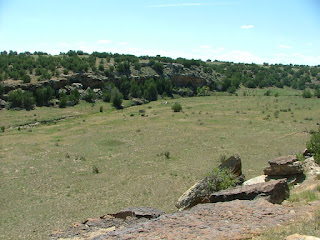
Comanche Grassland - La Junta, CO.
Photo property of the author

The Colorado Cowboy could easily have been the Colorado Sheepherder. Research shows that sheep were the first 'commercial' animal in Colorado.

In the book "Historic Ranching Complexes on the Pinon Canyon Maneuver Site" the authors state that ranching, specifically sheep ranching was brought to the southwest with the settlers from Mexico in the 1500s. It was sheep that formed the basis of ranching as the early settlers knew it. Other livestock were for personal use. It was the Churro Sheep that became the breed of choice due to its hardiness, meat, and wool. 

These ranchers would move the sheep across the open range seasonally, usually penning the livestock at night for protection. In winter they would settle them near the rivers and/or close to the settlements. Where the high country range was used on a more permanent basis, rock walls and shelters were built to create wind rain blocks.

Even as late as 1879, sheep and its wool, which is a twice a year crop, were still popular. In Colorado Springs, one of the principal money earners was wool growing. The city directory shows a list of twenty-five stock growers vs thirty-five wool growers. What is most interesting about this list is the number of people who were doing both.

So where does the Cowboy fit into this picture? Columbus and other early explorers may have introduced cattle to the new world, but Colorado really didn’t see them until people started their journey on the Santa Fe Trail, which passed through the southeast section of Colorado. The Bent brothers, of Bent’s Fort fame, would trade one oxen for two worn-out ones. Thus they built a herd of ‘beeves’. In the 1840s the Army ordered 500 ‘beeves’ from the Bents to supply Kearney and his Army of the West on their trip from Fort Leavenworth, Kansas to Santa Fe, New Mexico.

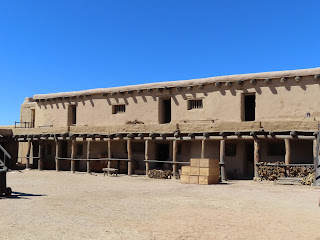
Interior of Bent's Fort 
Photo property of the author

In the central Colorado plains, there is a mention of one man who had cattle as early as the 1830s, but not much more is known about him and his herd.

It was during the cattle drives from Texas through Colorado that the cowboy took his place in this state’s history.  The 1866 Goodnight/Loving Trail went through Pueblo, along the Front Range to Denver, Colorado. This trail was one of the earliest to enter the state. In 1867 Goodnight established a ranch near Pueblo, Colorado. The barn his ‘cowboys’ built in 1869-70 in the Pueblo region, still stands today. 

A second trail, called the Potter/Blocker (Bacon) trail came through the eastern part of Colorado on their trip to Montana sometime around 1883. Not as well known and harsher than most, it traversed a drier and more unforgiving area for such drives. 

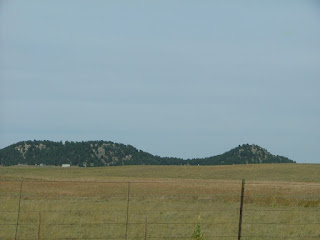
Eastern Plains of Colorado
Photo property of the author 

Today, Colorado still has cowboys and cattle grazing on the land. This legacy is traced back to the early settlers who braved this new country and left their mark. I will leave you with this quote from the book Century in the Saddle: The 100 Year Story of the Colorado Cattlemen’s Association, 1867-1967:

The cattlemen who built the Colorado range industry in the later 1860’s and 1870’s were not all heroes, nor were they all villains. However, there were both heroes and villains among them. Essentially they were pioneers, with the foresight to see a future in the cattle business...”


Doris Gardner-McCraw -
Author, Speaker, Historian-specializing in
Colorado and Women's History
Angela Raines - author: Telling Stories Where Love & History Meet

Angela Raines FaceBook: Click Here


Post (c) by Doris McCraw All Rights Reserved

Wednesday, January 4, 2017

THE KING RANCH by Cheri Kay Clifton

What and where is the King Ranch?


Some would answer, “It’s a Ford Truck.”  And yes, one can be found in our garage. My hubby has owned King Ranch trucks for years. 


However, seeing the famous “W” brand on our leather console and floor mats as well as the “EST. 1853” designation, the question for me arises, was there really a King Ranch?

Here’s a little history about a huge ranch in the big state of Texas.

Ranches in the American West grew in both size and number after the American Civil War. What may have been the largest ranch in the world in the late 1850’s was the enormous King Ranch, located in southeast Texas, south of Corpus Christie. Founded in 1853 by Richard King, the King Ranch covers 825,000 acres (1289 square miles) – a little over the size of Rhode Island.

Born to a poor Irish family, King grew up in New York City. Wanting to escape the confines of city life, young Richard learned the trade of seamanship, became a captain and with hard work and determination, made his way into the steamboat industry along the Alabama and Florida rivers. After moving to South Texas, he built up his river transportation empire, running supplies on the Rio Grande during the Texas Revolution. 


Soon he was investing his money in land for cultivation and cattle raising and by 1855 had grown a ranch empire of longhorn steers as well as thoroughbred horses. In fact, the legendary vaqueros and many of Captain King’s descendants have been devoted to the ranching life through the generations and have made top quality horses a clear priority on King Ranch.


The “running W” brand the King Ranch uses today first saw duty in the 1860’s and was officially registered in 1869. Not even the current King Ranch management knows for sure where the “W” really comes from. Some believe it represents one of the ranch’s many diamondback rattlesnakes or possibly the Santa Gertrudis Creek. Others say it signifies the sweeping horns of a Texas longhorn bull.


Regardless of its meaning, today the Running W appears on both prize-winning cattle and top quality leather goods as an indisputable icon of the American ranching industry.

Oil fields and timberland increased the success and wealth of King Ranch into the 20th Century and the empire now has satellite locations in Florida, New Mexico and South Carolina.

In 1961, King Ranch was designated a National Historic Landmark. Today the King Ranch Visitor Center in Kingsville, Texas offers an extensive museum, daily ranch tours and holds special events.

Is it still the biggest ranch in the world?

No … the biggest ranch is Anna Creek Station in South Australia covering 6 million acres. However, counting all its locations, the King Ranch is the biggest ranch in the U.S. and considered “one of the biggest” around the globe.

The King family and the ranch are part of the myth and mystique of Texas and have been featured in numerous stories and novels. The Kings of Texas traces the history of the ranch through “decades of conflict arising from the Mexican-American War, the Civil War, and the many skirmishes between Texas Rangers and border bandits.

Edna Ferber’s novel, Giant, about the ranches of Texas was turned into a film of the same name. The theme song of the film is a staple for high school bands in Texas. Many of the events of the King Ranch, such as the discovery of oil on the property, are also in the film.


In the James Michener novel, Centennial, the Venneford Ranch was said to be patterned after the King Ranch.

The western historical fiction novel, Lords of the Land by Matt Braun is based on the King Ranch and its founder, although names and some circumstances were altered.

After reading but a small portion of the history of Richard King and the King Ranch, I can see why Ford is proud to put its symbol on their trucks. 

Visit my web site at www.cherikayclifton.com and check out my books on Amazon 

"The Old West isn't just a time or place, it's a state of mind."


Saturday, November 26, 2016

THE WINTER THAT CHANGED CATTLE RANCHING FOREVER


Many parts of the United States are already experiencing snow. No matter how cold you are now, the winter of 1886-87 in Montana and the Midwest was colder. Not only did ranchers lose much of their stock and some ranchers and cowboys lose their lives, this weather changed the cattle industry forever.

In the Wild West, cattle were a staple—cattle drives, cattle towns, cattle herds, cattle ranches. Cattle were king through the 1870s up until the mid-1880s. The fenceless open range meant grazing land was easy to come by, so ranchers could own massive herds of cattle. Through much of the late 1870s and into the 1880s, cooler summers and mild winters meant that feeding the animals was relatively easy. Grass and feed were typically pretty plentiful.

Overstocking the Montana range had been the norm since the early 1880s. Texas and Eastern cattle were shipped or trailed in, joining herds already feeding on the rich grasses of the northern plains. By fall 1883, about 600,000 head of cattle filled the range, sharing the resources with an equal number of sheep and a proportionately smaller number of horses. By this time, the range was at its capacity.

By early 1886 more cattle, which had not yet developed the ability to withstand rugged Montana winters, filled the range, receiving less nourishment from the sparse grass. This resulted in more animals grazing on the same amount of grass, which became thinner, requiring more acres per animal even as more animals per acre arrived. By 1885 Montana's range showed the effect of this vicious circle.

Open Range

Rancher Conrad Kohrs noted, "It takes 20 acres on a new range to feed one cow, after the range has been grazed two years it will take almost 25 acres, and after six years all of 40 acres."

Things were about to get much worse. In 1884, a drought crept upward from Texas across the Great Plains and reaching Montana in 1886. By September, some places in Montana and Wyoming had received only two inches of rainfall. Usually lush grass became sparse. Crops failed. Due to the fertile grass of earlier years, most ranchers did not put aside hay for winter, so many cows that weren’t killed by the cold soon died from starvation.

By 1885, beef prices were falling and much of the open range was overgrazed, mainly because cattle barons had built up herds too large for the land. But the barons—many of them Europeans—who owned huge swaths of land from Canada to Mexico, maintained business as usual.

In his annual report of 1886, the commander of Fort McKinney near Buffalo, Wyoming Territory, wrote, “The country is full of Texas cattle and there is not a blade of grass within 15 miles of the Post.”

By 1886, the cattle business was in trouble. Overgrazing had depleted the grasslands, herds of sheep were competing for what remained, and farmers were beginning to stake off parts of the open range. Beef prices were falling, and during the hot, dry months of summer, the herds grew thin and weak. By November 1886, wholesale cattle prices in Chicago fell to $3.16 per hundredweight, half of what they had been in 1884.

More grass died. Brush fires burned off even more. Water sources dried up. Other signs pointed to a tough winter ahead—geese going south earlier, cattle growing thicker fur, beaver stacking more wood for dens.
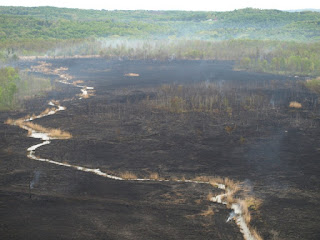
Brush Fire's Destruction

Following the summer drought disaster came the worst winter ever recorded. The first snow came on November 13, 1886 and fell continuously for a month. Then, in January 1887, the temperature dropped even farther, and blizzards came howling over the prairie, blasting the unsheltered herds. Some cattle, too weak to stand, were actually blown over. Others died frozen to the ground. Even buffalo died when their breath froze them to the ground where they stood. In some instances, people got lost close to their houses and froze to death very close to their front doors.

“It was all so slow, plunging after them through the deep snow that way..... The horses' feet were cut and bleeding from the heavy crust, and the cattle had the hair and hide wore off their legs to the knees and hocks. It was surely hell to see big four-year-old steers just able to stagger along.” Teddy Blue Abbott


No place was safe—California got nearly four inches of snow in San Francisco. North Texas and the Panhandle were inundated. Blizzards roared across the West in January 1887. Temperatures dropped to 30 below in some places. They hit 43 below the next month. On Jan. 14, 1887, temperatures in Miles City, Mont., bottomed out at 60 below zero.

The Laramie Daily Boomerang of Feb. 10, 1887, reported, "The snow on the Lost Soldier division of the Lander and Rawlins stage route is four feet deep, and frozen so hard that the stages drive over it like a turnpike."

Waiting for a Chinook by Charles Russell

Day after day the snow came down, thawing and then freezing and piling itself higher and higher. By January the drifts had filled the ravines and coulées almost level,” remembered Theodore Roosevelt, who was ranching in Medora, Dakota Territory at the time.

Warm Chinook winds began the thaw by March 1887. Then the losses of cattle were discovered. A large number of cattle carcasses were spread across the fields and washed down streams and polluted drinking water. Dead cattle littered the countryside and bobbed in the freshening rivers. An estimated hundreds of thousands of cattle carcasses littered the land—many pushed up against wire fences or lining roads. Total losses went unreported, but in some areas, up to 90 percent of the herds were wiped out.

“[I saw] countless carcasses of cattle going down with the ice, rolling over and over as they went, sometimes with all four stiffened legs pointed skyward. For days on end . . . went Death's cattle roundup.” Lincoln Lang

By spring, the magnitude of loss was staggering--60% to 95% in places. The few remaining cattle were in poor health, being emaciated and suffering from frostbite. Small ranches went out of business. Even some huge cattle companies declared bankruptcy.

The Conrad Kohrs herds in the Deer Lodge Valley survived. With a $100,000 loan by Butte banker A.J. Davis, Kohrs was one of the few able to rebuild. But the disaster foreshadowed the end of the open range cattle era.

John Clay wrote in MY LIFE ON THE RANGE, “As the South Sea bubble burst, as the Dutch tulip craze dissolved, this cattle gold brick withstood not the snow of winter. It wasted away under the fierce attacks of a subarctic season aided by summer drought. For years, you could wander amid the dead brushwood that borders our streams. In the struggle for existence the cattle had peeled off the bark as if legions of beavers had been at work.

Those who tried to carve out a ranch by claiming unbranded calves ran smack into the old guard cattle barons. Range conflicts broke out, perhaps most notably the Johnson County War in Wyoming.
That deadly winter had changed cattle country. As The Rocky Mountain Husbandman newspaper in Diamond City, Montana, reported, “…range husbandry is over, is ruined, destroyed, and it may have been by the insatiable greed of its followers.”

Ranchers stopped keeping such gigantic stocks of cattle and began larger farming operations in order to grow food for the animals they had. Most also quit the open range, where livestock could roam far from grain reserves, in favor of smaller, fenced in grazing territories. The winter of 1886-1887 signaled the beginning of the end to the days of roving cowboys and the untamed western wilderness.

Foreigners felt leery about investing out West. Cowboys became more of an iconic symbol than a constant presence. Cattle were no longer king. Thousands of cowboys were out of jobs. Some drifted back East or looked for work in Western towns. Others (like members of the Wild Bunch) turned to less honorable pursuits that included rustling and outlawry.

Then future President Teddy Roosevelt wrote his friend, Henry Cabot Lodge, “Well, we have had a perfect smashup all through the cattle country of the northwest. The losses are crippling. For the first time I have been utterly unable to enjoy a visit to my ranch. I shall be glad to get home.”

Historians generally agree that Wyoming cattle losses during that winter tend to be exaggerated. Larson thought overall the state lost about 15 percent of its herd, although operators in Crook and Carbon counties lost roughly 25 percent of their stock. The Wyoming cattle business never again achieved the stature it had from 1868 to 1886. Historians debate over when the Old West died. The Great Die-Up may not have been the end, but the disaster certainly played a role in finishing the era.

Winter of 1886–1887 was extremely harsh for much of continental North America, especially the United States. Although it affected other regions in the country, it is most known for its effects on the Western United States and its cattle industry. This winter marked the end of the open range era and led to the entire reorganization of ranching. Cattlemen reportedly called the winter of 1886-87 the "Great Die-Up." That winter proved again that nature could at any moment shatter all sense of human control.


Caroline Clemmons writes contemporary and historical western romance. Her latest release is her contribution to the bestselling WILD WESTERN WOMEN MISTLETOE, MONTANA. On November 29th, she will release ANGEL FOR CHRISTMAS. All her books are at her Amazon Author Page. Join her newsletter subscriber list for a FREE novella here.


Sources:
Elizabeth Ayers for Montana Sky Kindle World authors.