Showing posts with label Montana. Show all posts

Thursday, December 26, 2019

THE FIERCEST WINTER!


By Caroline Clemmons

As Marisa Masterson reported on the 24th, ranchers faced isolation and deprivation. I have great sympathy for the rancher’s wife who was left at home alone while her husband—if he was fortunate to afford them—rode with his cowhands. Both faced harsh conditions that I’m relieved I haven’t had to encounter.

Imagine being a new bride from the East whose husband dreams of becoming a rancher “out West”. The two of you set off with high hopes, little realizing the demanding life that awaits you. Of course there were happy times. I am picturing the young woman surrounded by friends and family who suddenly finds herself far from another house much less a town. Culture shock!

Not long after the mid-twentieth century, my cousin and her husband went to Dupree, South Dakota where he was in a government program to teach Sioux Indian veterans about farming. (Privately, she thought the Sioux knew more about farming on the reservation than their teachers.) My gregarious cousin and her husband lived in a home with a small acreage. She said she wondered when she arrived why there was a clothesline strung from the back door to the barn. She soon learned it was not for clothes but so they could reach the barn and back without becoming lost in the snow. She reported going to a rodeo in Pierre one fourth of July when it snowed. I don’t know how long they lived in South Dakota. She said after one particular year with 118 inches of snow, she was D.O.N.E. with South Dakota and they moved back to Texas.

Through much of the late 1870s and into the 1880s, cooler summers and mild winters meant that feeding the animals was relatively easy. Grass and feed were typically plentiful. During the last quarter of the nineteenth century, especially harsh conditions occurred. The entire continent was affected but especially the central United States. The drought began the summer of 1884 in Texas and climbed north up the great plains then turned west, saving the worst for Wyoming and Montana Territory in 1886. This period became referred to as “the Great Die Up” of 1887.

Overstocking the Montana range had been the norm since the early 1880s. Texas and Eastern cattle were shipped or trailed in, joining herds already feeding on the rich grasses of the northern plains. By fall 1883, about 600,000 head of cattle filled the range, sharing the resources with an equal number of sheep and a proportionately smaller number of horses. By this time, the range was at its capacity.

By early 1886 more cattle, which had not yet developed the ability to withstand rugged Montana winters, filled the range, receiving less nourishment from the sparse grass. This resulted in more animals grazing on the same amount of grass, which became thinner, requiring more acres per animal even as more animals per acre arrived. By 1885 Montana's range showed the effect of this vicious circle. 

Cattle in the mountain snow
Credit: Deposit photos

Successful rancher of that era, Conrad Kohrs, noted, "It takes 20 acres on a new range to feed one cow, after the range has been grazed two years it will take almost 25 acres, and after six years all of 40 acres."

By 1885, beef prices were falling and much of the open range was overgrazed, mainly because cattle barons had built up herds too large for the land. But, the barons—many of them Europeans—who owned huge swaths of land from Canada to Mexico, maintained business as usual.

In his annual report of 1886, the commander of Fort McKinney near Buffalo, Wyoming Territory, wrote, “The country is full of Texas cattle and there is not a blade of grass within 15 miles of the Post.”

Depending on the open range policy and the verdant grass of previous years, most ranchers didn’t store hay or feed for their cattle. When the drought hit with only two inches of rain the summer of 1886, cattle went into the winter undernourished.

During this time, there was an open range policy in which cattle had been allowed to roam free over the previous years’ lush grasses. With only tiny amounts of rainfall in 1886, creeks and rivers dried up and grass did not flourish. Without sufficient rain, the grass was sparse and not as nutritious for cattle. In addition, the dried out land sparked prairie fires that destroyed even more grazing.

Of course, in my romances set during this time in Montana, I write about astute rancher heroes such as Preston Kincaid in AMANDA'S RANCHER, Loving A Rancher Series book 1. They had fenced their land and grew hay, oats, and food crops to sustain them and their animals all year. They had dug trenches or canals to water sources, had root cellars to store fruit and root vegetables, and operated as an efficient and profitable business. In fact, some real-life ranchers did this but most did not—to their sorrow.

Following the summer drought disaster came the worst winter ever recorded. The first snow came on November 13, 1886 and fell continuously for a month. Then, in January 1887, the temperature dropped even farther, and blizzards came howling over the prairie, blasting the unsheltered herds. 

Some cattle, too weak to stand, were actually blown over. Others died frozen to the ground. Even wooly buffalo died when their breath froze them to the ground where they stood. In some instances, people got lost close to their houses and froze to death only a few feet from their front doors.

No place was safe—California got nearly four inches of snow in San Francisco. North Texas and the Panhandle were inundated. Blizzards roared across the West in January 1887. On January 9, 1887 almost a inch of snow fell every hour for a twenty-four hour period. Temperatures dropped to 30 below in some places. They hit 43 below the next month. On January 14, 1887, temperatures in Miles City, Montana, bottomed out at 60 below zero. Honestly, I don’t know how anyone or anything survived that!

The Laramie Daily Boomerang of Feb. 10, 1887, reported, "The snow on the Lost Soldier division of the Lander and Rawlins stage route is four feet deep, and frozen so hard that the stages drive over it like a turnpike."

Waiting for a Chinook
by Charles M. Russell

Warm Chinook winds began the thaw by March 1887. Then, the widespread losses of cattle were discovered. A large number of cattle carcasses spread across the fields and washed down streams and polluted drinking water. Dead cattle littered the countryside and bobbed in the freshening rivers. An estimated hundreds of thousands of cattle carcasses littered the land—many pushed up against wire fences or lining roads. Total losses went unreported, but in some areas, up to 90 percent of the herds were wiped out.

Day after day the snow came down, thawing and then freezing and piling itself higher and higher. By January the drifts had filled the ravines and coulĂ©es almost level,” remembered future President Theodore Roosevelt, who was ranching in Medora, Dakota Territory at the time. Later, Roosevelt wrote his friend, Henry Cabot Lodge, “Well, we have had a perfect smashup all through the cattle country of the northwest. The losses are crippling. For the first time I have been utterly unable to enjoy a visit to my ranch. I shall be glad to get home.”

The Wyoming cattle business never again achieved the stature it had from 1868 to 1886. Historians debate over when the Old West died. The Great Die-Up may not have been the end, but the disaster certainly played a role in finishing the era. Winter of 1886–1887 was extremely harsh for much of continental North America. 

Although it affected other regions in the country, it is most known for its effects on the Western United States and its cattle industry. This winter marked the end of the open range era and led to the entire reorganization of ranching.  That winter proved again that nature could at any moment shatter all sense of human control—as if we need a reminder.

Sources


One desperate young woman.
A chance meeting.
A life-changing outcome.

Growing up in a brothel, Mara O'Sullivan battled public disdain and contempt, but always remained kind-hearted, virtuous, and gracious. After testifying against vicious bank robbers, her life is threatened and Mara must find sanctuary far from everything she knows.  

One train ride changes her life as she fatefully meets a half-sister, Amanda, and a niece she never knew existed. But when circumstances end her sister's life, Mara makes a promise that she'll raise her niece as her own and take her sister's place as Preston Kincaid's mail-order-bride. As Mara (now called Amanda) and Preston grow closer, their marriage no longer seems like a ruse, but a relationship of love, passion, and desire.

Mara's past comes back to haunt her and she finds herself in danger—will her new husband forgive her deceit and protect her as his own? 

Purchase link is: 

This sweet adventure is available in e-book and print and Free in KU.

Caroline Clemmons writes about love that lasts forever. 
Check her titles at her Amazon Author Page and Follow her at https://amazon.com/Caroline-Clemmons/e/B001K8CXZ6/  
Follow her at her Book BubBub Page at https://www.bookbub.com/authors/caroline-clemmons
To receive a FREE e-book, subscribe to her readers' newsletter at https://carolineclemmons.us5.list-manage.com/subscribe?u=0a24664c906875718d975ad7b&id=7c2e488a51    


Tuesday, November 26, 2019

BLACKFEET -- AMERICAN INDIANS OF MONTANA


By Caroline Clemmons

My husband, daughters, and I have long been fascinated by American Indians. We have tromped over Anasazi ruins in summer heat from Tennessee to New Mexico. Although we did make it as far north as Hovenweep and Mesa Verde, the rest of our stops have been in the southern United States.

Recently, I needed a tribe of American Indians to use for my book MELODY. That setting is Montana Territory, so I investigated that area. The Blackfeet/Blackfoot tribe was perfect for my story. I’ve always wondered why they were called Blackfeet.  I found the reason is because they dyed their moccasins black.

The Blackfeet are an Algonquin people who were migratory hunter gatherers of the plains. Late in the eighteenth century, they acquired the horse. Having horses gave them the ability to become great buffalo hunters. They raised tobacco which they mixed with herbs and called kinnikinnik.

You can imagine that for a book, I needed descriptions of their lifestyle, dress, and customs. I found wonderful graphics and photos online as well as customary names. I imagined a chief named Grey Wolf.
 
Chief Grey Wolf

Because my hero, Nick Walker, was a doctor, I thought he should meet the Blackfeet shaman. The graphic I found would be frightening to encounter. The medicine man dressed in a bearskin with the head attached and worn on top of his head. On the fur were attached reptile skins, bones, and feathers.
 
Blackfeet Shaman/Medicine Man

There are three major tribal divisions:
Blackfeet (Siksika) – North Blackfeet are those with black-dyed moccasins
Blood Kainai) – Middle
Piegan (Pikani) – Poorly dressed of the Southern area and the largest of the three Blackfeet-speaking groups that make up the Blackfoot Confederacy.

Piegan peoples in Canada and the United States were forced to divide their traditional homelands in the nineteenth century according to national borders. They were forced to sign treaties with one of those two countries, settle in reservations on one side or the other of the Canada/U.S. border. They were enrolled in one of two government-like bodies sanctioned by those two countries. Those in the U. S. are the Blackfoot Nation, a federally recognized tribe in Montana. The Pikani Nation is a recognized Indian band in Alberta, Canada.

Women wore traditional deerskin dresses. Men wore buckskin tunics and breechcloths with leggings. Both were often fringed and decorated with porcupine quills, beads, and elk teeth. In winter, they used buffalo hides as coats.


In spite of treaties, Blackfeet lands were decreased many, many times. In 1896, a 20-mile wide strip of Blackfeet Reservation was ceded. This strip is known today as Glacier National Park. The Blackfeet claim the land was only provided for a 99-year lease.

Twice the band was decreased by smallpox. Other conflicts affected the population. The Blackfoot Massacre, often called the Bear River Massacre, the Baker Massacre, or the Marias Massacre occurred on January 23, 1870. The Heavy Runner Band was camped on the Bear River during cold winter weather. A column of cavalry and infantry under the command of Major Eugene Baker attacked the sleeping camp early in the morning. The attack was purportedly to be in response to the killing of an influential rancher, Malcom Clark. Clark had been in several conflicts with Owl Child, a Piegan, who was not camped with Heavy Runner, but with Mountain Chief. By the end of the attack, 217 people had been killed. The largest numbers of victims were women and children. The army gave the death count at 173. While some political leaders were outraged, no disciplinary actions were taken against Clark or any of the soldiers.

The first land allotments were made on the Blackfeet Reservation in 1907-1908. Approximately 2,656 individual Blackfeet tribal members received allotments. In 1911, this was amended to include children born after the middle of the year, who were allotted 80 acres.

In 1934 of the 1,785 eligible voters, 994 voted in favor of tribal organization under the Wheeler Howard Act, commonly known as the Indian Reorganization Act. Under this legislation, the Blackfeet Tribal Constitution and By-Laws were ratified in 1935, creating a representative form of government through elected tribal council representatives. Originally numbering 13, tribal council representatives now number nine.

Did you find this tribe as fascinating as I did? I hope so. I also hope you’ll chose to read MELODY, Angel Creek Christmas Brides book 7. The universal Amazon link is http://mybook.to/Melody


Here’s the blurb:

Such a tiny lie…
Desperation drove her…
She couldn’t know the risk…

After the death of her grandmother, Melody Fraser must quickly leave what has been her home in South Carolina. There are those who think she murdered her Nana Fraser. She’s innocent but there’s talk about arrest and prosecution. To escape, this Southern belle agrees to become a mail-order bride in far away Montana.  

Nicholas “Nick” Walker is a doctor from Gettysburg whose wife and children were killed when mortar fire destroyed their home. Eager to escape the memories and ravages of the Civil War, he buys a medical practice in Montana Territory. He wants a competent nurse who can assist him with operations and care for patients as his plans expand for a hospital. He wants a well-organized wife to keep him company and start a family. With his usual efficiency, he combines the two into one job description when he requests a mail-order bride.

What will it take to teach Nick that—although she isn’t what he expected—Melody is exactly what he needs?

Here are a couple of quotes from my beta readers:
“I REALLY like this story. It has a lot of substance with fleshed out characters. I loved reading it.”

“Melody is a charming, engaging story that will heal your heart.”


Saturday, October 26, 2019

BLACKFOOT INDIANS OF MONTANA


By Caroline Clemmons

The name Blackfoot Indians fascinated me since the first time I heard it. Until recently, I didn’t investigate this tribe. I felt certain this group of people didn’t really have black feet, but I did wonder why they were labeled Blackfoot. Their custom of dying their moccasins black gained them their name.

Blackfoot with horses

 
In the past few years I’ve set several books in Montana. I set out to learn more about the indigenous people there. Although there were Blackfoot, Crow, Sioux and smaller tribes in Montana, the area in which my latest book is set is where the Blackfoot live.

Blackfoot man wearing buffalo robe


The Blackfoot/Blackfeet are an Algonquian people who were migratory plains hunter-gatherers from the Great Lakes region until they acquired horses and rifles in the 1700s. They then became hunters and raiders and migrated to the Northwestern United States, specifically Montana and Idaho as well as Alberta Canada. They were notably defensive of their territory. Although either spelling is acceptable, Blackfoot is the original name.

Six chiefs of Blackfoot Confederacy
Note the way they wear feathers

Three groups make up the Blackfoot Confederacy. The Blackfeet (Siksika), the Blood (Kainai, Kainah), and the Piegan (Piikani, Pigunni). The Blackfoot Confederacy in the United States and Canada  were forced to divide their traditional homeland in the nineteenth century according to national borders. They were forced to sign treaties with one of the two countries and settle in reservations on one side of the border or the other. They were then enrolled in one of the two government bodies. The two successor groups are the Blackfeet Nation, a federally-recognized tribe in Montana, and the Piikani Nation, a recognized Indian band in Alberta, Canada.

Blackfoot girl teen

In my book, MELODY, book 7 of the Angel Creek Christmas Brides, the heroine and hero rescue an injured Blackfoot teen and take her to their home to recover. That meant I had to know what she would have worn. Blackfoot women wore long deerskin dresses. The photo of a teen shows her with a less elaborate style of dress than a woman would have worn. Men wore buckskin tunics and breechcloths with leggings. Blackfoot dresses and war shirts were fringed and often decorated with porcupine quills, beads, and elk teeth. Both Blackfoot women and men wore moccasins. In winter they wore buffalo-hide robes.

Burning sweet grass in the sweat lodge

 They used a sweat lodge for medical and purifying reasons. In the sweat lodge, they burned sweet grass. I had thought this was just nice grass. No, sweet grass is a plant they used for the scent and the idea that it purified the air.  

They used red paint on their
face for war. This is how I
described the girl's father in
my book


Blackfoot raised tobacco. Tobacco, Nicotiana rustica, was originally used primarily by eastern tribes, but Blackfoot often mixed it with other herbs, barks, and plant matter, in a preparation commonly known as kinnikinnick. They sometimes used kinnikinnick in a poultice to treat a medical condition.


There are many interesting facts about this group of people. I hope I’ve whetted your interest and you’ll dig into researching them. You can learn a little more from reading MELODY, now on pre-order for a November 8 release from Amazon. The Universal buy link is htpp://mybook.to/Melody.


The Angel Creek Christmas Bride Series for 2019 begins releasing November 1 with CAROLINE by Lily Graison. Releases will be each week. All six are available for pre-order. Covers are identical except for the author's name and the book's title.

Wednesday, August 14, 2019

THE BLACKFOOT AND CROW OF MONTANA BY SHIRLEEN DAVIES


The Blackfoot and the Crow were two tribes of Montana whose lands overlapped. Both play a significant role in book six, Promise Trail, from my Redemption Mountain historical western romance series.
Blackfoot with bone chestplate.
The Crow, sometimes we're referred to as the “Crow Nation” derived their name from their own native word, Aspalooke (opp-sah-loh-kay), which literally means “children of a long-beaked bird.” The French translated this as “People of The Crow.”

The Blackfoot Tribe, or sometimes “The Blackfoot Confederacy,” trace their roots to lands near Alberta, Canada. Their territory stretched all the way to the Yellowstone River of Montana. They were united by a common language, and originally carried the name Niitsitapi, literally translated as, “the original people.”

Although tradition made them enemies, each tribe had many similarities. Both were nomadic hunter-gatherers, lived in tipis, were expert horsemen, and hunted buffalo.

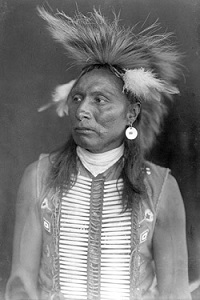
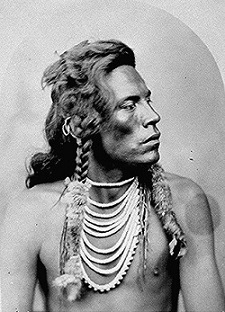
Crow brave.

Spirituality was important to both tribes, each embracing a mystical, earth-based religion. Both tribes believed everything in nature—plants, trees, rivers, mountains, and rocks—had a spirit. Crow and Blackfoot men used sacred sweat lodges to breathe in the steam from the sacred rocks, allowing mother earth to draw negative energy and toxins from their bodies and spirits.  The men emerged sweaty and virile, cleansed and rejuvenated.

Appearance was important to the Crow. Men never cut their sleek, beautiful hair. It flowed from their broad warrior shoulders past their muscled chests and flat stomachs to their powerful thighs and calves, and down to their feet. Oiled with bear’s grease, their long hair shined like raven feathers. When hunting or fighting, they’d pull the long tresses into a bun.
Crow chief.

Crow men took great pride in their dress, wearing opulent sun-bleached buffalo robes which were a brighter white and finer than those of other tribes.

The Crow were generally a friendly people, even towards the white settlers, securing them a sizable reservation in Montana. Their main food source came in the form of American Bison, which they hunted with impressive efficiency and innovation. They also used the bison skins for clothing in the winter and for their traditional shelters, the tipi and skin lodge.  Their main form of transport came from horses, which they learned to breed and train.

Crow women played an important role in society and were well regarded, evidenced by the fact that when a couple married it was always the man who moved into her home and never the other way around.
Blackfoot woman with child.

The Blackfoot were named that by French fur traders who watched them walk through a prairie fire, noticing the black bottoms of their moccasins. The name the Blackfoot called themselves means Lords of the Plains. And their plains, the majestic Blackfoot territory, held more buffalo per square mile than anywhere else in the northern lands.

Four northwestern plains tribes made up the Blackfoot Confederacy: the North Piegan, the South Piegan, the Blood, and the Siksika tribes. They shared the same language and culture, had treaties of mutual defense, gathered for ceremonial rituals, and freely intermarried.

These handsome lords of the plains fashioned their flowing hair into three long braids with a topknot or pompadour. The women wore their hair loose or in two long, thick braids.
Blackfoot chief Big Mouth.

A war-like people, the Blackfoot granted a great deal of honor and tribal esteem to members who committed brave and heroic deeds. They played a significant role in the Indian wars.

Thank you for reading the post. I’d love to hear your insights or comments about the Crow and Blackfoot people.

Promise Trail, book six in the Redemption Mountain historical western romance series, includes scenes about the Blackfoot and Crow tribes, and is available at most online retailers.


Please take a moment to sign up for my Newsletter and Follow Me on:


Sunday, May 12, 2019

Curly Learns a Lesson

by Rain Trueax

When I wrote this blog, I didn't know it'd end up on Mother's Day. For all you moms, and all of us who have moms-- which is all of us--

You know, a mom isn't just about biological mothers but all those who nurture others. In the book, from which he arose, Curly was a man and a lifelong cowboy. He'd never had a child, but he was one of those who nurture others (which is what cowboys do-- sometimes having to pull life into existence and then fight to keep it alive). He's appropriate for Mother's Day :)


*****************

Years back, for a friend's summer short story blog, I wrote one that followed up some of my favorite characters in the contemporary western romance, From Here to There and follow-up novella, A Montana Christmas.  


Sometimes a character takes hold of you, but there really isn't a whole story for them-- at least not at the time. Curly was such a character, a cowboy all his life with no desire to change it. He thinks he knows all he needs to know but is about to find out he's not too old for some new lessons. This is a short story that stands alone. I have though been considering a possible novella for the Rocking H-- a senior romance. The question is who would the characters be? The short story offers a few clues.


Curly Learns a Lesson
by
Rain Trueax

“Amos,” Curly yelled wondering where his boss had got to. Seemed he was more and more disappearing at odd times. When his friend’s bearded face appeared, he was grinning and in his hand was a cell phone.
“Dang it all,” Curly said glaring at the phone. “You on the phone to that woman again.”
Amos’s smile broadened. “You know her name.”
“Supposin’ I do.”
“Wal, use it.”
“Ever since you reconnected with that old teacher of yours, you ain’t been no good for nothing!”  If he had expected his older friend to take offense, he’d been wrong. He was grinning like a fool teen-ager.
“Well, first off, wasn’t talkin’ on the phone. We was texting.”
“Only kids text.”
“That and those without enough signal to talk on the blamed phone.” Amos' smile hadn’t disappeared. Clearly he was proud of himself.
“She’s old enough to be yore mother,” he tried a new tack.
“But she ain’t,” Amos said with a chuckle, “and it ain’t like she’s all that old inside. She can still dance me under the table.”
“Ninety-five if she’s a day.”
“Ninety-four and I’m seventy-six. So what. We ain’t kids, and we know what we want. More than I can say for you.”
“What’s that supposed to mean?” Curly walked over to a bale of hay and plopped down wishing he still smoked. Stupid habit smoking but it gave a man something to do with his hands and an excuse not to answer without seeming like stonewalling.
“You danged well know what it means.” Amos sat on the feed bin across from him.
Outside a welcomed summer rain began. The distant hills were quickly swallowed by mist as the rain grew heavier. The sound on the barn roof was pleasing to Curly’s ears though he’d heard it thousands, maybe millions of time. Never a time where Montana didn’t need more rain especially in the summer.
The steady rain also kind of set him and Amos off into a little world of their own. Friends for well over fifty years, nearer now to sixty, this little man was important to Curly, as important as his own existence. He guessed he didn’t want to lose him and suddenly felt he might. Danged women. Nothin’ but trouble, that’s what they were.
“All right,” he gave up when Amos wasn’t willing to let this go. Bad as a dog with an old bone. “Ain’t really goin’ nowhere with Linda.”
“That yore doin’ or hers?”
“Both. She’s busy a lot getting that little deli of hers going. Still got that brat daughter living with her. Ah hell maybe it’s all an excuse.”
“You just scared is all,” Amos suggested.
“Not of nothin’.”
“Sure ya are. You don’t want to get burned.”
“Been married four times. Seems a man oughta learn something one of them and I see she ain’t wantin’ nothin’ with me... not with no man right now. She’s been burned too.”
Amos nodded. “All right, if not Linda, how about Marion, Belle’s friend?”
“Belle? Now ya call her Belle?” Curly felt his face pickle up as though he’d eaten something sour.
She likes it better than Annabelle.”
He looked around for another excuse. “Marion’s older than you.”
Amos shook his head. “Don’t look older than you, ya old coot.”
“Likely had that plastic surgery stuff or maybe that Bo something that they inject in their skin.”
“So what if she has?”
“Well it’s all to fool a man.”
Amos chuckled again. “Never know about that ‘til you find out what’s under the peelings.”
“You talkin’ dirty to me, Amos?” Curly tried to find a shocked look.
“I mean personality, ya dumb...” He stopped before he finished the insult. “Trouble with you, Curly, is you never did get to know women. Married ‘em maybe but never took the time to get to know one. How about you double dating with me and Marion, go to a movie or something. Dinner out.”
Curly stood up with outrage. “This is going too damned far. First, you’re texting. Now you’re wanting to double date. Good God, Amos, how far you takin’ this with that woman?”
“Well with Phil and Helene busy with two babies and Rafe off on a buying trip for Phil’s business and Emile and Nancy busy with school stuff, I shore got no family reason to hold me here. As for age, she’s more likely to bury me than me her. Man only got so many years and better make ‘em good. Only got one nursemaid wanting me to back off. And that ain’t happening. I had one good marriage; and if I get lucky enough to get another, why I’ll just damned well do it.”
Curly let that seep in and fully digest. He could lose his friend. “Where would ya live if ya done that? She’s still got that painting stuff she does and wants to be in Bozeman. I cain’t see her coming out here.” He felt fear now greater than before. He’d be alone because Amos was right, the young ones had their own lives. What did he have?
“I been thinkin’ about that and ain’t ready to take it that far yet. Might be Belle don’t want a husband.”
“She’d be a fool not to want you.” Curly still found it hard to believe their old teacher and his best friend had found love at their ages.
Amos grinned. As for where it takes you... Wal, I’d say—learning to text. Want Marion’s number or would ya rather it be Linda’s?”
“She’s got one? Hell, I ain’t even got a phone.”
Amos’ smile broadened. “Sure ya do. I bought it for ya a month ago. Ya just been too stubborn to learn to use it. Ain’t like a seventy-year old man can’t learn new tricks.”
Curly slumped back to the hay bale. “Could ya write it all out for me?”ow

Saturday, May 12, 2018

A Ghostly Ghost Town?

by Rain Trueax


In 2010, my husband and i were on a freewheeling trip through Montana, with no set destinations. He suggested we stop at Bannack. I wasn't that excited at the possibility, since I knew little of its history as a mining town. When we got there, I learned it was where Henry Plummer met his end, and I instantly got more interested.

Bannack was supposed to be Bannock, for the Native American tribe. When registering it, someone misspelled it. After stopping at the visitor center, paying the admittance and getting a small pamphlet explaining some of the buildings, we were free to wander through the town. It was very picturesque, perfect for the camera with structures in better shape than many other ghost towns  I have visited.

In several of the buildings, I wondered if there might be ghosts. Mining towns of that time had many sudden deaths with much potential for a spirit hanging around. I didn't actually feel any energy from a ghost-- despite being open to it. Maybe a nighttime visit would have a different result. Do ghosts have a preferred time to come out? Especially in the hotel, I took photos wondering if something more would show up-- it didn't.

One of the more likely possibilities as a ghost would be Henry Plummer. His story is filled with all the controversy as is found with other bigger than life people of that time. Was Plummer a murderous outlaw or in the end victimized by the vigilantes who were the real robbers and killers. Online, you can find many opinions as to who he was and his history. Here's one-- [Henry Plummer].

When I decided to write about Bannack, I went looking online for 'ghost hunters' who had been there. Although I have never seen a ghost myself, I have been places where I've felt strange energies. I can't say it was true at Bannack. When I return someday, which I'd love to do, and camp in the lovely campground with our vacation trailer, I would at least know who might have been unwilling to leave even after death.

Dorothy Dunn was in her teens when she drowned in the dredge pond August 4, 1916. Her friend, who had been with her that fateful day, was the first to claim she appeared to her as a ghost. Today, it appears children are most likely to see her wearing a blue dress. She has talked to some in Hotel Meade, which had been her home, as her father was hotel manager at the time of her death.

Supposedly, the hotel has other apparitions. An older woman haunts the second floor as well as Dorothy. Crying children are also supposedly heard by some. Are those ghosts or impressions left by past energies. The hotel was used for a time
as a hospital-- places very likely to have ghostly manifestations.  Saloons like the one alongside here have sudden death stories of shootouts and bullets gone astray.
 
Another building with ghostly stories is Chrismans' Store. It had offices at the back used by Henry Plummer. Some, who do this kind of research, claim to have photographed hauntings with fuzzy figures. This though is the kind of thing that always makes me wary, since photos can be so easily faked. Still, are there even today ghostly meetings there where the men chew the fat-- so to speak?

The Bessette House is another claimed location. Abed Bessette, who first owned it, was one of the vigilantes. He raised sheep and owned several buildings, including the hotel. He died in Bannack in 1919. Did he not want to leave? 

The possibilities for ghosts in his home go beyond him. During typhoid, diphtheria, and other killer epidemics, his home was used to quarantine patients and many died there. There is supposedly photo evidence of a ghost there.

In terms of becoming a ghost, one of the most exciting potentials has to be Henry Plummer. After a checkered history (read link above) in 1863, he had arrived in Bannack where he was appointed sheriff.  Was he using that as a way to also rob and murder with his posse, named The Innocents? Whoever was doing the violence, 102 people were murdered in mining camps and along the road between [Bannack and Virginia City]. 

On December 23, 1863, a vigilante committee was organized, formed a posse, captured him, put him in his own jail before they hung him on a gallows above the town, along with two of his deputies. That gallows is still there or so goes the story. He'd done a lot in his 27 years but was he trying to do right by Bannack?  Questions remain as to whether the real robbers were the vigilantes since the robberies didn't stop with his death. 

Was Plummer wronged, and he hangs around the town out of anger at a tragic miscarriage of justice, a desire to find vindication, or did he have nowhere else to go after a misused life? There are those who claim they have seen him in the Skinner Saloon, Chrismans' store and other buildings in the town. His grave, higher up the gulch with the gallows, has been robbed twice. The second time it is claimed his skull was taken and put in a saloon. That saloon later burned to the ground.

Do I believe in ghosts? I don't know. I have friends who claim to see them. I've watched a couple of the cable shows where they search for them, knew one of the psychics who was on a show when they went to Tombstone ghost hunting. I haven't been convinced ghosts are a reality-- don't know that they're not either. 

I've put ghosts in only one of my books, A Price to be Paid. It's an Arizona paranormal/metaphysical romance that goes into reincarnation and whether one lifetime is enough to pay for wrong deeds. The possible man needing to pay for his misspent life was in one of my Arizona historicals, where he met a fitting end.

For me, such thinking comes under the heading of speculation and mystery. I won't go ghost hunting... well, unless I head back to Bannack to camp in that lovely campground.