Showing posts with label quilts. Show all posts

Monday, January 16, 2023

Gathering Around the Frame - The Quilting Bee by Jo-Ann Roberts


If you've been reading my blogs here on Sweethearts of the West, you know of my great love of quilts and quilting. Besides writing sweet historical romance, the afternoons I've spent creating quilts are the most relaxing, enjoyable, and self-satisfying hours to unwind.

  
Here are two examples of my quilts.

I quilt purely for pleasure, most days by myself. It's only during my annual Quilt Week in Lancaster County that I get together with my quilting "sisters" for ten days of sewing, fun, and food! In our own way, we are keeping alive the traditions of a quilting bee...exchanging ideas, swapping fabric, and sharing ideas and patterns.


Photos from my 2022 Quilt Week in Lancaster County, PA

So, what is a quilting bee?

The exact origin of the word is hard to determine, as is the case with many old things. It is either one, or a combination, of these two things:

  • The name bee stems from a beehive where bees work together for a single purpose
  • Bee is a folk-derivative from the word been or bean, meaning something good or helpful

Both words indicate the communal, helping-each-other spirit of a quilting bee. This spirit is still present in the quilting bees today.


A quilting bee has been a social tradition that has existed since the 19th century. Then, this social event was popularized as a way for women, especially for settlers of the Great Plains, to gather around the showcase their talent while they talked and gossiped with each other. Sometimes, women and their families came from miles away just to attend a quilting bee. Many times, the goal of a quilting bee was mainly social, and beginners were welcomed along with the experienced. A fun example of this was when young women would gather to help a bride-to-be finish her quilts before she married. What joyous social events these would have been.


These gathering were typically held when the weather got warm in the spring and
summer.  If a house was too small to hold a quilting frame, the quilting would be held outside. Gathered around a simply constructed wooden frame, the quilt in

Mehama, Oregon, 1905

progress would be stretched between two boards. This would result in a taut, flat surface for the women to sew on. Each woman would quilt her own block on the quilt. This allowed for the entire community to be represented on one quilt. Equally important, the women enjoyed getting away from the house and all the interruptions and distractions that come from being at home.


Edgar Melville Ward, Quilting Party, 1892
Collection of the International Quilt Study Center & Museum

Once the day was over, it was ended with a feast. The feast usually included wither roasted chicken or turkey. Men were also invited to the feast and gave the women the opportunity to mix and mingle.

The entire night was filled with dances and songs. The event was well-celebrated in many communities as it marked the end of long hours of labor, love, and exquisite craftsmanship.


The Quilting Bee by Anna May Robertson Moses (Grandma Moses)

 A quilting bee has always been a place where quilters help each other. In the olden days by finishing a quilt together, and in modern days by learning techniques and give each other feedback and inspiration. And mostly a quilting bee is a place for friendship and support. 
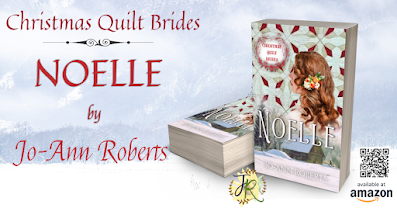


A widow reluctant to love again…
A deputy determined to win her heart…

Two years ago, Noelle Prentiss lost her husband to an outlaw's bullet. With two children to raise, a small farm to tend, and a job making quilts to sell at the mercantile, she's doing her best to keep her property and life intact...until a man claiming to be the new deputy rides into her life captivating her children with his dog, his smile, and his easy-going charm.

When Coleman West agrees to stop by the Widow Prentiss's home on his first day as a deputy in a small Kansas town, he has no way of knowing obeying the sheriff's order will change his life. Spurned by love years before, he became a lawman, dedicated to protect and serve. Yet, he has no idea the widow and her children would call to his heart in a way he never expected.

With Christmas looming, will the growing attraction between Noelle and the deputy reveal the gift of a second chance?

Or could a stranger from the deputy's past threaten the man who captured her heart?


Wednesday, December 16, 2020

QUILTING THE PAST- Part Two by Jo-Ann Roberts


QUILTING THE PAST- Part Two by Jo-Ann Roberts

“Our lives are like quilts, bits and pieces, joy and sorrows stitched with love."

“The best kind of sleep beneath Heaven above, is under a quilt, handmade with love.”

The first known quilt pattern published in an American periodical was the honeycomb or hexagon pattern published by the Godey’s Lady’s Book in 1835. While we know that some early periodicals like Godey’s, featured patterns for quilt making they seldom gave names to these patterns .

In the 1850’s Godey’s continued to publish quilt patterns for American quilt makers with a series of numbered but unnamed quilt patterns. Other mid-century periodicals published patterns occasionally, and references to quilts and patterns appeared with increased  frequency with the popularity of the periodical.


Quilt pattern names reflected all aspects of life on the trail West.  While Biblical names reflected the belief and conviction of the importance of a spiritual life so valued as the pioneers walked and rode into an unknown land, more down to earth names like Hole in the Barn Door, Broken Dishes, Cake Stand, Basket, Baby Blocks, Rail Fence, Churn Dash, and Log Cabin echoed the environment that the quilt maker lived in.

    
                                          Log Cabin                       Hole in the Barn Door
 

Quilt pattern names that reflected patriotic emotions and political views are proof that women were interested in these issues, and that they were knowledgeable of current social events. While their voices may not have been heard at the time, their words speak out from their work and remain for us to see today.  Abe Lincoln’s Log Cabin, Railroad Crossing, President’s Wreath,  Martha Washington Star, Fifty-Four Forty or Fight were popular choices.


Martha Washington Star 


But by far, the patterns created  from what pioneers saw, heard and experienced on the trek to their new homes are still some of the most popular quilts today. 

The Crazy Quilt

The Crazy Quilt is one of the oldest quilt patterns. Early quilters used an scrap, regardless of its color, design, or fabric type. Children’s worn clothing, women’s calico dresses, men’s canvas pants and coarse shirts, and household linens were cut, fitted and stitched together, resulting in a hodgepodge of color as well as a story behind each scrap.


The Road to California


The discovery of gold at Sutter’s mill, near Sacramento, triggered the great migration westward in 1849. Soon it was not just men but families on the road to California. Many of the Road to California patterns involve triangles. Many patterns created during the trek used triangles to represent the flight of birds and their movement. The Flying Geese pattern involved a series of triangles going in the same direction representing the migration of geese. So, it’s not surprising the triangles were used to represent the migration of pioneers as well. Sometimes  the pattern is known as Road to California or at other times The Underground Railroad or Jacob’s Ladder.


The Rose of Sharon


It was no secret that the trip west would be filled with danger.  Holding on to their faith and devotion to The Lord was, in many cases, all that kept them going. A quilt made with blocks named from the Bible would be a source of comfort.

One of the oldest applique quilt patterns is the Rose of Sharon. The Rose of Sharon, mentioned in the Bible, might actually refer to a wild tulip that grows today on the plains of Sharon in Palestine. When the Bible was translated into English, the word rose was used in place of the word tulip.

During the 1800s, there was a custom for a young girl to make a baker's dozen of quilt tops before she became engaged. This collection consisted of 12 utility quilts, and one great quilt, which was pieced or appliqued, as a show piece for a bed. The Rose of Sharon was often used for the great quilt. Many young women traveled West as brides, their great quilt folded safely in a trunk.

Many times the quilt maker deliberately sewed a mistake somewhere in the quilt. It is thought, by some, that this reflected the maker's faith in God; for only God can make a perfect thing.

The Schoolhouse Quilt 

In many cases, settlers went West for a better life, and part of that better life was education. It was natural then, that the schoolhouse was often one of the first public buildings constructed in many communities.  

The Schoolhouse block was often a variation of a house or church pattern. Most featured a side view of the building and were either pieced or appliqued. Depending on the skill of the quilter and time available to her, crosses in the windowpanes and outlines of the doors could be added. 


Anvil

Not only did quilts reflect the daily work of the women who helped to homestead the prairie, they told the story of the challenging work of the men.

The Anvil pattern represented one of the necessary and important activities of the early settlers-blacksmithing.


By 1890, catalogue sales included quilt patterns. If a woman ordered her yard goods from Sears or Wards, she could purchase any of 800 designs for just a dime.

The Friendship Quilt


The quilts the homesteaders brought with them were a comfort to these women who traded their home, family and friends in the East, for the uncertainty of traveling through vast prairies in the West. A quilt that held special value to the pioneer women was the Friendship Quilt.

Putting a Friendship quilt on the bed, gave a woman a sense of connection with her former way of life. It kept alive the memory of family and friends, providing comfort and company during the difficult days of homesteading.

One woman homesteader said, "When I get lonely, I read the names on my quilt. "

Through the years, quilts have become documents of history. They are the products of their society, influenced by the culture, and the environment of the people who made them. The history of America can be seen in the history of quilts. Stitched into these quilts is the rich heritage of thrifty self-sufficient women who helped homestead the land, the history of families sewn into quilts one patch or one stitch at a time, and the legacy of the art of quilting, passed on from generation to generation.


​Sources:

Barbara Brackman, “Encyclopedia of Pieced Quilt Pattern Names,” 1993. American Quilters Society.

Barbara Brackman, “Encyclopedia of Applique,” 1993, EPM Publications, Inc.

Maggie Malone, "5,500 Quilt Block Designs", 2003, Sterling Publishing Co. Inc. 

Jenny Beyer, "The Quilter's Album of Patchwork Patterns," 2009, Breckling Press.

Judy Rehmel, “The Quilt I.D. Book,”  1986, Prentice Hall Books. 
​
Yvonne M. Khin, “The Collector’s Dictionary of Quilt Names and Patterns,” 1980, Portland House.

Cross, Mary Bywater, Treasures in The Trunk, Rutledge Hill Press, 1993

Dallas, Sandra, Simonds, Nanette, The Quilt That Walked to Golden, Breckling Press, 2004

Ferrero,Pat, Hearts and Hands, The Influence of Women and Quilts on American Society, The Quilt Digest Press, 1987.

Finley, Ruth E., Old Patchwork Quilts and The Women Who Made Them, Charles T.Branford Company, 1929.

Martin, Nancy J., Pieces of the Past, That Patchwork Place, Inc., 1986.

Regan, Jennifer, American Quilts: A Sampler of Quilts and Their Stories, Gallery Books, 1989


Thursday, February 16, 2017

How valuable is that Quilt by Linda K. Hubalek

"The Quilt", by Edward Henry Spernon Tozer (English, 1864-1955)
Isn’t it funny how we used “old bedding” when we were growing up, and now realize how valuable these antique quilts are due to the work and love put into each of them?
When my parents downsized to a smaller home, they didn’t have room for two trunks of old quilts, and I was lucky to inherit them. Inside these wooden chests were the handmade quilts, made by my great grandmother and grandmother, which we had used on our own beds when I was young.
My childhood years in the 1960s were spent in a wood frame house built back in 1870. This house was featured in my Butter in the Well book series. The only heat for my upstairs bedroom came from a floor vent, which let a little warmth drift up from the room below. Therefore, during the winter months, there were “blanket sheets” on my bed, plus three or four quilts on top.
Then I grew up, left home, and started using the light modern blankets on my bed.
Looking through the inherited quilts again brought back many memories. Not only of the quilts, but other flashes—like tucking my feet up inside the flowered flannel nightgown I wore to bed, pink sponge curlers, and having only my nose sticking out from under the pile of bedding.
Now I think of how we treated those quilts that we had used for everyday bedding, and am amazed that they survived.
I marvel at the thousands of tiny handmade stitches and the variety and colors of the fabric—all scraps from past clothing of my ancestors.
How many hours did the quilters spend cutting out the block pieces, and then sewing them together?
Who sat around the quilting frame to quilt them? Relatives, friends, neighbors?
What was the conversation those days back in the late 1800s and early 1900s?
Did these women ever consider their handwork would keep their descedants warm after they were gone? Or that I would treasure these quilts and the memories of the quilters a century later?
Just think, whether it was a hundred years ago—or present time—a quilt made by someone’s hand, is keeping another person warm.
How valuable is that? Priceless…
North Dakota Quilters, circa 1885


Thanks for visiting Sweethearts of the West today!

Linda Hubalek


Saturday, April 16, 2016

The Meaning of Quilts by Linda K. Hubalek

By definition, a quilt is a coverlet or blanket made of two layers of fabric with a layer of cotton, wool, feathers, or down in between, all stitched firmly together, usually in a decorative crisscross design. The top layer may be a single piece of fabric, or it may be a made from a variety of scraps of material that were pieced together to form blocks, that are then sewn together to make the top layer.
Antique quilt made by author's great grandmother, Kizzie Pieratt
When one thinks of pieced quilts, pioneer women automatically come to mind. This group of women often had to move, start new households, and work with what they had on hand. Their quilts would have been used daily, made and patched to last through the rigors of pioneer life.
Trail of Thread series, featuring the author's descendants' first years in Kansas, 1854-1865.

For example, Deborah and John Pieratt, featured in the first book of my Trail of Thread series, left Kentucky in 1854 when the Territory of Kansas was formed. They were part of the thousands of families that packed wagons and headed east for the promise of a new life. Quilts would have been used for bedding—in the wagon or on the ground, as a hanging shelter, or as a partition for privacy. They were also used for burial of loved ones along the trail.

Margaret Ralston Kennedy
Thimble of Soil, the second book in the series, features Margaret Ralston Kennedy. She was a widow who moved with eight of her thirteen children from Ohio to the Territory Kansas in 1855. She was dedicated to the cause of the North, and helped with the Underground Railroad in both Ohio and Kansas. It is possible that some of the quilts she made had special blocks giving direction to runaway slaves.

Orphaned Maggie Kennedy, portrayed in Stitch of Courage, the last book in the series, followed her brothers to Kansas looking for a better life as the states fought out the history of the Civil War. Women made and gave quilts for the soldiers to use during their journeys and battles.

Maggie Kennedy Pieratt
What was the meaning for all these quilts? They were all just fabric to provide warmth and protection, but they also connected the hearts and souls of the past, present, and future.

The young woman on the trail packed quilts to use, but also to bring memories of her family left behind to her new frontier home.

The older woman—who stitched directions in her quilt that hung outside to air— gave freedom to people trying to escape a bad life.

The soldier wrapped in a dirty quilt, trying to keep warm and get a bit of sleep, was given the security of knowing that someone from home was thinking of him and waiting for his return.
Quilt passed down through author's family, circa 1830s

Think of the countless hours of work and devotion it took to create these pioneer quilts. These finished masterpieces of the fingers gave a sense of accomplishment to the makers, and comfort and connection to the users.

Do you have a special quilt passed down through your family? What does it mean to you?