Thursday, May 10, 2012

MAY 10, 1889: WHEN EAST MET WEST


By Guest Lynn Hubbard

I have always had a fascination with trains. So it was quite easy to choose what aspect of the West to write about.
Locomotive engine
My mother’s family is from a coal town in Kentucky.  On one family trip, we headed to Kentucky to visit. I remember their houses being backed up to the train tracks. They would use the tracks like a road, and walk the tracks to town to buy groceries. Back then, the trains hauled coal, and they would collect the coal that fell onto the tracks to use for heat.

I was so jealous, even then I loved trains. The long, mournful call as the whistle blew. The chug, chug, chug from the powerful engine. And they are huge! It is hard to comprehend how back in the 1800’s they were able to transform iron and steel into a 100+ ton machine.

Ship routes to California,
before and after the Panama Canal
Before the age of trains, if one wanted to head West, there were few options. Goods were mainly transported from the east coast by ships. Ships had to travel down and around Cape Horn, the tip of South America. Talk about a detour! The Panama Canal, which would cut that trip in half, was conceived in 1881 but not completed until 1914.

Mid 1800s Wagon Train Heading West
There was, of course, the wagon trains. Wagon trains were popular from 1840-1860. The cross-county trip could take up to 6 months. If you made it! About 1 in 20 would perish along the way. Most died from sickness or injury, rather than from Indian attacks. (In the TV show, “Wagon Train” it took them 8 years. My mother watches it, and I always ask her if they've made it yet.)

Promonotory, Utah, May 10, 1889!


Progress. That’s what they called it. Until May 10, 1869 Promontory Utah, was a speck on the map. That was the day when the last spike was hammered into place, and it just so happened to be made out of gold. That spike would transform a nation and open up the west to everyone.

Trains made intercontinental travel much safer, more comfortable, and quicker. Daily passenger service was soon offered. First class passengers could ride express and make the trip in a week for about a hundred dollars. Third class tickets cost about forty bucks and bought you a spot on a wooden bench. Your trip would take a bit longer since you would probably be tethered to a freight car, which had to stop for express trains. Nonetheless, you would make it in ten days or so, which is still better than six months.

Comfort. George Pullman built the first sleeping car in 1862. These posh coaches had bunks which could be folded up during the day to save space. They had wonderful finery such as wallpaper, drapes, and private washrooms. Some even had libraries! Life was good, if you could afford it. Sadly, George Pullman is better known for the Pullman Strike in 1894. Railway workers across the country took part and refused to pull Pullman Cars. This affected US mail delivery, and President Grover Cleveland sent in troops to settle the ruckus.

Pullman cars improved comfort for travelers
I was able to take a train ride with my sons on Amtrak. Since the sleeper cars were costly, we rode in coach.  What better way to see America? We traveled from Atlanta to Washington, DC, and back again. It takes great skill and balance to walk along rows of seats. You get well acquainted with your neighbors as you clutch onto each other for balance. The experience was one we all will remember, and it gave me great insight for my books.

Since train travel was such a vital part of the west, how could I write a book without it? My books are set in the 1880’s well after the merger.

In RUN INTO THE WIND, Sabrina takes a train west as she runs from her past. And into Brock’s arms. (Eventually)


One of my favorite train scenes is from CHASE THE MOON.  When Amelia and Chase first meet.  I would like to share an excerpt:


From CHASE THE MOON by Lynn Hubbard
It was nearly dusk. Amelia figured she had better use the loo before it got any darker. She climbed to her feet and held onto the backs of the chairs to steady herself on the ever moving floor. She clumsily made her way up the long aisle only to find she had to go into the next forward car.
She took a second to fumble with the lock on the door and slide it open. The blast of wind and dust in her face pulled loose most of her hair from its pins. So much for getting gussied up for travel she grumbled.
Squinting her eyes, she precariously crossed the moving ground below to enter the next train. Making her way to the front she was dismayed to find a long line and a horrible stench coming from somewhere up ahead.
The conductor spotting the well-dressed young woman hurried back to her. Amelia covered her nose as he approached.
“May I help you madam?”
“Um I need to use the loo.”
“Are you ill?”
“No why?”
“I’m a bit embarrassed, but some of the chicken that was served was spoiled and there is much sickness. I would not suggest using this privy for a woman of your stature.”
“Is there another?” She asked hopefully.
He leaned close and spoke into her ear so she could hear him above the noise of the train. “The last car is a private one. I‘m sure they would be willing to share theirs with a lady of your quality.”
Amelia smirked at that, she was half insulted and flattered. Another gust of foul odor filled the car as the door opened and released a rather white faced man and a green faced one took his place.
Amelia nodded her thanks and made her way back to her own car. She passed her seat and again went outside to cross over to the last car. She wondered what kind of people could afford their own private compartment. Well she would soon find out she rationed.
By the time she arrived her hair was completely lose and billowing around her in the wind and she really, really had to use the bathroom. The outer door was locked so she had to hold onto the railing as the wind threatened to rip her hair from the roots and knocked with her other hand.
When knocking didn’t work she resorted to pounding.

***

Chase was somewhere between consciousness and sleep. His eyes drifted shut as he finally relaxed to the swaying sensation of the train. After all the travel and bustling about it was nice to finally unwind.
His peace was interrupted by a droning sound. The resonance could be heard over and over again above the clank of the wheels. Ever alert, he slowly lifted an eyelid.
He gazed around the car to see if anyone else had heard the odd noises coming from the doorway. They had not.
Aggravated not a soul seemed to notice the eerie sounds he climbed sleepily to his feet and opened up the inner door.
Grabbing the swaying wall for support he stepped up to the outer door.
He was startled to find a white, ghastly face peering in through the small square window. An eerie howl arose from its mouth and a chill stole through him. The whipping hair reminded him of a childhood legend his mother used to tell him about: It was a banshee. Had he angered the Gods somehow?
An amazingly human like hand smacked the glass in front of him and he quickly wiped the sleep from his eyes. Taking a brave step forward he unlatched the door and the beast was upon him.
He instinctively grabbed it and wrestled it to the ground as his family scrabbled over to see the disturbance.
“Are you insane?” It screeched in an unearthly voice. Chase felt a sudden pain in his ear as his mother quickly summed up the situation and twisted. With a yowl, he was forced off the creature so that his ear would remain intact. He watched in slow motion as Thomas and Jaelyn hurried over to help it up to its feet.
“I am so sorry, Miss. My brother is a dimwit. Are you okay?” Jaelyn asked the sputtering girl who was still trying to claw her way to Chase’s face.
Taking a deep breath to try and force down her anger. Amelia closed her eyes and forced herself to calm down. She tried to smooth out her petty coats and windblown hair.
Chase watched the scene from behind his mother. Before his eyes she seemed to transform from a windswept creature into a beautiful young woman. Chase sat and stared in bewilderment.
“Just fine thank you. I am very sorry to intrude upon your family. The conductor suggested I might be able to use your privy? The one nearest to my car is unserviceable.” She blushed trying to explain her situation.
“Oh, of course!” Jaelyn said elbowing the still dazed Chase out of the aisle so she could show their guest to the back.
“What is wrong with you?” Anna badgered her son as he slumped into a corner like a beat down dog.
“I don’t know, I was trying to sleep. I thought she was a banshee.” He mumbled, the words sounding ridiculous even to his own ears.
“A banshee?” Anna asked with a scowl.
“You know like the legends.”
“Of course I know the legends; apparently you’ve been running around in the woods for way too long. That poor woman.”
“Poor woman? She almost ripped my eyes out!”
“Was that before or after you manhandled her to the ground?” his father, Jonathan, asked with an amused chuckle.


To find out more about my books please visit
My website: www.lynnhubbard.com

Facebook http://www.facebook.com/lynnhubbardbooks
Twitter http://twitter.com/#!/LynnHubbardBook


Lynn Hubbard, Author
Thank you for inviting me!

Sunday, May 6, 2012

Julesburg-The Town That Moved Four Times


When I began the research for my new work in progress, I spent several hours with a map, trying to plan all the towns my characters would pass through on their journey. To start the story, I chose Julesburg, Co. and wrote the rough draft. However, when I dug deeper into my research I realized the town had actually moved four times and had been on both sides of the South Platte River. I needed to discover where the town was during the time that my characters were there.

Julesburg-1 Across the river from the present-day town of Ovid, Julesburg was originally settled in 1859 by the French trader, Jules Beni.   His trading post was built on the south side of the South Platte River, at the junction of the Upper California Crossing. The trail forked at this point, one followed the North Platte Valley through South Pass to California and Oregon.  The other trail followed the South Platte River to the settlement of Denver.
Pony Express Monument

For a short time Julesburg was a stage station for the Leavenworth and Pikes Peak Express Company and Pony Express mail service.  In March of 1862 Ben Holladay bought the company and his Overland Express took over the mail route. The settlement grew into a blacksmith shop, store, telegraph office, warehouse, homesteaders’ cabins, billiard saloon, and the Overland Stage Station building.


Then between January and February of 1865, one thousand Cheyenne, Arapaho, and Sioux, attacked both Julesburg and stage stations along the Overland Trail. They killed both civilians and soldiers in retaliation for the Sand Creek Massacre in November of 1864. They burned twelve ranches, destroyed over seventy-five miles of telegraph wire in the Platte Valley, then returned to Julesburg and burned the buildings to the ground.


Julesburg, CO Burning of 1865
Julesburg-2 A year later, Julesburg was rebuilt farther east, about three miles downstream from the ruins of the previous town.  Then in June of 1867 the Union Pacific Railroad came through on the north side of the river. The second Julesburg died when most of the town moved across the river to the north bank although the stage station may have remained for a short time.


Julesburg-3 For a short time Julesburg was an end-of-the-track town situated at the base of a ridge of sandy bluffs about two miles north of Fort Sedgwick. It quickly developed a reputation for a wicked and bawdy lifestyle. As the railroad continued moving west, the town quickly faded and eventually became known as Weir.

Julesburg, CO UPRR Depot 


Julesburg-4 At the junction of the Transcontinental Railroad and Denver Branch of the Union Pacific was a town originally known as Denver Junction, but in the 1880’s it was renamed Julesburg, making it the fourth and last time the town was moved.


For my story, my characters will meet in Julesburg number three.


Wednesday, May 2, 2012

Bobby Slaughter's Half A Million Dollar Horseback Ride

By Paisley Kirkpatrick, taken from the November, 1961 issue of the Real West
Cattle king of Texas, Colonel C. C. Slaughter awakened his ten year old son Bobby in the cold darkness of a Dallas hotel room on a night in 1881. He told his son to hurry and dress in his lightest outfit and leave off the jacket. Bobby jumped out of bed and did as his father asked. The Colonel took his son to a nearby livery stable and roused the proprietor. He made a quick deal for a thoroughbred mare and a light English riding saddle. After lifting the small boy upon the horse, he placed a canvas sack in the saddle bag and handed the lad a slim envelope.
Patting the boy's knee, he said, "Bobby, I've got a job, a mighty important one that only you can do because of your size. You've got to ride to the Long S ranch without stopping except to change horses. You must beat the Englishmen who left here three days ago. When you arrive, give this envelope to my foreman. He will know what to do. There's $500 in gold in your saddle bag to buy fresh mounts. You can do it son, you've got to -- or we lose the Long S and half a million dollars. Your mother and I will start tomorrow and we'll meet you at home in a few days."
"Sure I can do it," Bobby answered. "I can ride like a real hand now and I can even help break horses." Flicking his spurs against the sides of the mare, Bobby was off in a flurry of hoof beats that rang out shrilly in the silent darkness of the winter night. The chill air hit his thinly clad body like a spray of ice water but the small boy galloped on.
Five days before the fateful night, the colonel had sold his ranch, the Long S near Big Spring, to a group of men, one who claimed to be of the nobility representing an English syndicate and had taken a British bank draft for a half a million dollars in full payment for the land and all holdings thereon. After giving the Englishmen a written order to his foreman to transfer the Long S, Slaughter had rented a carriage and dispatched the new owners toward the ranch at his own expense.
When Colonel Slaughter presented the draft to the Texas Land & Mortgage company, a Dallas branch office of an English loan corporation, the firm refused to hand over the cash without an investigation. A cablegram was sent to England and the loan company manager, suspicious of the English "lord" and his party, remained open that night awaiting the answer. His doubts proved correct. The answering cablegram revealed the men were imposters and the draft quite worthless. Slaughter, who had started on a shoe string and built the Long S into a mighty cattle empire, felt a stab of naked hopelessness. He had been taken to the tune of half a million dollars.
He came up with a hair-brained idea, but if it worked he wouldn't lose everything. He'd send his son...the only chance he had.
Bobby galloped through the cold dark night. It wasn't yet dawn when he reached Fort Worth where he watered the mare at a public drinking trough. The thoroughbred kept up a steady running gait into Weatherford, her slick coat was lustrous with foam and sweat. Bobby hastily bought a fresh mount. On and on Bobby rode over the austere Palo Pinto Mountains, heading ever westward to Clear Fork near Phantom Hill. He stopped only for water over the weary miles through the unmarked, rough country.
His horse started to limp. He headed toward the next ranch and when the horse almost collapsed he ran by foot to the ranch. The only horse they had available was a mustang that had been ridden only once. Bobby told them he had to go on and asked them to head the horse in the right direction and put him on the horse's back. The hands roped the rearing horse, blinded him, headed him west and threw the saddle upon his back. Bobby leaped in the saddle. The mustang reared and bucked, but Bobby stayed on. Then the animal bolted, running westward with the speed of the wind. Gradually the animal became accustomed to his light burden. He began to move with such exactness and precision that he lapped up the miles and sent the endless prairie whirling behind him. By dark Bobby found himself in the foothills of Taylor County.
Darkness dropped and with it came the cold. He hunched low over the mustang's neck to absorb what warmth he could. At dawn he headed toward Rock Springs which he knew was near the river bed. He and the mustang desperately needed water. Bobby's heart sank when he found the Englishmen camped at the river. He hastily skirted the camp and pushed his weary animal on toward the Long S. Now it was with the greatest effort that he held his eyes open. At noon he realized he was within the boundaries of his father's ranch. He was so tired that the countryside began to blur. He wrapped his arms about the neck of the mustang and urged him on.
At two o'clock that afternoon a Long S line rider saw a thin veil of dust on the far horizon. As it moved slowly nearer, he saw that it was preceded by a moving dot which gradually emerged into the shape of a slowly moving horse with a prone figure on its back. He summoned the ranch foreman and together they rode out to meet the mount and its burden. They found Bobby unconscious with his hands clasped tightly around the mustang's neck, so sound asleep they couldn't rouse him. But, the foreman found the envelope with Colonel Slaughter's orders in the lad's shirt pocket.
Leaving the lone rider to bring in the tired horse, the foreman gathered Bobby in his arms and galloped post haste to the ranch where he sent out a call for the entire Long S crew to assemble at the ranch house.
In the late afternoon the Englishmen drove up with a flourish. Haughtily the bogus "lord" demanded the Long S. Suddenly the coach was surrounded by the grim faces of the ranch crew. The foreman spoke only a few words, but the Englishmen realized their lives were in danger and immediately left the ranch.
A few days later colonel Slaughter and his wife arrived by carriage. They found their ten year old son fully recovered from the long ride and the Long S still Slaughter domain.
Written for the Real West publication by Louise Cheney

Saturday, April 28, 2012

THE TRADITIONAL WEST--A DREAM COME TRUE!

In the category of “dreams come true”, here is one of my best ones so far. I became

a member of the WESTERN FICTIONEER group a couple of years ago with the help of one of my friends, Kit Prate. Kit’s a fantastic western writer who’s been doing this a lot longer than I have, with many more “notches in her belt”—figuratively speaking—in the writing world. She put my name before the group and I was accepted—a greenhorn in the truest sense of the word.

I’m still totally in awe. Robert Randisi, Jory Sherman, Peter Brandvold, Kit Prate, Kerry Newcomb, Troy Smith, Larry Martin, James Reasoner, Livia Washburn Reasoner…the list goes on—these are the members of the WESTERN FICTIONEERS.

A few months after I joined up, they decided to put together their first anthology. Livia and James Reasoner worked tirelessly on it—collecting the stories from those of us who wanted to submit, editing, formatting, writing the introduction to the book, and even deciding the order of the stories. One of the other contributors, Pete Peterson, provided the gorgeous artwork for the cover of the book.

This book is not, by any means, a romance offering. But there are stories from 24 different authors with many different “takes” on the west. It’s the largest anthology of original western short stories ever put together, and though every one of them might not be to your liking, you’re sure to find some different authors you might want to try out for further reading pleasure from this fantastic collection.

My story is called THE KINDNESS OF STRANGERS. It has a LOT of paranormal twist to it, but it’s one of my favorite projects I’ve ever worked on.

I’ll leave you with a blurb and an excerpt.

Jericho Dean is on a one-man mission: to track down the outlaw gang that murdered his wife and daughters. When Freeman Hart joins forces with him, Jericho isn’t sure which side this peculiar stranger is on. Determined to gain his revenge no matter the cost, Jericho finds redemption in a most unlikely circumstance. Will he take that fork in the road, or will his thirst for revenge end his chance for a new start?

EXCERPT FROM “THE KINDNESS OF STRANGERS”

Jericho gave Dan one final pat. “Ain’t many men lost as much as I did on that day, Freeman. My wife, my daughters, and my desire to exist in this world without them.” He pointed at the growing pile of wood. “No fire.”

Hart gave a sage nod. “I see. You’re expecting to be reunited once you complete your mission—kill the Comancheros. Once you die, you think you and Elena will be together again, along with Maria and Ana.”

Jericho stood completely still. How did this stranger know the names of his family? How did he know Jericho’s own heart and purpose so clearly?

Hart dropped the last two pieces of wood on top of the pile, then dusted his hands. “We need to have a talk, Jericho. A good long visit about things. I don’t aim to do it in the cold. And make no mistake, this night’ll be an icy one—way too cold to spend without a fire. Trust me, boy. They ain’t gonna know—or care—if you spend it warm or freezin’. Got a match on you?”

Jericho sized up the other man once more, a shiver running up his spine. No, things were not what they seemed, but whether for good or evil, he didn’t know. He cursed his luck, either way. He didn’t want to be burdened with whatever it was this Freeman Hart brought to the table. He hadn’t asked for it, either way. He remembered that he had deliberately not prayed, carefully refrained from asking God for any favors, so he wouldn’t have to be in His debt. Well, he still didn’t plan on owing Him anything, no matter how this all worked out.

He finally forced his legs to move, walking stiffly to his saddlebags. He put the brush away, and drew out the box of matches wrapped in oilskin.

Hart caught them when Jericho tossed them over, opened the box and struck one of them on the bottom of his boot. The match head flared in the gathering semi-darkness and Hart hunkered down, cupping his hand around the flame as it caught the base kindling of the pyre and the wood above it began to burn.

Jericho stood watching as the fire flared to life, remembering how he’d burned the cabin. After he’d buried Elena, Maria and little Ana, he’d poured kerosene throughout their home. The smell of it had made his stomach twist and roll over. He’d poured it over the cabinetry he’d built so lovingly for Elena, remembering how proud she’d been to have a pantry in her kitchen. He’d poured it across the bed where they’d made love. Made children. Made a family together.

He’d opened up the old trunk that had been Elena’s, full of her keepsake treasures. He had taken only one thing from the chest before he’d saturated the rest of the contents with the kerosene remaining in the can. He’d stood at the door and tossed in the match, watching as the trail of fire raced across the dirt floor of the cabin and began to eat the furniture, the woodwork, and finally the walls.

Then, he had turned his back on the entire dream he’d created and then destroyed, riding away from it as it burned. It maybe burning still, he mused. That entire northern part of Indian Territory could be nothing but acres of smoldering blackness destroyed by his hand. Right now, if he could, he’d set the entire world ablaze.

Yes. A fire would be good to have tonight.

“Say, Jericho. You hungry? Me, I’m so hungry my stomach thinks my throat’s been cut. I’ve got some tins of beans and peaches we can open up.” Hart rose and crossed to where his saddlebags lay, rummaging for the tins of food. He pulled them out and came back toward Jericho, who stood rooted to the spot where he’d gone moments earlier to get the matches.

Hart nodded toward the fire. “C’mon. Let’s get some grub. Talk a spell. I can see you’ve got some questions.”

“Who are you?” Jericho’s voice was hoarse.

Hart laughed. “I knew that’d be the first one.”


THE TRADITIONAL WEST is available at Amazon for Kindle
Cheryl's Amazon Author Page:
http://www.amazon.com/-/e/B002JV8GUE

and here http://www.barnesandnoble.com/w/the-traditional-west-western-fictioneers/1104416089?ean=2940012796264&itm=1&usri=the%2btraditional%2bwest at Barnes and Noble for Nook.

Thursday, April 26, 2012

A LITTLE BIT OF HISTORY: GUTHRIE, OKLAHOMA


By Callie Hutton
Guest Author Callie Hutton

Have you ever been in love with a place? Maybe love is not the right word, but I have a deep fascination for Guthrie, Oklahoma. To prove my love, I will give away one copy of A RUN FOR LOVE and one copy of A WIFE BY CHRISTMAS to two lucky commenters.
Although I was a history major in college in New Jersey, somehow I missed the story of the Oklahoma Land Run. In most of my classes, my professors seemed more interested in bouncing from one war to the next. I guess that’s what happens when you have mostly males teaching history.
A little over four years ago, when we settled in Oklahoma, I took a job in the Archives Division of the Oklahoma State Library. It was there I learned about the Land Run. I researched it, and read everything I could get my hands on. The story of these brave men and women who left places they were familiar with, to race with thousands of others to get a piece of land, captivated me.

Oklahoma Land Run

In my research, I discovered two main cities resulted from the Run. One was Oklahoma City—the present capital of Oklahoma, and the other was Guthrie, which was the Territorial Capital. Once Oklahoma became a state, the capital was moved.
While I researched this amazing piece of Americana, the idea for a romance novel grew. Eventually, I had to find a way to stop the voices in my head, so my fingers hit the keyboard, and the story of Tori and Jesse ensued. Once A RUN FOR LOVE was completed, I decided to write a story about another character in that book, and A WIFE BY CHRISTMAS told the tale of the youngest niece, Ellie.


Before I started A WIFE BY CHRISTMAS, I took the forty minute ride from my house to Guthrie−camera, pen, and paper in hand. I was enthralled. You can see from the pictures that Guthrie has kept a lot of the old buildings. Some of them date back to the year of the Land Run.


On April 22nd, 1889−a bright, sunny day−thousands of men, women and children circled Oklahoma Territory (formerly Unassigned Lands), and waited for the bugles to blow, and the cannons to roar. Precisely at noon, the race began. The land-hungry pioneers raced on horseback, in wagons, on bicycle, and some even on foot. The area was so immense that not too long after the race began, the runners had disappeared. Some never saw another soul until they claimed their land.
Of course, nothing is perfect, and the race had its cheaters−dubbed “Sooners.” These claimants snuck into the territory before the official start of the race. Some uncaught Sooners waited until the homesteaders nearly arrived, and jumped onto their horses and rode until the animals were sweating and out of breath, making it seem as though they had just arrived. Another Sooner was already living there with a plowed garden and onions sprouting several inches high!
Years of lawsuits followed the Run, straightening out titles to land that had been illegally claimed.

Guthrie, Oklahoma after land run 1889

Guthrie started that day with zero population and a tiny train station, and ended with more than ten thousand people living in tents. By the end of the first week, buildings had already been erected, and a thriving town established.

Guthrie retains early aura

Guthrie today has kept its small town flavor. I recently attended the 89er Celebration−the anniversary of the Land Run. Lots of activities were scheduled−a rodeo, chuck wagon feast, old time baseball game, and a parade. People from all over the state descended on Guthrie to honor the men and women of the Land Run. The many antique stores did a booming business.

Guthrie utilizes early buildings

A couple of weeks ago, I typed the words “The End” on the manuscript for A PRESCRIPTION FOR LOVE, the story of the oldest nephew (Michael) in A RUN FOR LOVE. At least two more stories are planned. Writing about Michael, a pharmacist, drew me to the drug store museum in Guthrie. Another trip to that town produced the pictures indicating the early nineteenth century pharmacy was well stocked with medicines, some good, some questionable.

Old-fashioned drug store still in Guthrie

I hope you enjoyed this little bit of history that I find so fascinating, and the pictures showcasing the town one hundred and twenty-three years after horses thundered over the plains, carrying riders full of hope and dreams.
Buy link for A RUN FOR LOVE: http://www.soulmatepublishing.com/a-run-for-love/


Buy link for A WIFE BY CHRISTMAS: http://www.soulmatepublishing.com/a-wife-by-christmas/
My website: www.calliehutton.com

Readers, remember to leave a comment to take part in the drawing for a free copy of either A RUN FOR LOVE or A WIFE BY CHRISTMAS.

Tuesday, April 24, 2012

Ante Up


Contributed by Lauri Robinson

The Western Romance genre is strictly American, nowhere else in the world can lay a claim to the “Old West”. Other countries had their wild and rowdy times, but no one else had the vast open land west of the Mississippi—land of promise, change, beauty, wonder and riches. Of course there was also pain, hardship, broken dreams and death. Men had to be bold, women tough. But above all, they had to be willing to gamble. Ante up. 

People of all walks of life went west. Rich and poor alike. Single men and women and families. Those with trades and those with nothing more than dreams. And it was one big gamble. Not just with their lives, but with their money and possessions. 

Though it’s somewhat of a slapstick movie concerning gambling in the old west, I love the move Maverick with James Garner and Mel Gibson. It portrays how acceptable gambling was. 

As communities formed, some local laws were put into place, but ultimately, gambling wasn’t illegal. It was a much sought after activity and in some instances, the only hope people had. Prostitution was illegal either, and very few, if any, laws governed guns, alcohol, or drugs. 

Just like those who set up other businesses—trading posts, hotels, bath houses, blacksmith shops and general stores—those setting up gaming halls were welcomed, especially by groups building churches and schools. Many gambling entrepreneurs were known for their generosity, and community leaders recognized that. 

Gambling wasn’t any more taboo than riding a horse or wearing a gun. It was a part of life. Not even churches preached against gambling until after the temperament movement. Ultimately, gambling played a huge role in winning the west.

In my May 1st release from Harlequin, The Sheriff’s Last Gamble, the heroine, Stacy Blackwell is a gambler. (Yes, many, many women gambled.) She’s not a ‘soiled dove’, gambling to survive. Raised by her gambling grandfather, Stacy’s a thoroughbred gambler who excels in her chosen profession. Trouble happens when she encounters Sheriff Jake McCrery, a faro gambler turned lawman. The sparks fly between these two and Stacy recognizes she’s in the game of a lifetime. 

Here’s a short excerpt:
It was the man astride the animal that held her attention. Tall, broad, and with hair as golden brown as the horse’s, Sheriff Jake McCrery had to be the most handsome man in these entire United States, based on her experience leastwise, which was considerable.  Pappy had hauled her to most every state and all the territories in their twenty-three years of living together. The past three months in Founder’s Creek Township was the longest span of time she’d ever spent in one place.
Stopping on the bottom step, she pushed open the parasol that matched the mint-green linen dress, tailored just for her without the prominent bustle some women found so stylish. All that extra material made sitting much too difficult.
“Hello, Sheriff.”
Jake McCrery swung one leg over the saddle horn and landed on the ground as smoothly as an eagle swoops into its nest.
“Miss Blackwell.” He greeted her with a slight nod.
With her insides tingling, and without a doubt he’d follow, Stacy started walking along the road. “Tell me, how is dear Uncle Edward today?”        
“Fine,” Jake answered. “He’d like you to visit soon.”
“I’ll bet,” she said flatly. There was no sense getting riled over Edward Blackwell. She’d told him exactly what she thought of him three months ago, shortly after arriving. Her heart, not always in agreement with her mind, stung strongly enough to make her tighten her hold on her parasol.
“Speaking of bets,” Jake said, “how much did you win today?”
Stacy pretended to glance over her shoulder at the palomino at their heels; in reality she wanted Jake to see the smile on her face. “Now, Sheriff McCrery, this morning you specifically forbade me from gambling.”
“That hasn’t stopped you before.”
“Tsk, tsk.” She shook her head so the hair she’d spent an hour curling this morning fluttered around her shoulders. She’d learned years ago to style its mousy brown color to catch attention, therefore keeping people from watching her face too closely during an intense point in a game. Lately, though, thoughts of the handsome sheriff filled her head while curling the tresses—actually, while she did most everything. “We both know I never gamble while you’re in town.”
“How much was it?”
At times Jake seemed immune to her charms, and that had her wondering if she’d missed a lesson or two of Pappy’s teachings along the way—not that Pappy had taught her about men, but he’d taught her about life and the two went hand in hand.
Shrugging, mainly to keep a sigh from slipping out, she answered. “A few hundred.”
Jake caught her arm, and though the heat of his touch had her toes curling, fury flashed in his mahogany-brown eyes.
“Gambling’s a dangerous game, Stacy. You’re going to get yourself shot.”
His concern was genuine, and that warmed her heart, but not even Jake McCrery would stop her from playing. “I’ve played in far worse places than Founder’s Creek.”
“Then go there to play.”
An unreadable poker face was one of her most prized accomplishments, but keeping it on right now was a struggle. Not only did Jake sound exasperated, he said the words like he meant them. Wrenching her arm from his hold, she started up the street. Anger snapped inside her, but more painful was the possibility he wanted her to leave. “I can’t,” she said.


Friday, April 20, 2012

CROSSING THE RED RIVER

By Lyn Horner

Did you know there are two rivers called "Red River" in the U.S? Yup, there’s a Red River of the North, which forms the border between Minnesota and North Dakota. This stream flows northward into Manitoba, Canada.

The Red River of the South separates Texas from Oklahoma, formerly known as the Indian Territory. This river gave its name to my favorite old time movie, Red River, starring John Wayne and Montgomery Clift. It’s a fictional account of the first cattle drive up the Chisholm Trail. I love that movie so much that I decided to include a trail drive in DASHING DRUID, book two in my Texas Druids trilogy.

Crossing "Big Red" was a dangerous business. During dry periods, sand bars with treacherous patches of quicksand posed deadly traps. When heavy rains flooded the river, it became a raging torrent capable of sweeping away cattle, horses and men. Three different crossing points were used over the years. Doan’s crossing lay on the Western Trail, used during the later years of the trail drive era.

Crossing The Red River

Andy Adams described Doan's Crossing this way:
"Red River, this boundary river on the northern border of Texas, was a terror to trail drivers. The majestic grandeur of the river was apparent on every hand, with its red bluff banks, the sediment of its red waters marking the timber along its course, while the driftwood, lodged in trees and high on the banks, indicated what might be expected when she became sportive or angry. The crossing had been in use only a year or two when we forded, yet five graves, one of which was less than ten days made, attested her disregard for human life. It can safely be asserted that at this and lower trail crossings on Red River, the lives of more trail men were lost by drowning than on all other rivers together."


The trail drive in DASHING DRUID follows the Chisholm Trail, crossing at Red River Station, where the current helped the drovers shepherd their longhorn charges toward the north bank. I came by this information from an elderly gentleman named Glenn Wilson, whose father lived during the trail drive era. A good friend, who loves helping me research, accompanied me to Nocona, a town of some 3,000 residents near where the town of Red River Station once stood. There, we met with Mr. Wilson, and I’m grateful for the honor of meeting him.

Acting as our guide despite being legally blind, this kindly man directed us to the exact place where Texas herds crossed the Red. He told us why this bend in the river was so popular as a crossing point, describing how the river current carried cattle toward the north bank as it rounded the bend, and pointing out the low, accessible banks on both sides of the river. I used these facts for staging the cattle crossing in DASHING DRUID.


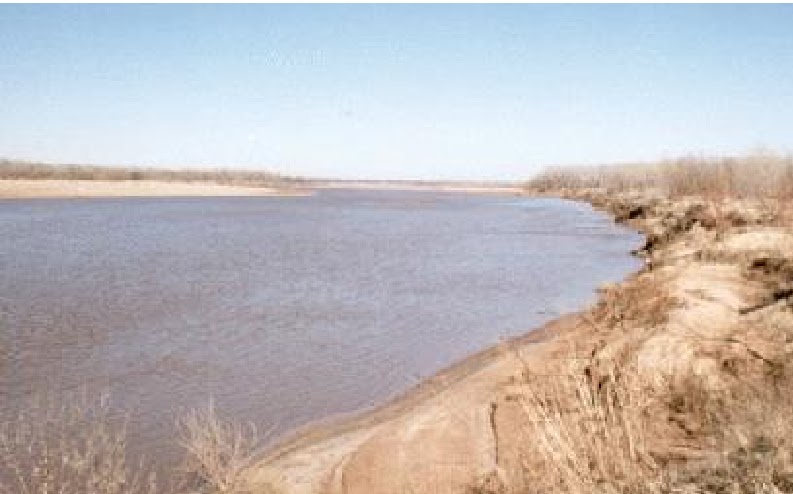
Red River between Texas and Oklahoma
Photo courtesy of TheChisolmTrail.com

Here are two excerpts from the scene:
Ahead, Lil spotted her father riding back from the river. He’d escorted the wagons to Pegleg Dave’s ferry. Noting his wet duds as he rode up, she surmised he’d also helped Luis and Jubal take the remuda across.

"Chic made it all right, the horses too," he shouted over the commotion.

"Pegleg’s fightin’ his way back now. Then he’ll haul the other wagon across. I’d feel better if you’d go with him."

"Pa, I’m not some frilly pink pretty in corsets and lace," she shouted back, slapping her rope against her saddle to keep the cattle moving. "I’ve never taken the raft across and I ain’t doing it now."

He glowered at her. "Sometimes you’ve got too much spunk for your own good, girl. The river’s come down a lot, but she’s still boiling."

"Yeah, and you’re gonna need every hand you’ve got to get these steers across. We both know that."

The creases around his mouth deepened. She thought he’d argue, but he didn’t. Tugging on his hat, he snapped, "Missy, you watch out for yourself, you hear?"

"I will. Quit worrying."

"Easy for you to say," he grumbled, kneeing his horse ahead.

Lil knew how he felt. She couldn’t stop worrying about Tye. Dang man! He was loony as a jay bird to take on the river all tore up like he was. She hoped he wouldn’t drown or be gored by a panicky longhorn.

He’d cornered her at the picket line a while ago and had apologized for the other night. One look at his pleading blue eyes, and she’d found it impossible to stay mad. Not that anything had really changed between them. She still needed him to leave her be. No matter how much she longed for him, she’d be loco to give herself to him. She had no future with him. He’d made that plain, hadn’t he?

Big Red’s ominous rumble drew her attention. A moment later the river came into view. It was lower all right, and the water was less choked with debris than the last time she’d seen it, but it was still moving plenty fast.

"I’ll take the lead," Pa called from the bank.

"We’ll be right behind ye," Neil replied for them both. He sent Lil a wry grin. "Time ta get wet, Lassie."

"Oh well, I need a bath," she joked, making a face.

He grinned but didn’t reply as they ran the lead steers down the cut toward the water. Her father rode his powerful sorrel into the flood and Jefe plunged in after him. The other leaders followed, prodded by the crowd behind them. Bellows of protest trumpeted over the water.

Neil urged his horse into the torrent. Having sent her boots, carbine and six-gun across in the hoodlum wagon, Lil tapped Major’s flanks with her stocking-footed heels. The chestnut splashed in, snorting, and Lil caught her breath as cold water engulfed her nearly to her armpits. Small geysers showered her throat and face.

"Good gravy, it’s cold enough to freeze your teeth!" she cried, clutching a handful of Major’s mane as he struck out from shore. He was a strong swimmer, or she might have needed to slide off and hang on to his girth strap to avoid weighing him down.

"Aye, and a few places farther down," Neil called from the opposite side of the herd.

Mildly shocked, Lil glanced over at him and laughed. Then she got down to business. Guiding Major against the strong current, she nudged a confused longhorn back into line.

Her father was almost halfway to the north bank, with the lead steers at his back. They were carried along by the current as the river rounded a bend and tumbled toward the far shore. That helpful bend in the current was the reason they crossed here year after year.

Shouts rang out behind Lil as the other hands drove more steers into the river. Alongside her, the swimming cattle formed a mass of heads and horns. Nothing else showed above water, but beneath the surface, their powerful legs churned. They could handle the rough water if they didn’t panic. It was up to her and the other drovers to make sure they didn’t.


Available on Amazon

Excerpt Two:
At least half the herd was across now, and most of the men were in the water, Tye included. Minutes ago, Lil had seen him driving cattle into the river. He was supposed to bring up the rear with Kirby, but he must have traded places with Dewey, because the black cowboy wasn’t in sight. She knew why Tye had done it; he wanted to keep an eye on her. She was certain of it because she’d caught him watching her with a worried look on his face.

He was as bad as her father. She wanted to shake him. All cut up like he was, he was the one who had no business in a raging river, not her.

She spotted him near the south bank. From the way he moved as he swatted a wayward longhorn into line, you’d think there wasn’t a thing wrong with him. The dumb galoot! Chic would likely have to stitch him up all over again. She shook her head in exasperation and turned her attention to the cattle. A moment later, she was nudging a steer back in the right direction when all hell broke loose.

"Lil, look out! Tree comin’!" Tye shouted.

Jerking her head around, Lil saw an uprooted stump headed straight for her. She gasped and kicked Major hard. He plunged forward just in time to avoid being rammed by the snag.

Several longhorns weren’t so lucky. The tree stump barreled into them with a sickening crunch of horn and bone. A few sank and were carried away along with the stump; others bawled in terror as they collided with their neighbors. Panicked animals milled in all directions. More went under, and some didn’t resurface.

It was move fast or lose dozens of cattle. Unmindful of danger, Lil headed Major into the tangle of bovine bodies. Neil, Jack, and the others did likewise, yelling and lashing out with their ropes as they fought to stop the mêlée. Luckily, they were over the sandbar; that made things a little easier. After several moments, all the steers were finally headed north again.

Lil glanced around for Tye. He’d swum the big roan he rode out to help. Bobbing in the water about twenty yards away, he met her gaze, and a relieved look spread across his face. She was just as relieved to see him safe. He smiled and waved, and she returned the gesture. Then she noticed how sluggishly Major was moving.

"Sorry, boy, I should’ve cut you loose to rest," she said, patting his neck. "Let’s head for shore."

They’d just left the sandbar behind when a wild-eyed sabina steer swerved out of line toward them. Lil tried to guide Major out of the way again, but he couldn’t react fast enough. The longhorn hooked him in the shoulder with a sharp horn. Screaming in pain, the chestnut pitched over sideways.

Lil cried out and heard Tye shout her name; then her head went under. Water filled her nose and throat. She kicked frantically, managing to break free of the thrashing horse and propel herself upward. She broke the surface coughing, fighting for air.

Major managed to right himself, and Lil grabbed for him. She missed as the tricky current carried him away. He kicked feebly; she was terrified neither of them would make it.

"Lil, I’m coming!" Tye cried, her terror slamming into him, doubling his fear for her as he forced his horse between two thrashing steers that blocked his way.

Lil twisted in the water to look at him. Then a wave slapped her in the face, dragging her under again. Tye held his breath the instant she did, experiencing her fear and desperate will to live as she fought her way upward amid the thrashing longhorns. She surfaced and he gulped air along with her, then silently cheered when she grabbed onto the horn of a passing steer. Its owner bellowed and tried to shake her off, but she clamped an arm around his thick neck and clung to him.

"Hang on, Lily!" Tye shouted, heart beating like a drum.


Lyn Horner resides in Fort Worth, Texas with her husband and four cats. After a career as a fashion illustrator and art instructor, she quit work to raise her children and took up writing. A member of Romance Writers of America, Celtic Hearts online RWA chapter, and Yellow Rose RWA chapter, she enjoys crafting passionate historical romances. The first book in her epic Texas Druids saga, DARLIN' DRUID, features a clairvoyant heroine, inspired by Lyn's own prophetic dreams. That book won the Paranormal Romance Guild 2011 Award. Lyn has also published a memoir, SIX CATS IN MY KITCHEN. To learn more about Lyn and her books, go to http://texasdruids.com/ or find her on her Amazon page at
http://www.amazon.com/Lyn-Horner/e/B004CY506Y She is also on Facebook
http://www.facebook.com/pages/Lyn-Horner/161787403863487 and Goodreads
http://www.goodreads.com/author/show/4639926.Lyn_Horner