Showing posts with label Druids. Show all posts

Monday, December 18, 2017

The Mistletoe Mystery by Sarah J. McNeal


Kissing under the mistletoe is a Christmas tradition that‘s been around for as long as I can remember. The obligatory kiss could be the start of something positively wonderful. Of course, mistletoe had to be avoided at all costs if someone you found obnoxious or repugnant seemed determined to get you under that poisonous greenery.

The question is, how in the world did this tradition get started and, of all the botanical choices for such an otherwise romantic tradition, why would a poisonous, parasitic plant be chosen to kiss under? Well here is some history into the mistletoe mystery:
Way back in the misty beginnings of human culture, some groups of people believed mistletoe had magical properties that had to do with fertility, vivaciousness, some people thought it an aphrodisiac. I’m wondering why humans came up with love remedies with the most contrary or repulsive things like raw oysters and now mistletoe to get their game on. No one ever said humans were all that logical though so let me proceed.

A Druid


The ancient Druids were among the first to attach a tradition with mistletoe. They believed mistletoe, especially the rare species that lived high in the branches of oak trees, must have sacred powers including healing powers, protection against nightmares, and could even assist in the prediction of the future. So, the Druids collected the toxic plant during the summer and winter solstices. They even decorated their houses with it at Christmastime even though they, of course, were not Christian.

Kissing under the mistletoe started in ancient Greece during the festival of Saturnalia and, later, it was used in marriage ceremonies since mistletoe was associated with fertility. The Romans would reconcile their differences with their enemies of war under mistletoe and would decorate their houses with it in midwinter to please their gods. I guess you can see where we’re going with the history of mistletoe toward our present day tradition.

Nordic Goddess of Love, Frigga

There is also a Nordic myth involving mistletoe that provides even more clues into the evolution of mistletoe as a kissing plant. Mistletoe was the sacred plant of the Nordic goddess of love, Frigga. 
Loki, Nordic God of Mischief

Loki, the god of mischief (I’ve seen enough Thor movies to get what our friend Loki was capable of) shot Frigga’s son with a spear or an arrow which some say was made from mistletoe. Frigga was able to revive her son under the mistletoe tree and, afterward, decreed anyone who stands under the mistletoe tree deserves not only protection, but a kiss as well.

Victorian Couple Kissing Under the Mistletoe

And now we come to the final movement in the evolution if the mistletoe and the kiss with the Victorian era. I just have to say here, for a bunch of prissy and restricted social norms developed by the Victorians, they sure did come up with some fascinating ways around all that prim and proper social etiquette. Just sayin’…

Naturally, the Victorians in England considered kissing under the mistletoe serious business. If a man’s kiss was refused, the girl was doomed not to receive any marriage proposals for the next year and many people would even snub their noses at her and make comments abut her ending up an old maid. Isn’t it funny how men always come up with something that is advantageous only for them? Some gentlemen would ask a kiss for each berry they plucked, but I think this is just a way to take advantage of those straight-laced Victorian ladies.


Foxy Modern Mistletoe Kissing

Anyway, today we keep the whole kissing under the mistletoe a bit more lighthearted. The couple gets one kiss if they find themselves under the mistletoe whether by design or by accident.

A final note…keep in mind that the mistletoe berries are poisonous and not for human consumption unless you want stomach cramps and vomiting. I wonder if birds eat those berries. If they don’t, how do they know those berries are poisonous? 


Diverse stories filled with heart


Tuesday, December 24, 2013

A Little Christmas History

by Linda LaRoque


In the early 1700s New England, Christmas was not celebrated in the colonies. In some it was even banned, and those caught celebrating would be fined. The Puritans and Calvinists considered Christmas to be similar to the Catholic pomp and idolatry, or worse, the pagan rituals of the Druids.

The Quakers in the Pennsylvania area didn't regard Christmas any different from any other day. Stores were open, there was no more baking than normal and no Christmas porridge on Christmas Eve.

As time passed and more immigrants moved to the Americas, they brought their traditions with them. Eventually the laws against celebrating Christmas were lifted. In 1856 Christmas was made an official holiday in New England.

Picture courtesy Wikipedia Commons
For the Anglicans, the holiday began with the Christian liturgical year, the four week period before Christmas. Time was spent in religious services, fasting, praying. It was also a time of reflection, anticipation and expectation for the coming of Christ. Both churches and homes were adorned with all types of greenery, especially those with colorful berries. Mistletoe and Holly along with evergreens were favorites. Evergreens were shaped into wreaths and tied into boughs. They added color and fragrance to their homes and were the most common decorations until the Christmas tree was introduced by Prince Albert in Victorian England.

Mistletoe was popular in the 18th century and was arranged in large clusters and tied with ribbons. The bundles were major focal points in colonial homes. The hanging of mistletoe resulted from an ancient Druid belief that it warded off evil spirits and promised fertility of crops for the coming spring.

Families attended church services, Christmas carols and hymns were sung. The most most popular of the time were those written by Isaac Watts. He wrote "Joy to the World," "The First Noel," "God Rest Ye Merry Gentlemen," among a few.

The giving of gifts wasn't as big a thing as it is today. Contemporary shops would set up displays of typical gifts such as little books, candles, and candy. It was not uncommon to give a cash tip as a gift. The Christmas card as we know it was introduced in the 1800s along with Santa Claus and the filling of shoes, and eventually stockings, with candy, fruit, nuts, and other small gifts.
Photo courtesy Wikipedia Commons.
Christmas during the Civil War.

As you read in my post on December 4th here on Sweethearts of the West, Christmas feasts were extravagant for those in the cities and on farms where livestock and wild life was plentiful. For those in the wilderness and homesteads far from town, celebrations were simple in comparison.

From Dicken's Christmas Past
Courtesy Wikipedia Comons
Activities of this era did not center around the children, but rather around the adults. Children were not welcome at the fox hunts, the balls and parties. And the celebration didn't end on Christmas Day. Our ancestors didn't know what we know about the 'twelve days of Christmas'—twelve days between Christmas and Epiphany on January 6th, because Christmas day had a different connotation back then. They believed the twelve days began on Christmas day and continued for a full twelve days. Nor did they have the extravagance of Santa in his sleigh filled with toys and presents under the tree.

Christmas on the prairie was often a difficult time, especially if facing blizzards and December storms, but every effort was made to celebrate, no matter how small or meager their supplies. Some people who rarely went to town, made a trip before Christmas for extra supplies, shoes and clothing which was often given to the family as gifts. Around remote military posts, soldiers could be heard singing carols, and venison roasted on an open fire filling the air with a pleasing aroma. Writer Washington Irving wrote about the explorations of Army Captain Benjamin Bonneville in the Oregon territory. They were friendly with the Indians and Kowsoter, the local chief, invited the entire company to a feast. Following the meal, both Indian and white men competed in games of strength and ability.

If the home had room, which many early prairie homes did not, there was a Christmas tree. It might have been a cottonwood, scrub brush or a tumble weed. Every effort was given to making it look festive. Bits of ribbon, berries and popcorn strings, pieces of colored paper and possibly candles. The candles were placed in tin holders and when lit, were never left unattended for fear of fire. Gifts were most often hand made—knitted scarves, mittens, socks, dolls made of fabric (rag dolls), and stuffed with straw and miniature quilts. Boys received wooden toys like tops or other toys made from available wood. Some gifts were placed on tree branches, others were place under the tree.

Those traveling west on wagon trains also celebrated. Dinner would be sausage, biscuits, rice and game if available. Pies and cakes would be baked and served with precious commodities brought from home—preserves, tea, coffee and possibly a fruit cake they'd saved for the occasion.

This is the first commercially produced Christmas card. It was designed John Callcott Horsley for Henry Cole.

I hope you've enjoyed this sample of Christmas customs and celebrations in our country. Unfortunately I was unable to find any pictures of Christmases on the prairie. I hope my descriptions will paint a picture in your mind. 


References:  


Writers Guide to Everyday Life in the Wild West.
http://hiddendirk.corecommerce.com/18th-Century-Christmas-Traditions.html/
http://www.lifeintheoldwest.com/celebrating-christmas-in-the-old-west/
http://www.legendsofamerica.com/we-christmas.html/
http://www.foodtimeline.org/christmasmenu.html/


Thank you for stopping by. I hope you'll leave a comment.

Linda
www.lindalaroque.com
http://www.lindalaroqueauthor.blogspot.com


Monday, August 20, 2012


I’ve guest blogged on Sweethearts before, but since I’m new as a member of the group, I’d like to introduce myself today. Born in San Francisco and raised in Minnesota, I’ve lived in Texas for close to three decades, along with my husband and an ever changing brood of cats. I’m a former fashion illustrator and art instructor, but I began writing years ago as a hobby. This hobby grew into an enduring love of historical research and the crafting of passionate love stories based on that research.

In late 2010, I self-published DARLIN' DRUID, book one in my Texas Druids trilogy, and a year later book two, DASHING DRUID. I’m currently working on the third book, due to be released in early 2013. Now, you’re probably wondering how Druids could possibly be in the Old West, right? It’s simple really. I’ve love western romances and stories set in Ireland or among Irish Americans. Combining the two was a no brainer. Eventually, when seeking to add a paranormal element to my stories about a trio of siblings – children of Irish immigrants – I decided to make them descendants of Irish Druids, each with a different psychic gift. I don’t think this combination has been tried before.

Here’s part of what reviewer Todd Fonseca had to say about Darlin’ Druid:

“I'll admit I was completely thrown by the title of this book. If for some reason you are as well, "fuhgeddaboudit"! This is an engaging, page turning, can't put it down, don't know where the time went, read. In fact, when I received Horner's book I had already started Steig Larsson's "The Girl Who Kicked the Hornet's Nest"; having finished the first two books in Larsson's series I was anxious to complete the third. But I picked up Horner's book and frankly the pace was so much faster and the book more engaging that I put best selling Hornet aside in favor of finishing Horner's book.”

 Did that make my day? You know it!

In addition to my novels, I’ve published a novella titled WHITE WITCH – a prequel to the trilogy – and a memoir, SIX CATS IN MY KITCHEN.

Find me at these sites:

Friday, April 20, 2012

CROSSING THE RED RIVER

By Lyn Horner

Did you know there are two rivers called "Red River" in the U.S? Yup, there’s a Red River of the North, which forms the border between Minnesota and North Dakota. This stream flows northward into Manitoba, Canada.

The Red River of the South separates Texas from Oklahoma, formerly known as the Indian Territory. This river gave its name to my favorite old time movie, Red River, starring John Wayne and Montgomery Clift. It’s a fictional account of the first cattle drive up the Chisholm Trail. I love that movie so much that I decided to include a trail drive in DASHING DRUID, book two in my Texas Druids trilogy.

Crossing "Big Red" was a dangerous business. During dry periods, sand bars with treacherous patches of quicksand posed deadly traps. When heavy rains flooded the river, it became a raging torrent capable of sweeping away cattle, horses and men. Three different crossing points were used over the years. Doan’s crossing lay on the Western Trail, used during the later years of the trail drive era.

Crossing The Red River

Andy Adams described Doan's Crossing this way:
"Red River, this boundary river on the northern border of Texas, was a terror to trail drivers. The majestic grandeur of the river was apparent on every hand, with its red bluff banks, the sediment of its red waters marking the timber along its course, while the driftwood, lodged in trees and high on the banks, indicated what might be expected when she became sportive or angry. The crossing had been in use only a year or two when we forded, yet five graves, one of which was less than ten days made, attested her disregard for human life. It can safely be asserted that at this and lower trail crossings on Red River, the lives of more trail men were lost by drowning than on all other rivers together."

The trail drive in DASHING DRUID follows the Chisholm Trail, crossing at Red River Station, where the current helped the drovers shepherd their longhorn charges toward the north bank. I came by this information from an elderly gentleman named Glenn Wilson, whose father lived during the trail drive era. A good friend, who loves helping me research, accompanied me to Nocona, a town of some 3,000 residents near where the town of Red River Station once stood. There, we met with Mr. Wilson, and I’m grateful for the honor of meeting him.

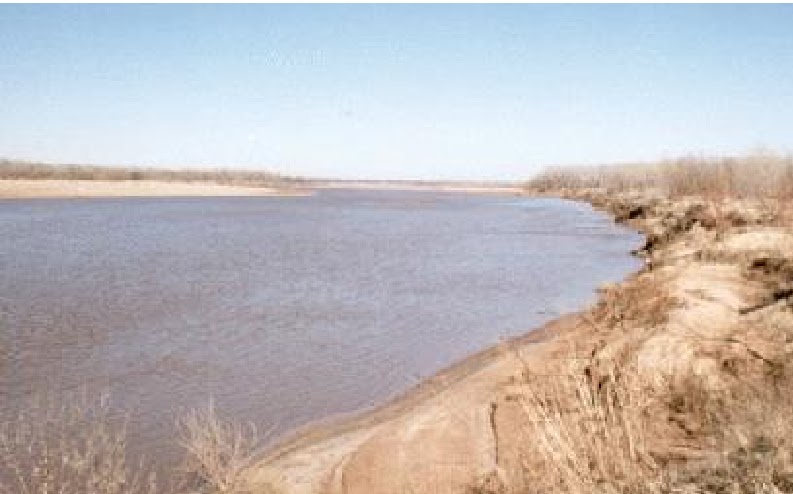
Acting as our guide despite being legally blind, this kindly man directed us to the exact place where Texas herds crossed the Red. He told us why this bend in the river was so popular as a crossing point, describing how the river current carried cattle toward the north bank as it rounded the bend, and pointing out the low, accessible banks on both sides of the river. I used these facts for staging the cattle crossing in DASHING DRUID.


Red River between Texas and Oklahoma
Photo courtesy of TheChisolmTrail.com

Here are two excerpts from the scene:
Ahead, Lil spotted her father riding back from the river. He’d escorted the wagons to Pegleg Dave’s ferry. Noting his wet duds as he rode up, she surmised he’d also helped Luis and Jubal take the remuda across.

"Chic made it all right, the horses too," he shouted over the commotion.

"Pegleg’s fightin’ his way back now. Then he’ll haul the other wagon across. I’d feel better if you’d go with him."

"Pa, I’m not some frilly pink pretty in corsets and lace," she shouted back, slapping her rope against her saddle to keep the cattle moving. "I’ve never taken the raft across and I ain’t doing it now."

He glowered at her. "Sometimes you’ve got too much spunk for your own good, girl. The river’s come down a lot, but she’s still boiling."

"Yeah, and you’re gonna need every hand you’ve got to get these steers across. We both know that."

The creases around his mouth deepened. She thought he’d argue, but he didn’t. Tugging on his hat, he snapped, "Missy, you watch out for yourself, you hear?"

"I will. Quit worrying."

"Easy for you to say," he grumbled, kneeing his horse ahead.

Lil knew how he felt. She couldn’t stop worrying about Tye. Dang man! He was loony as a jay bird to take on the river all tore up like he was. She hoped he wouldn’t drown or be gored by a panicky longhorn.

He’d cornered her at the picket line a while ago and had apologized for the other night. One look at his pleading blue eyes, and she’d found it impossible to stay mad. Not that anything had really changed between them. She still needed him to leave her be. No matter how much she longed for him, she’d be loco to give herself to him. She had no future with him. He’d made that plain, hadn’t he?

Big Red’s ominous rumble drew her attention. A moment later the river came into view. It was lower all right, and the water was less choked with debris than the last time she’d seen it, but it was still moving plenty fast.

"I’ll take the lead," Pa called from the bank.

"We’ll be right behind ye," Neil replied for them both. He sent Lil a wry grin. "Time ta get wet, Lassie."

"Oh well, I need a bath," she joked, making a face.

He grinned but didn’t reply as they ran the lead steers down the cut toward the water. Her father rode his powerful sorrel into the flood and Jefe plunged in after him. The other leaders followed, prodded by the crowd behind them. Bellows of protest trumpeted over the water.

Neil urged his horse into the torrent. Having sent her boots, carbine and six-gun across in the hoodlum wagon, Lil tapped Major’s flanks with her stocking-footed heels. The chestnut splashed in, snorting, and Lil caught her breath as cold water engulfed her nearly to her armpits. Small geysers showered her throat and face.

"Good gravy, it’s cold enough to freeze your teeth!" she cried, clutching a handful of Major’s mane as he struck out from shore. He was a strong swimmer, or she might have needed to slide off and hang on to his girth strap to avoid weighing him down.

"Aye, and a few places farther down," Neil called from the opposite side of the herd.

Mildly shocked, Lil glanced over at him and laughed. Then she got down to business. Guiding Major against the strong current, she nudged a confused longhorn back into line.

Her father was almost halfway to the north bank, with the lead steers at his back. They were carried along by the current as the river rounded a bend and tumbled toward the far shore. That helpful bend in the current was the reason they crossed here year after year.

Shouts rang out behind Lil as the other hands drove more steers into the river. Alongside her, the swimming cattle formed a mass of heads and horns. Nothing else showed above water, but beneath the surface, their powerful legs churned. They could handle the rough water if they didn’t panic. It was up to her and the other drovers to make sure they didn’t.


Available on Amazon

Excerpt Two:
At least half the herd was across now, and most of the men were in the water, Tye included. Minutes ago, Lil had seen him driving cattle into the river. He was supposed to bring up the rear with Kirby, but he must have traded places with Dewey, because the black cowboy wasn’t in sight. She knew why Tye had done it; he wanted to keep an eye on her. She was certain of it because she’d caught him watching her with a worried look on his face.

He was as bad as her father. She wanted to shake him. All cut up like he was, he was the one who had no business in a raging river, not her.

She spotted him near the south bank. From the way he moved as he swatted a wayward longhorn into line, you’d think there wasn’t a thing wrong with him. The dumb galoot! Chic would likely have to stitch him up all over again. She shook her head in exasperation and turned her attention to the cattle. A moment later, she was nudging a steer back in the right direction when all hell broke loose.

"Lil, look out! Tree comin’!" Tye shouted.

Jerking her head around, Lil saw an uprooted stump headed straight for her. She gasped and kicked Major hard. He plunged forward just in time to avoid being rammed by the snag.

Several longhorns weren’t so lucky. The tree stump barreled into them with a sickening crunch of horn and bone. A few sank and were carried away along with the stump; others bawled in terror as they collided with their neighbors. Panicked animals milled in all directions. More went under, and some didn’t resurface.

It was move fast or lose dozens of cattle. Unmindful of danger, Lil headed Major into the tangle of bovine bodies. Neil, Jack, and the others did likewise, yelling and lashing out with their ropes as they fought to stop the mêlée. Luckily, they were over the sandbar; that made things a little easier. After several moments, all the steers were finally headed north again.

Lil glanced around for Tye. He’d swum the big roan he rode out to help. Bobbing in the water about twenty yards away, he met her gaze, and a relieved look spread across his face. She was just as relieved to see him safe. He smiled and waved, and she returned the gesture. Then she noticed how sluggishly Major was moving.

"Sorry, boy, I should’ve cut you loose to rest," she said, patting his neck. "Let’s head for shore."

They’d just left the sandbar behind when a wild-eyed sabina steer swerved out of line toward them. Lil tried to guide Major out of the way again, but he couldn’t react fast enough. The longhorn hooked him in the shoulder with a sharp horn. Screaming in pain, the chestnut pitched over sideways.

Lil cried out and heard Tye shout her name; then her head went under. Water filled her nose and throat. She kicked frantically, managing to break free of the thrashing horse and propel herself upward. She broke the surface coughing, fighting for air.

Major managed to right himself, and Lil grabbed for him. She missed as the tricky current carried him away. He kicked feebly; she was terrified neither of them would make it.

"Lil, I’m coming!" Tye cried, her terror slamming into him, doubling his fear for her as he forced his horse between two thrashing steers that blocked his way.

Lil twisted in the water to look at him. Then a wave slapped her in the face, dragging her under again. Tye held his breath the instant she did, experiencing her fear and desperate will to live as she fought her way upward amid the thrashing longhorns. She surfaced and he gulped air along with her, then silently cheered when she grabbed onto the horn of a passing steer. Its owner bellowed and tried to shake her off, but she clamped an arm around his thick neck and clung to him.

"Hang on, Lily!" Tye shouted, heart beating like a drum.


Lyn Horner resides in Fort Worth, Texas with her husband and four cats. After a career as a fashion illustrator and art instructor, she quit work to raise her children and took up writing. A member of Romance Writers of America, Celtic Hearts online RWA chapter, and Yellow Rose RWA chapter, she enjoys crafting passionate historical romances. The first book in her epic Texas Druids saga, DARLIN' DRUID, features a clairvoyant heroine, inspired by Lyn's own prophetic dreams. That book won the Paranormal Romance Guild 2011 Award. Lyn has also published a memoir, SIX CATS IN MY KITCHEN. To learn more about Lyn and her books, go to http://texasdruids.com/ or find her on her Amazon page at
http://www.amazon.com/Lyn-Horner/e/B004CY506Y She is also on Facebook
http://www.facebook.com/pages/Lyn-Horner/161787403863487 and Goodreads
http://www.goodreads.com/author/show/4639926.Lyn_Horner