Saturday, July 2, 2011

Bandit Built Store

The following accounting was obtained from Roscoe Wyatt, Oscar John and Walter Ray. Oscar and Walter both remember the Younger brothers in person. Wyatt was a conscientious historian. Personal interviews included two of my family members: Emma John Weeks and Percy Weeks. Oscar John (87 at the time of the interview) worked on the Bandit Built Store. He knew the Younger brothers from when they hid out on his La Honda ranch.

Among the men hired to build John Sears’ store, referred to as the ‘Bandit-Built Store’ in 1877 were the Younger brothers from Forsyth, Kansas. At that time no one in La Honda, CA, knew them as the Younger brothers, because they were posing as cousins to Oscar John and Walter Ray. Jim Younger actually lived behind the Redwood City Court House for one year using the name of Joe Hardin.

Cole, Jim, Bob and John Younger lived in Forsyth, Kansas on their father’s ranch in May, 1861, when the Civil War broke out. Cole, the youngest son, joined the Confederate Army and became a colonel. In November of that year, a short leave gave him a chance to visit his parents. As he approached the ranch, he found the place engulfed in flames. A band of Union troops and local Northern sympathizers reached the ranch before him and stole all of the stock before burning the grain, corn, and feed. They also threw his youngest sister, who suffered from tuberculosis, out on the cold ground, causing her death. When their father discovered what had happened and put up a fight, they hung him from a tree on the ranch. This left their mother, oldest sister, Molly, and three younger brothers homeless.

Within hours Cole, along with a friend, organized local Southern sympathizers and within a few hours they started wiping out their enemies. It’s reported that Cole alone killed one hundred men that he knew had something to do with his father’s and sister’s death. By the end of the war, Cole had a price on his head for desertion, killing for revenge, and a long list of other charges. He left his family in the care of his cousin, John Jarret’s parents. He, John Jarret and a few friends left for California where they hoped to find sanctuary at his uncle’s ranch in San Jose, but ended up using a ranch in La Honda as their hideout.

Oscar John and his stepfather met the gang as they rode onto the ranch. Oscar was ten years old at the time. He recalls unsaddling ten horses. Everyone but Cole Younger and John Jarret left the ranch. They helped build the lakeside Ray ranch into a large two-story building. Cole and John traveled back to Kansas in order to bring the rest of their family west. They learned their mother had died and that Jim and Bob Younger had been accomplices to the James gang robberies. Cole was convinced the Ray ranch was the best place for the remainder of his family until everything blew over.

They arrived back in La Honda August, 1876, when big changes were happening. A new sawmill belonging to R.J. Weeks (my ancestor) opened and John Sears just started clearing an old bear pit site for his store and hotel. At last luck was with the Younger family. Oscar John talked John Sears into hiring his cousins from the east, no questions asked. The three brothers and John Jarret went to work on the store. Oscar John recalls seeing Cole shingling the roof of the store. When the store was finished, the men returned to the Ray ranch to work the harvest.

John Jarret spent that season at the Ray ranch, one season in Redwood City and then went back east. He returned the next year and started work on my family’s ranch. While he was there, he married Molly Younger, thereby becoming Cole’s brother-in-law as well as cousin.

The James Brothers were planning to rob the Northfield Bank in Minnesota.

They couldn’t pull the job by themselves and no longer trusted their gang. They sent a message to Cole by a man named Giles. Since the Youngers knew Northfield, they expected them to participate in the robbery. Frank and Jesse James sent a message stating that if the Youngers refused to come, they would have them exposed to the law. Cole decided to participate to save his sister and brother-in-law. He left a rare set of pearl handled pistols with Jarret at the Weeks Ranch. He realized if he got caught with them, they’d be a dead giveaway as to his identity.

Cole had an agreement with Jesse James that this bank robbery would be their last appearance in the mid-west. Jesse assured Cole that after this job, they would never have to worry about money again.
Unfortunately, the robbery went wrong. During their escape Jim Younger was shot in the jaw. Jesse wanted to kill Jim because it would hinder to their escape.
Cole absolutely refused. So, while Jim lay bleeding in a wet creek bottom, the James brothers made a clean getaway. The Younger brothers gave themselves up to the law to save Jim from bleeding to death. Cole, Jim and Bob Younger were sentenced to serve terms in the Minnesota Penitentiary.

When John Jarret learned what had happened to his brothers-in-law, he happened to be working away from the Weeks ranch and only coming home on the weekends. Giles showed up at the ranch with a forged note from Cole. Molly wasn’t home so he gave the note to their housekeeper. It was written to Molly and asked that she give Giles the two rare guns. The note stated that Cole’s prison term was just about up and that he wanted to sell the guns so he could get a new start in life. The housekeeper, remembering Giles from his first trip, thought he was on the level and handed over the guns. Jarret, for some unknown reason, came home that night and found Giles there with the guns in his possession. After he read the letter, he knew it was forged because Cole always wrote in of care of him, not Molly. Giles confessed that he had a chance to sell the guns to an Illinois museum.

Jim Bartley, La Honda rancher and teamster, visited the Younger brothers at the Northfield, Minnesota Penitentiary. He learned that an old sweetheart of Jim Younger visited him regularly. She promised to marry him when he got out of prison. Jim looked forward to that day, planning once more to start life anew. However, the woman turned him down when he got out. His heart was broken. Having nothing to live for, he rented a room at a cheap boarding house and shot himself through the head.

Cole and Bob dropped into obscurity after serving their terms.

Tuesday, June 28, 2011

ONE MAGIC NIGHT from A 2011 SUMMER COLLECTION


Have any of you ever incorporated your family history into your writing? Do you like to read books that are based, however loosely, on factual happenings?

My mom was the oldest of eleven children. She knew everyone in our family and how they were related. Because she and my dad grew up together in a tiny little town in southeast Oklahoma (their high school had a graduating class of twelve), she also knew quite a lot about his side of the family as well.

But when I was younger, I was not interested in the stories she told me. It was only later, when I was grown and had children of my own, that I began to wonder and ask questions, and by that time, her memory had already begun to decline.

If you have ever read the book, The Education of Little Tree, (by Forrest Carter) or seen the HBO movie, this story might sound familiar. When Andrew Jackson decided that the Indians were to be assimilated into the white man’s world, he put lots of plans into action that would take years to snowball and evolve into what they eventually became—a truly shameful period in the US governmental policies and procedures. One of Jackson’s plans, besides Removal, that was carried through into subsequent presidencies, was the idea of assimilating Native American children in white homes to integrate them more completely. The Native American children were taken from their villages and given to willing white families (along with a tidy little government stipend for their troubles) to raise.

My great-great-great grandfather was one of these children. We don’t know his real name. It was changed when he was delivered to his new “family”, a Presbyterian minister and his wife. Their last name was Walls. So his name was changed to Walls, and he was given the first name, David. Forbidden to speak his language, he was forced to forget all the ways of his People, and dress in white man’s clothing, go to white school. But he was never going to be white, and his place in the world was divided so drastically that he could not fit in anywhere. Eventually, the Rev. Walls sent David to medical school in Missouri. When he returned to the small town where he’d been raised, he was a doctor who rode to his patients on horseback. Later, he married and had children, but it was not a happy union and his son, my great-great grandfather, became an alcoholic whose own children, in turn, left home as soon as they possibly could. My great grandmother, his daughter, married at 13. Her older sister left home one day and never returned. No one ever knew what became of her.

I’ve often thought of these children that were abducted by our cavalrymen, and taken away to their white “families”, forbidden everything familiar and forced to adopt everything new and different, even their speech and childhood games. Can you imagine it? To never be allowed to see your mother and father again. Siblings separated and “given” to different families, their heritage and connection with one another lost forever. How many tears must they have shed? And how lonely and separate they must have felt, how isolated, even into adulthood…so that most of them, I imagine, never were able to fit in anywhere in the world.

My story in the 2011 SUMMER COLLECTION, available through Victory Tales Press, is based loosely on what happened to my long-ago ancestor.

Dr. Shay Logan has just returned to Talihina, Indian Territory, from medical school in Missouri. Shay hopes to settle down and make a life for himself, but how? He doesn’t belong to either world, Anglo or Indian He's made the acquaintance of Katrina Whitworth at the July 4th town social, and the attraction is mutual from the very beginning. Shay begins to have hopes and dreams that may be out of the question…but Katrina seems to have stars in her eyes for him as well. Will she risk everything to be with him? Katrina makes a social blunder, and Shay follows her into the woods to apologize to her, but when they return, Katrina's drunken father humiliates her. To make matters worse, her former beau shows a side of himself she had not seen before. Can Katrina and Shay have a life together that they so badly want? Here’s an excerpt for you.

FROM ONE MAGIC NIGHT:
As his hand started its descent, Katrina turned away. But Shay’s arm shot out, grasping Whitworth’s hand and holding it immobile.

“You will not.”

Three words, quietly spoken, but with a heat that could have melted iron, a force that could have toppled mountains.

Katrina’s father’s face contorted, his teeth bared, finally, as he tried to jerk away. He didn’t utter a word. He stared up into Shay Logan’s eyes that promised retribution, as the seconds ticked by. Finally, he lunged once more, trying to pull free, but Shay still held him locked in a grip of steel. Only when he released that grip was Whitworth freed.

“You presume too much, Doctor Logan, unless you are assuming the care and responsibility of my daughter.”

“Papa! Oh, please!” Katrina felt herself dissolving into a puddle of less than nothing beneath stares of the townspeople of Talihina. What had started as an exciting, beautiful evening had become an embarrassing nightmare. It was torture to think that she was the cause of it all. How she wished she had stayed home with Jeremy as she’d first planned, before Mrs. Howard had volunteered to keep him company.

Now, Papa was saying these things that she knew he would regret later. It was always this way when he drank too much. These accusations had gone beyond the pale of anything he’d ever said before. But Shay Logan wouldn’t realize that. He wouldn’t know that Papa would be sorry tomorrow.

Evidently, there was one thing Shay did recognize, though. She saw the very slight flare of his nostrils as he drew in the scent of alcohol on her father’s breath, and in that instant, there was a flash of understanding in his eyes.

“You’ve had too much to drink, Mr. Whitworth,” he said in an even tone. “I will overlook your behavior toward me because of that, but not toward your daughter. She has done nothing, yet you would strike her, and cause her shame.”

“She’s my daughter,” Whitworth replied sullenly.

“But not your property, Whitworth. Never that. You owe her an apology.”

“No, Shay, really—” Katrina began, then as her father whirled to look at her, she broke off, realizing her mistake. ‘Shay,’ she had called him. As if she had known him forever. As if she was entitled to use his given name freely. As if she were his betrothed.

“‘Shay’ is it, daughter? Not, ‘Dr. Logan’? Shay.” He spit the words out bitterly. He drew himself up, looking Shay in the face. “I’ll not be apologizing to her—or to you. And I’ll expect nothing less than a wedding before this week’s end. Do you understand me, Doctor?”

Shay had lost any patience he might have harbored. “You understand me, Whitworth. You will not dictate to me, or to your daughter on such matters of the heart. As I say, the alcohol has got you saying things you’re going to regret, and—”

“Threatening me, are you? Threatening me?”

“Truman.” Jack Thompson stepped out of the crowd and smoothly came to stand beside Katrina. “Let’s put this…unfortunate incident…behind us, shall we?” He confidently tucked Katrina’s hand around his arm. “I can see that the church auxiliary ladies have almost got everything set up for this wonderful Independence Day meal—” he frowned at Mrs. Beal, nodding at the picnic tables behind her. She jumped, motioning the other ladies to resume the preparation.

He gave a sweeping glance around the group of onlookers. “I, for one, am ready to eat! How about you all?”

Katrina was swept along at his side as he walked toward the tables, speaking to acquaintances and friends, laughing and…and seething with tense anger the entire time. She could feel it in his body, with every step he took and the tightness of his grip as he covered her hand with his. Katrina glanced back over her shoulder, hoping to catch a glimpse of Shay, but the crowd blocked her view.

“Smile, my dear,” Jack gritted into her ear. “I’m hoping we can still salvage your virtue, no matter what happened, really, between you and the good doctor. If I see him near you again, I’ll kill him.”

BUY LINKS
Smashwords:
http://www.smashwords.com/books/view/66862
http://www.smashwords.com/profile/view/victorytalespress
http://www.smashwords.com/profile/view/VTPanthologies

Lulu:
http://www.lulu.com/product/ebook/2011-summer-collection-anthology-sweetsensual/16048225
http://stores.lulu.com/store.php?fAcctID=55332464

Here's the link at Amazon:
http://www.amazon.com/dp/B00564A820
I WILL BE GIVING AWAY COPIES OF A 2011 SUMMER COLLECTION TO TWO LUCKY COMMENTERS! JUST LEAVE ME A COMMENT WITH YOUR E-MAIL ADDRESS AND I WILL DRAW WINNERS SOMETIME AFTER 8:00 TONIGHT!

Sunday, June 26, 2011

WHEN A GHOST HELPED SAVE A SCALPING VICTIM

Do you believe in ghosts and spirits? Josiah Wilbarger certainly did! Why wouldn’t he, when a spirit saved his life?

Josiah Pugh Wilbarger
and a son
On a hot August day in 1833, Texas settler Josiah Wilbarger and four other men were scouting territory near present-day Austin when they spotted a lone Comanche and gave chase. The brave escaped the party, and Wilbarger and the others turned back toward neighbor Rueben Hornsby’s cabin six miles away. At mid day, they decided to stop for lunch beside a small stream and give their horses a rest. Wilbarger, Tom Christian and a Mr. Strother unsaddled and hobbled their horses. Haynie and Standifer, wary of the Indian they had seen, decided to leave their mounts saddled and tied them loosely to a nearby tree.

The men started a fire to cook beef, and passed around cold corn pone. They were relaxed by the water when war whoops and rifle fire accompanied by flying arrows shattered their peace. The five men jumped behind trees and began firing, but the spindly scrub oaks offered little protection. Haynie and Standifer ran to their saddled horses. Wilbarger called out to them and they turned to see Wilbarger with arrows in both legs. He took a shot to the back of the neck which exited through the front of his throat, spurting blood, as Comanches surrounded him. Certain their friend was beyond help, Haynie and Standifer rode hard for Hornsby’s cabin.

At Hornsby’s, they sent a rider on to Wilbarger’s home some miles away to relay the sad news to Josiah Wilbarger’s wife, Margaret, and to rouse other neighbors. By the time men arrived from the surrounding area, it was too dark to retrieve the remains for burial.

As everyone slept that night, Sarah Horsby suddenly awakened from a dream that left her trembling. She woke her husband and told him of the vision of Josiah Wilbarger, naked and leaning against a tree. Her dream convinced her he was alive and waiting to be rescued. Reuben scolded his wife for waking him because he and the others had to rise early the next morning. He reminded her Comanches never left their victims alive, cutting throats to be certain they were dead. Sarah was unconvinced but went back to sleep.

Within a short time, the dream returned exactly as before. She awakened her husband and the other men. As she served them breakfast, she told them the dream was an omen and that they would find Josiah exactly as she had envisioned. She told the men to wrap Josiah in a sheet and bring him back for her to tend his wounds. The men scoffed at her vision. Reuben knew his wife was not given to irrational thinking, so he was less skeptical than the men with whom he rode. The mother of ten, Sarah had survived the rigors of frontier life and had more than her share of experiences with Comanches.

When the men arrived at the site, they immediately found the bodies of Christian and Strother. They buried the two while looking for Wilbarger. As they were about to give up their search for him, a rider spied what looked like an Indian leaning against a tree, naked, and covered with red war paint. The rider called to the others then raised his rifle to shoot. The naked man stumbled toward them and said, "Don’t shoot. It’s Wilbarger."

Though scalped, wounded in several places, and near death, Wilbarger was just as Sarah Hornsby said he would be. The rescuers gently wrapped him in the sheet Sarah had provided. Reuben held Josiah as they rode slowly back to the Hornsby cabin. Confident he would be found alive, Sarah waited with hot water, bear’s oil, and poultices ready. She nursed him for several days until he was able to be transported home on a makeshift sled.

Wilbrager described his ordeal. The bullet that passed through his neck temporarily paralyzed him, and he couldn’t resist the Comanches who attacked him. Not only did his injury convince the Indians there was no need to slit his throat, it also prevented him from feeling pain. However, he was alert as the Indians roughly stripped him and scalped him. He reported that it sounded like distant claps of thunder as they jerked the scalp from his head.

He fell unconscious until late afternoon. When he awakened, the paralysis had left his body and he experienced terrible pain. He crawled the few feet to the creek and remained in the cold water until he was numb. Before he fell into what was probably a comatose state, he crawled out to a sunny spot. When he awoke, he became aware of swarming blowflies feasting on his exposed wound. In hastily stripping him, the Comanche left him with one sock. He shooed the flies away and covered his head with the sock. He tried to move toward Hornsby’s, but managed only about six hundred yards. Believing his death was inevitable, he leaned against a tree and hoped for rescue.

A vision of his sister, Margaret Collins, who lived in Missouri, appeared to him. She spoke softly, "You’re too weak to go on, brother dear. You lie here and rest and help will come to you before another day is over." She turned and headed toward Hornsby’s cabin.

When Sarah described the woman in her vision, Wilbarger told her that was his sister. Weeks later, Wilbarger received a letter from Missouri. His sister Margaret had died the day before the Comanche attack. He firmly believed he saw his sister’s spirit that night, and that she not only gave him courage to hold on, but also alerted others through Sarah Hornsby’s dreams. People who knew both Josiah Wilbarger and Sarah Hornsby attested to their honesty and mental soundness, and believed their stories.

Josiah after being scalped
Wilbarger recovered from his wounds and lived another eleven years. From her silk wedding dress, his wife, Margaret Barker Wilbarger, 
made caps for him that he wore constantly.

After coming to Texas when it was a part of Mexico, the Wilbargers and Hornsbys joined Stephen F. Austin's 300 as Texas pioneers.

Wilbarger eventually operated a cotton gin near Bastrop. One day while walking through the building, he hit his head on a low ceiling beam. For most people, the event would have merely raised a bump. For Wilbarger, with no hair or scalp to pad the skull, the injury was fatal. He died on April 11, 1844.

Wilbarger's tombstone in
the Texas State Cemetery
A monument at Fifty-first and Berkman Streets in Austin marks the estimated site of the scalping. Josiah Wilbarger and his wife have been reinterred in the state cemetery in Austin. Sarah and Reuben Hornsby are buried in the Hornsby Cemetery at Hornsby Bend near Austin. (Baseball Hall of Famer Rogers Hornsby is a descendent of this pioneer family and is also buried in this cemetery.) Margaret Wilbarger Clifton, the spirit who saved her brother, is buried in Florissant, Missouri.

Now do you believe in ghosts?

Thanks to FROM ANGELS TO HELLCATS: LEGENDARY TEXAS WOMEN, by Don Blevins. Thanks also to other sources including THE HANDBOOK OF TEXAS ONLINE and Wikipedia.

Friday, June 24, 2011

Tin Cup, Colorado - Mining Gold on Several Levels


It’s been several years since my husband and I have been up to Tin Cup. The old mining town in Colorado’s Rocky Mountain lies above Gunnison at 10,157 feet elevation. Some of the poor pictures I took way back in October of 1991 are shown here. If we manage the excursion later this summer, I’ll compose better shots--a repost would be worthwhile, at least in my unbiased opinion. LOL

Big Horn Sheep above Gunnison near Taylor Park Resevoir
I learned about the town through my husband, who hunted the area with his brother, father, and friends from the 1950s through the 1990s. The first time my husband took me, I fell in love with the town, its history, and its unique cemetery.

The last time we visited, Tin Cup sported a couple businesses. The most notable was Frenchy’s which is a restaurant housed in an old log cabin I’m sure boasts of a colorful, if not dramatic past as the most famous of the town’s early saloons. Today’s Frenchy’s is said to serve up a delicious burger. I wish I could verify that. Unfortunately, a closed sign has always been prominently displayed whenever we drove past.

Research sources often claim Tin Cup is a ghost town. However, the real truth is that those few hardy year round residents and the additional summer occupants who desire the peace and quiet that blanket the high country have cleverly refurbished original log cabins so it appears nothing has changed in 150 years.
 
Capt. Zebulon Pike
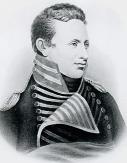
Captain Zebulon Pike reached the general area in late December 1806 during an exploration of territory acquired by the United States in the Louisiana Purchase. (Christmas In The Old West - Sweetheart post December 18, 2010) But, it wasn’t until the late 1850’s that this picturesque valley was settled by white men, disheartened prospectors who hadn’t realized their dreams of riches in California’s gold fields and who paused for rest on their long trips back east. The story goes that in October 1859, one such young man, James Taylor, an 18 year old from Georgia, took a sip of water from Willow Creek and discovered gold in the bottom of his tin cup. He promptly dubbed the area Tin Cup Gulch. Obviously, Jim was neither creative nor romantic. Other versions of this story time the incident in 1861 and/or add two friends with Jim. I also found reports that attributed the town’s name, not to a profitable sip from a tin cup, but to the tin cup being used as a storage vessel for a lucky prospector’s poke of gold dust while he headed out of the valley to parts unknown.

Although it may never be absolutely certain which version inspired the name, Tin Cup Gulch seemed to remain unknown by most until the 1870’s. Strikes of high grade gold and silver in 1878 drew adventurous souls to the area and the town of Virginia City was born in March 1879. The following year, Virginia City census counted 1,495 inhabitants. Maybe the growth spurt started the trouble, maybe something else, but, whatever it was, Virginia City’s citizens found their hometown increasingly confused with Virginia City, Nevada and Virginia City, Montana. I, for one, am glad they officially changed the town’s name in July 1882 to simply Tin Cup, minus James Taylor’s descriptive “Gulch” attached.

Tin Cup boasted of a population of 6000 in 1882, a number that easily supported the 20+ saloons in town and made it lucrative for some entrepreneurs to ski or snowshoe out for supplies and then unload their bounty to the highest bidders upon return. Declared one of the top three of Colorado’s wildest, unruliest mining towns, Tin Cup quickly found itself taken over by an underworld of cutthroat gamblers. The gang hired and controlled local law enforcement to their benefit, for unsuspecting visitors and settlers were lured by the façade of law and order. It was only after being fleeced of their money and/or valuables that the victims wised up and left--if they were alive to do so. This dismal history wore on the upstanding men hired as fronts. Colorado’s Historical Society states the first one quit, the second was fired, the third was gunned down, the fourth was shot by a gambler, the fifth quit and became a preacher, the sixth went insane, and the seventh was shot.

Which brings us to my favorite part: Tin Cup’s cemetery. It’s divided into four parts.


Protestant Knoll lies to the north. Jewish Knoll sleeps to the east.


Catholic Knoll occupies the center. Boot Hill Knoll to the west still sports a few intriguing markers.


The epitaph on Black Jack Cameron’s grave, located in the southeast corner, reads “He drew 5 aces.” Another is marked Pass Out/Dance Hall Girl. How can you not wonder, “What if...?”

Tin Cup’s eighth marshall miraculously finished his term. I’m unaware of the exact timing of the town’s string of men of the law. However, I suspect the eighth’s luck held because of Tin Cup’s decline to around 400 citizens as mines played out about 1884. The shrinking town clung to life though, installing fire hydrants in 1891, a few of which remain. The local post office closed in 1918.

Sandra Crowley

CAUGHT BY A CLOWN, a spicy romantic suspense about a spontaneous freelance journalist on a mission of mercy who finds herself entangled with a methodical undercover agent out to settle a score.
BUY paperback at The Wild Rose Press or Amazon


www.sandracrowley.com     

Wednesday, June 22, 2011

Talkin' the Talk

I don’t normally appreciate the vast collection of books and magazines my husband stores in the powder room (commonly referred to in our house as “the library”). But every once in a while I stumble across something of note while decluttering the stacks.

Here’s a gem I discovered recently. I have books on Old West slang and have several websites bookmarked devoted to the topic, but finding these in an old Uncle John’s Bathroom Reader was a surprise; many of these were new to me. Hope you find a smile or two among them, I know I did!

He's crooked enough to sleep on a corkscrew (dishonest)

Raised on prunes and proverbs (a religious person)

Coffee varnish (whiskey)

Fat as a well-fed needle (poor)

Deceitful beans (meaning they'll talk behind your back,or give you gas)

Got a pill in his stomach that he can't digest (shot dead)

Like a turkey gobbler in a hen pen (proud)

Like a breedin' jackass in a tin barn (noisy)

Fryin' size but plumb salty (an old person)

Quicker'n you can spit and holler howdy (fast)

Studyin' to be a half wit (stupid)

Built like a snake on stilts (tall)

Right on melody but strong on noise (a bad singer)

Weasel smart (crafty)

Scarce as bird dung in a cuckoo clock (hard to find)

Dry as the dust in a mummy's pocket (very dry)

In the lead when tongues was handed out (talks too much)

If he closed one eye, he'd look like a needle (very skinny)

Lives in a house so small he can't cuss his cat without gettin' fur in his mouth (a tightwad)

Died of throat trouble (hung)


Happy Trails!

Nic

www.nicolemccaffrey.com

Monday, June 20, 2011

GUEST AUTHOR CAROLINE FYFFE AND WOMEN OF THE WEST

Author, Caroline Fyffe
Hello, Sweethearts of the West.  It’s my pleasure and honor to be here today talking with you about one of my favorite things—the West.  And of course, the women who helped make it into the splendid place it is today.  You know, it’s quite interesting, and remarkable, that every time we make the effort to dig into the history of some famous thing, be it a man, place or event, there’s usually a woman somewhere there giving it wings to fly.  Using ingenuity, fortitude and love, women have made their mark in so many places.  Today I salute two of them. 
And so it is in my post….   
A few years back I found myself at the American Quarter Horse Hall of Fame and Museum, in Amarillo, Texas.  I was standing in the gigantic grand hall name for Anne B. Windfohr Marion, the 6666 Ranch, and the Burnett Foundation, and my imagination took off.  I’d noticed that the hall was dedicated to a woman—that’s all it took.  At that time, I knew little of AQHA’s history.   Most horse people have heard of the renowned 6666 Ranch, also called the The Four Sixes Ranch, founded in 1870 and located in Guthrie Texas, as a leader in all disciplines of exceptional Quarter Horses. 
Anne Burnett Tandy
But, digging deeper--ahhh yes, you say--as I mentioned in my introduction, I discovered it was ranch founder, Caption Samuel “Burk” Burnett’s daughter, Anne Burnett Tandy, affectionately called Miss Anne, who had inherited the ranch (can you even imagine!) that was instrumental in the creation of the American Quarter Horse registry.   
Four Sixes Ranch
Guthrie, Texas
In 1940, the current owner of the 6666 Ranch and her husband, James Goodwin Hall, had a dinner party in their Fort Worth home to talk with other breeders of ranch type horses, the same animals that were bread in Texas, Colorado, California and such, after the great westward migration.  The American Quarter Horse Association, the world’s largest breed registry, was born the very next day.
Anne Windfohr Marion
Then, her only child, Anne B. Windfohr Marion, and current head of the ranch, (a beautiful woman in Stetson and chaps—a true heroine, in my way of thinking ) re-introduced quarter horse racing back into the ranch breeding program in 1993.   
Available Now!
Just as Penny Tweedy Chenery was the driving force behind Secretariat, believing in him, giving him the opportunity to be the best that he could be, and seeing his true heart, so too the Burnett women had the desire to see where the horses of the West, the true athletes that built so many outstanding cattle and horse breeding operations west of the Mississippi, could go, if given the chance. 
Today, we salute all the hard-working, dedicated women, sometimes hidden in the shadows, sometimes not, who forged ahead in history, to greatness.   Do you know one of these such hero’s?  Maybe someone in your family history?  And, has anyone one else besides me had the tremendous opportunity of visiting the Hall of Fame in Amarillo?

American Quarter Horse Hall of Fame and Museum
Amarillo, Texas


Saturday, June 18, 2011

HEADING WEST - LOAD THE WAGONS!

Jeanmarie Hamilton is overwhelmed today, so I’m filling in for her. Actually, Linda Hubalek has graciously allowed me to quote from her book TRAIL OF THREAD, in which Dorothy Pieratt describes preparing for the trip West from Kentucky to Kansas.


Dorothy Pieratt's words:

We debated, but finally packed two wagons for each family. We felt it was better for the animals’ sake to limit the weight on each wagon to around 2000 pounds instead of overloading one wagon....Since we need six oxen per wagon, we bought extra animals a few weeks ago. John decided to use oxen instead of mules because the oxen are easily managed, patient, and gentle--even with the children--and not easily driven off or prone to stampeding like mules and horses...After much discussion, John agreed to hitch a cage of chickens on the back of the wagon.

Yesterday we sold everything that wouldn’t fit in the wagons at a public auction on our farm. The strain of the day is still on my mind. This morning I’ve been ready to fetch something and then I stop in midstep, wondering if it’s tucked in the wagon or was sold yesterday. It was hard to see most of the animals and all but a few chickens leave the place. But we can’t take everything along, and we need the money.

New wagon beds were built using seasoned oak boards. Sides were jointed together. No nails were used that could work out along the bumpy road and spell disaster. Along the inside of the three-foot-high sides, John built long boxes running the length of the wagon for storage. These boxes will serve as seats during the day if the children want to ride inside. We just add boards cut to fit across the storage boxes, put bedding on top, and the wagon is outfitted for sleeping. The boards fit in a wooden holder that runs along the outside of the wagon. They can also be used to make a bench or table when laid across stumps, or, heaven forbid, as lumber for a coffin.

I had a big hand in preparing the wagons, too. The wagon beds were fitted with a framework of hickory bows high enough to give head clearance, and I hand-sewed long pieces of cloth together for coverings. It was quite an undertaking. It had to be tight, strong enough to withstand heavy winds, and rainproof so things inside don’t get soaked. Even though it was extra work, I ended up making them a double thickness to keep out the cold. A dark muslin went over the framework first, then a heavy white linen. The dark cloth cuts down on the brightness of the reflection as we walk beside the wagon. I coated the outside material with a mixture of hot beeswax and linseed oil for waterproofing. It turned the material a sand color, which should help the reflection, too.

The covering is drawn together on the ends by a strong cord to form tight circles. End flaps an be buttoned on to completely seal the wagon top. My stitches and buttonholes will be tested by the first storm we run into. I even stitched pockets on the inside covering to hold little things like our comb, sunbonnets, and other personal things I didn’t want out of reach.

John borrowed a guidebook to Oregon and California from a neighbor, which suggested that for each adult going to California, a party should carry 200 pounds of flour, 30 of hardtack, 75 of bacon, 10 of rice, 5 of coffee, 2 of tea, 25 of sugar, 2 of saleratus, 10 of salt, a half-bushel each of cornmeal, parched, and ground corn, and a small keg of vinegar. We’re not going to California (unless the men change their minds), so we shouldn’t need that much per person, but we’ll need supplies until we get crops and garden planted and harvested. Who knows how long it will be until towns with stores get established in the new territory?

I’ll take one barrel of pickled cucumbers along to prevent scurvy...the decision of what kind and quality of item to trade for had to be made...The mill sells different grades of flour. I wish I could have bought the superfine flour, sifted several times...I bought the next grade, middlings, for our cooking. It’s much more coarse and granular, but it serves the purpose...The mill’s shorts, a cross between wheat bran and coarse whole wheat flour, looked clean, so I also bought 125-pound sack of it...

We can’t afford to carry the flour in heavy barrels, so it is mostly stacked in fifty-pound cotton cloth to cut down on weight. Because the flour is not kiln-dried, we double-sacked it in a leather bag. If the flower absorbs too much moisture, I’ll end up with a heavy loaf and will have to add more flour to my baking.

Sorghum molasses, our main sweetener, will make the trip in small wooden kegs...For special occasions, I bought three cones of white sugar. The New Orleans sugar we buy reasonably in the stores her may fo for top dollar on the frontier. The cones resemble pointed hats. They are molded at the factory, and wrapped in blue paper. Usually I leave the cones whole and use sugar snippers, a cross between scissors and pliers, to break off lumps as I need them. To save space on the trip, I ground up the cones and divided the two types of sugar (the white sugar on the top gradually changes to brown sugar on the bottom), then sifted to remove the impurities. The storekeeper said I should pack it in India rubber sacks to keep it dry, but I decided not to add that extra expense. I tucked the cone papers in the wagon because I can extract the indigo dye from it to color yarn and material blue.

I also bought a small quantity of low grade brown sugar since it is ten cents cheaper than the cones. It’s dark, smelly, sticky, and sometimes dirty, but it still gives sweet taste to cooking.
Parched corn is another sacked commodity in the wagon. The kernels were sun dried last fall and I’ll grind them into meal with the mortar when I need it.

Smoked bacon was double-wrapped in cloth, put in wooden boxes, and covered with bran to prevent the fat from melting during the trip. I cooked the crocks of cut meat I had left into a thick jelly. After it set up in pans and dried, we broke it into pieces and packed it in tins. If I add boiling water to some, we’ll have portable soup on the trail.

Smaller sacks of beans, rice, salt, saleratus, and coffee are wedged around the whiskey jugs underneath the wagon seat. The medicine box, filled with tiny cloth sachets holding dried medicinal herbs and little medicine bottles, is wedged on top, ready for an emergency.

I put the sacks of yeast cakes, dried bead, and hardtack inside one of the long boxes, along with the box of homemade soap bars. I’ll have small sacks of each staple in the back box and refill them from the bigger sacks when I need to.

The back end of the wagon drops down partway on chains and will serve as a preparation table for food or for other jobs. The provision box faces the back so it can be opened up without hauling the box out of the wagon every time. It has my tinware, cooking utensils and small sacks of necessities for cooking everyday.

Wish I could have brought all my kitchen utensils, but I settled for two spider skillets, three Dutch ovens of various sizes, the reflector for baking, the coffee pot, the coffee mill, the mortar and pestle, a few baking pans, knives, and my rolling pin.

Walking out to the wagons for the umpteenth time, it struck me that they are starting to look like a peddler’s caravan. They are overflowing with items attached to the sides. The wooden washtubs and zinc washboard are fastened to one side of the wagon. The walking plow is lashed to the other side. Small kegs of water, vinegar, and molasses fit in where needed to balance the wagon. Everybody can see what we own because it’s hanging in plain sight.

The second wagon is packed even tighter than the first with household and farming tools we’ll need after we get to our new land. All the boxes are packed tight so they won’t slide around, rattle, or spill. I hope we won’t have to unpack it until we reach our destination.

You can learn more about preparing for a wagon train trip and pioneering in a new land from Linda Hubalek’s TRAIL OF THREAD, the series of the same name, and at http://www.lindahubalek.com/