Showing posts with label Butch Cassidy. Show all posts

Tuesday, April 24, 2018

Bank Robbers in the Old West


Books, movies, and television have made the west far more wild than it really was. I’d never claim that it wasn’t a hard life! It took courageous people to pack up and move west, knowing they most likely would never see the family and friends they were leaving behind.

However, truth be, there are more bank robberies per year in Ohio than there were in four decades of the old west—which includes 16 states. North and South Dakota, Montana, Idaho, Washington, Oregon, Utah, Wyoming, Colorado, Nebraska, Kansas, Nevada, New Mexico, Arizona, Texas and California. 

Yes, some bank robberies did occur during the frontier period, which is defined as the time frame 1859-1900. A few, such as Butch Cassidy robbing the bank in Telluride, Colorado and Jesse James robbing the bank in Northfield, Minnesota, were made famous. Telluride was Butch’s first bank robbery and Northfield was Jesse’s last. Butch and Jesse, as well as other outlaws, robbed far more trains and stagecoaches than banks, not necessarily because they were ‘easier’. The money on trains and stagecoaches was usually gold, or coins, which was easier to spend elsewhere in the nation than bank notes.

There was more of an epidemic of bank robberies during the 1920’s in the middle section of the old west states than ever before. Bonnie and Clyde and other such career criminals struck like lightening, sometimes hitting the same bank more than once. 

In response to the robberies, rewards soared and bank ‘insurance’ was created. The insurance companies required banks to install security measures. A bank in Arizona installed teller-controlled tear-gas guns over teller cages, but had to have them removed after nervous employees had gassed too many legitimate customers. 

One final number—According to the FBI an average of 4,000 bank robberies/burglaries occurred in the US per year. 

My latest book, In the Sheriff’s Protection, has Sheriff Tom Baniff chasing down a train robber.

He will protect her

But can the sheriff resist his forbidden desire?

Oak Grove sheriff Tom Baniff might be hunting Clara Wilson’s criminal husband, but that doesn’t mean he won’t help protect Clara and her young son from the outlaw’s deadly threats. When he invites Clara to his hometown, Tom is determined to keep her safe. But with her so close, can he resist the allure of the only woman he’s ever wanted?

Thursday, April 28, 2016

OUTLAW HIDEOUTS AND BOOK GIVEAWAY! BY PATTI SHERRY-CREWS

OUTLAW HIDEOUTS
Hole-in-the-Wall, Robbers Roost, and Brown’s Park

My favorite scene in the movie Butch Cassidy and the Sundance Kid is when Butch and Sundance retreat to Hole-in-the-Wall to find that Kid Curry has proclaimed himself head of the gang in Butch’s absence. While Logan and Cassidy spar, you get a glimpse of the hideout: a corral, log cabins, and a good number of matronly looking women in the background busy with domestic chores.

I know this scene well because almost every year in school we were led to the auditorium to watch Butch Cassidy and the Sundance Kid. Now we can argue if this was suitable viewing for young children or not, but because some classmate’s father was connected to the film, we got to see it. The same reason we were also shown Downhill Racer—another excellent choice for schoolchildren.

Suitable or not that scene at Hole-in-the-Wall took root in my imagination.

In my book Margarita and the Hired Gun, Margarita and Michael (a.k.a., Rafferty, a.k.a., Jack) are forced to take a detour after some really bad things happen to them (these events are chronicled in detail in my book Margarita and the Hired Gun). Michael knows he’s taking a taking a risk to bring Margarita to an outlaw hideout, but he wants to live.

When Michael made that decision, I had to create the world of an outlaw hideout. I had a lot of questions.

With such advancements in technology such as the telegraph, and the railroad opening up the west to increased population, life for the man on the run got tougher. In response a series of hideouts sprung up along the outlaw trail from Mexico to Canada. Places were chosen because they were remote and easy to defend. Places like Hole-in-the-Wall, Brown’s Park, and Robbers Roost were spaced so an outlaw could pick up fresh horses, supplies, and ammunition—advantages the perusing posse didn’t have.


I hate to remind you we’re not talking Paul Newman and Robert Redford here. These were characters like Tom Horn, who killed 17, including a defenseless 14-year-old boy. Men who made a living robbing from others. And they all holed up together? How did that work out?

Sometimes the various gangs would ride out together, but mainly they stayed within their own gangs. There was no Head Outlaw King: the gangs separately maintained their own hierarchies.

The gangs seemed to coexist just fine. Not stealing from each other was an actual rule. They entertained themselves while they cooled their heels. Butch Cassidy was famous for organizing horse races, shooting contests, and even throwing barbeques while at Hole-in-the-Wall.


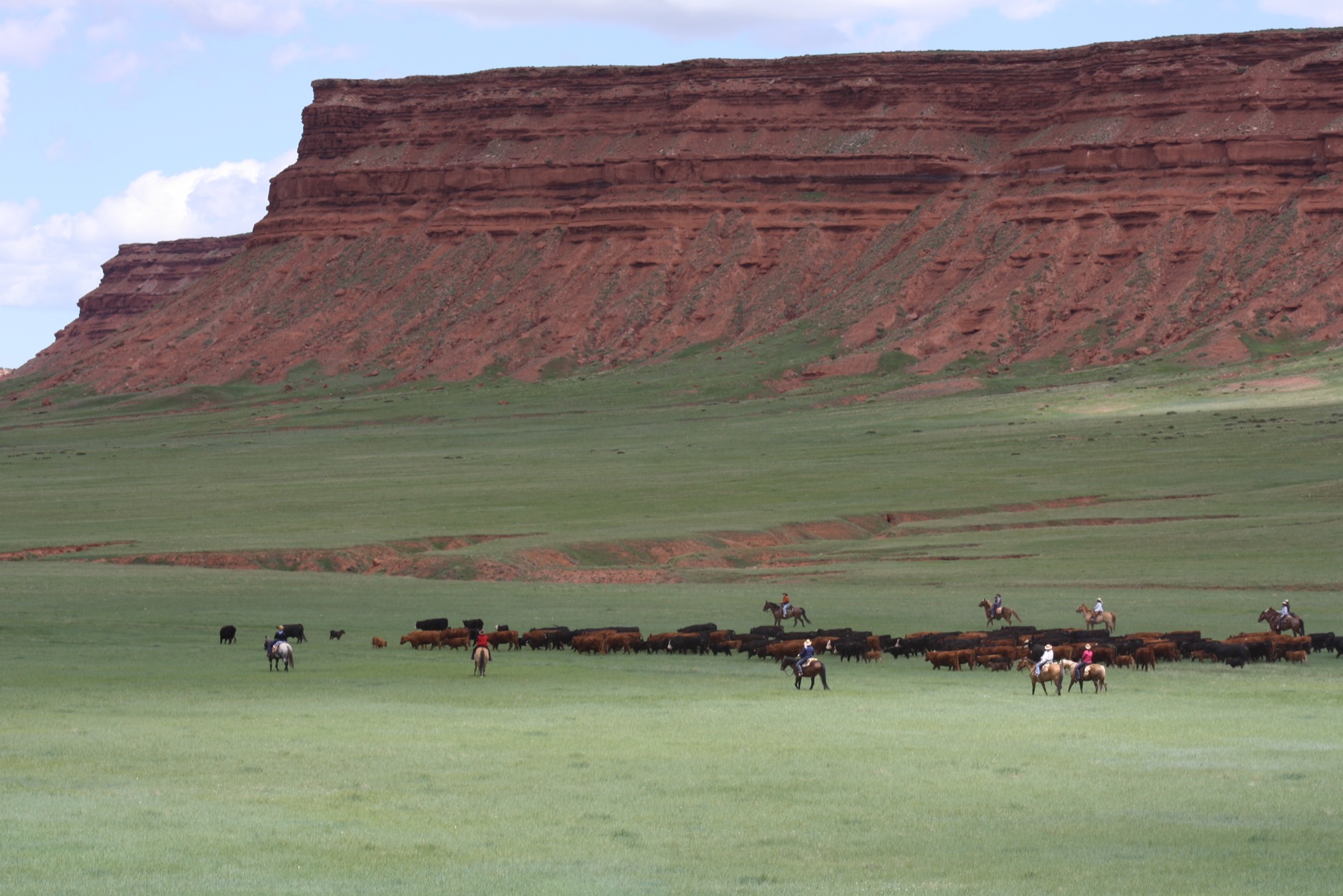
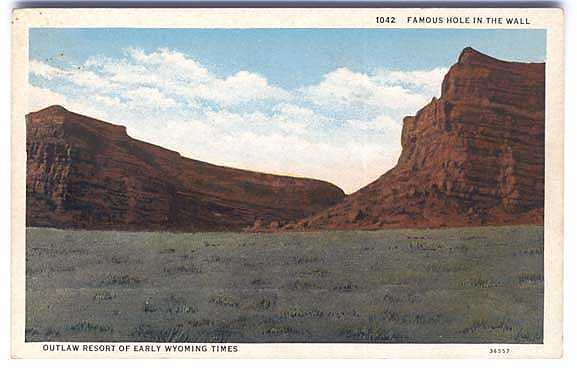
Hole-in-the-Wall was reached by a gap eroded into a rock wall. From its spot on top of a mesa, the outlaws had a 360 degree view and could see anyone approaching. And the surrounding box canyons were perfect places to hide the cattle you’d just stolen, which was good because if caught, the rustler would immediately get invited to be guest of honor at a Necktie party. Hole-in-the-Wall ran as a bandit refuge for 50 years without once being penetrated by the authorities.

To reach Robbers Roost (which Butch Cassidy found a dull place), one has to first cross 40 miles of open desert. If that wasn’t enough to stop you, there were rumors it was well protected with bobby traps and dynamite, which it wasn’t, but the wise lawman gave the place wide berth. In its 30 years of activity the law never reached Robbers Roost.

I read a brief mention that undercover attempts to infiltrate the gangs were unsuccessful. I want to know that story!

How did a hungry outlaw survive in such remote locations? Some of the hideouts were in Mormon territory, and those ranchers and farmers didn’t exactly care for authority either. The ranchers and the outlaws had a reciprocal relationship with an exchange of goods and favors. The hideouts themselves were situated in spots right for grazing, so they were able to kept cattle and chickens of their own.

These were not permanent settlements. The gangs would flow in and out, maybe sheltering in the cabins during the harsh winter months. The enormous area the gangs criss-crossed is astounding. We have an idea how long it takes to cross one state in a car. Can you imagine crossing multiple states on horseback? Jesse James would venture out all over the west and then return to his home base in Missouri, for instance.

I had to people my hideout with characters. Obviously, there were outlaws, but what about women? What would happen when Michael/Jack showed up with Margarita (hint: she stirs up some interest)?

Few women were admitted to the hideouts—only four were ever allowed in Robbers Roost. But there were lady outlaws like Laura Bullion and the very interesting Basset sisters from Brown’s Park. These ladies had various romantic liaisons with the Wild Bunch. And like the Sundance Kid and Etta Place, some outlaws did bring their girlfriends or wives along. There was a report that Cassidy would send women—thought to be prostitutes—into nearby towns for supplies when he didn’t dare show his face.


So, yes, women in the hideouts were not unheard of, but I doubt the amount of feminine domestic activity seen in the movie was accurate. I don’t see any of the above-mentioned women fading into the background wearing dowdy dresses and making lye soap, but there may have been a few behaving like this.


And if you want to see what comes out of showing children inappropriate things, here’s a link to Margarita and the Hired Gun:

http://www.amazon.com/dp/B01EAS7F50/ref=cm_sw_r_tw_dp_PKwexb1H1WD6N via @amazon


I'm giving away a digital copy of MARGARITA AND THE HIRED GUN! Do you think you could have survived with the outlaws in one of these hideouts? Leave me a comment along with your contact information to be entered for the drawing tomorrow evening for a copy of MARGARITA AND THE HIRED GUN. Thanks for stopping by today! I leave you with an excerpt to wet your appetite...

Margarita meets her protector for the first time...

"Rafferty,” said Homer, nodding his head in the direction of the man, who was now moving toward the stairs, eyes still on Margarita.

He walked slowly, swinging one long leg after another, a slight swagger in his shoulders. Unable to bear up under his direct gaze any longer, Margarita looked down at her coffee. Her ears were burning, and her throat was constricted in anticipation, but still, he moved down the stairs and across the room at an unnervingly slow pace.

When he arrived on the scene, the women at the table stopped talking and looked expectantly at him. He didn’t register their presence as he walked past them—to their apparent disappointment. The men playing poker watched him with wary eyes. One of them touched the gun in his holster, nervously. The cowboys stopped talking and drew closer together.

Without a word or invitation, the tall man pulled out the chair across from Margarita. The gun sticking out of his waistband put a lump of fear in her stomach.

He jerked his head in her direction, looking at Homer.

“Why is she here?” he asked in a deep voice, speaking in the same slow pace as he walked. He had an Irish accent, she noted. Homer poured out a cup of the thick, dark liquid for him.

“Rafferty. This is Margarita McIntosh, Jock’s daughter.”

“And she’s here for what reason?” he asked again, in a brusque tone.

Margarita looked up, her face burning with indignation. She was met with quite a sight. The man across from her had a few days’ growth of black whiskers covering the lower part of his face. Jet-black hair stood in loose curls around his head in an uncombed mass. His hair was in need of a wash, strands clumping together with something she didn’t want to dwell on. It was hard to guess his age. Older than she, certainly, but she couldn’t discern much beyond that.

He was without a jacket or shirt, and his long john’s undershirt was pushed up at the elbows, showing long, muscular forearms. Worse, the top buttons of his shirt were unbuttoned, exposing the patch of black hair on his chest. The tight, sweat-stained garment showed every bulge and indent in his lean torso, including his nipples. He was as good as naked.

Margarita tried to hide her shock at this unseemly display. She’d never seen so much of a man’s body before, up close. His eyes bored into her. They were steely eyes the color of indigo set in bloodshot orbs. Her discomfort seemed to amuse him. He narrowed his eyes at her, and a smirk twisted his lips as he observed her watching him. Other than his lips and eyes, he was as still as if he’d been carved in stone. Very economical in his movements, Margarita thought.

“Well, here’s the thing. She’s the job. Jock wants his daughter delivered to his sister in Durango. He wants you to make sure she gets there. Safe—and intact,” Homer said, in a way which made her redden.

The man called Rafferty grinned rakishly, displaying surprisingly even, white teeth. “If it’s safety he after, there’s better ways to transport his precious cargo, I would think.”

“He wants her movements to go undetected.”

Rafferty leaned over the table. She could smell him now. He smelled like sour sweat, whiskey—and cheap perfume. There was some other odor Margarita couldn’t identify, but it was a smell which repelled her.

Repelled her, yes, but she felt an odd measure of arousal at the same time. She raised her handkerchief to her nose to breathe through its lavender-scented folds. Catching her gesture, the dark man glowered at her briefly before the smirk returned to his lips.

Sunday, April 5, 2015

FACT AND FICTION ON A COLLISION COURSE FOR A FUN STORY AND GIVEAWAY!! by Kirsten Lynn

Sometimes a story is born from an actual event in history. This is the case with my newest release THE WIDOW'S LAWMAN.  Butch Cassidy, Harry Longabaugh (The Sundance Kid) and the rest of their Wild Bunch are popular subjects of study near where I live, mainly because the Hole-in-the-Wall is right down the road.

From researching the Wild Bunch and the Wilcox train robbery, a stubborn widow and an outlaw failing to reform were born. Along with these two wild and wonderful characters, Butch, Sundance, Etta and the boys came to life and joined forces to wreak havoc on the Wyoming countryside.

First let me give you a little peek at the Hole-in-the-Wall.


In Southwest Johnson County, Wyoming lying between the Red Wall and Big Horn Mountains is the most famous hideout on the Outlaw Trail, the Hole-in-the-Wall. Between roughly the 1860s and 1910, 30 to 40 outlaws stayed in the secluded spot including Jesse James and Butch Cassidy’s Wild Bunch.                                                                               

The area was (and still is) isolated taking about a day’s journey by horseback from any semblance of civilization. It is a steep climb to the top of the Wall, but overlooking the country below it is no wonder this location was chosen. With sweeping 360 views the pass was well situated to spot approaching lawmen and the narrowness of the approach made it easy to defend. The grassy plateau at the top and creek bed of the canyon below made it a good spot to graze all the rustled cattle.


In this area in the 1880s and 1890s, rustlers grazed stolen cattle and provided refuge to outlaws. Inhabitants of the six cabins that stood in the valley were known as the Hole-in-the-Wall Gang. Members of the gang included Bob Smith, Al Smith, Bob Taylor, George Currie, Tom O’Day, and the Roberts Brothers. Later Robert Leroy Parker (Butch Cassidy), Harry Longabaugh (the Sundance Kid), and Harvey Alexander Logan (Kid Curry).


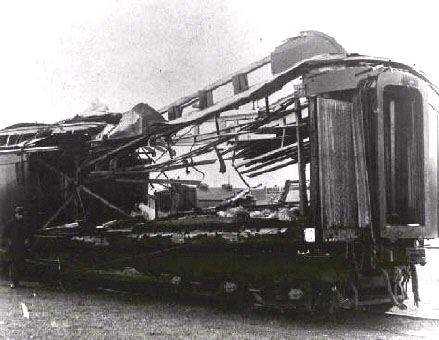
A trestle across the Union Pacific near Wilcox, Wyoming at 1:00 a.m., June 2, 1899, forces the Overland Flyer to halt. Men wearing masks made from white napkins, possible stolen from the Harvey House Restaurant, boarded the train. One of the men after unsuccessfully forcing the engineer to pull the train forward, clubbed the engineer with a gun butt and pulled the train forward himself. The trestle was dynamited to prevent the second section of train from catching up. The train was pulled forward two miles and stopped.
There the express car was surrounded, and the attendant, E.C. Woodcock, was ordered to open the door. He refused. The car was blown up. Woodcock suffered a concussion from the blast and couldn't remember the combination to the safe. The gang blew up the safe. Initial reports stated the Wild Bunch made off with $30,000, some of the bank notes being scorched by the explosion or stained with raspberries also in the car. Later the superintendent of the Union Pacific, confirmed the gang made off with over $50,000 in stolen items, bank notes and even gold. 
then Union Pacific Superintendent W.L. Park wrote that the railroad had actually lost more than $50,000, some of it in gold. The outlaws escaped in a northerly direction, toward the Hole-in-the-Wall, a well-known outlaw enclave in the middle of Wyoming. - See more at: http://www.historynet.com/the-wilcox-train-robbery.htm#sthash.RHe0zya9.dpuf

Even though the men were masked immediate suspicion fell on the Wild Bunch.  Other newspapers identified the culprits as the Roberts brothers and reported the robbers to be George Currie and the Roberts brothers. It is now believed the name “Roberts” was used by Sundance and Harvey Logan. Authorities believed some of the robbers were headed for the Hole-in-the-Wall. Posses gave chase. Near Teapot Creek some of culprits were cornered by a posse led by Converse County Sheriff Joe Hazen. In the ensuing fire fight, Sheriff Hazen was killed and the train robbers made their escape by swimming across the river.

The members of the Wild Bunch involved included: "Flatnose" George Curry, Harvey Logan "Kid Curry," Lonnie Logan,  Harry Longabaugh "Sundance Kid," Ben Kilpatrick "The Tall Texan,"  and Will Carver.  Butch was thought to have been the mastermind behind the robbery, but did not participate in the actual robbery. In 1896, Butch was pardoned by Governor William A. Richards from the Laramie Penitentiary. The condition of this pardon was Butch promised to never again participate in any crimes within Wyoming's borders.

The Wilcox train robbery became one of the most famous train robberies in the West. A year later the Wild Bunch held up a second train near Tipton, Wyoming. While these robberies were successful, they also signaled the end of the Wild Bunch. Butch, Sundance and Etta made their way to South America. Other members were eventually tracked down and killed or imprisoned.

In one of those history makes a great a story, poor Agent Woodcock was the agent aboard the train during the Tipton train robbery. 

The Flyer also carried horses...And that's where Jake and Ellie enter the picture.


GIVEAWAY: Today I'm giving away TWO e-book copies of THE WIDOW'S LAWMAN, so you can have a chance to join the fun. Please leave a comment and your contact information for a chance to win.

Join Jake, Ellie, Butch, Sundance and the Wild Bunch on the track to true love...and a lot of shenanigans along the way.

Outlaw Jake Avery is handed an ultimatum--hang for his crimes, or become the new Sheriff of Sheridan, Wyoming. When he chooses the life of a lawman, he doesn’t expect a local widow woman to tangle with his emotions.

Ellie Reed needs Sheridan’s new sheriff to help her rob a train, and recover her late husband’s treasured property. She doesn’t expect the outlaw-turned-sheriff to steal her heart, as well.

As the train barrels through Wyoming, Jake and Ellie plan a robbery to avenge the past. But can they heist a future together?


 AMAZON BUY LINK

BARNES & NOBLE BUY LINK


 Kirsten Lynn writes stories based on the people and history of the West, more specifically those who live and love in Wyoming and Montana. Using her MA in Naval History, Kirsten, weaves her love of the West and the military together in many of her stories, merging these two halves of her heart. When she's not roping, riding and rabble-rousing with the cowboys and cowgirls who reside in her endless imagination, Kirsten works as a professional historian.
 
FACEBOOK    WEBSITE   TWITTER   NEWSLETTER

Wednesday, October 26, 2011

BUTCH CASSIDY, SUNDANCE KID, AND THE WILD BUNCH

By Caroline Clemmons
Several weeks ago, fellow Sweetheart Ashley Kath-Bilsky invited me to a luncheon to hear Dr. Richard Selcer speak on the history of Fort Worth's Hell’s Half Acre. What a great program for any western history lover! We hated for him to finish speaking, but he had to sell a few books and get away in time to teach his next class. (Yes, of course I bought several books.) Our plan was that we would split the information and I would do Butch and Sundance today while she did Hell’s Half Acre on the 30th.

THE WILD BUNCH, 1900
Seated: Harry Longabaugh (Sundance Kid),
Ben Kilpatrick (Tall Texan), and
Robert Leroy Parker (Butch Cassidy)
Back: Will Carver (News Carver) and
Harry Logan (Kid Curry--
the most feared Wild Bunch member)
You’ve all seen the above grouping, but do you know the story behind the photo? Legend has it that someone saw it in the photographer’s window and alerted authorities, who then had copies made and sent them across the west. After extensive research, Rick Selcer disputes this. His research proved the photographer’s studio was on the second floor. Said photographer did the mug shots for the Fort Worth police. When an officer brought a handcuffed prisoner up to the studio for a mug shot, the officer saw the photo on a shelf. He recognized the Wild Bunch and asked the photographer for a copy. That’s how it came to be distributed to other law enforcement professionals. Together with the other members of The Wild Bunch gang, Butch Cassidy and the Sundance Kid performed the longest string of successful train and bank robberies in American history!

Butch Cassidy and Sundance Kid each boasted they never killed a man, and the gang was best known for their lack of violence during the course of their robberies. However, Kid Curry, George Curry, Will Carver and other members of the gang killed numerous people during law enforcement's pursuit. Kid Curry killed nine lawmen and two civilians during shootouts. Elzy Lay killed two lawmen following a robbery, was wounded, arrested, and sentenced to life imprisonment. George Curry killed at least two lawmen, before being killed by Utah lawmen.


"Wanted Dead or Alive" posters were posted throughout the country, some with as much as a $30,000 reward for information leading to their capture or death. The gang began hiding out at Hole-in-the-Wall, located near Kaycee, Wyoming. From there they could strike and retreat, with little fear of capture, since it was situated on high ground with a view in all directions of the surrounding territory.


Harry/Sundance
 Harry Alonzo Longabaugh was born in Mont Clare, Pennsylvania, in 1867, the son of Pennsylvania natives Josiah and Annie G. (nee Place) Longabaugh. He was the youngest of five children and his older siblings were Ellwood, Samanna, Emma and Harvey. At age 15, Longabaugh traveled westward on a covered wagon with his cousin George. In 1887, Longabaugh stole a gun, horse and saddle from a ranch in Sundance, Wyoming. While attempting to flee he was captured by authorities, convicted, and sentenced to 18 months in jail. During his jail time he adopted the nickname of the Sundance Kid. After his release, he went back to working as a ranch hand. I’ll save more about him and his common law wife, Etta Place, for another time. Butch deserves the spotlight today.
 

Robert/Butch
 Butch Cassidy, a so-called gentleman bandit, rivals Jesse James and Billy the Kid as the most celebrated outlaw of the American West. His specialty was robbing banks and trains.

Robert Leroy Parker, who later became known as Butch Cassidy, was born on April 13, 1866 to Ann (nee Gillies) and Maximillian Parker. The Parker and Gillies families were British Mormons who came to America and took up residence in Utah, where Ann and Maximillan met. At the age of 13, Butch began working at a ranch some miles from the Parker homestead. In his late teens, Butch found employment closer to the Parker home at a neighboring dairy farm. He met another hired hand, Mike Cassidy, who taught Butch cattle rustling and how to use guns. Butch was an excellent student and later adopted his mentor's surname when he chose his alias.

In June of 1884, 18-year-old Butch left his family home and traveled to Telluride, Colorado. He got into trouble with the law, but he successfully fought the charges. He wandered around Wyoming and Montana as a ranch hand before returning to Telluride in 1887. On the morning of June 24, 1889, Butch, Matt Warner, Tom McCarty, and another man, were seen in and around Telluride saloons watching people going in and out of the San Miguel Valley Bank. Later in the day, one of the four entered the bank and gave a teller a check he wanted cashed. The group quickly gathered up approximately $20,500 before escaping to Robbers’ Roost.

In 1894, Butch and a friend were arrested for stealing horses and possibly for running a protection racket on local ranchers in Lander, Wyoming. Butch was found guilty of horse stealing and sentenced to two years. He entered prison on July 15, 1894, at the age of 28.

After serving 18 months of his term, Butch requested an early release from the Wyoming governor. The governor agreed to release him if he would go straight. Butch said that rustling and robbery were too much a part of him, but promised that if he were released, he would not commit illegal activities in the state of Wyoming. The governor agreed and the early release was granted on January 19, 1896. How's that for justice at work?

Butch began gathering a gang of outlaws that would become The Wild Bunch.
Matt Varner

His former partner Matt Warner was in prison in Utah for murder, so Elzy Lay replaced Warner as Butch's second-in-command. Elzy was a native of Boston who had journeyed west and started a respectable life in Denver as a horse car driver. When a man was harassing one of his female passengers, Elzy threw the man from the horse car. He believed he had killed the man and Elzy fled Denver. Eventually he ended up among the outlaws.

Butch's criminal activities were interwoven with long stretches of legitimate work. Beginning in 1890, Butch purchased some land near Dubois and Blue Creek, Wyoming and set himself up as a rancher. Butch never prospered as a rancher and he soon returned to a life of crime. For a brief stint in Rock Springs, Wyoming, he worked as a butcher, which probably accounts for his nickname.

Butch was true to his word to the Wyoming governor. In August of 1896, Butch, Elzy and an another man traveled to Montpelier, Idaho, and waited until just before a bank’s closing time before they entered and approached a cashier. The bank was nearly deserted, so two of the men entered the bank with bandanas over the lower half of their faces. One kept watch at the door, while the other demanded all of the paper money the bank had. The robbery netted more than $7,000 in cash, gold, and silver. After the Montpelier robbery, Butch added Harry Longabaugh to his gang.

On July 11, 1899, near Folsom, New Mexico, a train was held up and, because one of the principal thieves was Elzy, Butch may have masterminded the robbery. Lawmen chased the gang and caught up with them a few days later. In the shootout that followed, Elzy killed a sheriff and was captured and sentenced to life imprisonment. Butch had lost his right-hand man again to a jail term. Harry Longabaugh stepped in as Butch’s new second in command.

Losing Elzy Lay so soon after Matt Warner’s imprisonment probably contributed to Butch’s decision to seek clemency and end his outlaw life. He consulted Utah Governor Heber Wells and Pacific Railroad to see if an agreement could be reached whereby the Union Pacific would not prosecute Butch for any of the train robberies. A rendezvous was arranged between Butch and Union Pacific officials, and Butch showed. The train officials were delayed by a storm and arrived one day late. Butch had already gone and left a note saying, "Tell the U.P. to go to hell."

Butch allegedly decided to pull a couple of jobs to collect enough money to live on comfortably for the rest of his life and get out of the robbery business. Butch, Sundance, and one other man traveled to Winnemucca, Nevada, on September 19, 1900, and relieved the First National Bank of $32,640. Around noon, three unmasked and armed men entered the bank and ordered a cashier to open the safe. This successful heist was followed up in July 1901 with a $65,000 train robbery near Wagner, Montana.

Following the Wagner heist, Butch, Sundance, and Sundance’s common-law wife Etta Place went east. The trio departed New York on a ship bound for Buenos Aires, Argentina on February 20, 1902.
In South America, the three bought a ranch and lived in peace for several years. No one knows the reason, but they went back into robbery and were joined by Etta. A Buenos Aires newspaper described this new addition to Butch’s gang as "an interesting woman...who wears male clothing with total correctness...a fine rider...handles...all classes of firearms."

In February of 1905, a group of men rode into Rio Gallegos, Argentina, and told residents that they were interested in buying land for raising livestock. After spending some time in the town setting up this façade, the men entered the bank on February 13th and robbed it of $100,000. A posse chased after them but only found the abandoned horses and an empty box the bank had used to store its silver. Most scholars agree that Butch and Sundance did the actual robbing while Etta waited outside and held the horses.

In a similar robbery later that year, four men robbed a bank at Villa Mercedes of about 13,000 pesos. This time the outlaws encountered more difficulties than they had previously. One of the bank employees managed to get to a gun and fired at the bandits, but missed them entirely. A man across the street from the bank ran over when he heard the shots, was held captive by the thieves, managed to escape and return to his office, and later fired at the escaping outlaws but also missed hitting any of them.

After the Villa Mercedes robbery, Butch’s trail goes quiet, and it is unclear how the trio occupied their time or exactly where they went. Etta apparently left after the Villa Mercedes robbery.

So much conjecture and myth abounds of what happened on November 4, 1908 in a remote region of Bolivia, that it is impossible to separate fact from legend. But here's the gist: A man and a mule made the difficult journey along a remote trail in Bolivia, carrying a mining company payroll. Two English-speaking bandits held up the payroll and rode off. The two bandits went to a small village called San Vincente and spent their days and nights in a boisterous manner, drawing attention to themselves and behaving in ways that Butch and Sundance never had previously just after a heist. Three nights after the robbery, the two men were surrounded in the small house where they were staying.


See the resemblance?
 Robert Redford and
Paul Newman as
Butch and Sundance
Researcher Anne Meadows, after many years of investigative searching, unearthed the original report on the events of that night as written by the Bolivian authorities and printed it in DIGGING UP BUTCH AND SUNDANCE, her detailed chronicle of her investigation into the final days of the two bandits. The official document states that the village’s mayor, miscellaneous village officials, and two soldiers went to the house where the two bandits were holed up. One of the soldiers approached the house and was shot by someone from within. The soldier retreated to care for his injury, and a few more volleys of gunfire were exchanged, although no sounds came from within the house after midnight. As the sun came up the following morning, the men outside cautiously approached the house again and found both men inside dead. The money from the mining company payroll heist was also there and was later returned to the company. The bodies of the two outlaws were soon buried in a local graveyard. Later, some time after the hasty burials, someone put forth the theory that the pair was Butch and Sundance.

Almost immediately after this identification, doubt about the identities of the dead men spread, and rumors and sightings of Butch and/or Sundance became common. Matt Warner, Mormon Church officials, and his family claimed sightings of Butch after his death. In her biography of her brother, BUTCH CASSIDY: MY BROTHER, Butch’s sister Lula Parker Betenson cites several instances of people familiar with Butch who encountered him long after 1908, and she relates a detailed impromptu family reunion that included Butch, their brother Mark, their father, and Lula in 1925. Doubtful researchers point to the cessation of all correspondence from Butch after the San Vincente episode, although Butch periodically wrote to his family up until 1908.

Rare book collector Brent Ashworth says he has obtained a 200-page manuscript, BANDIT INVINCIBLE: THE STORY OF BUTCH CASSIDY. The manuscript dates to 1934, and is twice as long as a previously known but unpublished novella of the same title by William T. Phillips, a machinist who died in Spokane in 1937. Ashworth and Montana author Larry Pointer say the text contains the best evidence yet with details only Cassidy could have known and that BANDIT INVINCIBLE was not biography but autobiography, and that Phillips himself was the legendary outlaw.

BANDIT INVINCIBLE’s author claims to have known Cassidy since boyhood. He acknowledges changing people and place names. "Some descriptions fit details of Cassidy's life too neatly to have come from anyone else," said Ashworth, owner of B. Ashworth's Rare Books and Collectibles in Provo, Utah. They include a judge's meeting with Cassidy in prison in February 1895. The judge offered to "let bygones be bygones" and to seek a Cassidy pardon from the governor. Cassidy refused to shake the judge's hand. "I must tell you now that I will even my account with you, if it is the last act I ever do," Cassidy is quoted as saying by Philips.

Wyoming's state archives contain an 1895 letter by the judge who sentenced Cassidy. The letter relates how Cassidy seemed to harbor ill-will and didn't accept the friendly advances of another judge, Jay Torrey, who had visited Cassidy in prison. Cassidy had sued Torrey's ranch two years earlier for taking eight of his cattle, Pointer said.

"What's really remarkable to me is that, who else cares?" Pointer said. "Who else would have remembered it in that kind of detail...about an offer of a handshake and refusing it in a prison in Wyoming in 1895?"

Others believe the book is a work of fiction. "Total horse pucky," said Cassidy historian Dan Buck, husband of researcher Ann Meadows. "[The book] doesn't bear a great deal of relationship to Butch Cassidy's real life, or Butch Cassidy's life as we know it."

What do you think? Did Butch and/or Sundance die in Bolivia?
 
Material from to HELL'S HALF ACRE by Richard Selcer, http://www.legendsofamerica.com/, http://www.wikipedia.com/, and the Butch Cassidy website. 
 
BUTCH CASSIDY


SUNDANCE KID

Sunday, April 10, 2011

MY FAVORITE OUTLAW by ELIZABETH LANE


Elizabeth Lane, Author

Harlequin Historical author, Elizabeth Lane is a guest today at Sweethearts of the West. Elizabeth is graciously donating a copy of her March 2011 release, THE WIDOWED BRIDE, to one lucky person who leaves a comment on her post. Thank you Elizabeth!


           MY FAVORITE OUTLAW


What can you say about a guy who was played by Paul Newman in one of the best Westerns ever filmed? The real Butch Cassidy wasn’t as cute as Paul (who is?), but he had his own charms. What’s more, to this writer, Butch is practically a hometown boy!

Robert Redfore as
the Sundance Kid
and Paul Newman
as Butch Cassidy
Butch was born Robert Leroy Parker in 1866, in Beaver, Utah, the first of thirteen children. In 1879 the family moved over the mountain to Circleville, Utah. I never knew Butch (no, I’m not that old), but I grew up an hour from Circleville. My sister married a Circleville boy, and I went to school with descendants of Butch’s younger siblings. Lots of Parkers down that way.


Butch Cassidy
 Young Roy, as he was called, cut loose early and worked odd jobs. He earned the name Butch from the time he worked as a butcher. Cassidy was the name of a shady rancher who befriended him as a youth. By 1884, Butch was rustling cattle outside Parowan, Utah. From there he drifted to Telluride, Colorado where he pulled his first major crime, the robbery of the San Miguel Valley Bank. He and three cowboys got away with $20,000. They escaped along the Outlaw Trail, a meandering path that ran from Mexico to Montana.

After Telluride, Butch’s reputation grew. He liked to think of himself as a kind of Robin Hood, fighting for settlers’ rights against the railroads and cattle barons. Of course, he was really just a criminal. But what he did, he did with flair. He gathered a band of outlaw cowboys (including Harry Longbaugh, known as the Sundance Kid) and established a hideout at the Hole-In-The-Wall, in central Wyoming. The gang became known as the Wild Bunch.

Etta Place
By 1896 the Wild Bunch was robbing trains and banks all over the West. Butch was a clever strategist. His gang would strike fast and flee over a network of hidden trails. They became bold and confident, even sprucing up to pose for the famous photograph that helped lawmen identify them. But their glory days couldn’t last forever. By 1900, they were on the run. In 1902 the Wild Bunch disbanded.

Butch, Sundance, and Sundance’s girlfriend Etta Place (who was no schoolmarm) fled to Europe, then to Argentina where they bought a ranch. In 1908 the famous shootout, with Butch and Sundance supposedly gunned down by Bolivian troops, took place.

Harlequin Historical, March 2011
Now, here’s where the story gets interesting. According to Butch’s last surviving sister, Lula Parker Betenson, her brother showed up to visit the family sixteen years later. Current research suggests that Butch faked his death, sailed to Europe and got a facelift and returned to the U.S. where he married and went into business. He died of cancer in 1937. Evidence to support this includes a detailed manuscript about Cassidy’s life, which he appears to have written himself.

Nobody can call Butch a good man. But you have to admit he was entertaining. Do you have a favorite bad guy, historic or fictional? Do you find outlaw heroes appealing?