Thursday, August 16, 2012

Young Brides, Old Wives Tales ~Tanya Hanson


Thirty eight years ago this very week, I was a bride. I recall having several of those girly occasions called bridal showers. This womanly gathering owe owes its roots to a Dutch maiden three hundred years ago whose wealthy papa pooh-poohed her marital choice of a lowly miller. His refusal of a dowry had her friends and neighbors “shower” her with enough household goods to start life with her true love.

In the 1890’s, gifts for the bride were actually placed into a Japanese parasol which was later opened over her head. Hopefully there wasn’t a cast iron frying pan or meat cleaver knife in there. 
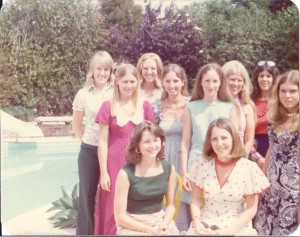
 (This pic is my friends and me, lower right, at my July 1974 shower. Talk about a vintage photograph!)   

Bridesmaids  (not the movie LOL!!) got their got their start during the bride-stealing days of the Anglo-Saxons. The gaggle of lovelies usually dressed identical to the bride even to their veils to confuse marauders and act as decoys. Later, the flock of bridesmaids was believed to ward off evil spirits who might curse the happy couple.

In the good ole days of bride-stealing and kidnapping, the groom of course had to surround himself with pals ready to assist in abducting his woman. Sometimes the “groomsmen” snatched brides of their own from the herd of bridesmaids. Romantic? Can't decide if there's a historical romance plot in there somewhere. WDYT?

Here are some helpful proverbs for any superstitious brides out there.

    1. If you find a spider on your wedding gown, you’ll come into money. 
    2. If you see a flock of birds, your marriage will be blessed with fertility. 
    3. If it snows on your wedding day, you’ll be wealthy.
    4. If the sun is out, you’ll be happy.
    5. If you marry as the hands of the clock move up (after the half hour), you’ll have good fortune. 
    6. If you drop the ring during the ceremony, it’s best to start the whole thing over. 
    7. If you look in the mirror before walking down the aisle, you’ll leave a part of yourself behind. 
    8.  If you cry on your wedding day, especially before the kiss, you’ll prevent tears during the marriage. 

Well, as I leave you with these pearls of wisdom, I can positively say that I did not cry on my wedding day, and Hubby and I are still going strong. It did not snow, and while we’re never been wealthy, we’ve never been in want. The sun shined bright, though, so that adage works. And of course I looked in the mirror. If any part of me got left behind, I haven’t missed it!

Love to all,
~Tanya Hanson

Tuesday, August 14, 2012

Elizabeth Dumont: Lady Gambler

By Anna Kathryn Lanier


Next month I’ll be teaching my class PIONEERING WOMEN OF THE WEST once again on the Hearts Through History RWA chapter’s campus.  I thought I’d give you a taste of what you’ll learn if you take the class with today’s post.  Elizabeth Dumont made and lost a fortune via gambling as well as owning several gambling clubs in the Old West.  Her downfall came not from cards, but from love. 

Born in New Orleans in 1829, Elizabeth travelled to California in the early 1850’s to make her fortune. By 1854 she had her own gambling den in Nevada City, California. It was tastefully decorated and was open twenty-four hours a day.  With Elizabeth herself manning the gambling tables, it soon became a favorite spot for the local miners and travelling gents.


While men seemed in awe of the dealing sensation, women were appalled.  They saw Elizabeth as a threat to not only their marriage but the delicate feminine sensibilities of the time.  She was “bad company that drew their men to drink and gamble.”  The women however were out-numbered by the men, out flocked to watch “the trim beauty with nimble fingers shuffle the deck.” Rival gambling dens found it necessary to hire women dealers just to stay in competition with Elizabeth.


Given her beauty and skills, she was never short of marriage proposals, but she turned them all down. Her heart, it seemed, belong to one man, the editor of the local newspaper, Mr. Wait.  He, however, did not return the affection, feeling as if Elizabeth was not of good social standing to be a wife. His rejection spurred Elizabeth to build a bigger and better gambling house with a partner, David Tobin. Within a few years of arriving in Gold Country, she had amassed a fortune.


By 1856, the gold in the area had run out and business began to dwindle.  David and Elizabeth decided to dissolve their partnership and go their separate ways.  It is probable that Elizabeth decided to move on for more than financial reasons. She’d recently learned that Mr. Wait was engaged to another woman. It’s said she never truly got over the rejection she suffered.


Over the next few years, she would move from town to town, following the gold finds and increasing her own holdings.  She was well-known for her honest and generous ways to the gambling miners, often loaning them money to gamble with.  By the time she was thirty, her looks began to fade and she grew weary of the life she was leading. She decided to pull out of the gambling business and instead purchased a cattle ranch near Carson City, Nevada.


Unfortunately, Elizabeth knew little about ranching. In addition, she was lonely and this combination set up for the worse loss of her life. Jack McKnight showed up at the ranch one day, claiming to be a cattle buyer.  What he really was a scammer, but he was also handsome and he swept Elizabeth off her feet.  They married shortly after meeting.


Less than a month after the wedding, however, Jack was gone. He took with him all her money and sold the ranch right out from under her.  She was not only heart-broken, she was out and out broke.  Given little choice, Elizabeth returned to the mining camps and gambling. By this time she was sporting facial hair under her nose and had become known as Madame Mustache. She was not as nimble at playing cards as she’d once been, but people still came from miles to watch her play and chat with her.


            Her skills as a gambler continued to diminish and eventually, she had to rely on prostitution to earn money for her keep.  During this period of time, she also turned to drinking.  She landed in the town of Bodie, California by the time she was fifty.  She set up a blackjack table in one saloon where she would be challenge by professional gamblers. Not the same player she’d been in her younger days, she was soon penniless. 

  
One night, after losing yet another hand, Elizabeth excused herself from the table and staggered off down Main Street.  The next morning, her body was found several miles outside of town, a bottle of poison beside her. A coat pocket held a note asking that she be buried in Nevada City, next to her one true love, Mr. Wait.


The locals however, where only able to raise enough money to bury her in the Bodie cemetery, which kept her, at least, from being buried in the pauper’s cemetery.


Elizabeth lived a life of adventure.  When things were good, they were very good, but when they were bad…. Unfortunately, she fell for a low-down dirty scoundrel who took her, literally, for all she had. She was one of the women, however, who left her mark in the Old West.


If you’d like learn more about the women who helped shape the West, please join me September 4-30 for PIONEERING WOMEN OF THE WEST.  Read more about this class and register for it HERE. If you’d like a chance to take the class for FREE, please leave a comment. I’ll draw a name from those who leave a comment here, as well as those who leave a comment on my August 19th blog at Seduced by History for a free registration.

Works Cited: WITH GREAT HOPE: Women of the California Gold Rush by JoAnn Chartier and Chris Enss.
Anna Kathryn Lanier
www.aklanier.com
annakathrynlanier.blogspot.com
Never let your memories be greater than your dreams. ~Doug Ivester

Sunday, August 12, 2012

U.S. Marshal History by Paty Jager


U.S. Marshals have had a presence in the United States since 1789. While most people think of U.S. Marshals as the gun toting images seen in movies and depicted in books, the first marshals were created by the first Congress of the United States to carry out all lawful orders issued but judges, Congress, or the president.  They were limited to a four year renewable term or could be replaced by the president whenever he chose.

Marshals hired their own deputies from their judicial districts so keep close ties and credibility with the community.

This is the summary or the original mandate for a U.S. Marshal as published in The Lawmen by the Smithsonian Institution Press in 1989:

“The primary function of the marshals was to support the federal courts. They served the subpoenas, summonses, writes, warrants, and other process issued by the courts; made all the arrests; and handled all the prisoners. They also disbursed the money, paying the fees and expenses of the court clerks, U.S. attorneys, jurors, and witnesses. They rented the courtrooms and jail space and hired the bailiffs, criers, and janitors. “

Not only did they carry out the above jobs, they also took the national census every decade from 1790 – 1870. Another job was distributing presidential proclamations, collected statistics on commerce and industry, registered enemy aliens during wartime, exchanged spies and prisoners of war with foreign countries.  They were the government’s civilian police power.

When the 20- year ban on African Slave trade ran out in 1808 and it was made a capital crime in 1819 the U.S. Marshals found themselves with even more work. The marshals in the North captured fugitive slaves and returned them, often against violent opposition and the marshals in the South tried to stop the slave trade amidst anger and resentment.

At the beginning of the Civil war most U.S. marshals in the Southern judicial districts resigned and marshals in the Western states and territories struggled t  keep the secessionist movements from tearing more states from the union. After the war, the marshals mad mass arrests of Klansmen.

As the population moved west so did the U.S. Marshal. In this vast sparsely populated area and unorganized territories, they weren’t the only peace officers, but because they were representatives of the federal government they held the highest rank.   The local authorities took care of most of the local altercations but if the federal mail was robbed during train and stagecoach hold ups they were brought in to help capture the outlaws.

During the 1870’s 200 deputy marshals patrolled 74,000 square miles of Indian Territory. This is a list of the problems they were to deal with:

“U.S. Marshals for the Western District of Arkansas may make arrests for: murder, manslaughter, assault with intent to kill or toe maim, attempts to murder, arson, robbery, rape, bribery, burglary, larceny, incest, adultery…these arrests may be made with or without warrant first issued and in the hands of the Deputy or the Chief Marshal…For violations of the revenue law and for introducing ardent spirits into the Indian Country, the Deputy cannot make an arrest without warrant unless the offender is caught in the act.”

Marshals did not shoot to kill or travel with large posses. They went out “on the scout” in groups of four or five with a wagon they used as a jail on wheels. They looked for stolen horses, suspicious travelers, stills and contraband whiskey and wanted men.

They received $.06 a mile traveled and $2 per arrest. They were lucky if they made $500 a year. Trying to bring their prisoners back to Fort Smith for trial was sometimes thwarted by the prisoners friends and relatives.

This was information I found in The History of the U.S. Marshal by Robin Langley Sommer when I was researching for my book Improper Pinkerton.

Blurb:
An impetuous Pinkerton agent is out to prove to a righteous US Marshal that she's the best "man" to complete the assignment and the only "woman" who can capture his heart.

Mae Simon is on her first assignment as a Pinkerton operative and determined nothing will stand in her way of accomplishing her task. When the simple assignment turns into a murder and kidnapping, she has to stop hiding behind her disguises and trust a man she’s betrayed.

U. S. Marshal Beck Harlan can’t afford to befriend anyone. Not with a vengeance seeking outlaw killing off his intimate acquaintances. Yet, he falls hard for the French prostitute he talks into being an informant, not realizing she is a Pinkerton operative after the same man.


Friday, August 10, 2012

Meet TWRP Author-Sylvie Kaye

Welcome to Sweethearts of the West, Sylvie!
Sylvie's Honky Tonk Man in the new series for The Wild Rose Press was the first published.
She was born and raised in Northeastern Pennsylvania in the shadows of the Pocono Mountains and in its honeymoon havens, Sylvie Kaye breathes the air of romance daily. After getting one short story published in 1994, she went from hooked on ready romances to hooked on writing them.
Her years of work experience in Manufacturing, as well as varied jobs in offices, retail, and a bank...to name a few...lent itself to writing contemporary romances. Road trips to exciting location in the beautiful country inspired the settings for her stories.
She's a member of Romance Writers of America, the New Jersey Romance Writers, the Pocono Lehigh Romance writers, EPIC for electronically published authors, and PASIC, a publisher author special interest chapter.
When a down-on-his-luck honky tonk musician mistakes a rich rancher's daughter for a waitress, sparks fly until he realizes he’s broken one of his main rules....
~*~*~
He has rules for a reason.
Pool shooting, guitar playing, honky tonk singer, Jace Monroe, has a knack for hooking up with the wrong kind of women, rich ones who don't take him or his music seriously. So when he meets a down-to-earth, honey-haired waitress at the Lonesome Steer Honky Tonk, he thinks his luck has finally changed.
Rules have never been her strong suit.
The last place Sunny Brooks wants to be is on her daddy's thriving ranch, but her mother needs her. To escape the constant concern for her mother's health and stay out of her father's overbearing presence, she spends most nights out at the Lonesome Steer Honky Tonk and eventually in the arms of Jace.
But when misconceptions come to light, the sweet music they make together might be silenced forever unless she can show her honky tonk man that some rules are meant to be broken.
Excerpt:
“Mind if I cut in?”
The familiar voice made her insides quiver.
With a nod from her, Tommy Lee stepped aside and Jace took her in his arms. Sigh.
She stared at his throat and Adam’s apple and inhaled his unique scent of soap and man. Until his large hand cradled the back of her head and pulled her closer.
Her face rested in the crook of his neck, her temple against his jaw. After a minute, she closed her eyes and relaxed into the intimacy of his hold. She felt the rise and fall of his chest, the heat from his body. The hand clasping hers was firm and warm. The same hand that strummed the guitar and made such beautiful music. Could he do that to her body? Strum it, make her hum?
His thighs felt muscled and the bulge between them hard. She smiled, liking that he wanted her. But to what end? Was he looking for a booty call or a relationship? Did she even know which one she wanted? It had been awhile since she’d been with a man, which might explain her shameless fascination with him.
Sunny wished he’d say something. Maybe then she’d stop analyzing and wondering. She tried not to think and concentrated on the music and moving to its rhythm. Which didn’t help at all. His hips moving in time with hers only made her hotter.

BUY LINKS:
Available at The Wild Rose Press
Available at Amazon Kindle
Available at B&N NOOK
Available at Lulu, Bookstrand, Powells


Monday, August 6, 2012


Boston City Hospital-


In my up-coming Victorian, holiday novella, Another Waltz, my hero ends up in a hospital in Boston.  While doing the research I became engrossed in a fascinating book, A History OF The Boston City Hospital From Its Foundation Until 1904, by David Williams Cheever, George Washington Gay, Amos Lawrence Mason, Johns Bapst Blake, Boston City Hospital

Built to provide comfort and care to the poor patients of the city, construction of Boston City Hospital was begun in 1861, on Harrison Avenue in the South End of Boston, north east of Roxbury.

In the 1830’s a project was begun in which fill was brought in by trains to fill in a large portion of Boston’s Back Bay and it was on the former Tidal Marsh that the hospital was built.

The four buildings of the original group were designed in the French Renaissance style.  The administration building was an imposing structure of brick, with tall wooden columns, balustrades and porches with a large dome at the very top, 148 ft. above the street. The first floor was used for general administrative purposes, with a reception room for visitors and offices and apartments for the superintendent and trustees. The second floor contained private rooms for patients and the third floor, flooded with light from the great dome, was used for operating rooms. Two stairways and a hand elevator were used to move patients. The basement rooms were 13 ft. high with another sub basement. These lower stories contained a kitchen, storerooms, a dispensary, a laboratory, and a dining room for the employees, with rooms for clerks and stewards.

To the left and right of the administration building were Pavilion’s I and II.  One hundred feet away, they were connected by a cover colonnade. Each building was 180 ft. X 48 ft. and had three stories with a basement 3 ½ ft. below the grade of the ground. Pavilion I, the surgical side, contained Wards, A, B, C, & D, and Pavilion II, the medical side held Wards, E, F, G, & H.

Because of the surgical and antiseptic methods of the day, hospital gangrene and general sepsis were common. In 1866, Pavilion III, known as the “Foul Ward,” was built where the old Roxbury canal had channeled its sewage into the old marsh. The main ward was for men and the second story for women.

The original boiler room was located on Albany Street, parallel with the Administration building. Steam was generated from three tubular boilers at thirty pounds of pressure. Steam was carried to a large battery of steam coils, and fresh air, drawn through a latticed window was forced by a large propulsion fan 15 ft. in diameter, through a large sub basement conduit. From here the heated air was distributed by smaller ducts, to the various wards.  A secondary system of ducts admitted cold air and by mixing the valves the correct portion of hot/cold air could be maintained.

The problem was that the conduits, which in some places were 10 ft. wide and 12 ft. high, had too many leaks to properly achieve this.  Then rats, which soon burrowed between the sewers and the imperfectly constructed conduits, caused sewer gas to be mixed with the heated air and pushed into to the wards. All patients in beds near the air inlets invariably ended up with septic complications, many of whom died.

Then because the hospital was built on such a low grade, the flow of tides caused seepage of ooze into some areas of the buildings.

In these early days sewage was removed by barrel sewers, but the sluggish flow caused solids to settle and form deposits that gradually became obstructive.

The original medical and surgical staff consisted of eighteen members. One third was consulting physicians and surgeons. The rest were house officers, (interns) who roomed in various parts of the hospital and were equally divided between the buildings.

Patients slept on beds with horse hair mattresses of blue and white striped ticking.  They were covered with a coarse linen sheet and beige wool blankets. In the wards of the hospital, there were seven windows on each side of the ward with two beds to each window.  It had also been voted that except for emergency cases, no one could be admitted to the hospital without a satisfactory character reference.

ANOTHER WALTZ

Excerpt:

Above her loomed a wide porch with four Corinthian columns and balustrades. She blew her runny nose and pushed her spectacles tight to the bridge of her nose. After stuffing her handkerchief into her coat pocket, she grasped the fabric of her skirt and carefully limped up each snowy step one at time, eighteen times.

Inside, the ceiling soared above her head even higher than twelve foot ceilings in Payton’s house. On either side two large staircases stretched toward the second floor. A door snapped shut somewhere; the sound echoed through the building. Across the width

of the room she spotted a sign over a door of a room marked Visitors. Her heels clicked loudly against the tile, their cadence out of time. After all these years, she could still hear the sing-song chants of the girls from boarding school ringing in her head. “Gimpygirl! Gimpy-girl!” Even her brother had mimicked their taunts.

“Excuse me?”

The woman seated behind the desk raised her head. Her shrewd gaze silently appraised Madeline from the bonnet which protected her head to the kid gloves which covered her hands.

Madeline continued. “I’m looking for a man—”

The woman interrupted with a quick bark of laughter, flashing rows of crooked, yellowed teeth. “Dearie, ain’t likely anyone of your quality would be here.”

Madeline shuddered at the limp strands of salt and pepper hair, which had fallen from the woman’s bun to frame her face and sagging throat. The fingernails of her hands, as they dealt a game of solitaire, were rimmed with black.

Adjusting her spectacles Madeline repeated her question. “Do you have a patient here by the name of Sean MacAuley?”

“An Irishman, eh? Well, we got lots a them here, but none by that name.”

Madeline glanced beyond the desk, to the file cabinets, tables, and shelves, stacked with ledgers and piles of papers. How could this person remember the name of every patient?

“Could you please check your records? He would have been admitted the night before last.”

The matron heaved a sigh, which strained the bosom of her too-tight blouse, as she half-heartedly sifted through the piles of papers littering her desk. After a couple of minutes, she looked up and shook her head.

Madeline’s shoulder’s drooped. Where else could he be? This had to be the right hospital. Unless he’d gone back to where he’d been staying. With all the hotels in the city, it would be like hunting for a needle in a haystack. Maybe she should just forget the whole idea and let him go.

“There was a man—” the woman added, startling Madeline from her musing. “—the police brought him in. Don’t know his name.” The wooden chair creaked under her cumbersome weight as she flipped open the book beside her. “He was listed as an accident patient. That would put him in North Pavilion,” she pointed toward a side door on the right.

Madeline murmured her thanks and once outside walked beneath the covered colonnade, which spanned the curved distance between the administration building and the entrance to the Pavilion.

Once inside, the nurse in Ward A informed her that the beds were filled to capacity, but some of the male patients were being tended to in the basement, and Sean might be with them.

Stale sweat, urine, and vomit blended together with an assortment of noxious odors, forcing

Madeline to swallow an urge to gag.

Though less than half of the wall was actually below ground level, she still wondered how these poor souls could survive in such damp conditions. The nurse on duty indicated the bed at the end of the row as the one, which held the nameless patient.

As she started down the wide aisle separating about twenty beds, for the first time she prayed that Sean wouldn’t be here. She pictured him on a train, heading back to Texas, his wide grin in place as he seemingly laughed at the world like it was all some secret joke.

She passed through a pocket of cold air, into a wave of heat blowing from a large ventilation duct, then shivered as she moved back into the cold. A few more steps and she was forced to detour around a pile of soiled linens and dirty bandages which littered the aisle like flotsam in a stream, all while maintaining her focus on that last bed. She glanced around, certain every eye was on her as she limped through the ward, relieved to find most of the men were either asleep or watching her with vacant eyes.

As she came to a stop at the end of the iron bed, a gasp that was part relief and part horror escaped her lips. For although she was relieved to have finally found the man, who, until Thursday night had been known to her as James Sullivan, she barely recognized the battered visage of the man sleeping restlessly before her.

Another Waltz is scheduled for release October 10th  from The Wild Rose Press.


Saturday, August 4, 2012

A Modern-Day Horse Story

by Amber Leigh Williams

It’s been some time since I’ve posted here at Sweethearts of the West. I apologize to my fellow Sweethearts and our readers for being away so long. I have a great horse story I hope will make up for my absence!

In the Corral

 My husband and I took a road trip with his brother and sister-in-law and two of their children a couple of weekends ago. It was a rescue mission. They are horse owners. Before our trip, they had three horses and room for one more. When they heard of a wild, abandoned horse on a large property outside Mobile, they decided to help.

The story of the horse unfortunately has a lot to do with the economic downturn. A family built a beautiful mansion in the woods outside Mobile. It’s removed from the city and sits on several acres. The family, however, couldn’t afford the house and were forced to give it up to foreclosure. Instead of finding their horses loving and caring homes, they left them to roam wild on the land that now belongs to the bank. It’s rumored that one of the horses died because by the time my brother- and sister-in-law got wind of it, there was only one horse on the property. The upside to this tragic story is that the bank was concerned for the remaining horse’s welfare, so much so that they offered it free of charge to whoever could catch it.

Several people tried and failed. One Saturday, my brother- and sister-in-law traveled with a horse trailer to Mobile to see if they could rescue the poor animal. They spent the better part of the day trying but couldn’t quite get the horse corralled. That night my brother-in-law called my husband, asking for his help. My husband agreed and the next day I tagged along for the ride.
Brother-in-law & Hubby in the Corral with the Horse

When we pulled through the gate onto the property, we spotted the horse lingering around the house. She shied at our approach even when my sister-in-law got out of the truck and tried walking to her with a bucket of feed. We parked the truck and horse trailer. While their youngest child and I watched from the house, the horse ran into the woods and the others did their best to catch her. It was a hot day, as most are on the Gulf Coast in July. Thankfully, the bank had left the back door to the house open so we could take advantage of the air conditioning and restrooms if we needed to. My niece and I watched as the horse ran from the woods and into the fenced-in pasture where it was once stabled. The others hurried to build a corral with portable fencing we had brought in the truck at the entrance to the pasture. It took them less than an hour after building the corral for them to corner her inside. The four of them were already exhausted from running across the large property, but now that they had the horse in the corral they were so close to their end goal of getting her safely into the horse trailer that they couldn’t stop.

It was now clear to everyone that the horse hadn’t had any human contact for some time. Her diet was poor and she was dirty. The fact that she was small took everyone by surprise. My sister-in-law managed to get a look at her teeth when the horse took a treat from her hand. They were so tiny, she couldn’t have been older than two years. Still, she didn’t make it easy for my husband and his brother to get her into the horse trailer. By the time they finally did so, their clothes were soaked clean through and everyone was in desperate need of some cold beverages.
Meeting her new family....

The ride back to our side of the bay was a long one, but we made it safely out of Mobile and soon brought the horse to her new, loving, caring home. It’s been a few weeks since she arrived at my brother- and sister-in-law’s house and she seems to be doing well on a healthy diet and in the shade of their front pasture. When my husband and I visited a few days ago, she even let me pet her face.

Thank goodness for people like my brother- and sister-in-law who are willing to go out of their way to help horses like this one. I thought it was an important story to tell because I know there are others horses out there who might have been abandoned or suffer from poor care. I personally don’t have much experience with horses, but I do know there has to be better options for those whose owners can no longer care for them. I also think it’s important to recognize everyday heroes like my brother- and sister-in-law, their children, and my husband who take action when an animal is in need.

Thursday, August 2, 2012

Gold Discovered in 1849

By Paisley Kirkpatrick
The 1849 gold discovery sparked a mass hysteria as immigrants traveled from around the world to what soon would be known as the gold country of California. Digging for gold from early dawn until dusk was a backbreaking job, but the desire to find their fortune in gold drove these miners on. A miner had to find an ounce of gold a day to just break even. Most miners barely found enough for daily expenses.
The gold discovery wrought immense changes upon the land and its people. The peak production of placer gold occurred in 1853. Every year after that, more and more men were in California, but less gold was found. Thousands of disillusioned gold seekers returned home with little to show for their endeavors, glad to escape with their health.
After the boom, many miners -- broke and looking for wages -- headed to San Francisco. Some stayed in the towns that developed during the gold rush. I found this rebuilding of the lives and communities an exciting time in history. Some let disappointment send them into lives of drink and gambling. Others pulled together to rebuild their towns and start businesses, some of which still stand today. Placerville, known as both Dry Diggins and Hangtown during the heydays, still holds onto some of those grand houses, rock buildings, and tunnels zigzagging underneath the town.
Luckily for me, I have this history at my fingertips to inspire my stories. My first book, Paradise Pines Series: Night Angel will be released by Desert Breeze Publishing August 21st. It is a story of a hotel owner who anonymously helps the downtrodden citizens of his community by traveling through the tunnels at night to provide families with goods they need. A vibrant saloon-singing poker player arrives in town and stirs it out of its doldrums with her beautiful voice and colorful costumes.
EXCERPT:
The Scot's insensitive words snapped across her back. Amalie jerked her hands from his grasp and moved behind the chair. She barely controlled the urge to slap his face. "That's the second time you've taken my character to task, Mr. Grainger. Prostitute myself indeed."
Declan got to his feet. Disgust exuded from his powerful gaze. "Woman, you take yourself far too seriously. I did not call you a prostitute. I said--" He stepped back, stared at his feet a moment before speaking again. "You have my apologies. I meant no insult to your character. Buck Thatcher is a dangerous man and must be taken seriously. You and I both know he wanted more than a kiss for the gold nugget."
"I didn't need you to swoop in and protect me. I am not some inexperienced schoolgirl."
He threw up his hands. "My mistake."
He gave her the most pitiful, insincere look she'd ever seen.
"I should have remembered you explained all of this with eloquence outside the saloon tonight, but I couldn't concentrate on your well-chosen words with you barely contained in your black dress."
She caught the mischievous tilt to his lips. She also noticed where his gaze settled. At any other time she'd appreciate the attention, but not under these circumstances. She pulled the soft woolen blanket tighter across her breasts. He baited her, but she couldn't let his comment go. The deliciously handsome man was far too sure of himself and needed to be put in his place.
"Lily Fox doesn't need or want your advice on how to handle Buck Thatcher. She's dealt with worse than the cocksure gambler."
"Not in my presence, you haven't." He moved with slow, but determined steps toward her. "Surely you can find it in your generous heart to take pity on this most humble of men?" He placed his hand over his heart and tapped his fingers. "An uncontrollable desire to protect a woman just bursts outta me when I see her in harm's way."
When he flashed a wide grin, she relaxed her stance. "Oh, you are a charmer, aren't you?"
His low rumbling chuckle shot through her. If she was as smart as she proclaimed, she'd flee from the man's hotel this very night. He was a lot more dangerous than Buck Thatcher ever could be. She feared her defenses might not be strong enough to protect her heart from his more than abundant charm.