Showing posts with label Soul Food. Show all posts

Thursday, August 16, 2012

Young Brides, Old Wives Tales ~Tanya Hanson


Thirty eight years ago this very week, I was a bride. I recall having several of those girly occasions called bridal showers. This womanly gathering owe owes its roots to a Dutch maiden three hundred years ago whose wealthy papa pooh-poohed her marital choice of a lowly miller. His refusal of a dowry had her friends and neighbors “shower” her with enough household goods to start life with her true love.

In the 1890’s, gifts for the bride were actually placed into a Japanese parasol which was later opened over her head. Hopefully there wasn’t a cast iron frying pan or meat cleaver knife in there. 
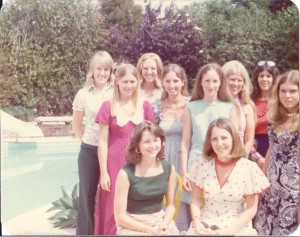
 (This pic is my friends and me, lower right, at my July 1974 shower. Talk about a vintage photograph!)   
Bridesmaids  (not the movie LOL!!) got their got their start during the bride-stealing days of the Anglo-Saxons. The gaggle of lovelies usually dressed identical to the bride even to their veils to confuse marauders and act as decoys. Later, the flock of bridesmaids was believed to ward off evil spirits who might curse the happy couple.

In the good ole days of bride-stealing and kidnapping, the groom of course had to surround himself with pals ready to assist in abducting his woman. Sometimes the “groomsmen” snatched brides of their own from the herd of bridesmaids. Romantic? Can't decide if there's a historical romance plot in there somewhere. WDYT?

Here are some helpful proverbs for any superstitious brides out there.

    1. If you find a spider on your wedding gown, you’ll come into money. 
    2. If you see a flock of birds, your marriage will be blessed with fertility. 
    3. If it snows on your wedding day, you’ll be wealthy.
    4. If the sun is out, you’ll be happy.
    5. If you marry as the hands of the clock move up (after the half hour), you’ll have good fortune. 
    6. If you drop the ring during the ceremony, it’s best to start the whole thing over. 
    7. If you look in the mirror before walking down the aisle, you’ll leave a part of yourself behind. 
    8.  If you cry on your wedding day, especially before the kiss, you’ll prevent tears during the marriage. 

Well, as I leave you with these pearls of wisdom, I can positively say that I did not cry on my wedding day, and Hubby and I are still going strong. It did not snow, and while we’re never been wealthy, we’ve never been in want. The sun shined bright, though, so that adage works. And of course I looked in the mirror. If any part of me got left behind, I haven’t missed it!

Love to all,
~Tanya Hanson

Monday, July 16, 2012

Yellow Ribbons..by Tanya Hanson


I never liked the song much, Tie a Yellow Ribbon 'Round the Old Oak Tree, but that doesn't mean I can't sing it at will all these years later!  These days, I see frequent reminders to pray for our troops on yellow-ribbon car magnets.

But not until a recent visit to Old Sacramento, California, did I learn the origins of the yellow ribbon. For almost 150 years, displaying a yellow ribbon is a sign of loyalty to family, friends and loved ones far away from home in difficult situations such as war or captivity.

According to legend, the custom of a yellow ribbon showing support for a loved one far away began during the Civil War. At this time, the United States Cavalry wore yellow piping on their uniforms. Women who were married or promised to a Cavalryman wore yellow ribbons while waiting for their soldiers' return. Supposedly the practice kept prospective suitors at bay as well as warned of reprisal by the soldier if his lover was harmed.

Another version of the custom traces its origins to the horrific Andersonville Prison. Officially known as Camp Sumpter, Andersonville was one of the largest, most notorious Confederate prison camps. During its 14 months of operation, more than 45,000 Union soldiers were confined, 13,000 losing their lives from disease, malnutrition, overcrowding, and exposure.

Supposedly a member of the Ninth Ohio Cavalry who had been a Confederate prisoner there for several years, wrote to his wife with the suggestion that, rather than wear her ribbon, she tie it to a signpost near the train station so he could see it upon his return. The tale soon became part of Civil War lore.

The following song spread throughout the North, its words set to an old British drinking song:

Around her neck she wore a yellow ribbon
She wore it in the Springtime and in the month of May.
And if you ask her why the hells he wore it,
She wore it for her soldier who is far, far away.


(Chorus)
Far away, far away.
She wore it for her soldier who is far, far away
.

During the 1991 Gulf War and following 9/11, the yellow ribbon symbol has gained widespread popularity as it sends our service members the message that they are never far from our hearts.

Sincere thanks to the Old Sacramento School House Museum for this information.

~Tanya Hanson
www.tanyahanson.com

Thursday, February 16, 2012

Some Black Magic, Western-style~ Tanya Hanson

By Tanya Hanson
     Not long ago, my hubby and I recently took a fantastic city slicker wagon train trip around the Tetons. Just as we started planning the trip, I started writing the eight-book Hearts Crossing Ranch series where wagon train adventures play a big part. In fact, one of the eight Martin siblings is a chuck cook on her family’s adventures. The fifth book in the series, Soul Food, stars Kelley Martin and will be out in the spring.

     Of course, Kelley cooks many outdoor meals for those city slickers in cast-iron Dutch ovens. Any discussion of this hearty kettle starts by mentioning the method of casting with iron in dry sand molds. The technique’s exact origin isn’t known, but it most probably dates from the Dark Ages in Western Europe, refined later in both England and the Netherlands. The term “Dutch oven” may have come from the Netherlands connection and the Dutch traders who peddled them.


     The “bulge” style pot –in my head I envision a witch’s cauldron— likely came over with the Pilgrims, but the 3-legged “bake” or “camp” oven appeared in the early 1700’s. Paul Revere (yes, he of the famous 1775 Midnight Ride) is said to have adapted the oven lid’s flanged lip to hold coals on top while the pot rested on a campfire. However, the oven was versatile and could be used on the hearth and for roasting in a stove’s oven.
     Lewis and Clark’s Corp of Discovery (1803-05) carried a “large-size Dutch oven” across their entire route to the Pacific Northwest and home again. No self-respecting covered wagon or cattle drive traveled without the Dutch oven, and every Gold Rush mining camp had several, needing at least one for their historic sourdough bread. Miners lucky enough to have a burro or pack mule invariably had a Dutch oven tied on top.

     By the mid 1870’s, every American household had some sort of cast iron cooking item, Dutch oven, skillet, or pot. Around 1920, casting iron reached its pinnacle in quality and quantity, but the invention of the electric stove in the 1890’s had already started a decline in interest of the Dutch ovens. However, one great casting company, Lodge, began operations in 1896 and continues to this day.
     In recent years, the mystique of Dutch oven “black pot” cooking has made a comeback, not because of need but because of a resurgence in the outdoors, in nostalgia, and in love of history. Most Dutch oven recipes can be revised for stove top, oven or slow cooker as well.

     Today’s Dutch oven chef needs a lid lifter, heavy special gloves, wooden utensils, briquettes, and a Dutch oven of 5 to 22 inches in diameter. The 12-incher is the most popular. The well-sealed lid allows heat and pressure to build while preserving the moisture of the food. Although there are many directions (e.g. “above-to-underneath” and “checkerboard pattern” among them) for actual food production, the general rule for the cook is to use twice as many briquettes as the diameter of the lid. Briquette placement on the lid and under the pot is crucial, as is rotating the lid and pot 90 degrees every fifteen minutes. Altitude, sun and even wind play important roles, too.
     The premier organization for Dutch oven cooking, the International Dutch Oven Society (http://www.idos.com/) began in the Rocky mountains and now has 48 chapters in 27 states and 2 Canadian provinces. Each spring IDOS holds the World Championship Dutch Oven Cook-off.
    Any Dutch oven stories or recipes to share today?