Wednesday, September 14, 2011

Western Sayings

By Anna Kathryn Lanier

Few weeks ago, I got a new book “Savvy Sayin’s: True Wisdom form The Real West” collected by Ken Alstad.  The back blurb says: Ken worked as an Arizona farm and ranch reporter, became vice-president of Leo Burnett Advertising and, as a researcher of frontier lore, spent 20 years collecting Old West witticisms. This is the books 14th printing, reflecting the sayings’ enduring relevance.  I thought I’d share a few of his sayin’s with you. 
·         Silence can be a speech.

·         A cowboy who says he ain’t never been thrown is a liar.

·         Wild oats make a mighty poor breakfast.

·         Sleepin’ late keeps a fellow huntin’ his horses.

·         Life is one man getting’ hugged for sneakin’ a kiss and another getting’ slapped.

·         You can educate a fool, but you can’t make him think.

·         When a territory gets full of family men and empty of game, it’s time to move on or get married.

·         An optimist is a man who, when she says, “I’m tellin’ you no for the last time,” he says, “I knew you’d weaken in time.”

·         Priceless ain’t free.

·         Careful is a naked man climbin’ a bobwire fence.

I really haven’t had time to read the book, including the 4 page introduction.  The book is about 95 pages long, and probably averages 7-10 quotes on each page.  Woodcutting illustrations by Fredric Remington and Charles M. Russell are included throughout the book, so the number of quotes per page varies, but needless to say, there are a LOT of saysin’s. 

Do you have a favorite Western Sayin’?  On my own blog today, I’m offering up an Old West recipe: Stack Cake….come by and see what that means and when they were often served.

Anna Kathryn Lanier
http://annakathrynlanier.blogspot.com/

Monday, September 12, 2011

"Do Not Give up Your Father's Home."

Whoops! This post snuck up on me. I can't believe it's nearing the middle of September...Where did my summer go?
The third book of my spirit trilogy set among the Nez Perce of NE Oregon has been contracted. This book takes place along the route the Wallowa, and a couple of other bands of, Nez Perce take to avoid being placed on a reservation far from the burial grounds of their fathers.

"Do not give up your father's home" were the words that haunted Young Chief Joseph as he and others led the Nez Perce farther and farther from the land they knew and tried to keep their people free.

By reading the first two books of my trilogy the love the NezPerce felt for the land is apparent. Not only because their fathers and mothers were buried within the fertile soil but because it was their home, where they hunted, fished, played, and loved one another with equal fierceness.

The Wallowa and Snake River bands weren't at the treaty signing that took away their lands. Each time General Howard came to Joseph to get him to remove his band to the reservation, Joseph told the one-armed soldier they were not present at the signing of the White man's paper. They would not leave the land of their fathers. Joseph was a pacifist like his father and believed in talking things through and not shedding blood. But when young warriors with hot heads were easily goaded by the impatient white men who wanted the fertile valley, Joesph had to flee, the army was not longer listening, they wanted action. When young warriors of his band bloodied their hands Joesph knew the worst would come.

He packed up his band and along with the bands of White Bird and Looking Glass headed for freedom.

Spirit of the Sky is the story of that journey from an Indian spirit whose job it is to keep the Nez Perce safe and the cavalry officer she falls in love with.

I'm not sure when this book will be released but until then you could check out Spirit of the Mountain which garnered a first place paranormal finish in the Lories Contest and Spirit of the Lake. Both books will give you an entertaining insight into the life and love the Nimiipuu(Nez Perce) feel for their land.

Paty Jager
www.patyjager.net
www.patyjager.blogspot.com

Saturday, September 10, 2011

Guest-Joyce Henderson-a versatle Westerner!

Joyce Henderson is presently writing Historical Romance for The Wild Rose Press. Writing since 1984, she holds a certificate from the Newspaper Institute of America and wrote for local newspapers: straight news, human interest stories, and a by-lined column, "It Ain't Necessarily So…" Joyce believes in giving back to organizations that have nurtured her career by mentoring aspiring authors, and she teaches the craft of fiction writing workshops. She's a member of Romance Writers of America (RWA) and a charter member of Southwest Florida Romance Writers (SWFRW), Published Authors Network (PAN), Published Authors Special Interest Chapter (PASIC), and Novelists, Inc. (NINC.)

Welcome, Joyce!  

Hey, Folks, nice to be here at Sweethearts of the West. Thanks for asking me to expound on…
Well, let me think.

My latest book, Promise the Moon, is a departure from my usual Native American, mid 1800’s stories. It’s set in 1898, Southern California, and though I write about horses…soooo dear to my heart, and specifically showing Western Equitation…I also included the budding avocado and orange industry that my hero pursued as his vocation on his San Diego County ranch.

Why did I do that? It boils down to, I usually write what I know something about, and research what I need to layer my stories with historical fact or my vision of what happened in the era. This is fiction, remember? LOL Sooo…when we lived in San Diego County for 20 years we owned and rode horses, but what took us there from LA County and the aerospace industry in the first place was avocado ranching.

So mount up and follow me down my

Memory Lane
trail. My husband didn’t like avocados, still doesn’t other than guacamole, but that didn’t mean we couldn’t have a wonderful life in the country. We also grew oranges, limes, kiwi (the fruit not the bird), and cherimoya. Fallbrook, CA was country in those days. Now it’s solid city, and it breaks my heart to go back and see all those avocado and orange groves gone and replaced by homes. Okay, really lovely homes but it’s no longer country.

For those folks who put an avocado pit in the ground or in a jar of water and think they’ll grow a tree that will ultimately produce avocados, it will but it probably won’t bear much resemblance or taste like the avocado it was grown from. Producing avocado trees are the product of grafting to a sturdy host tree from a producing tree. Take a tip from a former grower, don’t just reach up and pluck an avocado off the tree. Nope, you gotta clip close to the base of the stem and leave the little nub or the avocado will rot before it ripens.

How many of you knew that? LOL

As I mentioned, my husband left the aerospace industry to farm avocados, which we knew absolutely nothing about! He went from designing rockets to the moon to designing irrigation systems for avocado groves. Stepping off a cliff, so to speak, has never stopped us from trying something new. J

Okay, let’s talk about Garrett Montez, my half-Mexican/half-Anglo hero (A hunk, but that goes without saying. J) and the grove he planted. I didn’t specify a variety of avocado, but at that time it’s likely it could have been Fuerte, which came from Mexico, where Garrett was raised, and means vigorous. And for me, it’s the most tasty variety over Hass, which is now the most common variety in California. But there are many others. Btw, the first avocado tree planted in the US was in Florida; however, California produces 60 % of the avocados grown in the US.
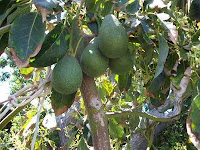
The aquacate was imported from Mexico in 1871, so in 1898 Garrett’s grove is already mature and producing avocados and Valencia oranges. Remember, I mentioned I write something I know a little about? J I had great fun writing a scene where the ranch hands are picking oranges and an earthquake rocks their world. And of course, that makes Garrett fear for Neely’s life and he rides hell-for-leather to his house to see if she’s all right. He discovers she’s missing….

~*~*~Here’s an excerpt from Promise the Moon:~*~*~

The screech and roar ground on and on. Tree limbs shook. Jesu, they must be right on top of the
fault. With each turn, Garrett saw Hank still clinging to the horse’s headstall. One more jolt and
he feared the draft horse would win the battle. If the wagon rolled over Hank, he’d likely be killed. Then Sancho lunged to grab the other horse’s headstall.

“No!” Garrett bellowed, but it did no good.

Now, both men flailed about like wet sheets in the wind. To hell with Rocco. Two of his men were about to be killed. He kicked free of the stirrups and swung his leg over the saddle horn. He hit the ground running and leaped onto the wagon. Circling the reins off the brake, he braced his
knees on the front boards, fighting the animals’ strength, and pulled back, drawing the horses down.

By the time he got the draft horses calmed, the rolling and grinding had ceased. Hank released his death grip on the headstall, then walked over to drop under a tree. Sancho released his hold and wound his arm around like a windmill, holding his shoulder.

“You okay?” Garrett asked.

“Sí.” On wobbly legs, Sancho joined Hank. “Dios!” the boy exclaimed quietly as he collapsed on the ground.

Garrett stood high on the wagon, glancing around. “Anyone hurt?”

A few muttered, “No.” Others shook their heads.

“Whew!” Eduardo said.

“I have to get to the house.” Garrett leaped down, then scanned the wagon road between the
trees. “Damn.” Rocco was nowhere in sight. Looking back at Eduardo, Garrett continued, “You men with families, go check on them.”

Still speaking, Garrett back-pedaled. Lifting his arm, he pointed at Hank. “You, and you.” He stabbed his finger toward Sancho. “Let the damn horses run if we have aftershocks that spook them. If we lose a wagon, we do, that’s all. You got that?”

Saluting, Hank grinned and Sancho nodded.

Satisfied, Garrett turned and loped away. He hadn’t covered more than a half mile when
he spied Rocco between a row of orange trees, contentedly munching tufts of grass.

Splaying his feet, Garrett planted his fists on his waist. “You crazy nag.” He whistled and Rocco raised his head, his ears pricking forward. “Come here, you.”

Rocco meandered, lowering his head twice to tear tufts of the pesky Johnson weed before he got
close enough for Garrett to catch up a rein.

Gaining his seat moments later, Garrett scanned the barns as he tore by. Everything seemed
okay. He hadn’t even realized he’d been holding his breath until he saw the house’s roof in the distance. Thank God he had built with wood rather than adobe, which simply crumbled during an
earthquake.

Rocco hadn’t come to a complete halt before Garrett slid from his back and sprinted to the porch.
“Mindy! Neely!” he called.

The dishsafe doors stood ajar, but miraculously, nothing had tumbled from the shelves. He noticed greens, a tomato, and an onion on the counter as he hastened through the kitchen. Salad tonight, he thought, and pushed open the swinging door. He paused in the atrium, frowning. Shards of glass glittered on the tile floor. He glanced up at the ceiling. Two of the four panes had come crashing down.

“Is it over?” Mindy asked, her dark eyes round. She sat cross-legged on the second floor gallery, both hands gripping the banister’s rails.

“Yes, sweets, it’s over. There may be some aftershocks, though. Are you okay?” His boots
crunched the glass, and then he took the stairs three at a time.

“Think so,” the girl said, shakily rising. She clutched his waist, her cheek against his chest. “I
was scared,” she mumbled into his shirt.

“It’s okay now,” he reassured.

The door to Neely’s bedroom stood wide open. “Neely,” he called, but no one answered. He looked at Mindy’s dark head nestled against him and caressed her hair. “Do you know where Neely is?”

“I saw her go out awhile ago.”

“She went out?” He frowned. “When?”

The girl shrugged. “An hour or so.”

His chest tightened.

He led Mindy down the stairs. As he reached the base, movement caught his attention. Lita stood in the parlor archway. Díos, he’d forgotten about her.

She appeared calm, but her eyes were rounded, too. “That was scary,” she said.

He agreed with a nod. “Have you seen Neely?”

“No.”

“Are you sure?”

“Garrett, I would know if I had seen the housekeeper,” she said, a sneer in her voice. “I
haven’t seen her since...breakfast.”
He noted the slight hesitation and wasn’t fooled. But why would Lita lie?

He slid his fingers under Mindy’s chin. “Sweets, I must find Neely. Will you be all right alone?”

Lita stood no more than five feet away, but she hadn’t gone to Mindy after the quake. No reason to think she’d aid the girl if there were strong aftershocks.

“I guess.” Mindy’s lips trembled.

He caressed her cheek. “If it starts shaking again, go outside and sit on the grass. It’s safe out
there.” He turned toward the kitchen.

Lita called, “Garrett, a lamp tipped—”

“Later.” He increased his pace. Where the devil was she? Bursting out the screen, he scooped up
Rocco’s reins again. The horse plodded along behind while he circled the house.

“Neely!” he called time and again. Only to be met with silence.

Mounting, he set Rocco to an easy lope toward the barns. His gaze darted in every direction. He detoured by the Carreras’, but she wasn’t there. A few minutes later, when he led Rocco into the
barn, he cursed under his breath. “Dammit, where are you?”
~*~*~
Again, my thanks to Celia Yeary for asking me to visit today. I hope y’all enjoyed learning something about avocado farming, what some Westerners do besides ride horses, herd cattle, or search the prairie for Indians during days gone by.

My favorite guacamole recipe for you:

3 medium California avocados - Fuerte or Hass
3 Tbsp fresh lime juice
2 oz green jalapeño pepper sauce
¼ cup fresh cilantro, chopped
 2 Tbsp onion, chopped
3 medium plum tomatoes, diced
Scoop avocado from shells into medium bowl. Mash with fork - can leave small chunks
Stir in lime juice, jalapeño sauce, cilantro, onion, tomatoes, and salt to taste
ENJOY with tortilla chips!

Joyce will give a free Pdf of Promise the Moon to one lucky commentator. And she loves to hear from readers. Visit her at  www.joycehendersonauthor.com 

You may purchase Promise the Moon in print or digital format at:
The Wild Rose Press:
http://www.thewildrosepress.com/index.php? main_page=product_info&cPath=89_117&products_id=4512  

Amazon:

JOYCE, THANKS FOR BEING OUR GUEST. CELIA

Tuesday, September 6, 2011

GUNMEN AND PEACEMAKERS by KATHY OTTEN


God created man, but Sam Colt made them equal. With its distinctive plow-blade shaped handle and large front sight, no one has to be a gun expert to easily recognize Colt’s Model 1873 Single-Action Army revolver. This gun became so popular it quickly became known as the Peacemaker (Colt’s dealers coined the name). Almost every western movie and romance novel hero carries one as he faces down the villain gunfighter in a climatic, guns blazing shoot out.

The term single-action simply means that there is only one way to fire the gun, by cocking the hammer then pulling the trigger.

The original Colt Peacemaker, which was issued to the army in 1874, was designed with a strap across the cylinder and a one piece walnut grip. It came in two barrel lengths, the 7 ½ inch Cavalry model and the 5 ½ inch Artillery model. Both were designed and sighted for a .45 caliber, black powder cartridge.

Most westerners carried their revolver in a leather holster with a loop at the top which threaded through and hung from their cartridge belt. Shoulder holsters were often used in winter so the gun could be easily reached under a slicker or heavy coat. This also kept the gun warm which kept the oil from thickening up.

The movie image of the man wearing two guns strapped to each hip so he could shoot both with accuracy was either a myth or a very green newcomer. Professional gunmen sometimes carried two guns, but if he did, he didn’t let anyone see the second one and would carry it in a hide-away holster under his arm.

The Single-Action Army Colt was never intended for precision work. On the open range the revolver was a survival tool. It was used for defense, hunting game, and killing wolves and coyotes. For amusement cowboys would shoot tin cans in the air or roll them along the ground with bullets. Another game was to rapid fire at a post from the back of a horse at a full gallop. The winner was the man who placed the most shots, closest together. Some cowboys practiced a lot, but for most the extra ammunition was expensive and men kept their spent shells to be reloaded in their free time around the bunkhouse.

Most cowboys were fairly good shots. For hunting, when accuracy counted from a distance, they held the gun with both hands, straight in front of their body.


The movie image of the hero pinned down in the rocks, firing one-handed at the outlaws with his trusty Colt, was a myth. The fixed sights of the Colt were calibrated and set for 50 yards using the .45 caliber ammunition. With its maximum effective range being about 75 yards, it did pretty well grouping shots inside a 6-inch circle from 50 yards. But to have even a slim chance of hitting anyone from 200 yards you would have to aim 8 feet over his head. Also, since the rifling inside the barrel twisted to the left the bullet would drift to the left at approximately 10 inches for every 100 yards.


Most westerners were good natured men, but there were a few bullies and men on the dodge from the law. A gunman was what the old west called the outlaw who had a reputation with a weapon. He liked to get close then using speed, fire his weapon. He tended to be more of a bully or a brawler.

Throughout the west there were two kinds of gunfights, close range and distance. Across a bar room or card table in a range of 6-7 yards (the normal range of the relaxed human eye), where the target is the size of a human, it wasn’t necessary to aim, just instinctively point and shoot. In this case time and the quick-draw mattered and the Colt Single-Action Army had the best grip ever designed for quick straight pointing. Outside that 7 yard circle however, the eye has to accommodate and the ability to aim was vital.

To aim means to locate the target, point your weapon at it and mentally make all the adjustments and corrections before pulling the trigger. The gun fighter was the lawman or hero who didn’t shoot first, not because of honor, but because he shot back with accuracy and took the time to aim. When old timers spoke of ‘taking time’ to draw their weapon they referred to the split second it took to make these decisions. This dispels the quick draw myth because in a gun fight it’s not the first shot that matters but the first hit.

Wild Bill Hickok once said, "When you get into a row be sure and not shoot too quick. Take time. I’ve known many a feller slip up for shootin’ in a hurry."

Hickok also believed that no one could out run a bullet, so if one was coming it was better to face it. And aim for the body rather than anywhere else. It might not be fatal, but it will give him a shock that will paralyze his brain and arm so much the fight will is all over.

Also at this period in American history the word ‘fast’ was not a term used to describe the time it took for someone to pull his gun from its holster. The word ‘fast,’ was generally applied to a loose woman or a town with no morals and no law. Quick was the term more commonly used, but even this was second to getting ‘the drop’ on a man.

Some men could draw, shoot and hit their target from 10-12 yard in ¼ of a second, however this is against a target that is not shooting back. No one knows how fast anyone shot in a gunfight because they were never timed. All any gunfighter ever said was that when the gun is drawn in a gunfight the brain switches from peace time to wartime. Karl Von Clausewitz, Prussian soldier and German military theorist, said, "of a sudden you find yourself operating against a terrific resistance, like a swimmer in molasses, a man trying to run through deep mud."

Which is why, in looking at accounts of old Western gunfights the young kid with the fast-draw and guns blazing, is killed by the older, slightly overweight sheriff who takes his time and places his shot.

"Fast is fine, but accuracy is everything." --Wyatt Earp
 

Saturday, September 3, 2011

The "Message Board" of the American West


The high desert of western New Mexico isn't the kind of place you would expect to come across an oasis...or what is known today as "sky island"...or, for that matter, a veritable message board for the American West. Yet if you happen to be traveling there and come across the El Morro National Monument, you would find all of the above.
Soft, flat El Morro Mesa has been a landmark for centuries. Thousands of years before people began carving their names in El Morro Mesa, Paleo and Archaic hunters gathered there, probably because even then it was a desert oasis. The ruins of a 13th century pueblo can still be found on top of the mesa and are known as the village of Atsinna. The people who lived there built the pueblos on top of the hard-to-reach mesa as a defensible position during a period of drought and famine.

The runoff from the mesa feeds the spring and gives it constant, reliable flow. It was a camping ground for Anasazi/Zuni traders, Spanish Conquistadors, the U.S. Army, and American pioneers. In fact, all of the above have carved their names into Inscription Rock at El Morro Mesa. The first translatable and dated message dates back to the 17th century when Adelantado Don Juan de Onate carved the following...


"Passed by here, the Adelantado Don Juan de Onate, from the discovery of the Sea of the South, the 16th day of April, 1605."

In the inscriptions of El Morro Mesa, history is written in many ways. For example, though they eventually lost control of New Mexico to the Mexicans (who in turn lost the colony to the United States), the Spanish ruled there for two centuries before the Pueblo Rebellion of 1680. They then reigned again for twelve years, after a victory against the Pueblo during which another a Spanish general carved the following....

"Here was the General Don Diego de Vargas, who conquered for our Holy Faith and for the Royal Crown all of New Mexico at his own expense, year of 1692."

The first American inscription at El Morro Mesa appeared in 1849 and was made by "Lt. Simpson" of the U.S. Army. In 1906, the state of New Mexico decided to recognize El Morro Mesa and Inscription Rock's historical value by incorporating both into El Morro National Monument. For the same reason, carvings are no longer permitted at Inscription Rock, but it remains a favorite camping spot for many modern explorers of the American West who don't mind going a bit off the beaten track to see a bit of history carved into desert stone.


Amber Leigh Williams
"Williams has brought the romantic back to romance!" ~ LASR

Thursday, September 1, 2011

Moving to Oregon in 1850

I spent the last month in a very informative online class about Pioneer Women, which was given by our own Anna Kathryn Lanier. One of the subjects pertained to wagon train travel, so when I saw this information I thought it would be fun to share. Anna Kathryn asked everyone what were the important things they would have to pack as momentoes. The answers were varied and maybe not all of them realistic.

What you need and how much it costs:
Remember, your wagon is all you have to carry your equipment and food for 2,000 miles. You have to walk because there is no room in the wagon!
So what do I need to make the trip west?

Must Haves
A strong wagon, fit for the journey - A Wagon can carry 2,000 lbs.
Oxen (4 head, but 6 is better)
Tack and Harness - To attach the oxen to the wagon
Food - See list below for amount and type of food
Clothing (2 sets per person - a set includes 1 shirt, 1 pair of pants and 1 pair of boots)
Tent - a tent will hold 4 people
Pots
Pans
Cups, Plates and Utensils
Matches

Optional Items
Milk Cow
Mule or Riding Horses - If you do not want to walk
Please include Saddle and Saddle Bags, Bridles and Blinders for the horse
Mule or Pack Horse Please include a Pack Saddle
Tools - See below for examples
Nails
Candles
Tubs
Buckets
Rope
Axe
Whetstone
Hand Tools
Shotgun or Rifle with Gunpowder and Shot

DRAFT ANIMALS
ox $35.00 At least 4-6 for each wagon
milk cow $75.00
cattle $20.00 For meat
mule $15.00 Can be ridden or to carry stuff
mule collar $1.25 To attach to the mule
pack horse $25.00
pack saddle $2.50 Needed for Pack Horse
riding horse $75.00
bridle & blinders $3.00 Needed for Riding Horse
saddle & saddle bags $5.00 Needed for Riding Horse
tack & harness $5.00 1 per 6 oxen
horse blanket $2.00
whip $1.00

WAGONS
covered wagon $70.00
There's no evidence that wagons made for the emigrant trade held up any
better than ordinary farm wagons
wagon bows $3.00/set To repair your wagon - 1 set per wagon
cloth cover $1.00/yard 10 Yards per Wagon

CAMP EQUIPMENT
woolen blanket $2.50
tent $15.00 1 Tent will hold 4 people
nails $0.07 per pound
soap $0.15 per pound
sheet iron stove $20.00
coffee mill $1.00 For grinding coffee beans
coffee pot $0.75 For brewing ground coffee
frying pan $1.50
stew kettle $0.50
bread pan $0.25
butcher knife $0.50
tin table settings $5.00 Includes plates, cups, knives, spoons and forks for a family of eight
candles $0.15 per pound
10-gallon wash tub $1.25
whetstone $0.10 for sharpening knives and axes
bucket $0.25
tar bucket $1.00
"tar buckets" for storing axle grease had tight-fitting tops to keep flies out and cost $1.00
axe/shovel/hoe $1.25 These are sold separately
hand tools $2.50 Augurs, Planes, and Saws
$2.50 for one tool
1 set of handkerchiefs $1.08
1 tea set $24.00 Tea Kettle, Cups, Saucers, Creamer and Sugar Bowl
1 flannel shirt $8.00
1 pair of pants $18.00
1 pair of boots $24.00
1 gross matches $1.00 1 Gross = 144 matches
rope $2.50 75' coil of 3/4" hemp rope

WEAPONS
rifle - For hunting or protection $15.00 - Double barreled rifles were sometimes seen on the frontier. Repeating rifles were not widely available until after the Civil War (1865)
shotgun - For hunting or protection $10.00
There were also double barreled shotguns, as well as hybrids fitted with
one rifled barrel and one smooth-bored shotgun barrel powder & shot $5.00 Powder and Shot were sold by the pound
hunting knife $1.00

FOOD
flour $0.02 per pound
corn meal $0.05 per pound
bacon $0.05 per pound
sugar $0.04 per pound
coffee $0.10 per pound
dried fruit $0.06 per pound
salt $0.06 per pound
pepper $0.08 per pound
lard $0.05 per pound
vinegar $0.25 per gallon
baking soda $0.12 per pound
tea $0.60 per pound
rice $0.05 per pound
beans $0.06 per pound

Recommended for each person:
150 lbs. of flour
20 lbs. of corn meal
50 lbs. of bacon
40 lbs. of sugar
10 lbs. of coffee
15 lbs. of dried fruit
5 lbs. of salt
1/2 a pound of baking soda
2 lbs. of tea
5 lbs. of rice
15 lbs. of beans
1 pound box chocolate $40.00
1 pound tin of crackers $8.50

Sunday, August 28, 2011

The Life and Times of Cheryl Pierson


Hi everyone,

Well, here’s a bit about me. I’m from Oklahoma, born and raised here. My parents and two “much older” sisters and I lived in Duncan, where I was born, until the summer I turned 6—that was 1963. That summer, my dad, who worked in the oilfields as a chemical engineer, was transferred to Seminole. My oldest sister Annette had managed to graduate from Duncan High School, but my middle sister, Karen, was going to have to do her last two years in Seminole.

We were pretty much the typical family, like the Cleavers, only Mom didn’t vacuum in high heels and pearls like June did. She kept busy with my sister Karen’s activities, and I started first grade that year at Woodrow Wilson Elementary, just a three-block hike from my front door.

I was lucky to have a stay-at-home mom, who loved to bake and cook things from scratch. Being a child of the Dustbowl and the Great Depression, it was the only way she knew to cook. A wonderful seamstress, she made a lot of our clothes, including my first prom dress!

Talk about an idyllic childhood. It was small-town America. The “neighborhood gang” rode our bicycles all over that part of town with no restraint, other than most of us were not to go past the main busy street, Strothers. However, there were plenty of other places to ride and we explored every inch of them. My best early childhood friend, Jane, moved in the same week I did, and she was only one year older than I. We grew to be as close as any sisters, and I was heartbroken when her father was transferred a few years later. I took dance lessons and played the flute in band. I was a classically trained pianist, and though I hated the hours of practice, if my mom was still here today, I would tell her what she always said I would—“THANK YOU.”

Going to the library was an every-Saturday affair. When Mom went to get her hair done, she dropped me off at the library. Goldie Barnett was the old maid librarian. Books were her life. She had a humped back and the sweetest, gentlest smile that you ever saw. She knew every book on the shelves, and loved to see young people come in and choose “no more than seven” to take home with them.

In the summers, we ran wild, playing sandlot baseball, riding bikes, climbing trees (yes, I was a bit of a tomboy!) and lying on an old packing quilt in the shade with a pitcher of cold lemonade and a favorite book for hours on end. We made frequent trips to Durant, in the southeastern corner of the state, where both my parents were from and where we still had many, many relatives on both sides. My dad’s parents had a huge garden that we would go down and help harvest. This was where I learned the fine art of shucking corn, picking beans and okra, and canning tomatoes.

When I finished my junior year in high school, my dad was transferred again--this time, to Charleston, West Virginia. I was told time and again how lucky I was to have been able to stay in school in one place all those years. I didn’t feel so lucky, though, to have to leave everyone I knew, and all that was familiar. I finished high school in Winfield, a small suburb of Charleston, and started college nearby. Turned out, the move was “in the cards” because I met my husband, Gary, there at college.

Gary and I were married in 1979, and here we are nearly 33 years later—still together. Only because we never owned a gun, I’m sure. (just kidding, really!)

Gary had been married before and had two children from his first marriage, Jennifer and Russell, who came to live with us in 1982. It was really a saving grace, because this was a very hectic time, and a time filled with upheaval, as Russell’s mom insisted on taking him back to live with her, leaving Jennifer with us. Time flew, and in 1986, our first child, Jessica, was born. I had started to write by then, but only at night when everyone else was in bed. In 1989, our son, Casey, came along, and by then Jennifer was a senior and ready to graduate.

We moved into Oklahoma City from one of the outlying suburbs and bought the home we still live in today. For many years, my life was full with taking the kids to their sporting events, play practices, and school activities. I worked part time during those years, and taught piano and guitar for many years, as well. Jessica, Casey and Jennifer all live nearby. Sadly, we lost Russell in a car accident when he was 18.

I’ve loved to write my entire life. I remember as a child, my mother would take little notepads to church with her in her purse for me to “occupy myself” with. In elementary school, I wrote poems, short stories and even a play that my 4th grade teacher let us practice and perform in class. My writing career took off a few years ago when I sold a short story to Adams Media for their Rocking Chair Reader collection. I sold several more to them, sold some newspaper articles, and then sold my first novel, FIRE EYES, a western historical, to The Wild Rose Press. I had a wonderful editor there, Helen Andrew, who really helped me find my way with the book, and will be forever grateful to her. I have since sold another novel there, SWEET DANGER, a contemporary romantic suspense, and a short story, a western historical, A NIGHT FOR MIRACLES.

Since then, I have sold many short stories with Victory Tales Press for their anthologies as well as having sold TIME PLAINS DRIFTER, a paranormal western, to Western Trail Blazer, an imprint of VTP. I’m really excited about TIME PLAINS DRIFTER, because it was given a 4 ½ star rating in Romantic Times Magazine, and has garnered many wonderful reviews. My daughter created the cover for it, and this book means a lot to me because of the rocky road it had on the way to publication.

My latest release is a short story called THE KINDNESS OF STRANGERS, that appears in an anthology called THE TRADITIONAL WEST. This is an anthology of stories that was put together by a group of well-known western writers that I belong to called the Western Fictioneers. I am thrilled to be included in the group, and have gotten some great reviews on my story.

That’s my life in a nutshell. Not too greatly exciting, just a life mixed with some trials, tribulations, and wonderful happiness. I hope you haven’t been bored—I loved getting to read all about you all and getting to know you. I’ve been in and out a lot this month and haven’t always commented, but have read every single post, and feel glad that I got to know you all a little bit better.

Hugs to all my SWEETHEART sisters!
Cheryl