Wednesday, January 26, 2022

LOST IN THE WILDERNESS!

By Caroline Clemmons

Suppose you were hiking and became lost. Or, perhaps you’ve been kidnapped and are escaping from your captors. Suppose you’re a pioneer whose horse is startled and throws you, then takes off with your provisions. What would you do?
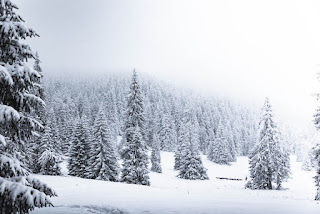
Beautiful, but brrrrrr!


This question puzzled me several years ago when I wrote a book in which the heroine rushed through a snowstorm to rescue her stepson (Surprise Brides: Jamie). They’re lost, but know the hero will come for them. Until then, what can she do to protect and feed them?  

When I was a small child, our neighbor in Bakersfield, California, harvested wild foods such as mushrooms, prickly pear cactus pads and flowers, and dandelions. There were more, but small kids don’t notice everything. My mom—also known as the pickiest eater ever—thought her friend was going to poison herself and her family. Yet, the family thrived. But, that memory wouldn’t help me with the book set in snow by a forest.

Even in winter, edible plants are available. But beware! There are also poisonous plants (as I used in Brazos Bride and High Stakes Bride in the Stone Mountain TX series). How do you tell the difference?
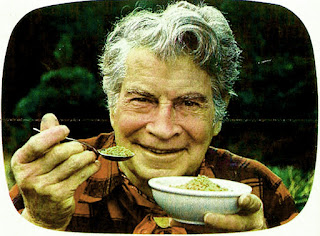

I recalled hearing about Euell Gibbons, famous for recommending foraging for edible plants. I started investigating his recommendations and proceeded from there. What an interesting man he must have been. Let me digress here to tell you a bit about Gibbons.

Euell Gibbons

He was born in 1911 in Texas. As a boy in Texas and New Mexico, Euell Gibbons began foraging to supplement the diet of his impoverished parents and siblings. At fifteen, he left home and spent many years working at various jobs and drifting. He admitted that for much of his time, he lived as a hobo. I’m pretty sure he didn’t go hungry.

After entering the University of Hawaii as a 36-year-old freshman, Gibbons majored in anthropology and won the university's creative-writing prize. In 1948, he married Freda Fryer, a teacher, and both joined the Society of Friends (the Quakers). The couple relocated to the mainland in 1953, where Gibbons became a staff member at Pendle Hill Quaker Study Center near Philadelphia. While there, he cooked breakfast for everyone every day. Around 1960, through his wife's urging and support, he was able to follow through on his earlier aspirations and turn to writing.

Capitalizing on the growing return-to-nature movement in 1962, the resulting work, Stalking the Wild Asparagus, became an instant success. Gibbons then produced the cookbooks Stalking the Blue-Eyed Scallop in 1964 and Stalking the Healthful Herbs in 1966. He was widely published in various magazines, including two pieces that appeared in National Geographic.

The first article, in the July 1972 issue, described a two-week stay on an uninhabited island off the coast of Maine. Gibbons, along with his wife Freda and a few family friends, relied solely on the island's resources for sustenance. The second article, which appeared in the August 1973 issue, features Gibbons, along with granddaughter Colleen, grandson Mike, and daughter-in-law Patricia, stalking wild foods in four western states.

Gibbons was not a survivalist, but simply an advocate of nutritious but neglected plants. He typically prepared these in the kitchen with abundant use of spices, butter, and garnishes. Several of his books discuss what he called "wild parties", dinner parties where guests were served dishes prepared from plants gathered in the wild. His favorite recommendations included lamb’s quarters, rose hips, young dandelion shoots, stinging nettle, and cattails. He often pointed out that gardeners threw away the more tasty and healthy crop when they pulled such weeds as purslane and amaranth out from among their spinach plants.

His death occurred December 29, 1975 in Pennsylvania. A rumor spread that Gibbons died from eating a bad mushroom. That is not true. He die of an inherited disease called Marfan syndrome, which caused a ruptured aortic aneurysm.

But that doesn’t help us survive in a Colorado winter.

Cattail–. I checked many sources and learned that every part of the cattail was used by Native Americans. My heroine dug up the bulbous roots and baked them like potatoes. In late winter the first shoots that are starting to emerge are reported to taste good.

Conifer Needles– The needles of evergreen conifers are probably the easiest and most widespread thing to forage in winter, even in the coldest climates. Most conifers are edible, with the exception of the yew tree, which is toxic. According to several sources, pine, spruce, fir, and redwood needles make a “tasty” tea.

Juniper Berries– aren’t really berries at all. They are actually a fleshy pine cone with a distinctive scent and flavor. They are most commonly used as a spice rather than a food, and they are the main flavoring agent for gin. A well-known Aspen restauranteur uses them as a spice and as a garnish.


Birch Bark and Branches–Birch trees are another one that can be foraged in colder regions. The bark and small twigs and branches can be made into a tea. The inner bark can also be made into a flour substitute. (Don’t take too much of the bark from one tree as it can be harmful to the growth of the tree.)


Tree Sap– Beyond maples, many trees can be tapped for sap, even black walnut. This is something that is usually done towards the end of winter, as temperatures are just barely starting to get warmer, but the exact timing is dependent on your location. Birch trees are tapped earlier than most, often in late winter, and you can even ferment the birch sap into wine.


Acorns– The nuts of oak trees, acorns (along with most other nuts) come into season in the fall, but you may still be able to find some in the winter if the squirrels haven’t gotten to them first. Acorns require processing first to make them edible, but the resulting flour is supposedly good enough to be used for flatbread. I heard a Native American lecture on the process, and if you were stranded, you might starve before you finished the process.


Maple Tree Seeds– The little helicopter seeds from maples are edible. They may be a bit  dried up and may not taste great in winter, but they are often still hanging around.


Dock Seeds–Curly dock and yellow dock are common leafy weeds that are foraged in spring and summer for their greens. In late summer they shoot up a large stalk that will eventually be covered in seeds in fall. Once winter comes, the plant will die back, leaving the dried seed stalk. I’ve heard it’s a pain to forage dock seeds and do much with them, but they can be made into a flour.

Rose Hips–Rose hips are the fruit of the rose flower, and can be found in the wild or in cultivation. They appear in the fall, but may persist through most of the winter, often covered in snow or ice. They are high in vitamin C, and good for tea, jelly, or rose hip syrup. Supposedly, the cold makes them sweeter but a little mushy.

Hawthorn Berries– There are many types of hawthorn berries, and they also persist into wintertime. Not all varieties taste great, but none are poisonous, except for the seeds. Don’t eat the seeds! The berries are high in pectin and can be used to make jelly or jam.

Wintergreen (Teaberry or Checkerberry)–Teaberries, also called checkerberries, are the berries of the wintergreen plant. They will over winter and will often still be on the plant when the snow melts in the spring. The leaves of wintergreen are also edible and can be chewed on or made into a tea.

Uva Ursi (Bearberry or Kinnikinnick)– Uva Ursi is common in the Western states, and is highly prized for its medicinal properties, particularly for urinary tract infections. It does produce berries, but they aren’t tasty, so is more commonly used for its leaves. It’s a low growing relative to the manzanita, and looks somewhat similar. In winter it can be found under the snow, if you are willing to dig for it.

Watercress– This water plant loves cold water and will often grow all winter long. Watercress is a peppery tasting green that is used in salads or any other way that you would use leafy greens.

Oregon Grape– While there probably won’t be any berries left on Oregon grape plants in the winter, the inner bark of the stems and roots is highly medicinal. It contains berberine, the same compound that’s in goldenseal, which is beneficial for the immune system, as well as being antibacterial and anti-inflammatory. Note that Oregon grape is at risk for being over-harvested and is on the plants to watch list.

Burdock  Burdock is a thistle that has an edible root. In fact, there are many types of thistles that have edible roots that you might be able to dig up, as long as the ground isn’t totally frozen solid.

Chicory–Chicory grows almost everywhere and the root can be harvested all through the winter (once again, if your ground isn’t completely frozen solid). It makes a nice coffee substitute if you’re in need of a hot drink.


Dandelion–Dandelion root can also be collected through the winter if the ground isn’t too frozen. One author (Wild Food Girl) wrote:


“Other recent snow-forage we’ve found in the Colorado high country includes dandelions, currants, and gooseberries. We found the dandelion greens poking out of snow from grassy beds under willows along the same mining road. Some were as long as my arm!


I took a small bag and they almost wilted by the time I got home so I washed and ran them through the food processor immediately. The chopped greens smell exactly like a fresh mowed lawn—which, instead of off-putting, is a smell we treasure, as we don’t get much of it in these parts. To this I added finely chopped raw onions, oil, soy sauce, and tofu cubes for a batch of the cold marinated salad that has become my go-to dandelion recipe. Yum!"


Many edible mushrooms can be foraged during the winter, especially those that grow on trees above the snowline. .

Yellowfoot Chantrelles– Also called winter chanterelles these tasty mushrooms in the  chanterelle family can be found through most of the winter. They have the same false gills as chanterelles, but a hollow stem.

Oyster Mushrooms–Oyster mushrooms grow on downed logs or standing dead wood, and can often be found year round. They won’t tolerate a hard freeze.

Chaga Fungus–Chaga fungus is all the rage right now with its powerful medicinal properties. It presents as a large knobby growth, usually on birch trees. Great care is required when harvesting to ensure that it will come back year after year, as it is a very slow grower.

Turkey Tail Mushroom– This medicinal mushroom also grows on trees through the winter, making it great to forage in the colder months. Turkey tail mushrooms are usually made into a tincture. They support the immune system.

Now you know how to survive in the wilds of winter. Have fun foraging. As for me, I find writing about adventures far more appealing than having them. I’ll be waiting at home.

Sources: 

https://en.wikipedia.org/wiki/Euell_Gibbons

https://www.growforagecookferment.com/what-to-forage-in-winter/

https://wildfoodgirl.com/2011/theres-no-foraging-like-snow-foraging/

http://www.coloradoplants.org/edible.php  


Monday, January 24, 2022

EVER UPWARD! by Marisa Masterson

 Excelsior! It means every upward. Great words for the beginning of a new year. But, also those words were the focus of a certain group of pioneers I've recently been researching. 


A man named George Bertram founded a town (or at least envisioned one) on the shores of Lake Minnetonka about 100 miles outside of Minneapolis and called it Excelsior . The next year he helped a group of settlers from New York and New England to form what was called the Excelsior Pioneer Association. In a state dominated by Scandinavians, these Episcoplians decided to farm and live around  large Lake Minnetonka.

One thing I found intriguing about this group was that they claimed both a lot in town and up to 160 acres of farmland. All for a cost of only $1.25 per acre. So they were connected to both the land and the village.

As far as buildings in town, Trinity Church and the school were the early focus. The settlers started by meeting for services in homes before building a log church two years later.  Next they put up a school. They had no mercantile until 1860, but this group still managed to keep a town going. All of this was laid out along the lakeshore rather than in the usual grid used by towns.


One thing that intrigued me was the public commons set aside by the group. That's an older custom in England, where the village green or commons was dedicated for public use so people in a town could allow their animals to graze. I couldn't find out through research why this association felt a public commons was needed. Makes me wonder...

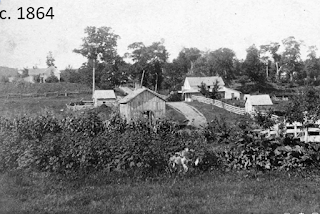
Farm outside of Excelsior, 1864

Now, what am I doing with this research? I'm sending a mail-order bride from the South to cold Minnesota in late 1861. Too bad her groom doesn't meet her. What's a woman to do then? Why, rely on the kindness of strangers, of course. And it just so happens that one kind stranger has a nephew who needs a wife...


Burned and heartsick, Joshua Gibson hides away from the world. Only the animals on his farm and the leather which he works keep him from madness. Unfortunately, the townspeople don't believe that. They're convinced that the fire burned away all traces of sanity in him.
Regina Wilson needs a man. The good women of the town come to her aid when the mail-order bride arrives to discover that her groom is dead. The problem, as the ladies tell her, is that only one bachelor is available--Goofy Gibson.

Will Regina hibernate with her forced husband or will her presence bring new life to the farm and to Joshua?


Saturday, January 22, 2022

What Were They Reading?

 Post by Doris McCraw

writing as Angela Raines

Photo Property of the Author

Have you ever wondered what they read in the 1800s?  There are times when I see a book mentioned and I wonder, was that book even written then? We know not everyone could read, but that doesn't preclude telling others about the story. Since I wondered, I thought, why not try to find out. Below is a list of books that you might not know were around in the 1800s when the west was opening up. Some of the books listed began as a serial in a magazine prior to book publication. 

 "The Corps of Discovery - The Lewis and Clark Expedition" Two volumes

"The Legend of Sleepy Hollow"  by Washington Irving

"Narrative of the Life of Fredrick Douglass" by Fredrick Douglass

"Candide" by Voltaire ( written in the 1700s )

"Robinson Crusoe" by Daniel Defoe (written in the 1700s )

"The House of Seven Gables " by Nathanial Hawthorne

"The Prairie Traveler" by Randolph B. Marcy - Captain U.S. Army

"Walden; or Life in the Woods" by Henry David Thoreau

Photo Property of the Author

Additional books that they may or may not have read that were published in the 1800s

"On the Origin of the Species" by Charles Darwin

"Communist Manifesto" by Karl Marx

"The Life of Samuel Johnson" by James Boswell

"On Liberty" by John Stuart Mill

"Two Years Before the Mast" by Richard Henry Dana

Photo Property of the Author

I've not included poetry although it was popular. What do you think these travelers were reading or sharing stories about? How many who may have been snowbound perhaps learned to read from some of these works. 

The 1800s were a time of growth and change. Of the books we read now, how many were influenced by these early works? It does make one think.

Until next time, happy reading and writing! Doris


Sunday, January 16, 2022

Ring in the New Year - Past New Year's Traditions 1865-1920 by Jo-Ann Roberts


Happy New Year, Friends!

Since many of our holiday traditions in the United States came to our shores from immigrants looking for a better way of life for themselves and their families, New Year's was no exception. 

Following the Civil War, parties, dancing, and festive spirits were staples of New Year's celebrations, just like today. Yet, there were many other odd, quaint, and charming customs that, for the most part, are no longer practiced today. 

Matchmaking

Wealthy folks would hold "open houses", inviting all the local eligible bachelors into their homes to meet their unmarried daughters...similar to today's speed dating! The bachelors would spend about fifteen minutes chatting with the unmarried daughter, provide her with his calling card and move on to the next home. If interested, the daughter would call upon the bachelor for another visit to talk and to meet her family.


In New York City, young men would race around the city to visit (call on) as many young women as possible. By the 1890s, the custom had fallen out of fashion in in favor of more exclusive New Year's Eve parties.  

The calling card to the left is that of Mr. Augustus Rux (pictured on the card). Apparently, he was successful as he married Mary Beck in 1916. They had two children together.

New Clothes

While many people didn't have the means to purchase a new outfit to wear on New Year's Day, women and girls often tied ribbons in their hair. Pioneer men might sport a new kerchief to symbolize fresh beginnings, and leaving of all the past year's hardships.

The Threshold 

The threshold represented the crossing from one year to the next. At the stroke of midnight, the front door was flung open, and one greeted the new year with shouts of "Welcome!" The head of the household would take three bits of bread before throwing the loaf against the door while those gathered prayed "that cold, want or hunger might not enter" in the coming year. 

If the first visitor of the year to cross the threshold by stepping into the home (whether family or friend) had dark hair, it meant good fortune was ahead for the family. If the person had blonde hair, it meant troubles loomed.

Pigs and Clovers


Postcards were often sent to and from loved ones, a number of them containing pigs and clovers, as they were considered bearers of good fortune for the year ahead.

Cleaning the Hearth

Cleaning out the ashes from the hearth was completed on New Year's Eve as a sign of sweeping away all the past year's misfortunes and ushering in the new year with a clean slate.

Divination 

People would playfully predict one another's fortunes for the new year interpreting each other's tea leaves, and by engaging in opening the Bible to a random page. Known as "dipping", the player would, without looking, point to a particular passage. The selected excerpt was thought to predict the good or bad fortune of the person doing the dipping. 

Bell Ringing

Many towns and cities rang bells at midnight to chase away evil. This may have led to the present-day tradition of noisemakers and party horns. 

The tradition of ringing in the new year at Times Square in New York dates back to December 31, 1904.

In 1904, the New York Times newspaper moved their location to Longacre Square.  To mark the joint celebration of its move, a name change to Times Square, and the impending new year, thousands were invited to the festivities.

Shortly before midnight, dynamite exploded as a signal that fireworks were set to begin, and the giant numerals 1 - 9 - 0 - 5 were illuminated atop the New York Times building in the direction of theaters, hotels, and restaurants downtown. This annual celebration with fireworks continued for the next two years. 

In 1907, New York banned fireworks and a new way to ring in the new year was sought. It was decided a ball, constructed of wood and iron, and illuminated with 216 electric lamps would signal the new year. 


New Year's Eve, 1907. The streets were blocked off from traffic and the crowds kept back to ensure safety for all visitors, hence the scene seems bare.

The ball has changed locations through the years, its move to its current location at One Times Square in 2009. The dropping of the ball has been an annual tradition in Times Square since December 31, 1907, the only exceptions being 1942 and 1943 in observance of wartime blackouts.

Although many of these traditions are obsolete or have morphed into something different, opening one's home, along with special foods served and enjoyed on New Year's has lasted for generations. My wish for you is still the same as those who have gone before us...luck, good fortune, prosperity and health throughout the coming year.


Wednesday, January 12, 2022

A Few Western Terms by Bea Tifton

Not too far from me is one of the greatest places on earth. It’s a big used (and some new) bookstore just perfect for finding interesting books. It’s a great way to find specific books, but my favorite thing is just to wander. Upon one recent expedition, I found something perfect for a book/word nerd. The Dictionary of the American West by Will Blevins can provide you with many useful terms to fit in if you are magically teleported to the Old West or if you just want to learn and use a few more colorful phrases. Some of  the definitions in the book are for more modern cowboys, as well. 

Here’s a sampling to get you started: 


Back East: The reverse of out West. For some, it had the implication of being ‘back in civilization.’ For others, it meant “back where everything is messed up.’ 

Belly Gun: A short-barreled pistol stuck naked into the waistband of your pants instead of holstered

Cash in His Six-Shooter: What an outlaw was said to do when he used his pistol to withdraw money from a bank 


Hen Fruit: A logger’s name for eggs 


Last Roundup: Death

Leaky Mouth: Someone who is too talkative

Like Getting Money from Home: Easy and pleasant

Mail-Order Cowboy: A tenderfoot decked out too fancily in what he hopes is cowboy clothing

On the Dodge: On the run from the law

Pie Buggy: A wagon sent to town for supplies 


Rust the Boiler: To drink alkali water 

There’s a One-Eyed Man in the Game: someone is cheating at poker 


Whomper-jawed: a sideways, crooked, or roundabout way 


So put on your bat wings (chaps), saddle your horse,  and go out and use a few new expressions today. 


Saturday, January 8, 2022

I'm Thankful for Western Authors! by Cora Leland

 For the first few weeks of each year, I walk through life with a deep sense of gratitude. Today I'm thankful for all my wonderful colleagues who also write historical western novels.  It's a language that a good deal of the world doesn't speak.

Julia Ridgemont spoke of her latest work that takes place in Denver. My Native American books have unleashed fervor I didn't know existed in me -- especially during the sub-zero Nebraska winter. I'm convinced that overlooked details that paint stories are key for bringing the 19th century to life.  

I enjoyed Caroline Clemmons' article about the Comanche scalping of that poor fellow: & it was exactly what I've unearthed. Comanche stripped and scalped settlers at the very least; and their movements were swift. Comanches were in charge of the southern plains (like Texas). Unlike the other tribes, they weren't driven from the east of the country because of crowding. They simply saw better prospects on the plains. They treated other tribes with the swift brutality that settlers received in order to gain control of the southern plains. 

Cheri Kay Clifton wrote that sounds of nature and the wildlife can stir curiosity in readers.  My readers seem to enjoy these Native books. Hopefully the details of every day tribal life, ceremonies and dances are part of it. 

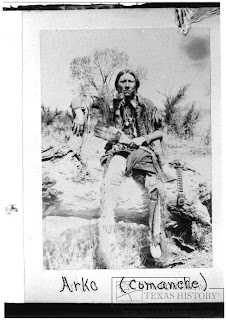
I'm not sure how I'll convey the prosperity this Comanche chief shows; others have said the same: Comanches always had money, always had plenty to eat and share, wore good clothes, spoke several languages. But he'll make an excellent antagonist -- guns and all.

The man to the left is in Oklahoma. I've sat on rocks like that myself.  I was surprised at the layers of fringed and finely decorated garments he wore.  Like other plains tribes, Comanches often had several wives. (I wondered how many women  sewed the fine clothes and moccasins he wore and if their needles were animal teeth, as was reported. Certainly they'd tanned the hides.) 

However, Comanches weren't vindictive if their wives were stolen (tribal women were in demand,just like settler women), or if they ran off.  They seldom tried to recover their errant wives, though occasionally they'd ask the new husband for payment.   (Other plains tribes deformed the runaway wives, cutting off noses and ears.)

The site where I got this photo is Texas History. The photo belongs to the Rescue Texas History program. They offer a useful zoom and good downloads. 

For example, the gun belt, holster and gun to his left, resting on the rock can be seen without a zoom. More difficult to see is the arrow on his right thigh. Besides being aggressive raiders, Comanche thought about the long term effects of trade.  When they arrived on the plains, they'd immediately allied with the French fur trappers and traders, for metal objects like guns, ammunition, metal arrows and knives, but also for creating allies.  The French traders were eventually driven from America, but they'd married Natives. 

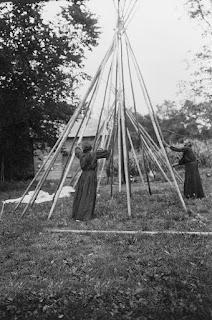
Native women putting up a tepee


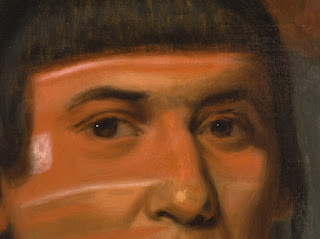
No-Tin, Chippewa chief

But for my romantic hero, I didn't want fierce looks or gun belts.  I found him on Useum.  This portrait was commissioned by the US govt. for promoting peace with the tribes.  The government asked a  hundred chiefs to Washington D.C. and asked portrait artists to capture their likenesses.

My romantic heroine? Her sister Vera, in book 1, married a Lakota man, Black Wolf.  This must be a trope:  Lucy, Vera's sister, is in love with Elk, Black Wolf's brother.  Here is one painting that inspires me to create Lucy and to write yet another demanding romance novel. 

Thank you all for your interest, and thanks to all my author colleagues for their inspiration and guidance.

Cora Leland
and coming soon...
Rescuing Baby and Bride
Bk. 2, Lakota Rescue Series


Tuesday, January 4, 2022

WILDLIFE IN THE AMERICAN WEST By Cheri Kay Clifton

As western authors, we know that settings are as important as our characters and plots. We want our readers to get a clear and vibrant sense of the western location in which our story takes place.

One way I use to engage my readers and enhance the believability of my fictional books is to be sure to include the sights and sounds of western wildlife common to the story’s location, be it in the prairies, great plains, mountains, or deserts.

For you reference, below is a compilation of commonly found wildlife in the Western United States.

 GREAT PLAINS & PRAIRIES:

American Bison
Pronghorn Antelope
Mule Deer
Black Tailed Jackrabbit
Whitetail Deer
Prairie Dog
Ferret
Coyote
Grey Wolf
Western Diamondback Rattlesnake
Badger
Golden Eagle
Prairie Falcon
Prairie Chicken
Western Meadowlark

MOUNTAINS ELEVATION 5000 & ABOVE

Elk (Wapiti – is a Native American word meaning “white rump)
Black Tailed Deer
Bighorn Sheep
Rocky Mountain Goat
Grizzly Bear
Black Bear
Mountain Lion
Bobcat
Wolf
Beaver
Porcupine
Tree Martin
Great Horned Owl
Peregrine Falcon
Moose
Mountain Chickadee
Downy Woodpecker
Mountain Jay
Western Bluebird

DESERTS:

Blacktail Deer
Pronghorn Antelope
Desert Bighorn
Antelope Jackrabbit
Coyote
Desert Woodrat
Mountain Lion
Jaguar
Desert Tortoise
Roadrunner
Trap Door Spider
Gila Monster
Harris Hawk
Common Raven
Quail
Desert Sidewinder Snake
Desert Iguana
Stink Bug

HAPPY NEW YEAR & THANKS FOR STOPPING BY!


My Author page: https://www.amazon.com/-/e/B002BLZOKC

Book 1, Trail To Destiny - A turbulent cross-country journey of heated passion, bitter vengeance and a haunted past lead Grey Wolf & Laura Westbrook on their Trail To Destiny.

Book 2, Destiny's Journey - Family deception kept Jennifer O’Malley from marrying her first love ten years ago, West Point officer, Glen Herrington.  Now a Civil War widow, she leaves war-torn Richmond, determined to find her destiny.  She makes the long journey west in search of Glen, only to discover he is a notorious outlaw with a price on his head.

Book 3, Yesteryear’s Destiny - When Angela Moore skydives out of a plane and into the western frontier of yesteryear, she not only meets the love of her life, Ben Herrington, but discovers a fateful revelation that exceeds the boundaries of time and will control her destiny.