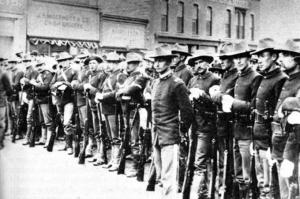
As our nation grew and the railroad connected the East and West peoples from every nationality traveled to the promise of prosperity the West offered. In big cities and small cultures and peoples clashed and for Wyoming it was no different. The worst case occurred in Rock Springs, Wyoming.
Since gold was found in California, in 1849, Chinese immigrants
started arriving in the West. California welcomed them, at first, a much
needed source of labor. Soon Chinese men worked alongside whites from
farming to railroads and shops. Even after the transcontinental
railroad was finished and thousands of jobs were lost, the Chinese
stayed. They didn’t mind living eight or nine to room to save money,
and they accepted jobs at lower rates of pay. “Taking jobs away from
whites.”
In July 1870, white workers in San Francisco led a large
street demonstration making it clear Chinese weren’t wanted, and should
consider their lives at risk. In Los Angeles, October 1871, a fight
between rival Chinese gangs broke out and whites flooded into the
neighborhood murdering 23 Chinese (no one was charged with a crime).
But
none of this violence kept the Chinese from coming to the United
States. They referred to themselves as Sojourners, meaning they always
planned to return to China, aggravating whites even more as these men
became nothing more than trespassers in America. After more violence
erupted in Arizona and Nevada, in 1882, Congress finally limited the
number of Chinese immigrants. But this law was full of loopholes and the
immigration question was more confusing than ever.

Coal
was the main reason the railroad followed the route it did across
southern Wyoming. The trains ran on coal from rich Union Pacific coal
mines in Carbon, Rock Springs, and Almy, Wyoming.
The Union
Pacific, in financial trouble, saved money by cutting miners’ pay, and
the miners and their families were required to purchase food, clothes,
and tools only at the company’s stores where prices were much higher
than in the surrounding towns. There were strikes about the wage cuts
and about having to shop in the company stores.
In 1871, after one
strike, the company brought in Scandinavian miners eager for work and
willing to work for less and follow the rules. In 1875, after another
strike Chinese workers were brought in for the same reason. By 1885,
there were nearly 600 Chinese and 300 white miners working in Rock
Springs.
The whites, mostly Irish, Scandinavian, English and Welsh
immigrants, lived downtown Rock Springs. The Chinese lived in what was
called Chinatown on the other side of a bend in the railroad tracks and
across Bitter Creek. There, the Chinese miners lived in small wooden
houses the company built for them. Other Chinese ran businesses, herb
stores, laundries, noodle shops, social clubs, and lived in shacks they
built themselves.
Although
they worked side by side the language barriers and fact that the white
and Chinese miners lived separately meant each knew very little about
the other. This ignorance, on both sides, made it possible for each race
to think of the other as not entirely human.
Adding fuel to the
fire, because the Chinese were willing to work for lower wages,
everyone’s wages remained low. White miners resented it, and joined a
new union, the Knights of Labor. In 1884, the Union Pacific told mine
managers in Rock Springs were told to hire only Chinese.
In the
summer of 1885, there were scattered threats against and beatings of
Chinese men in Cheyenne, Laramie and Rawlins. Posters were hung in
railroad towns warning Chinese to leave Wyoming Territory. Company
officials ignored these threats and direct warnings by the Knights of
Labor. Resentment and hostility continued to boil throughout the mining
community.
On September 2, 1885, a fight broke out between white
and Chinese miners in the No. 6 mine. A Chinese miner was fatally
wounded with blows of a pick to the skull. A second Chinese miner was
badly beaten before a foreman arrived and stopped the violence. Instead
of going back to work, white miners went home and grabbed guns,
hatchets, knives and clubs. The armed miners gathered on the railroad
tracks near the No. 6 mine, north of Chinatown. Some made an effort to
calm things down, but most moved to the Knights of Labor hall. They held
a meeting, then went to the saloons where miners from other mines began
gathering, as well. Sensing an increasing tension, saloon owners closed
their doors.
It was a Chinese holiday, so many of the Chinese
miners had stayed home from work and were unaware of the spark about to
catch fire.
Shortly after noon, 100 to 150 armed white men, mostly
miners and railroad workers, convened again at the railroad tracks near
the No. 6 mine. Women and children started joining the group. The mob
divided at 2:00p.m. Half moved toward Chinatown across the plank bridge
over Bitter Creek. Others approached by the railroad bridge, leaving
some behind at both bridges to prevent Chinese from escaping. A third
group walked up the hill toward the No. 3 mine, north and on the other
side of the tracks from Chinatown, leaving Chinatown completely
surrounded.
At the No. 3 mine, white men shot Chinese workers,
killing several. The mob moved into Chinatown from three directions,
pulling Chinese men from their homes and shooting others as they ran
into the street. Many Chinese fled, dashing through the creek along the
tracks or up the steep bluffs and out into the hills beyond. A few
terrified Chinese ran straight for the mob and met their deaths at the
hands of white men, women and children.

The
mob moved through Chinatown, looting stores, shacks and houses and then
setting them on fire. More Chinese were driven out of hiding by the
flames and were killed in the streets. Still others burned to death in
their cellars. And still others died that night out on the hills and
prairies from thirst, the cold and their wounds.
The mob left
Chinatown burning and confronted the company bosses telling them it
would be in their best interest to leave Rock Springs on the next train.
They did. The sheriff of Green River, 14 miles away, learned of the
killing and rushed to Rock Springs on a special train, but when he
arrived no one would join him in a posse, and all he could do is join a
few men to protect the company buildings from fire.
In Cheyenne, Territorial Governor Francis E. Warren learned of the murders late in the
afternoon. Union Pacific officials took a special fast train all the
way from Omaha, Nebraska (company headquarters) and arrived in Cheyenne
at midnight. Warren joined them on the train and they all arrived in
Rock Springs at daybreak on September 3rd.
Warren appeared to be the only person who knew what to do. He sent
telegrams to the Army and to President Grover Cleveland asking for
federal troops to restore order. At Warren’s suggestion, the company
train ran slowly along the tracks between Rock Springs and Green River,
taking stranded Chinese miners aboard and giving them water, food and
blankets.
In Rock Springs,
Warren met with more company officials and then with the white miners.
The miners demanded that no Chinese ever again be allowed to live in
Rock Springs, and that no one would be arrested for the murders and
burning. They said anyone objecting to these demands risked being hurt
or killed.
To
show he was unafraid, Warren left the railroad car several times during
the day and made a show of walking back and forth on the depot
platform. The people, now quiet and orderly watched him and nothing
happened.
Uinta County Sheriff J.J. LeCain in Evanston, Wyoming
was sweating bullets. Hundreds of Chinese miners lived there, too, and
worked in the coal mines at nearby Almy. White miners had left work, and
armed mobs were in the streets of Almy.
LeCain telegraphed
Governor Warren. With no territorial militia to command and no word
about federal troops, there wasn’t much Warren could do, but to go to
Evanston. He arrived the morning of September 4. LeCain deputized 20 men
who barely managed to maintain order. On the fifth, a small detachment
of troops arrived in Rock Springs. On the sixth, the striking white
miners at Almy warned the Chinese if they went to work they wouldn’t
leave the mines alive. Troops escorted the Chinese from their camp to
the much larger Chinatown in Evanston. Although, the company assured the
Chinese their property in Almy would be safe, as soon as they were gone
whites looted their homes.
Most Chinese wanted was to get out of
Wyoming as soon as possible. Ah Say, leader of the Rock Springs’
Chinese community, asked for railroad tickets. Company officials
refused. Then he asked for the two months back pay the company owed
Chinese workers. Again the company refused.
Over two hundred white
citizens of Evanston presented Governor Warren a petition asking for
the Chinese to be paid off so they could leave. Warren refused, saying
it was a matter between the company and its employees. This was a risky
decision considering things were ready to explode in Evanston.

Finally,
more troops arrived in Rock Springs and Evanston nearly a week after
the first killing. On September 9, under the protection of armed guards
600 Chinese in Evanston were taken to the depot and loaded on boxcars
and told they were headed for San Francisco and safety. Without their
knowledge, however, a special car carrying Warren and top Union Pacific
officials was attached to the back of the train with 250 soldiers on
board.
The train left Evanston heading east, not west, arriving in
Rock Springs that evening. An angry crowd of white miners gathered. So
the train continued a little farther, stopping just west of the ruins of
Chinatown. The boxcar doors opened, and the Chinese realized they’d
been tricked.
Climbing out of the boxcar they saw what little was
left of the homes many fled in panic a week before. Chinatown was gone.
Even more horrifying, bodies still littered the streets. Some had been
buried by the coal company, but about a dozen had not. Many were in
pieces, “mangled and decomposed being eaten by dogs and hogs.”
Compounding this horror, the Union Pacific owners expected the miners to
bury their dead, put the nightmare of this abomination behind them and
get back to work. Until new houses could be built, they were expected to
live in the boxcars.

For
many days, the fearful Chinese miners would not go back to work. Again
they asked for passes to California or their back pay, and again they
were refused. The company store refused to sell goods to the Chinese who
were not working and threatened to evict them from their temporary
homes. About 60 fled Rock Springs by whatever method they found. The
rest surrendered, and returned to work.
Sixteen white miners were
arrested and released on bail. Though the killing had been done in
daylight, no one could be found who would testify to seeing the crimes
committed. No charges were filed.
In all, 28 Chinese were killed,
15 wounded and all 79 of the shacks and houses in Rock Springs Chinatown
were looted and burned. Chinese diplomats in New York and San Francisco
drew up a list of damages totaling $150,000. Congress, under pressure
from President Cleveland, agreed to reimburse the miners. Many Chinese
gradually left Wyoming throughout the following decades.
In Rock
Springs, federal troops built Camp Pilot Butte between downtown Rock
Springs and Chinatown to prevent further violence and stayed for 13
years.
Because of Governor Warren’s decisive courage in the first
days after the riot, many more killings were avoided. However, Warren
refused to help with the back-pay question and played a role in tricking
the Chinese onto the train that took them back to Rock Springs,
therefore not resolving the issue in the best interest of those
victimized, or even the white miners.
After all was said and done,
the Union Pacific was able to keep a large supply of Chinese miners
around, making sure coal kept flowing and the wages could be kept low.
This is what the Union Pacific wanted all along, leaving only one winner
and hundreds of losers at the end of the violence.
On a more positive note, Rock Springs later became a bit of a melting pot with over 78
nationalities represented, and living peaceably (for the most part)
together. Every year the 56 original nationalities to inhabit Rock Springs are celebrated through food, dance, games and fun.
SOURCES:
http://www.wyohistory.org/essays/rock-springs-massacre
http://www.ghostcowboy.com/node/118
http://historymatters.gmu.edu/d/5042
http://www.wwcc.cc.wy.us/wyo_hist/chinese.htm
Kirsten Lynn is a Western and Military Historian. She worked six years
with a Navy non-profit and continues to contract with the Marine Corps
History Division for certain projects. Making her home where her roots
were sewn in Wyoming, Kirsten also works as a local historian. She loves
to use the history she has learned and add it to a great love story.
She writes stories about men of uncommon valor…women with undaunted
courage…love of unwavering devotion …and romance with unending sizzle.
When she’s not writing, she finds inspiration in day trips through the
Bighorn Mountains, binge reading and watching sappy old movies, or sappy
new movies. Housework can always wait.
Kirsten Lynn's Wild West
FACEBOOK