Recently, I've been talking about everything bright and beautiful in Wyoming, but for this post I thought I'd discuss a controversial figure in Wyoming’s
history. Aren’t most Wyoming figures controversial you might ask? If you get a chance to stop for a bit as your run out of the state for a smart tongue, take a look at the story of Tom Horn.

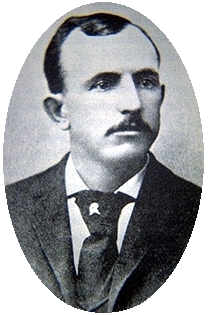
Tom
Horn was born in Scotland County, Missouri, in 1860. By his own
account, he left home at the age of fourteen. Taking up a series of
livestock and stage-driving jobs, he ended up in Arizona Territory. Horn
was intelligent and tough. He had an ear for languages and quickly
picked up Spanish and later some of the Apache language. He’d also
picked up an ability as a tracker.
Therefore, it wasn’t a surprise
that while still in his teens he became employed by the Army as a scout
and interpreter. The chief of the scouts for the U.S. Army, Al Sieber,
recruited Horn in the Army’s campaigns against the Apache. In April
1886, Horn was one of the scouts that escorted the Army column led by
Lt. Charles B. Gatewood to find the famed Chiricahua Apache leader,
Geronimo.
In his posthumously published autobiography, Horn took
credit for the actions of Lt. Gatewood. He claimed it was he whom
Geronimo trusted and it was he who convinced Geronimo to surrender.
However, the autobiography is the only account of Horn’s involvement
with the negotiations.
Whatever the level of his involvement in
the surrender of the Chiricahua leader, Horn made a name for himself.The
Pinkerton Detective Agency hired Horn, in 1891, to pursue bandits who
robbed the Denver and Rio Grande train near Canon City, Colorado. He
stayed employed by the Pinkerton’s over the next decade.
About the
same time Horn started working for the Pinkerton’s he came to Wyoming.
He already had a reputation for certain skills and his services were
sought after by some of the prominent ranchers in the area. A few of his
“secret” employers included, Ora Haley, John Coble, Coble’s partner
Frank Bosler, and the huge Swan Land and Cattle Company.
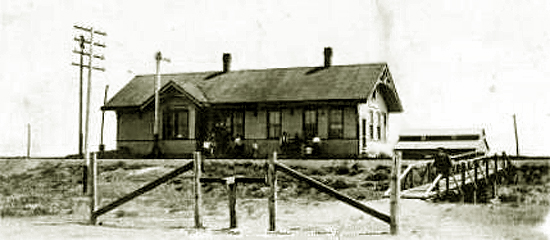
 |
| Bosler Depot, 1916 |
Yep,
folks here we are again with those cattle barons. As discussed in the
post on the Johnson County War, the large cattle ranchers were suffering
from beef glut and blaming the small ranchers for the lack of grazing
land and accusing many of rustling. As many ranchers went out of
business and many longstanding cowboys and more recent immigrants to the
Territory took up homesteads and other land claims, the once powerful
Wyoming Stock Growers Association found its membership and its revenues
from dues dwindling drastically.
After the public outcry against
the Sweetwater lynchings and the backlash of the Johnson County
invasion, the large cattlemen decided to take care of the “rustling
problem” in secret. Enter Tom Horn.
By May of 1892, Horn was
working for the Pinkertons and was deputized by U.S. Marshal Joseph P.
Rankin to investigate a murder in the aftermath of the Johnson County
invasion. But by 1895, Horn was most likely fully employed by private
interests when he was suspected of murdering two settlers.
The
first was William Lewis. Lewis was an English immigrant who moved to
Wyoming in 1888. He settled southwest of Iron Mountain between the
Chugwater Creek and Ricker Creek on the Laramie-Albany County line.
Lewis had been jailed for stealing clothing and cheating a boy at a faro
game. He was suspected of cattle theft and under a court order to
refrain from butchering cattle.
In July 1895, Lewis received a letter telling him to leave the area. He ignored the warning, and on July 31
st, as
Lewis was loading skinned beef into a wagon he was shot three times.
The coroner estimated the shooting had been done from a distance of 300
yards. A rumor circulated about an offer Tom Horn made at the
Stockgrowers’ Association and the tall stock detective, Tom Horn, was
summoned for questioning.
Horn was located in the Bates Hole
region of Natrona County, two counties away. Laramie County Prosecutor,
John C. Baird assumed Horn was hiding out after the shooting and
prepared an indictment. However, Tom Horn had a number of rancher and
cowboy witnesses who were willing to swear straight faced that he had
been in Bates Hole the day of the killing. The alibi couldn’t be shaken
and the authorities released him.
Horn immediately rode into
Cheyenne and indulged in a ten-day drinking spree dropping hints at the
truth. “Dead center at three hundred yards, that coroner said!” And he
grinned. “Three shots in that fella ‘fore he hit the ground. You reckon
there’s two men in this state can shoot like that.” Publicly, he denied
everything. Privately, he created a blood-chilling image of himself as a
hired assassin.
The second settler was, Fred Powell. Powell
homesteaded with his wife Mary and 18 month old son Billy east of
Laramie County. The marriage was not a blissful one, and Fred carried a
long scar on his face where Mary took a butcher knife to him. Powell was
charged with stealing cattle and horses at least seven times, each time
he was let go for lack of evidence. Evicted from his homestead he
moved to another along Horse Creek, proving up his claim in 1892. Like
Lewis, Fred started receiving notes telling him to get out. Powell
ignored the warnings.
On the morning of September 10, 1895, Powell
and his hired hand Andy Ross were along the creek working when Ross saw
Powell clutch his chest and gasp, “My God, I’m shot!” He collapsed and
died.
Again, Tom Horn was the first suspect, and was brought in
for questioning. Horn shook his head and kept his face expressionless
and his voice calm. He had a strongly supported alibi ready, and again
he was released.
Enjoying a night of liquor and entertainment
provided by the professional ladies of Cheyenne, Horn made vague
insinuations admitting to the killings. “Exterminatin’ cow thieves is
just a business proposition with me. And I sort of got a corner on the
market.”
After a friend once told him that he didn’t think
dry-gulchin’ a man seemed very sporting. Horn replied in amazement, "I
seen a lot o' things in my time. I found a trooper once the Apache had
spread-eagled on an ant hill, and another time we ran across some
teamsters they'd caught, tied upside down on their own wagon wheels over
little fires until their brains was exploded right out o' their skulls.
I heard o' Texas cattlemen wrappin' a cow thief up in green hides and
lettin' the sun shrink 'em and squeeze him to death. But there 's one
thing I never seen or heard of, one thing I just don't think there is,
and that's a sportin' way o' killin' a man."
After the first two murders, the warning notes were rarely ignored. The lesson learned.
When
Fred Powell's brother-in-law, Charlie Keane, moved into the dead man's
home, the anonymous letter writer took no chances on Charlie taking up
where Fred had left off and wasted no time on a first notice: "IF YOU
DON'T LEAVE THIS COUNTRY WITHIN 3 DAYS, YOUR LIFE WILL BE TAKEN THE SAME
AS POWELL'S WAS." This was the message found tacked to the cabin door.
Keane left, within three days.
For three straight years, Tom Horn
patrolled the southern Wyoming pastures. How many men he killed after
Lewis and Powell, if he killed Lewis and Powell will never be known.
One
of Horn’s most notable “clients” was Wyoming Governor W.A. Richards who
was being plagued by cattle theft on his own land. Richards was good
friends with W.C. “Billy” Irvine president of the Wyoming Stock Growers
Association. In a meeting between the two men, Richards told Irvine he
would like to meet Tom Horn, but didn’t want him coming to the
Governor’s office. Irvine offered to hold the meeting in the WSGA
President’s office just down the hall. Horn, in his usual calm manner,
informed the Governor he would either drive every rustler out of Big
Horn County, or take no pay. But when he finished the job to the
governor’s satisfaction he would receive $5000.00. Horn put no limit on
the number of men he planned to kill. Though stunned, Richards agreed.
After Horn left Richards told Irvine, “So that is Tom Horn! A very
different man from what I expected to meet. Why, he is not bad-looking,
and is quite intelligent; but a cool devil, ain’t he?”
Horn
continued his work as a cattle detective through the 1890s. In 1900, he
murdered Matt Rash and Isom Dart, two suspected cattle thieves, in
Brown’s Park where the Colorado, Utah and Wyoming borders intersect.
The crimes received little notice in Wyoming.
The only thing
cattlemen hated more than homesteaders were sheepherders. And while the
large and small cattlemen fought amongst themselves the sheepherder
entered the territory taking over land and grazing their destructive
herds over the already crowded land. But it didn’t take long for the
eyes of the cattleman to turn his wrath on the sheepherder. We’ll get
into all this in more detail next week, but for now we’re looking at one
particular sheepherder Kels Nickell.

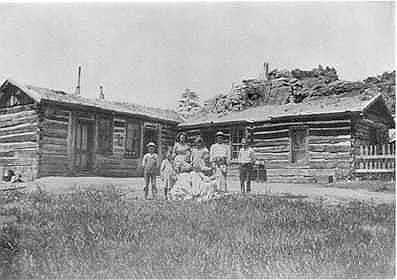
- Nickell Homestead
Seven
miles from Iron Mountain was the ranch of Kels Nickell, the only
sheepherder in the area. On July 18, 1901, Nickell’s fourteen-year-old
son, Willie was shot and killed by two bullets to the back. Willie, tall
for his age, wore his father’s coat and hat and rode his father’s
favorite horse, and therefore it was believed the killer mistook him for
Kels. Though Willie fell face down, someone turned the body over and
placed a stone under Willie’s head. There were no footprints or shells
left at the scene. Seventeen days after that, Kels was shot, wounding
him in the arm, hip and side. While he was in the hospital, masked men
clubbed a number of Kels’ sheep to death. The Nickell family moved to
Saratoga not long after he recovered.

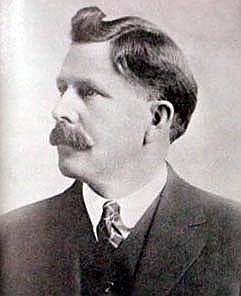
- Joe LeFors
Deputy
U.S. Marshal Joe LeFors was hired by the county commissioners in
Cheyenne to investigate the crime. LeFors used letters from a former
boss in Miles City, Montana stating the need for someone to do a
“secret” job to lure Tom Horn out of hiding.
Horn left John
Coble’s place in Bosler meeting LeFors at the U.S. Marshal’s office in
Cheyenne on January 11, 1902. LeFors secreted a stenographer, Charles
Olnhaus, and a witness, Laramie County Deputy Sheriff Leslie Snow,
behind a locked door. Over the course of a two hour interview, LeFors
led Horn into making a series of incriminating remarks about the Nickell
killing. The most damaging statement being, “It was the best shot I
ever mad and the dirtiest trick I ever done.”
Horn allegedly told
LeFors that he had been paid in advance and received $2,100 for killing
three men and taking five shots at another. He told LeFors the reason
there were no footprints is he was barefoot. LeFors asked whether Horn
had carried the shells away, to which Horn responded: "You bet your
[expletive deleted] life I did." On Monday, January 13, Laramie County
Sheriff Edwin J. Smalley, accompanied by Deputy Sheriff Richard A.
Proctor and Cheyenne Chief of Police Sandy McNeil arrested Tom Horn in
the bar of the Inter-Ocean Hotel. Deputy United States Marshal Joe
LeFors watched.

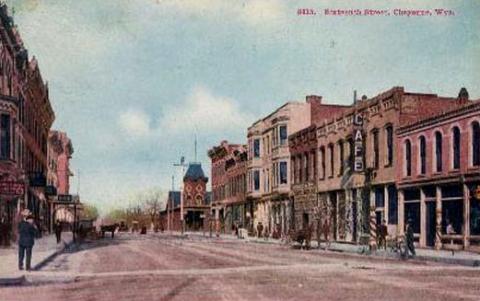
- 16th Street, Cheyenne, 1902
John
Coble paid for Horn’s defense, with the general counsel for the Union
Pacific, John W. Lacey representing Horn. The trial was held during an
election year with both Prosecutor Walter R. Stoll and Judge Richard
Scott up for re-election. On top of this, public interest in the case
was overwhelming and the trial received widespread newspaper coverage in
Wyoming and Colorado.
Horn’s defense was three-fold:
(1.)
Horn was under the influence of liquor, tended to make things up, and
became talkative when drunk. Witnesses were produced that Horn had been
drinking. He denied making the statements in the Scandinavian. He
contended that his jaw had already been broken when he was in the
Scandinavian and with the cast he could not talk.
(2.) Horn had an
alibi and could not have been in the Nickell ranch at the time of the
killing. He was in Laramie City, as proven by the fact that Horn's
horse, Pacer, was lodged at the Elkhorn Livery in Laramie City for a
ten-day period at the time of the killing. Witnesses testified that Horn
was nowhere near the Nickell Ranch at the time of the slaying.
(3.)
The killing could not have occurred as he described to LeFors in the
following regards: (a.) Dr. Amos Barber testified, based on learned
texts, that the wounds could not have been inflicted with a 30-30
similar to Horn's. (b.) Frank Stone had bunked with Horn several days
later and had observed no injury to Horn's feet such as would have been
produced had Horn gone barefoot. One of Horn's lawyers testified to
having examined the area of the Nickell gate where the killing took
place. He testified that the area was strewn with cacti and rocks such
that no one could go barefoot in the area. Samples of the rocks were
introduced into evidence. (c.) Horn, in his statement to LeFors,
described the shooting as coming from one direction. The fatal shot came
from another.
Horn took the stand in his own defense. The
cross-examination by the prosecutor, Walter Stoll, was devastating.
Statement by statement, Horn admitted making the various statements
testified to by LeFors, Snow and Ohnhaus with the exception of one
statement which Horn did not remember but conceded he might have made.
Horn’s
lawyer closed emphasizing all evidence was circumstantial, and Horn’s
supposed confession was nothing but drunken boasting.
The
prosecution claimed Horn killed Willie Nickell to keep the boy from
reporting his presence in the area. But in the day before sequestered
juries it is likely they had their minds made up before they entered the
courtroom.

Despite
appeals to the Governor to spare Horn and fears that Horns numerous
friends would attempt a jail break, on November 20, 1903, Horn was
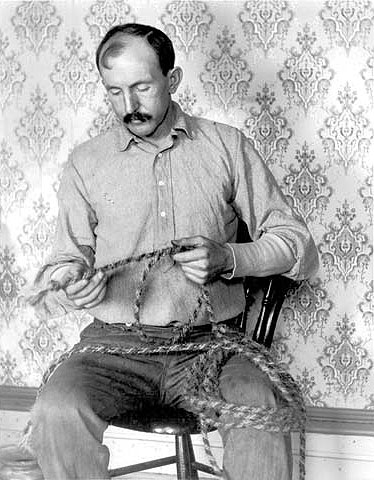
hanged at the Cheyenne jail. Prior to his hanging, Horn spent his time
in jail braiding a rope. When it was clear his time was at an end, Horn
wrote John Coble:
Dear Johnnie:
Proctor told me that it was all over with me except
the applause part of the game.
You know they can't hurt a Christian, and as I am
prepared, it is all right.
I throuroughly appreceiate all you have done for me.
No one could have done more. Kindly accept my thanks,
for if ever a man had a true friend, you have proven your-
self one to me.
Remember me kindly to all my friends, if I have any
besides yourself.
Tom
Horn remains a controversial character due to the lingering questions
regarding his guilt or innocence in the Nickell murder. There's also a
question regarding the WSGA's involvement with the trial, and the
contention Horn was a scapegoat for the powerful cattlemen. Horn’s
supporters and later historians questioned his confession to LeFors
stating LeFors got Horn drunk and tricked him. Others stand firm that
not only did Horn kill Willie Nickell, but an unknown number of men, and
that Horn received a fair trial and was represented by one of the
finest trial attorneys in Wyoming.
Like the outcome of the Johnson
County War, more than the question of Horn’s guilt or innocence is the
political shift evident in Wyoming during his trial. Horn, friend of
cattle barons was convicted and executed. Their power once
unquestionable was on the dwindle as ordinary Wyoming citizens refused to
cower under their heavy hand.
SOURCES:
Carlson, Chip.
Tom Horn: Blood on the Moon : Dark History of the Murderous Cattle Detective, High Plains Pr., Sept 2001.
Ball, Larry D. Tom Horn in Life and Legend. University of Oklahoma Press., 2014.
http://www.wyohistory.org/essays/tom-horn
http://www.wyomingtalesandtrails.com/horn.html
Kirsten Lynn writes stories based on the people and history of the
West, more specifically those who live and love in Wyoming and Montana.
Using her MA in Naval History, Kirsten, weaves her love of the West and
the military together in many of her stories, merging these two halves
of her heart. When she's not roping, riding and rabble-rousing with the
cowboys and cowgirls who reside in her endless imagination, Kirsten
works as a professional historian.


.jpg)