Wednesday, November 13, 2013

Really, Really West

By Anna Kathryn Lanier

I know this blog is for Western lovers, but I figured it was time that I did a little blogging about my trip really, really west….all the way from Texas to Western Australia in July.  Last year, my friend Skhye Moncrief and family moved to Perth and this year they invited me to visit.  Aside from the non-stop 17 hour flight (which was just part of the traveling time), it was a great trip!

I first flew from Houston to Dallas, then from Dallas to Sydney and stayed 1½ days, where I climbed the Sydney Harbor Bridge and toured the world famous Opera House.  Then I flew cross-country (5 hour flight) to Perth and spent 10 days in the Western Australia.


Here’s a pictorial blog of my trip.
Sydney

Ummm, the Opera House, I think

The Bridge I climbed, see the flags? Yep all the way up to them.

The Opera House at Night

The Opera House, again...oh from a really good view point!

Yea! I made it to the top (and back to the bottom) without falling off.

A room with a view...the Indian Ocean, Perth


The Indian Ocean, Perth

London Street, in Perth

King's Park, Perth in the background

The Perth Zoo

This is a country with lots of rainbows...this is just one of many I saw.

Tingle Trees at Valley of the Giants National Park.


A Tingle Tree.

Cape Leeuwin, where two oceans meet

Whale Watching in the Southern Sea

A Kookaburra 

A video of the kookaburra singing

Petting a Koala (Caversham Wildlife Park)

What's a trip to Australia without petting a kangaroo?


Replica of one of the largest gold nuggets ever found in Australia.

As some have said, it was the trip of a life time and I'm so glad Skhye and family let me come for a visit.  It was well worth the 26 hours of traveling time (one-way, and done all at one time on the way home) and I would love to do it again sometime!
 
I have more pictures on my pinterest page: http://www.pinterest.com/melindaporter60/australia-2013/

Anna Kathryn Lanier
Author, A Gift Beyond All Measure
http://aklanier.com/

Never let your memories be greater than your dreams. ~Doug Ivester 

Tuesday, November 12, 2013

Kitty LeRoy: Beloved Tramp

By Kathleen Rice Adams

courtesy National Archives and Records Administration


Some historical episodes in the Old West read like adventures. Some read like tragedies. Some read like romances.

A few real-life characters — like Kitty LeRoy — managed to combine all three.

“…Kitty LeRoy was what a real man would call a starry beauty,” one of her contemporaries noted in a book with a ridiculously long title*. “Her brow was low and her brown hair thick and curling; she had five husbands, seven revolvers, a dozen bowie-knives and always went armed to the teeth, which latter were like pearls set in coral.”

Though no photos of her are known to exist, from all reports LeRoy was a stunning beauty with a sparkling personality that had men — including both notorious outlaws and iconic lawmen — throwing themselves at her feet. She was proficient in the arts of flirtation and seduction, and she didn’t hesitate to employ her feminine wiles to get what she wanted.

Often, what she wanted was the pot in a game of chance. One of the most accomplished poker players of her time, LeRoy spent much of her short life in gambling establishments. Eventually, she opened her own in one of the most notorious dens of iniquity the West has ever known: Deadwood, South Dakota. With LeRoy and the spectacular diamonds at her ears, neck, wrists, and fingers glittering brightly enough to blind her customers every night, it’s no wonder the Mint Gambling Saloon prospered.

And, with her reputation as an expert markswoman, there was very little trouble … at least at the tables.

LeRoy was born in 1850, although no one is sure where. Some say Texas; others, Michigan. One thing is certain: By the age of ten, she was performing as a dancer on the stage. Working in dancehalls and saloons, she either picked up or augmented an innate ability to manipulate, along with gambling and weaponry skills that would serve her well for most of her life.  At fifteen she married her first husband because, according to legend, he was the only man in Bay City, Michigan, who would let her shoot apples off his head while she galloped past on horseback.

Deadwood, c. 1878-80
A long attention span apparently was not among the skills LeRoy cultivated. Shortly after her marriage, she left her husband and infant son behind and headed for Texas. By the age of twenty, she had reached the pinnacle of popularity at Johnny Thompson’s Variety Theatre in Dallas, only to leave entertaining behind, too.

Instead, she tried her hand as a faro dealer. Ah, now there was a career that suited. Excitement, money, men … and extravagant costumes. Players never knew what character they would face until she appeared. A man? A sophisticate? A gypsy?

Texas soon bored LeRoy, too, but no matter. With a new saloonkeeper husband in tow, she headed for San Francisco — only to discover the streets were not paved with gold, as she had heard. While muddling through that dilemma, she somehow misplaced husband number two, which undoubtedly made it easier for her to engage in the sorts of promiscuous shenanigans for which she rapidly gained a reputation.

Although the reputation didn’t hurt her at the gaming tables, it did create a certain amount of unwanted attention. One too-ardent admirer persisted to such an extent that LeRoy challenged him to a duel. The man demurred, reportedly not wishing to take advantage of a woman. Never one to let a little thing like gender stand in her way, LeRoy changed into men’s clothes, returned, and challenged her suitor again. When he refused to draw a second time, she shot him anyway. Then, reportedly overcome with guilt, she called a minister and married husband number three as he was breathing his last.

Now a widow, LeRoy hopped a wagon train with Wild Bill Hickock and Calamity Jane and headed for the thriving boomtown of Deadwood. They arrived in July 1876, and LeRoy became an instant success by entertaining adoring prospectors nightly at the notorious Gem Theatre. Within a few months, she had earned enough money to open her own establishment: the Mint. There, she met and married husband number four, a German who had struck it rich in Black Hills gold. When the prospector’s fortune ran out, so did LeRoy’s interest. She hit him over the head with a bottle and threw him out.

Meanwhile, thanks to LeRoy’s mystique — and allegedly, to no little fooling around with the customers — the Mint became a thriving operation. LeRoy reportedly “entertained” legendary characters as diverse as Hickock and Sam Bass. But it was 35-year-old card shark Samuel R. Curley who finally claimed her heart. Curley, besotted himself, became husband number five on June 11, 1877.

Shortly thereafter, Curley learned LeRoy hadn’t divorced her first husband. The bigamy realization, combined with rumors about LeRoy’s continued promiscuity, proved too much for the usually peaceful gambler. He stormed out of the Mint and didn’t stop until he reached Denver, Colorado.

Folks who knew LeRoy said she changed after Curley’s departure. Despite nights during which she raked in as much as $8,000 on a single turn of the cards, she grew cold and suspicious.

Gem Theatre, c. 1878
Her grief seemed to dissipate a bit when an old lover showed up in Deadwood. LeRoy rented rooms above the Lone Star Saloon, and the two moved in together.

By then, Curley was dealing faro in a posh Cheyenne, Wyoming, saloon. Acquaintances called him miserable. When word of LeRoy’s new relationship reached him, he flew into a jealous rage. Determined to confront his wife and her lover, he returned to Deadwood December 6, 1877. When the lover refused to see him, Curley told a Lone Star employee he’d kill them both.

LeRoy, reportedly still pining for her husband despite her new affair, agreed to meet Curley in her rooms at the Lone Star. Not long after she ascended the stairs, patrons below reported hearing a scream and two gunshots.

The following day, the Black Hills Daily Times reported the gruesome scene: LeRoy lay on her back, eyes closed. Except for the bullet hole in her chest, the 27-year-old looked as though she were asleep. Curley lay face down, his skull destroyed by a bullet from the Smith & Wesson still gripped in his right hand.

“Suspended upon the wall, a pretty picture of Kitty, taken when the bloom and vigor of youth gazed down upon the tenements of clay, as if to enable the visitor to contrast a happy past with a most wretched present,” the newspaper report stated. “The pool of blood rested upon the floor; blood stains were upon the door and walls….”

An understated funeral took place in the room where Curley killed his wife and then took his own life. Their caskets were buried in the same grave in the city’s Ingleside Cemetery and later moved to an unmarked plot in the more famous Mount Moriah.

The happiness the couple could not find together in life, apparently they did in death. Within a month of the funeral, Lone Star patrons began to report seeing apparitions “recline in a loving embrace and finally melt away in the shadows of the night.” The sightings became so frequent, the editor of the Black Hills Daily Times investigated the matter himself. His report appeared in the paper February 28, 1878:

…[W]e simply give the following, as it appeared to us, and leave the reader to draw their own conclusions as to the phenomena witnessed by ourselves and many others. It is an oft repeated tale, but one which in this case is lent more than ordinary interest by the tragic events surrounding the actors.

To tell our tale briefly and simply, is to repeat a story old and well known — the reappearance, in spirit form, of departed humanity. In this case it is the shadow of a woman, comely, if not beautiful, and always following her footsteps, the tread and form of the man who was the cause of their double death. In the still watches of the night, the double phantoms are seen to tread the stairs where once they reclined in the flesh and linger o’er places where once they reclined in loving embrace, and finally to melt away in the shadows of the night as peacefully as their bodies’ souls seem to have done when the fatal bullets brought death and the grave to each.

Whatever may have been the vices and virtues of the ill-starred and ill-mated couple, we trust their spirits may find a happier camping ground than the hills and gulches of the Black Hills, and that tho’ infelicity reigned with them here, happiness may blossom in a fairer climate.


Sources:

* Life and Adventures of SAM BASS, the Notorious Union Pacific and Texas
Train Robber, Together with a Graphic Account of His Capture and Death, Sketch of the Members of his Band, with Thrilling Pen Pictures of their Many Bold and Desperate Deeds, and the Capture and Death of Collins, Berry, Barnes, and Arkansas Johnson (W.L. Hall & Company, 1878)

The Lady Was a Gambler: True Stories of Notorious Women of the Old West by Chris Enss (TwoDot, October 2007)

Women of the Western Frontier in Fact, Fiction and Film by Ronald W. Lackmann (McFarland & Company Inc., January 1997)


Wishing for a CowboyKathleen Rice Adams' short story "Peaches" appears in Wishing for a Cowboy: Running a ranch and fending off three meddlesome aunts leaves Whit McCandless no time, and even less patience, for the prickly new schoolmarm’s greenhorn carelessness. The teacher needs educating before somebody gets hurt.

Ruth Avery can manage her children and her school just fine without interference from some philistine of a rancher. If he’d pay more attention to his cattle and less to her affairs, they’d both prosper.

He didn’t expect to need rescuing. She never intended to fall in love.


Sunday, November 10, 2013

SAN ANTONIO AND IT'S RIVER WALK


San Antonio is one of my most favorite cities in Texas. The history of San Antonio is well documented as is the river that winds it's way through the city's core.

Wikipedia tells us:

The San Antonio River is a major waterway that originates in central Texas in a cluster of springs in Midtown San Antonio, approximately four miles north of Downtown, and follows a roughly southeastern path through the state. It eventually feeds into the Guadalupe River about ten miles from San Antonio Bay on the Gulf of Mexico. The river is 240 miles long and crosses five counties: Bexar, Goliad, Karnes, Refugio, and Wilson.

The river was named after San Antonio de Padua by the first governor of Spanish Texas, Domingo Terán de los Ríos in 1691.
On June 13, 1691, Governor Terán and his company camped at a rancheria on a stream called Yanaguana They renamed the stream "San Antonio" because it was Saint Anthony's Day.

The most famous mission located along the historical river is San Antonio de Valero, better known as the Álamo, and its complementing fortress is Presidio San Antonio de Bexar.
Four other major 18th century Spanish missions along the river are Mission Espada, Mission Concepcion, Mission San José, and Mission San Juan Capistrano.
The Presidio La Bahía and its mission, Mission Nuestra Señora del Espíritu Santo de Zúñiga in Goliad, Texas are also located along the southern portion of the river.


The waterway is also host to the San Antonio River Walk, one of San Antonio's primary tourist destinations and the centerpiece of the city. The River Walk, also known as Paseo del Río, is a network of walkways along the banks of the San Antonio River, one story beneath the streets of Downtown San Antonio, Texas. Lined by bars, shops and restaurants, the River Walk is an important part of the city's urban fabric and a tourist attraction in its own right.


Strolling along the River Walk is the highlight of any trip to San Antonio and a favorite destination for me and my family when we visit. I love it so much that I knew someday I wanted to write a story including it somehow. On this past November 1, I released my short story, A SANTA FOR CHRISTMAS, that takes place on the River Walk. It's a story of hope and magic for the child in all of us.
 

Blurb for A Santa For Christmas:


 Merry Hernandez has lost both her father and her brother in the last year to unfortunate circumstances, and, due to a bad economy, stands to lose her business, Very Merry Events, as well.,. No one is spending unnecessarily for parties they can plan themselves. While that is bad, she regrets most not participating in the  Riverwalk Christmas Pageant in San Antonio, Texas, where her father always played Santa and handed out toys to the children. Will the handsome stranger and his father be able to help her fulfill her dreams?
Sam Claus has journeyed to Texas with his father to help him make a young woman's Christmas wish come true. Due to the older man's illness, Sam doesn't see a way to help Merry Hernandez. Throughout their evening together on Christmas Eve, too many circumstances occur that he can't explain. Will Sam be able to turn the tide of events in her favor?

Will Sam and Merry realize their special connection and reach their Happily Ever After?
 
A SANTA FOR CHRISTMAS is available on Amazon, http://tinyurl.com/oqjdq9f
I hope you're able to read my short story and enjoy it as much as I enjoyed writing it. While you're there, I've also released a short story for New Years Eve that I'll talk about next month called, LILAH BY MIDNIGHT. http://tinyurl.com/opgrccg.
Thanks for stopping by today,
Carra


Friday, November 8, 2013

THE LAST FREE LAND IN TEXAS


When at last I completed the raw manuscript titled Texas Dreamer and sent it off to my partner/reader, I immediately began to think of a new series. For months, the idea of Mail Order Brides has been floating around in my head, yet the idea didn't seem completely right for me.
THIS UNKNOWN WOMAN
MIGHT LOOK LIKE MY FIRST
WEST TEXAS BRIDE--
KATHLEEN PARKER

I scanned a couple of books and websites about pioneer Texas women who helped settle our state, hoping to find an idea. All these women were strong and unique in some way, and one story in particular grabbed my attention.

By the turn of the century, almost all the land in Texas had been designated for a particular use. Only one strip in West Texas remained and the government listed it as Free--4 Sections to a man. A section of land is 640 acres, one square mile. Four sections would be 2,560 acres, or four square miles.

Aha. My new series will be titled: WEST TEXAS BRIDES.

The first story is in the beginning stages, about my characters Josiah Fremont and Kathleen Parker. These two have an unlikely meeting--thus, the outline for my story. As yet, it is untitled.

At the dawn of the Twentieth Century, unsettled land was treasured by many. For it to be offered free, with a few requirements, enticed men, some with families, to go out west to the South Plains and stake a claim. After having it surveyed and staked off, the man would ride to Lubbock, about twenty miles away--or a day's ride on horseback--and file his claim in the courthouse. After three months of living on the land, the claim was completed.

Some owners lived alone on the land until a sod half-house could be constructed. Then he
would bring out his family, and they would begin to homestead.
A few women chose to live on the land right away, even if it meant living in their wagon.

My characters, though, are as concerned about whether to marry or not as they are about the free land. Josiah is definite about staking a claim, and he's just as determined to find a woman to look after his three motherless children.

Whether he marries her or not, he must convince one particular woman to accompany him on his venture. 
~~*~~
WIP Excerpt:
"All right. Can you cook? Do you think you could get used to children? Mine are real good, obedient...well, most of the time.  Lucas is a strong little guy and often acts like a man. He sees after his sisters real well."

She nodded. "I can cook, but I'm not used to cooking large amounts. That's something I could learn. But Mr. Fremont, I truly don't think I'm suitable for you as a wife. The life seems rather rugged, and I'm not used to that. I might make a mess of things. So, I must decline your offer."

Standing, she held out her hand. "Good day, Mr. Fremont. Good luck with your search for a wife."

Josiah stood. His heart pounded, knowing she was perfect. Her manner was likable and calm, the kind of woman he preferred, the kind he needed for this journey. Yes, it would be difficult, but he honestly could envision success that would make them all proud. She couldn't say no.

What could he do to persuade her?

Kathleen lowered her hand, but she didn't walk away. She kept searching his face and blinking.

He stood as immobile as she.

"Miss Carter..."

"Mr. Fremont..."

Both laughed. "You go first, Miss Carter. What were you about to say?"

"No, you go first, Mr. Fremont."

Twisting his hat by the brim around and around, he said, "Please don't say no. I can find another woman, I'm pretty sure. I have two other names, women I know personally, but truth be told, I don't think I could live with either one. You see, my Louise was a winner, a real lady who worked beside me. We were a team, and that's what I'm looking for, a partner...who might be my wife if that's what both of us want."

"A partner. Now, I rather like that. So based on these five minutes, you have concluded you could live with me."

A tiny quirk at one corner of her mouth told him she wanted to laugh. Ah, she had a sense of humor. Now that was something he liked.
~~*~~
Resources:
Handbook of Texas Online
Wikipedia
Wikimedia
Texas Tears and Texas Sunshine
Women of the West


Wednesday, November 6, 2013

Fort Griffin and "The Flats"


File:Fort Griffin State Historic Site in 2009.jpg
photo attribution:
TxHC at English Wikipedia
 
Since I wrote about Fort Martin Scott, I thought it might be fun to search out other forts and write about them. Actually, I love visiting old forts in my search for possible locations for stories so I’ll probably start with those forts I’ve been to.
This past summer, my husband and I made it a point to veer off the beaten trail on our way home from Dalhart so that we could visit Fort Griffin. Unfortunately, the fort itself was closed for renovations, but we were allowed the pleasure of driving through the reconstruction of a nearby western town.
Built in 1878, the Fort Griffin Civil Jail
housed as many as 18 at one time.
Fort Griffin opened its doors in 1867 to help protect settlers against Comanche and Kiowa attacks. A stepping-off point for expeditions headed west, it served many wagon trains and cattle drives. A very rough town called “The Flats” settled just north of the Fort. The town was also known as Griffin. We visited with the woman at the visitor’s center for the fort and she claimed that during its peak the town boasted over twenty saloons and over twenty cat houses (she told us an exact number and I remember it being something like 21 or 22 but I failed to write it down), all there to serve the cowboys and military personnel that passed through. When the drives came through on the Western Trail headed for Dodge City, Kansas, the trail would be five miles wide with cattle.
Clampett's Wagon Yard
Some very notable characters visited “The Flats”; Bat and Jim Masterson, John Selman, Doc Holliday, Wyatt Earp and Dave Rudabuagh.  In 1874, Fort Griffin became the temporary county seat to Shackleford County but the citizens felt that the unsavory element surrounding the fort would not do for a county seat. An election was held and it was voted to move the county seat to land offered by Sheriff Henry C. Jacobs. In 1875, the town of Albany became the county seat but emotions ran high between the two towns and Albany struggled until the waning fur trade and cattle drives forced the demise of Fort Griffin. In 1881, the army abandoned the fort. The railroad came to Albany and while Albany prospered, the town of Griffin and the fort became all but a ghost town.


Monday, November 4, 2013

Texas Oil Boom of the 1930s and Texas Ranger "Lone Wolf" Gonzaullas


In 2011, my book, A Way Back, was released. It's a time travel set in the 1930s oil field of Kilgore. To gather information, my husband and I visited the East Texas Oil Museum in Kilgore, Texas, a area with the World's Richest Acre. At one time there were more than 1,000 wells in downtown Kilgore.
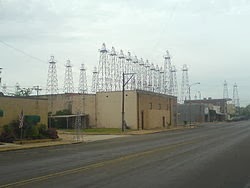
In the early 1930s, Kilgore's main commodity was cotton. The people were not rich by any means, but they were making ends meet and putting food on the table. During this time the population of Kilgore was around 400.

Several oil wells in nearby Rusk County drilled  by C. M. (Dad) Joiner came it, but production died down and the wells proved to be "dusters." Then on September 3, 1930, Joiner's third attempt, the Daisy Bradford No. 3 came in and caused quite a stir. As news traveled, thousands of people gathered at the well site. Hamburgers sold for a dime and cheese sandwiches for $.15 cents. (In the picture, cars are double parked for the celebration.)

Though the Daisy Bradford No. 3 caused quite a stir, it was the Lou Della Grimm No. 1 that proclaimed to the world that there was oil in the piney woods of east Texas—one of the greatest finds the world had seen during that time. Ed Bateman and his partner, Bill Cain, had been drilling along and on December 28, 1930 their well blew and began pumping 22,000 barrels of oil a day.

On December 29, 1930, the people of Kilgore woke to chaos. People were camped on their lawns, churches were taken over by squatters, and families including children slept in cardboard boxes and packing crates. Some made do with a quilt stretched tent-like over a barbed wire fence. Landowners had difficulty controlling the mass of humanity that descended on them. Ditches, or a ditch between tents, were used for disposal of garbage and offal. Kilgore had no city government at the time and was helpless with the arrival of the teeming mass of unemployed men, during the great economic depression of the 1930s, looking for a way to make enough money to feed their families. Along with these honest men seeking work also came undesirables.

The city of Kilgore had few paved streets and wooden sidewalks and due to frequent rains the streets were muddy. Businesses set up shop with amazing speed. Within 4 days of the Lou Della Grimm No. 1, Tom Foster moved his newspaper business in from Center City and began printing THE KILGORE DAILY NEWS. Large oil companies rushed in to buy up leases on properties in the area. May set up camps on their leases with bunkhouses, bath houses,  boarding houses for meals, and latrines. They also had areas for tents, and rag-houses. And national oil field supply houses were buying up property along Commerce street to set up their businesses.

We don't have time here to go into all of the economic ramifications of this rapid rate of oil production, so if you have time, google the issue and read. The Texas Railroad Commission issued a conservation order, but when it couldn't be enforced, Gov. Ross Sterling had to stepped and sent 12the Calvary of the Texas National Guard under the command of Gen. Walters in to enforce martial law.

At the beginning of the oil boom, Kilgore had one marshall and members of the Gregg County Sheriff's department. Lawlessness was rife and hard to curtail with the small crew. Rumor has it that it wasn't uncommon for a criminal to be given a get out of town notice and if seen in town again he was shot on site. Though harsh, it lessened the load on the already over burdened jails and court system.


The Mayor of Kilgore called the Rangers and the stage was set for a super-hero. The first to step into this hot bed of crime was Texas Ranger M. T. Gonzaullas, also known as "El Lobo Solo" or "Lone Wolf" The monikers came from his ability to get in and out of scrapes by himself. Gonzaullas arrived in town in the dark of night and met with the mayor secretly. He then went "underground," disguised, and mingled with he riff raft to discover the whereabouts of the dangerous criminals in the area.

(To the above right is a picture of "Lone Wolf" with his car. Note: The right front window will open where a machine gun is mounted. He could fire while driving.)

A deeply religious man, Gonzaullas admitted that his survival didn't depend on his pistols and rifles alone. He admitted himself, "It was more than that, much, much more. Sure, some luck was involved, but you can't make it just on luck at all times. The good Lord has to have His arm around you and has to help you in a situation like that. You can't count on judgement or luck alone. I know that He had His arm around me many, many times."

Two weeks later, Gonzaullas's partner, Robert "Bob" Goss, who had been recovering from a gunshot wound in the hospital, joined him February 28, 1931. Gonzaullas came out of his disguise and led a raid of other rangers and the Kilgore police and arrested 300 criminals. They marched them down the main street of town and into the Baptist church as Kilgore's jail was unfinished. He hooked them to a long, heavy chain. At intervals smaller chains were attached which was looped around the prisoner's neck and secured with a padlock. A bucket was passed down the line for restroom facilities.Those who were wanted for other crimes were held for transfer. Some were given four hours to leave town and most left instantly.

For almost a month, Gonzaullas averaged 100 arrests a day. The people in town called the chain, "Lone Wolf's trot-line," but though the Rangers kept the town from falling completely under the control of the criminal element, they still couldn't completely eliminate lawlessness.

In protest against military occupation, fires broke out on August 23, 1931. The Presbyterian and Methodist churches were destroyed as were the gin and seed house and a grocery store. Flammable materials were found. Gen. Wolters ordered his men to fire at the waist in hopes of curbing the fires and eliminating the arsonists. Trials were short and to the point. Usually individuals were told to leave town. If they didn't, they were shot. During this time, the rangers were given leeway in whatever methods they used to "restore order and preserve the peace," methods we might question as legal in this day and time.

I'd love to include more about this man's personal beliefs and character, but that's another story all together. Google him and/or visit the Texas Ranger Hall of Fame in Waco, Texas.

Kilgore has a wonderful museum and a number of historical sites to explore. Thought most of the derricks have been removed from downtown, visitors can still see their footprint. Plus, a few are still working. It's interesting to note that in the early days an oil well was drilled in the floor of the bank. No space went unused.

References:
Al Eason, Boom Town: Kilgore, Texas. 2005.
Bownson Malsch, "Lone Wolf" Gonzaullas, Texas Ranger.

A Way Back 
A Way Back – blurb and excerpt   


In the 1930s oil fields of Texas, a woman from the future finds new purpose as she helps a banker rebuild his financial empire.


Amber Mathis, a Wall Street investment banker, returns to her office after burying her mother. Distraught, tired of the rat race, she's determined to make a career change. In the elevator she falls and rises to find herself in a vintage lift.  The date is February 25, 1930, and a man stands on the window ledge in her office ready to jump.

Wellman Hathaway, owner and CEO of Hathaway Bank in New York struggles to pay his depositors half their losses. A woman claiming to be from the future appears in his office and involves him in a scheme that forces them into marriage. With Amber's knowledge of the financial history of the 1930s, they travel to the oil fields of Texas to recoup Wellman's funds.

Two people from different centuries are thrown together to survive a difficult time. Will they find more than A Way Back to prosperity?


Excerpt:

Do it her mind screamed. In one swift move she locked her arms around his waist, pulled, and dropped to the floor. She cringed at the loud crack when his head hit the window sash as he fell back landing on top of her.
They both remained still for a moment. The air knocked out of her, she managed to gasp out, “Could you move? You’re squashing me.”
He rolled and her head bounced on the floor as she changed positions from trying to rise to flat on her back. Long arms held hers above her head and muscled legs kept her body from moving. Striking gray eyes pierced hers, examining every inch of her. Her face flushed at the intrusion and she struggled to get him off. He applied more pressure and she stilled.
A lock of blonde hair fell over his forehead, a patrician nose flared in anger, as his square jaw tightened. He ground out, “Who the hell are you and why’d you try to knock my head off?”


Thanks you for stopping by today!

Linda LaRoque
www.lindalaroque.com
http://www.lindalaroqueauthor.blogspot.com


Saturday, November 2, 2013

The Day Old Wheezer Earned His Biscuits

By Paisley Kirkpatrick
I found this nugget from western history and thought it would be fun to share a bit of humor today.
Captain Hub Smith of the Yuma, Arizona, Territorial Prison knew a good bloodhound when he saw one, and the one he was looking at right now wasn't worth his biscuits. The captain was on a manhunt and Old Wheezer had chased off after a jack rabbit, an unforgivable sin. It was the second time that day this had happened.
"You blankety-blank idiot!" Smith fumed. "You cross between a worthless bloodhound and a bitch beagle. I'll teach you a thing or two. Hand me that club."
Old Wheezer's pitiful howls echoed out over the desert as the captain laid into him with a vengeance, but fifteen minutes later he chased off again on what was believed to be another rabbit track. No human footprints were visible in the sandy soil.
"That's the end," Smith said. "When that hound comes back, shoot him."
The dog had been given the name "Old Wheezer" because when he was on a trail, with his head down, his heavy breathing caused him to wheeze like a locomotive going up hill.
The rest of the pack chased on up the wash, confused, running every which way and finally had to be called in, the trail hopelessly lost.
The fleeing convict, a man named Cooley, apparently had made good his escape. He was armed with a rifle stolen from a guard at the penitentiary and was considered extremely dangerous. The rifle was known to have contained three cartridges. How many more Cooley had managed to get his hands on before he pulled out, no one knew.
The posse made camp and prepared for a new start in the mornng.
Throughout the night Old Wheezer, at almost regular intervals, sent his baying cry winging across the lonely desert, and this kept up until dawn.
"What do you suppose that fool's got up a tree?" Smith said, vexed. "Maybe we better go see."
"Like as not he's treed that rabbit," a guard said and everybody laughed. The remark was to become still funnier -- later.
They found Cooley sitting dejectedly in the fork of a live oak, just out of the hound's reach. He'd been there all night, he said.
"Where's that rifle you took?" Smith asked warily.
"Threw it away, Cap. What good's a rifle without ammunition? You don't think I'd let myself be treed by a hound if I'd had a cartridge left, do you?"
"What happened to your ammunition? You didn't fire at us. What did you shoot at?"
"Jack rabbits. I was skinning them and wrapping the hides around my feet to throw the dogs off. See?" He pointed down at his prison shoes around which he'd wrapped the furry pelt of a rabbit. "Fooled them all, except this old mutt."
After that Old Wheezer got his biscuits -- regularly.
Published in the Frontier Times, Spring 1969 -- Submitted by Dan King