Showing posts with label candy corn. Show all posts

Wednesday, July 4, 2018

SWEET HISTORY - PART 1 By Cheri Kay Clifton


First of all, on this, the 242nd year of our country's Independence,  I want to wish all our patriotic Sweethearts, families & friends a very Happy 4th of July!


Although our characters, settings and plots may be fictional, our historical western stories should remain true to important facts in order to make them believable for our readers. Thus, when we authors do research, obviously we check for significant dates of major events, inventions, the founding of states, cities and towns and the famous and infamous who inhabited them. But we also put emphasis in making sure the small things in our stories remain factual as well.

Where am I going with this … well, in my previous book as well as the one I’m writing now, one of the characters is eating candy. But what kind of candy was available then?  Could he eat a Hershey’s chocolate bar? How about a Tootsie Roll? A bag of candy corn? What about chewing gum? Hence, my post on the American candy industry from the 1800’s forward.

Even though the history of candy-making dates back thousands of years, as major advances in candy production developed, it became a major industry. Penny candy in American could be easily produced and sold by the pound, from glass jars in drugstores and general stores. As sugar prices decreased, both home based candy makers and candy factories refined their skills with candy brittles, taffy, caramels and simple hard candies.

However, it wasn’t until the latter 1800’s that candy making became even more popular with the addition of an ingredient called chocolate. Before this time, powdered chocolate was primarily used to create hot chocolate as a drink. Chocolate became more popular with advances made to offer chocolate as a solid, not just a powder. The ingredient could be molded into a bar, used as a flavoring, as well as a coating. Milton Hershey was the first American to bring the chocolate bar into mass production with machinery he purchased from a German company.

Out of the hundreds of sweets that could be listed, below is a timeline of some of the favorites I recognize. Many retro candies and their founding companies have come and gone. However, a large percentage of American candies have been around for more than a hundred years.


Hope you enjoy the journey through Sweet History. 


1847 Oliver Chase invents a machine for cutting lozenges, which were made into flavored candy wafers. Not until 1901 was NECCO Wafers introduced by the company it was named after — New England Confectionery Company.

1848 John Curtis produces the first branded chewing gum, made from tree sap, called The State of Maine Spruce Gum.

1854 The first packaged box of Whitman's Chocolate is produced.

1868 Richard Cadbury makes the first Valentine's Day box of chocolates, a tradition that continues today.


1880s Wunderie Candy Company creates candy corn, which remains a best-selling Halloween candy.


1893 Quaker City Confectionery Company, located outside Philadelphia, introduces Good & Plenty which becomes the oldest retro candy still in production.

1893 Milton Hershey attends the World’s Colombian Exposition in Chicago and watches chocolate being manufactured. Impressed, he purchases the German equipment for his factory in Pennsylvania.

1893 William Wrigley, Jr. introduces Juicy Fruit Chewing Gum and Wrigley’s Spearmint Chewing Gum

1894 Milton Hershey creates what is known as the first “American” candy bar, although his famous Milk Chocolate Bar won’t be invented for a few more years.


1896 Leo Hirshfield, New York confectioner, introduces Tootsie Rolls, named after his daughter’s nickname, Tootsie.


1900 Milton Hershey introduces a variation of what will become the Hershey’s Milk Chocolate Bar.

1900 Clark Gum Company introduces Teaberry Gum.
.
1901 Multicolored candy disks called NECCO Wafers first appear.

1902 New England Confectionery Company makes the first Conversation Hearts which remains a thriving Valentine’s tradition.

1904 Emil Brach starts Brach’s Candy.


1906 Hershey’s Milk Chocolate Kisses appear in the famed silver foil wrapping. The town of Derry Church changes its name to Hershey. The first name for the popular candy was called Silvertops.

1906 The American Chicle Company, founded by Thomas Adams, introduces Chiclets, the candy-coated gum that uses chicle (derived from the sweet sap of a tropical tree and means chewing gum in Spanish) inside.
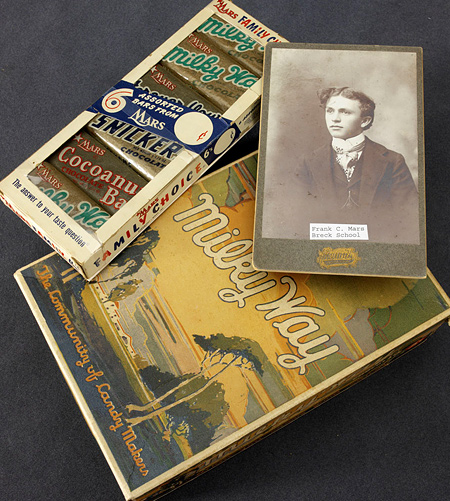

1911 Ethel and Frank Mars open a candy company in Tacoma, Washington. The company, later Mars, Inc., would become one of the largest, privately owned candy companies in the entire world.

1912 Life Savers, reportedly named because of their resemblance to life preservers, are introduced in peppermint flavor. The five-flavor roll isn’t marketed for another 22 years.

1912 The Whitman's Sampler box of chocolates debuts and is the first box of chocolates to include an index for chocolate lovers to pick exactly which piece they want to eat.

1913 Goo Goo Clusters is introduced, the first candy bar to combine milk chocolate, marshmallow, caramel, and peanuts.

1914 The Heath Bar is introduced by L.S. Heath & Sons.

1914 Mary Janes, a peanut-butter and molasses flavored taffy-type candies are created by Charles N. Miller in Boston, MA.


1916 George DeMet introduces the Turtle, a chocolate covered caramel and nut candy that resemblances a real turtle.  

I will continue with Part 2 of Sweet History next month. In the meantime, satisfy that sweet tooth and stay tuned!


Friday, October 26, 2012

GOT CANDY CORN?


What makes you think of fall? Cooler weather? Changing leaves? A few weeks ago my daughter was walking down the aisle of a well-known drug store chain. A woman clasped a package of candy to her chest and said, “Candy corn! It must be fall!”

Tasty Traditional Treat

Are you one of the many who consider candy corn a sign of fall? I admit I adore the tiny candies. October 30 is National Candy Corn Day. Truly! You know I wouldn't lie to you. For those of us over the age of 25  (and some of us are way over that age), when you think of Halloween candy you probably think of candy corn, those sugary little spikes of Halloween cheer. They've been around for as long as I remember and even as long as my grandparents remember, but did you know that they were invented in the 1880's?

George Renninger, an employee of the Wunderlee Candy Company, invented the popular confection in the 1880s and Wunderle Candy Company of Philadelphia was the first to go into commercial production of candy corn. However, the company most closely associated with this wonderful confection is the Goelitz Confectionery Company. Founder Gustav Goelitz, a German immigrant, began commercial production of the treat in 1898 in Cincinnati and is today the oldest manufacturer of the Halloween icon.The Goelitz Candy Company is now also Jelly Belly Candy Company (Yum!) and still produces candy corn today.

A serving of Candy Corn is nineteen pieces, and 140 calories and has zero grams of fat. More than 35 million pounds of candy corn will be produced this year. That equates to nearly 9 billion pieces—enough to circle the moon nearly 21 times if laid end-to-end. But who's laying it end to end? At our house we're eating that sweet stuff.
Trick or Treat for Candy Corn

When candy corn first appeared, it was popular among farmers because of its agrarian look. The tri-color design was considered revolutionary and the public went crazy for it. Lack of machinery meant that candy corn was only made seasonally from March to November. Candy corn has remained unchanged for more than 100 years and is a favorite at Halloween.

                                                          How is Candy Corn Made?


In 1900, it was the job of many men to produce candy corn for eight months of the year. Sugar, corn syrup and other ingredients were cooked into a slurry in large kettles. Fondant and marshmallow were added to give a smooth texture and bite. The 45 pounds of hot candy was poured into buckets called runners. Men dubbed stringers walked backwards pouring the candy into cornstarch trays imprinted with the kernel shape. A strenuous job at best before the days of air-conditioning and electric fans. It took three passes to make the white, yellow and orange colors. Perishability prevented widespread distribution. Originally, candy corn was delivered by wagon in wooden boxes, tubs and cartons. I prefer my candy corn in a nice sterile wrapper, don't you?


All this strenuous labor wasn't lost on the public. It's tricolor design was considered revolutionary for its time and people flocked to buy them. Their shape was also a big selling point for the mostly agrarian population of the early 1900's. So popular was candy corn that companies tried other vegetable shapes including turnips. (What? Candy turnips? Oh, well, I like the little candy pumpkins.) The Goelitz Candy Company even had to turn orders down for lack of production capacity.


The process of making candy corn is very similar today, but now machines do most of the work, as shown in the video above. Manufacturers use a method called the corn starch molding process. A tray containing depressions is filled with corn starch. Candy corn is made from the bottom to the top and in three-color passes. First, the depression is filled one-quarter full with yellow syrup and allowed to partially set. Next, the orange syrup is added. The mold is then topped off with the white syrup and is cooled. The candy now can gel together. After is it has finished cooling, the trays are emptied and the little candy corns are ready to be eaten.

During WWI, Herman Goelitz, son of Gustav, moved to Fairfield, California to start his own company, the Herman Goelitz Candy Company. Their product? Candy Corn! The fortune of the Halloween treat would rise and fall many times as recession and boom, war and peace, and sugar rationing affected the humble confection. Throughout the hard times it was the sale of candy corn that kept the companies afloat. In the sugar crisis of the mid 1970's when the price of raw sugar skyrocketed, the company had to borrow heavily to buy sugar to keep up production. After the crisis, the market plummeted. Many companies went out of business. It was demand for candy corn that kept Goelitz from bankruptcy.

Today you won't have to look very hard to find candy corn. Computer and machine aided production have made them a plentiful staple no matter what time of year. So plentiful in fact that according to the National Confectioners Association, in 2001 candy manufacturers sold more than 20 million pounds of candy corn. Roughly 8.3 billion kernels! A popular variation called "Indian corn" features a "special" chocolate brown wide end, orange center and pointed white tip, often available around Thanksgiving. During the Halloween season, blackberry cobbler candy corn can be found in eastern Canada. Corn confectioners have introduced additional color variations suited to other holidays. Red, white, and green corn is available for Christmas. Red, pink, and white is sold at Valentines. Pastels corn is produced for Easter. Very impressive for a product that has remained virtually unchanged for well over 100 years.

While you're munching your candy corn and other Halloween goodies, why not read a good book? Any of our authors offers a great read. Ahem, you might even try my latest release, HIGH STAKES BRIDE.


Souces:
www.Wikipedia.com
http://www.hauntedbay.com/history/candycorn.shtml


http://www.candyusa.com/FunStuff/CandyType.cfm?ItemNumber=1582


www.jellybelly.com
video: The History Channel via You Tube

Thanks for stopping by!