Showing posts with label brothel. Show all posts

Monday, January 6, 2014

Notorious Brothel of Cripple Creek

My family just spent a wonderful 4 nights and 4 days in Cripple Creek Colorado at the Hotel St. Nicholas. While there, my bother-in-law took us on several tours around the area so we could get a sense and feel of the place. On Thursday, my sister-in-law took us to the Old Homestead, a brothel that surpassed all others of its time. The establishment was run by a well educated and beautiful woman named Pearl De Vere.

To make the town more safe, Marshall Hi Wilson moved all the dance halls, houses of ill repute and cribs to Myers Avenue which became the red light district. While prostitution wasn't exactly legal, he established a system that benefitted both the girls and the police force. The girls paid a yearly "fine" for their activities that went right into police funds. They also had monthly check ups with a physician to determine they were disease free. Pearl took very good care of her girls, insisting they use good hygiene and providing them with two good meals a day.

Pearl ran her house differently than the other madams. A gentleman had to apply to visit. After she determined his wealth, he was then allowed admittance. If there for the first time, he would be shown to the viewing room, a small room upstairs. The girls would enter the adjoining room and disrobe. He could peer in at them and make his selection. Most evenings began with some form of entertainment in the parlor or music room. Gents could play cards with their favorite ladies, dance or just visit before being led upstairs.

The Old Homestead is filled with all sorts of original antiques and well worth the visit. There are many more stories the curator tells and all very interesting. I was surprised that the rooms were rather small but furnished with rare imports.

In 1897, Pearl died of a morphine overdose. As the use of drugs in these houses was commonplace, no one knows for sure if she merely took a dose  to help her sleep or if she committed suicide. When her sister came all the way from Indiana to claim the body, she had no idea the profession her sister enjoyed. When she discovered Pearl was a madam, she refused to take responsibility for the funeral an disowned any relations to the woman. Prior to dying, Pearl had hosted a lavish party sponsored by a prominent Denver man. He'd bought her a $800 Parisian dress. They argued that night but after her death and anonymous donor sent $1000 dollars and a note that she was to be buried in the dress. She had the most lavish funeral ever with several wealthy business men in attendance and a band that accompanied them to the gravesite.

Hazel Vernon eventually took over running the Old Homestead. She would be known as the longest reigning madam of Cripple Creek. She sold the house in 1905. Even then, the house continued as a place of ill repute. As the mines dried out, business decreased and in 1917, the house became a boarding house.

Product DetailsWhile at the museum, I bought 3 books. One was a romance by Anna DeForest that was written in 1997 and featured the town of Cripple Creek and the Old Homestead. I'm reading Golden Dreams now and while it's typical for the time written, it's still a good romance. The best part is how she incorporated the history of the area into her story. It's no longer in print but the copy I got was signed and I think you can still find a few older copies at Amazon. The other two books were research books addressing the Old Homestead and Myers Avenue.

Thursday, February 24, 2011

Saloon and Brothel Tokens


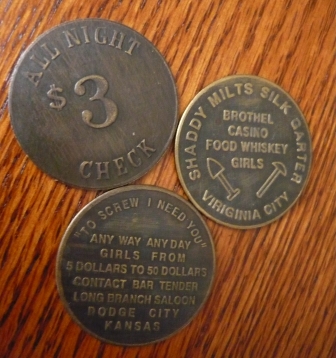
I'm Sandra Crowley, writer of contemporary romantic suspense. So, what am I doing as a member of this blog that specializes in The Wild West, The Old West, the just plain but still fascinating west? Well, I live in Colorado. My stories take place in various western states. John Wayne is my favorite actor. LOL OK, maybe that's hokey, but I don't care. I'm a half a bubble off plumb, and I like it that way. That's why my husband wasn't the least bit surprised when I bought three saloon/brothel tokens years ago.

Experts say that beginning in the 1700s and lasting through the early 1900s, when prohibition halted legal activities at saloons, establishments in the western United States, through the Yukon territories, and into Alaska minted their own currencies known as saloon tokens. Born out of the barter system necessary within those raw lands these tokens are prized collectibles now. 
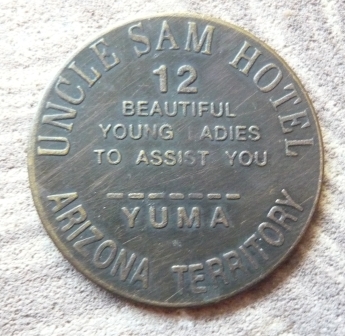
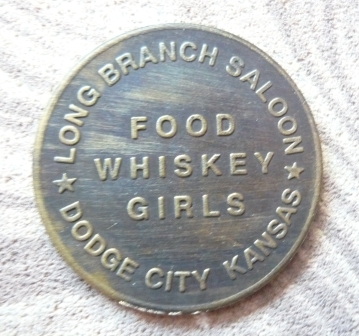
How could I afford three valuable "coins?" Well, my tokens belong in the fantasy, or reproduction classification. They're usually more explicit or bawdy in their claims. Prices for fantasy tokens offered on eBay run from a dollar or two up to ten. What they actually sell for is a good question. We keep ours as conversation pieces. They’re usually in our guest bathroom by the sink for the observant to discover and comment upon.
A real token would fetch a price somewhere in the hundreds or higher. Some have holes in the middle, are octagonal shaped, or even scalloped edged besides the mundane round my fake ones are. Most have a tender value listed: 12 ½ cents equaled one bit or the price of one drink. When a saloon patron paid real cash for his whiskey or “service”, the owner returned change in the form of the tokens he had made himself or had forged. This ensured the customer returned to his place of business since other establishments accepted only their privately minted “change.” Because of this non-monetary value, they are considered exonumia which also includes military medals, commemorative coins, and personal tokens like those used to identify group affiliations such as the Freemasons.
Why were saloon or brothel tokens needed in the Old West? Money couldn’t travel with the ease and speed of our current banking systems. Banks sent money on stage coaches or by Pony Express riders, time consuming adventures. As trains took their places, delivery became easier, quicker but still suffered delays and outright robbery that could cause disaster for a business owner caught without funds. Especially when increased westward travel of the poor and penniless further shortened circulation of money.
Another reason was that saloons and brothels clustered around mining camps. Mine owners hired workers, allowed them to buy supplies from the company owned stores, and then deducted those amounts from the miner’s wage. This system is called payment by scrip. Its popularity curtailed the flow of legal tender (dollars and cents) in mining communities. Some of you may remember one of my favorite songs, Sixteen Tons by Tennessee Ernie Ford. Its chorus describes this vicious circle. “You load sixteen tons, what do you get, Another day older and deeper in debt, Saint Peter don’t you call me ‘cause I can’t go, I owe my soul to the company store.”
So, saloon and other business owners did what was necessary for their survival; they minted their own tokens for their customers to use in exchange for goods and services. That kept their money out of the control of the greedy mining companies.
I hope you enjoyed this glimpse into Old West economics. Happy Ridin'