Showing posts with label Pilgrims first Thanksgiving. Show all posts

Wednesday, November 24, 2021

THANKSGIVING AND PRAYER: a look at the origin by Marisa Masterson

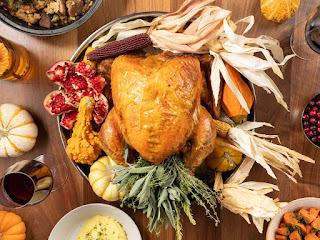
 Thanksgiving Day. I think of many things on that day--food, shopping, parades--but I rarely connect it with prayer. Yet, the roots of the holiday go back to that very thing.


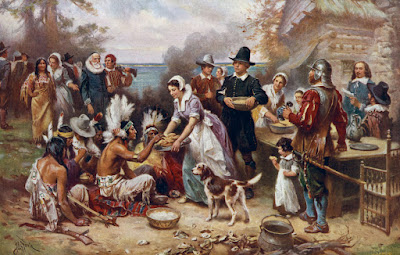
William Bradford, the Plymouth colony's first governor, declared a religious feast after a successful corn harvest. The focus, as I found in research, was to give thanks to God for their very survival. Bradford's idea for this feast was inpsired by the Hebrew Feast of Tabernacles, a time when the people refrained from work and recited the great deeds of the Lord. While the Pilgrim feast wasn't a day of fasting as Bradford called for at other times in Plymouth, the Puritan Thanksgiving undoubtedly included prayer.

The harvest observance remained relatively unknown until the American Civil War. Bloody and decisive, the Battle of Gettysburg was a victory for Union forces. After it, Lincoln called for the nation to celebrate Thanksgiving Day on November 26 of that year, 1863.


Excerpt from Abraham Lincoln's 1863 proclamation--


It has seemed to me fit and proper that they should be solemnly, reverently, and gratefully acknowledged as with one heart and one voice by the whole American people. I do, therefore, invite my fellow-citizens in every part of the United States, and also those who are at sea, and those who are sojourning in foreign lands, to set apart and observe the last Thursday of November next as a Day of Thanksgiving and Prayer to our beneficent Father who dwelleth in the heavens. And I recommend to them that, while offering up the ascriptions justly due to Him for such singular deliverances and blessings, they do also, with humble penitence for our national perverseness and disobedience, commend to His tender care all those who have become widows, orphans, mourners, or sufferers in the lamentable civil strife in which we are unavoidably engaged, and fervently implore the interposition of the Almighty hand to heal the wounds of the nation, and to restore it, as soon as may be consistent with the Divine purposes, to the full enjoyment of peace, harmony, tranquillity, and union.


Notice that Lincoln refers to it as a day of prayer. Earlier that year, he had signed a proclamation for a national day of prayer and fasting. Using a holiday known only in New England, he was able to once more that year call for a day of prayer. And he recommends what the citizens of the Union should pray for.
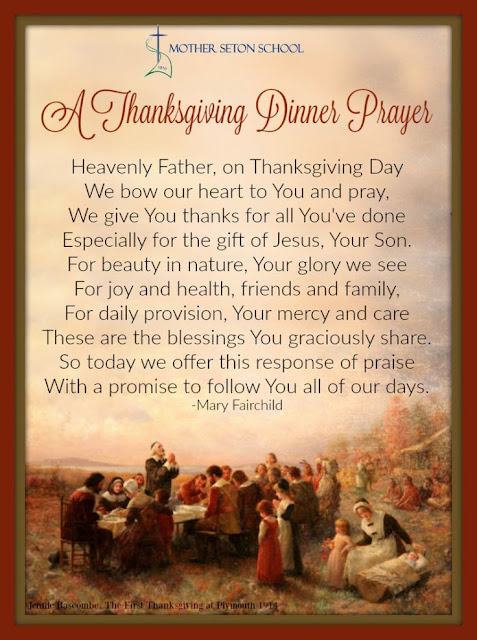


Thanksgiving Day, the day I know, comes about later. In 1939, Franklin Roosevelt establishes a specific day for Thanksgiving each year. Why? He wanted to boost sales for the Christmas buying season. It seems to me that our modern, hedonistic holiday traces back to his decision. But the true roots of the holiday, well, those are worth remembering.


ON SALE for a limited time! A thank you to my readers.

Friday, November 20, 2020

When Thanksgiving was Political


According to historian Michael LaCombe, Chief Massasoit and his people contributed freshly killed deer for the first Thanksgiving. Much appreciated by the Pilgrims, I’m sure. However, LaCombe asserts that the Native Americans undermined Governor William Bradford’s authority by giving the meat to the colony’s leading members, rather than to Bradford himself, for redistribution. Thereby thumbing their nose at Bradford’s rule.

"The First Thanksgiving at Plymouth"
(1914) By Jennie A. Brownscombe; public domain 
{{PD-US}}

Decades later, in 1675, Massasoit’s son, Philip (alias Metacom or Metacomet), gathered together several tribes who had been enemies. Faced with spreading, permanent English colonization, they fought the colonists in “King Philip’s War” – called the deadliest war in American history, in proportion to population. Doubtless, the natives did not favorably recall the first Thanksgiving.

In 1776 colonists accused King George III of allowing “the merciless Indian Savages” . . . to attack “the inhabitants of our frontiers”. In truth, these early Americans had spent more than a century taking native territory that did not belong to them. When the Revolutionary War ended with the defeat of Great Britain and her native allies, more indigenous territory was seized. How to divide so much land between southern slave interests and northerner anti-slavery forces ultimately sparked the American Civil War.

Which brings us back to Thanksgiving.

Sarah Josepha Hale, ca. 1831; public domain

In 1863, novelist and magazine editor Sarah Josepha Hale convinced Abraham Lincoln to make Thanksgiving a national holiday on the last Thursday in November. She had started campaigning for the holiday in the 1840s, hoping a national day of celebration would help prevent the quarrel over slavery from erupting into Civil War. Her idea met with resistance from the southern states, as well as inconsistencies in how to celebrate the holiday.

Since colonial times, the meaning of thanksgiving days has varied greatly. Prior to 1863, thanksgiving events occurred throughout the year and could involve religious fasting and feasts to mark important events. In 1777, the Continental Congress proclaimed a day of thanksgiving for all 13 states to celebrate winning a battle against the British at Saratoga.

Professor Matthew Dennis observes that by 1850 every northern state, and several southern, Midwestern and far western states (including Arkansas, California, Illinois, Indiana, Iowa, Louisiana, Michigan, Minnesota, Mississippi, Missouri, Ohio, Oregon, Texas, Utah, Virginia, Wisconsin) celebrated Thanksgiving, at least occasionally.

Sarah Josepha Hale believed an official thanksgiving date would give the states more in common than they had differences. In 1854, as editor of Godey’s Lady’s Book, she wrote: The last Thursday in November has been selected as the day best suited to the general convenience, when the people from Maine to Mexico, from the Atlantic to the Pacific, might sit down together, as it were, and enjoy in national union their feast of gladness.”

In the south, however, slaveholders viewed the holiday as an opportunity for Yankee preachers to sermonize against slavery, and in their eyes to push the country closer to war. In 1853, Governor Joseph Johnson of Virginia refused to declare Thanksgiving a holiday, and in 1859, Governor Stewart of Missouri proclaimed December 8th instead of November 24th a day of Thanksgiving, a deliberate act of defiance.

Despite Hale’s efforts, war broke out, and Lincoln’s decision to make the holiday a national one was intended to support the north’s cause as much as to commemorate an event in the nation’s history. Thanksgiving did not prevent the Civil War, but it was used to help bolster the Union’s cause – partially through food. Mentions of turkey, sweet potatoes, pumpkin pie and cranberry sauce appear in association with Thanksgiving in 1860s editions of Godey’s Lady’s Book.


In this year of the terrible Covid pandemic, Thanksgiving may not be a subject for political debate, but it does present a challenge for all of us. Common sense calls for us to avoid large family gatherings, to stay home in our personal bubbles and, I pray, live to see next year's national day of thanks. Amen.


Lyn Horner is a multi-published, award-winning author of western historical romance and paranormal romantic suspense novels, all spiced with sensual romance. She is a former fashion illustrator and art instructor who resides in Fort Worth, Texas – “Where the West Begins” - with her husband and two very spoiled cats. As well as crafting passionate love stories, Lyn enjoys reading, gardening, genealogy, visiting with family and friends, and cuddling her furry, four-legged babies.


Amazon Author Page: viewAuthor.at/LynHornerAmazon (universal link)  

Website:  Lyn Horner’s Corner 

Twitter   Facebook   Goodreads   Sweethearts of the West