Showing posts with label John Wesley Hardin. Show all posts

Sunday, May 24, 2020

FASTEST GUN IN TEXAS by Marisa Masterson

Maybe you've tried channels like Sling or Philo? They offer seven days free just to surf their programing. That's what I was doing when I ran into the fastest shootist Texas ever experienced.

I'm a documentary junky. I love learning. Perhaps that's why I became a teacher. For whatever reason, I ran across this documentary on a man who sent shivers through Texans.

John Wesley Hardin. Mothers used his name as a threat to make their children behave "or Wes would get them." Even Bill Hickok found himself facing the business end of this man's guns. So, exactly who was he?

John Wesley Hardin
Named for the evangelist John Wesley, Hardin was the son of a preacher and grew up in Civil War era Texas. With his father's encouragement, he practiced with the gun until he was a marksman at the age of twelve.

One of the tricks this shootist did to prove himself was to hit playing cards at fifteen paces, never missing. By the end of childhood, the man was deadly and bore a nasty grudge against Yankees and any people of color be they Mexican or African-American.

Maybe that's why he killed his first man when he was only fifteen. The former slave had bested him in a wrestling match. When he encountered the man alone in the woods, he shot him and claimed the man attacked him with a stick. The victim lived long enough to declare that a lie. Hardin ran from his home, fearing arrest.

Cowboys in Kansas
From there, he leaves a trail of dead men. He easily hid amongst a group of cattle drovers taking a heard to Kansas. That's how he eventually met Wild Bill Hickok in Abilene, Kansas. Guns weren't allowed while walking the streets of that town. Typically defiant, Hardin kept his on.

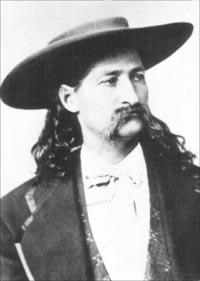
"Wild" Bill Hickok
Hickok confronted the armed cowboy, being the marshal, and demanded he remove the guns, Hardin did so and handed them toward Hickok with the handles first. Before that man could grab them, the shootist flipped them so he held them cocked and pointed close to the famous marshal's face.

This wasn't the first man Hickok talked down to avoid violence. The two went into a saloon and shared a drink bought by the lawman. When they met again another year, Hickok didn't ask the shootist to remove his guns.

That was just the type of man Hardin seemed to be. Showy, cocky, and willing to kill. After he returned to Texas and killed a lawman, Texans had had enough.Many put pressure on the governor to send a new group called the Texas Rangers after the man. With a $5,000 bounty on his head, the governor was confident the man would be caught.

I would think so, considering the amount. It was one more thing Hardin boasted about to people--the size of his bounty! In 1875, that $5,000 was equivalent in purchasing power to about $116,540 in 2020.
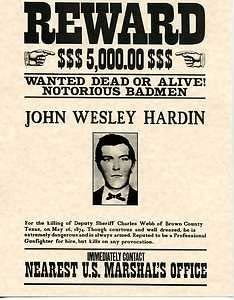
Someone was willing to risk Hardin's guns to claim it, and the rangers caught the man in a railroad car. Not a very glamorous life!

Here's where it gets interesting for me. While Hardin sat in Hunstville Prison, he wrote his autobiography. This is why historians view him as a man with no conscience. He detailed murders, excused them, and vowed he felt no remorse. He was the faster gun and that was all that mattered.

After serving seventeen years, the murderer went free, a supposedly changed man. While in prison, he'd earned a law degree and tried to set up a law practice. Surprise, surprise, but people were too afraid of him to use his services.

He eventually ended up in El Paso where he was shot from behind and killed. It didn't matter how fast he was since he hadn't guarded his back.

One last note--the word shootist. I used that rather than gunslinger to be authentic. Amazingly, the word gunslinger was invented in the 1920's by author Zane Grey. Men in the old west never used it, calling men like Hardin shootists. Very accurate for Hardin, I think!


If you enjoy action, romance, and adventure, please take a look at Ruby's Risk. With our 380,000 pages read on Kindle Unlimited, readers are falling in love with this book.


A man might homestead, but it takes a woman to turn that place into a home! This matchmaker will settle the West one couple at a time.

Under suspicion after his wife’s murder, Elias Kline knows he has to leave Mills Bluff. Learning a lynch mob is planning to kill him, he slips away from town. Taking only his smithy tools and his young son, he chooses a new name—Ezra King. Heading west seems a fine way to start over, but he’ll need a wife to raise his son and cook his meals. One sent by an agency shouldn’t expect love, he decides.

A matchmaker convinces lonely Ruby Hastings to take a risk on Ezra King. After all, the man is helping fulfill the nation's destiny of settling the west. Reading the man’s letter, Ruby aches for the widower's little boy and seizes on this chance to be a mama to him. After all, with a brother on the run from the law and a newly married sister, her siblings no longer need Ruby and this motherless boy does.

It should be a convenient arrangement. What happens when the mail-order wife begins to push past the walls guarding Elias’ heart, challenging him spiritually and emotionally? When danger follows him from Mills Bluff, will Elias be able to keep his family together?

Friday, October 4, 2019

R. I. P. By Cheri Kay Clifton


We western authors have researched stories of legendary frontiersmen, outlaws, gunslingers, lawmen, and Native Americans.  For this post, I’ve written how and where a few of their stories ended and where they now “rest in peace.”


For many notorious outlaws, the Old West cliché is true, they died with their boots on! Not surprising that a number of cemeteries in the West are named Boot Hill.  The most famous one of all is Boot Hill in Tombstone, Arizona.  And its most famous inhabitants are Billy Clanton and Tom and Frank McLaury, all killed at the gunfight at O.K. Corral on October 26, 1881.


Certainly another outlaw at the top of the numerous list of those lying 6 feet under is Henry McCarty, aka, William Henry Bonney, aka, Billy the Kid.  On July 14, 1881, Pat Garret, the Lincoln County, New Mexico Sheriff was questioning a friend of Billy’s at his home in Fort Sumner, New Mexico. Sitting in a darkened bedroom, Garrett was asking Billy’s whereabouts when Billy unexpectedly entered the room.  Billy didn’t recognize Garrett in the dim light and asked, “Quien es?” – “Who is it?”  These were the last words Billy uttered.  Garrett shot Billy twice in the heart.  Billy the Kid was buried the next day at Fort Sumner cemetery.  He was just 22.  The old Fort Sumner Post Cemetery is near present-day Fort Sumner, New Mexico.


As for lawman, Pat Garrett, (proper name, Patrick Floyd Jarvis Garrett), he endured a sullied reputation from folks accusing him of killing Billy the Kid without warning.  After finishing his term as Lincoln County Sheriff, Garrett wrote (with the help of a ghostwriter), his experiences with the Kid.  He died his own strange death, shot on the road while talking to a rancher who he’d leased grazing rights to in order to pay debts.  Originally buried in Odd Fellow Cemetery in 1908, Las Cruces, New Mexico, Garrett was reinterred in the Masonic Cemetery in 1957.


Outlaw Jesse Woodson James held the well know distinction of gang leader, bank robber, stagecoach robber, train robber, and murderer from the state of Missouri and the famous member of the James-Younger Gang. In 1882, he was killed by a member of his own gang who hoped to collect a reward.  Originally buried at his homestead in Kearney, Missouri, his grave was moved to Mount Olivet Cemetery in 1902.  Jesse was 34 years old.


Known as Texas’ most deadly gunman, John Wesley “Wes” Hardin killed over thirty people.  Captured by a Texas Ranger, he was released in 1894 after serving eighteen years in prison.  One year later, Hardin was shot and killed by John Selman, an outlaw-turned-lawman in El Paso’s Acme Saloon.  Selman was gunned down just a year later.  Hardin is buried at the Concordia Cemetery in El Paso, Texas at the age of 42.  Ironically, Hardin’s killer, John Selman is buried just a few feet away.

John Henry “Doc” Holliday was a gambler, gunfighter, dentist and good friend of lawman Wyatt Earp.  He’s best known for his role as a deputy marshal in the events leading up to and following the gunfight at O.K. Corral.  The man suffered nearly his entire life with tuberculosis.  In 1886 he moved to Glenwood Springs, Colorado, hoping that the hot springs vapors would improve his health.  However, a year later after spending two months in bed, he looked down at his bare feet and said, “That’s funny,” and died.  He’d always figured he would have died with his boots on.  He was 36 years old.


The Glenwood Springs cemetery sits high on a steep hill.  At the time of Doc Holliday’s death, the steep road was too icy so he was buried at the bottom of the hill with the intention of his body being moved when the ice thawed.  But, he never was and many years later, a housing development was built at the base of the hill and though a marker sits in the cemetery, his actual remains are probably buried in someone’s back yard!


Don’t want to discriminate, for there was also the female legendary “outlaw queen,” Belle Starr who was a horse thief, outlaw and part-time prostitute, and the first woman to be tried for the serious crime of horse thievery by the famous Judge Isaac Parker. In 1889, she was shot in the back and killed by an unknown assailant. Forty years old, she was buried at her cabin southwest of Porum, Oklahoma. Her daughter, Pearl had the following inscription engraved on her tombstone:
“Shed not for her the bitter tear,
Nor give the heart to vain regret,
‘Tis but the casket that lies here,
The gem that fills it sparkles yet.”


Can’t leave out James Butler “Wild Bill” Hickok, a legend in his time and one of the most famous frontiersmen in the West. On August 2, 1876, he was playing poker at the Nuttall & Mann’s #10 Saloon in Deadwood, South Dakota when he was shot from behind by Jack McCall.  At age 39, lying dead on the floor, Wild Bill was holding a pair of black aces and a pair of eights, which has since been known as the “Dead Man’s Hand.” When in Deadwood, I visited his grave at the cemetery. Calamity Jane, who had long been infatuated with Wild Bill during his lifetime, asked to be buried next to him. Her last request was granted when she died on August 2, 1903.


Another famous lawman and gunfighter, Wyatt Berry Stapp Earp, who was marshal of Ellsworth, Kansas in 1873, marshal in Wichita in 1874, and marshal in Dodge City in 1876, spent his final years working mining claims in the Mojave Desert during the winters and summered in nearby Los Angeles, California.  In 1929 at age 80, he died peacefully with his wife, Josie at his bedside.  Earp is buried at Hills of Eternity Memorial Park in Colma, California.


Lt. Col. George Armstrong Custer’s death became one of the most famous American legends known as “Custer’s Last Stand.” Custer finished at the bottom of his West Point class in 1861, yet led courageous service during the Civil War, only to lead his 7th Cavalry troops to their demise at the Little Bighorn Battlefield in 1876. He was 36 years old and is buried at West Point, New York.


 In a previous blog, I had reported on Buffalo Bill Cody, the greatest showman the Old West ever knew and his extensive museum in Cody, Wyoming.  After his death in 1917, he was buried on Lookout Mountain in Golden, Colorado.  He was 70 years old.


Speaking of Buffalo Bill, I’d also like to add Phoebe Ann Moses, a sharpshooter who rose to fame in a way most men could only dream of doing and became a legend in her own time!  She was known as Annie Oakley.  Buffalo Bill cast her as “Little Sure Shot” and she did trick shooting with his Wild West show for 16 seasons.  Even at age 60, she was still performing and winning shooting contests.


 Her health declined in 1925 and she died of pernicious anemia in Greenville, Ohio at the age of 66 on November 3, 1926. Her body was cremated in Cincinnati two days later and the ashes buried at Brock Cemetery near Greenville, Ohio. Assuming their marriage had been in 1876, Oakley and he expert marksman husband, Frank Butler had been married just over 50 years.

Butler died 18 days later in Michigan. His body was buried next to Oakley's ashes, or, according to rumor, Oakley's ashes, placed in one of her prized trophies, were laid next to Butler's body in his coffin prior to burial. Both body and ashes were interred in the cemetery on Thanksgiving Day (November 25, 1926).

Hope you visit my website at www.cherikayclifton.com

Happy Trails To You!


Monday, May 2, 2016

How Much Do You Know About The Old West?

By Paisley Kirkpatrick
Q: What famous Western shootist operated a saloon in Nome, Alaska, at the beginning of the twentieth century?
A: Wyatt Earp operated a Nome barroom during middle-age wanderings that took him to Texas, California, Idaho, Kansas, Colorado, Arizona, Nevada and Alaska, before he retired in Los Angeles in 1906.
Q: When was Jesse James murdered, what was he doing at the time of his death and who killed him?
A: On April 3, 1882, Jesse James was killed from behind by a single shot to the head fired by gang member Bob Ford. The notorious outlaw leader was brushing the dust off a wall picture in his home at St. Joseph, Missouri, when he was killed.
Q: In 1871 Deputy Sheriff Charles H. Nichols of Dallas, Texas, was shot to death trying to arrest John Younger, a member of the Jesse James-Cole Younger gang. Why was the sheriff trying to arrest Younger?
A: Younger, who escaped after gunning down the sheriff, was wanted by Dallas authorities for taking off a cowboy's nose while trying to shoot a pipe out of his mouth.
Q: What was the weight and speed of the bullet fired from the famous Colt .45 of the Old West?
A: The metallic cartridge originally designed for the .45-caliber Colt handgun, loaded with 40 grains of black powder, normally held a lead bullet weighing 233 to 265 grains, which was fired at a speed of 700 to 900 feet per second.
Q: Who killed the notorious gunfighter John Wesley Hardin?
A: On August 19, 1895, Hardin was shot and killed from behind by John Henry Selman, an outlaw-turned-constable who had a grudge against Hardin and surprised him in El Paso's Acme Saloon.
FACT: Billy the Kid was not left-handed. Contrary to Hollywood portrayals, like the 1958 Left-Handed Gun, Billy the Kid was right-handed. Popularizers of the Billy the Kid legend were sometimes misled by old photographs that were carelessly transposed when printed and made the young gunman appear to be wearing his weapon on his left side.
Taken from The Old West Quiz & Fact Book by Rod Gragg