In my current work in progress, my heroine, Brunhilde, is a German
immigrant who, in 1873, travels to St. Louis, Missouri, in the United States.
By then, steamships replaced most sailing vessels, which cut down travel time
across the Atlantic Ocean. As for the port of entry, I chose New Orleans for
several reasons. One was, ships carrying cargo like cotton and tobacco brought
passengers from Europe on the return voyage in order not to lose money. That
was a more logical departure port for those commodities. Also, St. Louis, which had a large German-speaking population, was right
up the Mississippi River from New Orleans.
 |
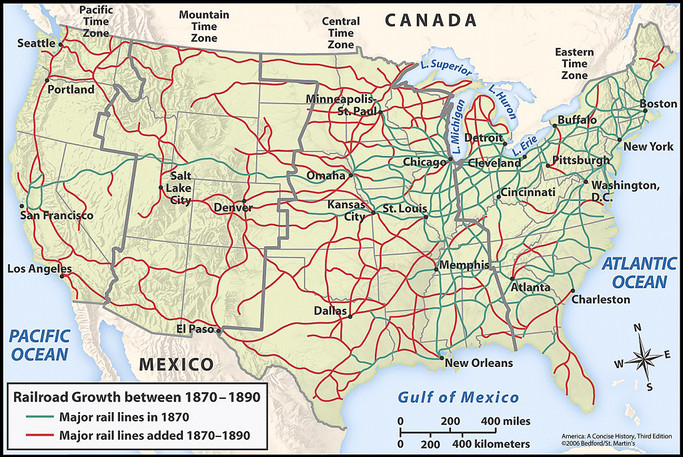
1870-90 Railroad Map
|
The question I faced was, in 1873, what was the most logical form
of transportation between the two cities? Was it train travel, or was it still river
boat? A look at the railroad map for 1870-90s showed there were railroads that
traveled north, but the more established lines ran east of the Mississippi.
Since that was such a wide river to cross, I next checked to see if a railroad
bridge crossed the river near St. Louis.
Work on the Eads
Bridge, a combined road and railway bridge over the Mississippi River began
in 1867. It connected the cities of St. Louis, Missouri and East St. Louis,
Illinois. The bridge is named for its designer and builder, James Buchanan Eads.
It
was
the first bridge across the Mississippi south of the Missouri River. Earlier
bridges were located north of the Missouri, where the Mississippi is smaller.
None of the earlier bridges survive, which means that the Eads Bridge is also
the oldest bridge on the river.
 |
Eads Bridge photo taken in 2012 from LaClede's Landing
|
The west end of the bridge is located on the St. Louis
riverfront near Laclede’s Landing, which
now is in the historic district and was the northern part of the original
settlement founded by the Frenchman, Pierre Laclede. Even today, it had
cobblestone streets and vintage brick-and-cast-iron warehouses dating from 1850s.
That sounded like a good place for a steamboat to land to disgorge passengers
and freight.
 |
Eads Bridge 1875 drawing by Camille N. Dry- note river traffic
|
Since the Eads Bridge was not complete until 1874, a year
after my immigrant heroine and her family arrived. Based on that information, I
wrote the story so the family traveled by steamboat up the Mississippi.
Brunhilde and her family stayed with her stepfather’s
oldest brother, who had been a part of the German community in St. Louis since
he and his young family arrived in 1848 after a failed revolution in Germany.
The second oldest also brought his family. After his
first wife died, he remarried. However, when he heard that the new Transcontinental Railroad was being built with its eastern terminus in Omaha,
Nebraska, he moved his family to the large German community there. His second wife’s parents, also German
immigrants, both died before his wife’s grandmother, Oma Bergmann. This brother, knowing his newly arrived youngest
brother has an older stepdaughter, begged her to come and care for the elderly
woman who had driven off every caretaker in Omaha he hired.
For Brunhilde, this means more
travel. Should my heroine board another steamboat and travel up the Missouri
River to Omaha—a prospect she does not favor after making the trip from New
Orleans? Or, should she travel by train, which would take her from the east border of the state to the west? Before I could decide that, I needed
to know if, in 1873, there was a bridge across the wide, muddy, and
unpredictable Missouri River.
 |
Omaha Union Station
|
The Transcontinental Railroad was a big project, the
planning of which started in 1862 during the Civil War. Actual construction did
not start until after. However, in order to complete the dream of connecting
the country by rail from the Atlantic Ocean to the Pacific Ocean, it became
necessary to have railroad bridges across the large rivers that drained into the Gulf of Mexico.
The Chicago and North Western Railway reached
Council Bluffs in 1867. To make the connection across the river, for a time, the
Union Pacific tried to run freight trains across the frozen river during the
winter. Also, the Union Pacific Transfer company maintained a ferry service
from 1866 to 1872.
For an interesting early photograph of a train crossing the river, please CLICK HERE.
In 1869 the transcontinental railroad was completed. However,
that was not satisfactory to the U.P.R.R stockholders, who, in 1871, declared: “The want of a bridge over
the Missouri River, at Omaha to connect the eastern railroads with the Union
Pacific, has been one of the most annoying incidents connected with the trip to
California.”
The bridge required 11 spans, 250 feet each. The deck was 50
feet above high water and rested upon one abutment and eleven iron piers, all in
place and the larger part already sunk from 60 to 72 feet in the sand, and
resting in the bed-rock.
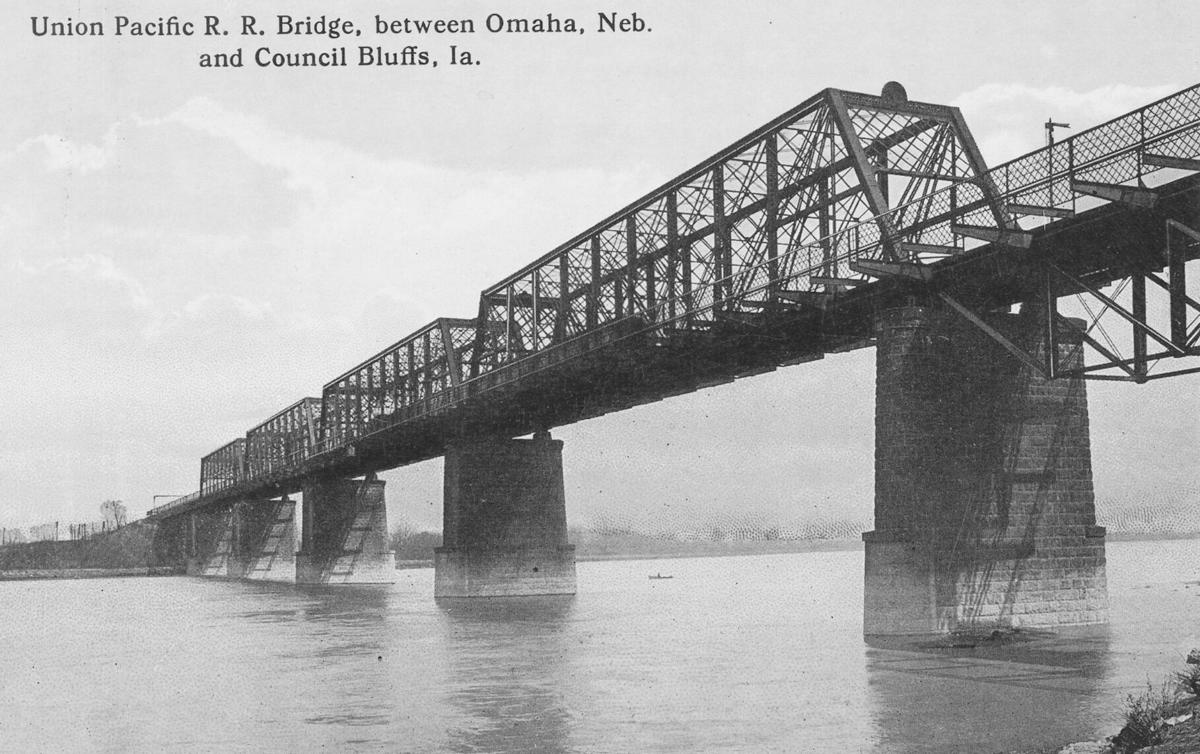
The new single-track railway bridge was completed in 1872.
It cost $1.75 million, which is about $39.6 million in today’s money. It
opened on March 27, 1872, a little over a year before my heroine arrived in the
United States.
 |
Bridge to Omaha, Nebraska, in 1872
|
In 1877, a tornado weakened the two easternmost spans,
requiring them to be replaced with a wooden trestle. However, that was after
the timeframe of my story. My heroine, who ended up being escorted by her
step-cousin, who was only a few years older that she was, took the train. They
crossed the 1872 bridge to reach Omaha.
The book for which I needed to know this information is Bee Sting Cake by Brunhilde, Book
12 in the Old Timey Holiday Kitchen series. It is currently on pre-order. To
find the book description and pre-order link, please CLICK HERE.
Sources:
https://en.wikipedia.org/wiki/Eads_Bridge
https://en.wikipedia.org/wiki/Laclede%27s_Landing,_St._Louis
https://en.wikipedia.org/wiki/Merchants_Bridge
https://blairhistory.com/archive/early-railroads/
https://www.councilbluffslibrary.org/archive/items/show/2406
https://en.wikipedia.org/wiki/Union_Pacific_Missouri_River_Bridge