Showing posts with label Union Pacific. Show all posts

Saturday, July 30, 2022

Bridging the Rivers by Zina Abbott


In my current work in progress, my heroine, Brunhilde, is a German immigrant who, in 1873, travels to St. Louis, Missouri, in the United States. By then, steamships replaced most sailing vessels, which cut down travel time across the Atlantic Ocean. As for the port of entry, I chose New Orleans for several reasons. One was, ships carrying cargo like cotton and tobacco brought passengers from Europe on the return voyage in order not to lose money. That was a more logical departure port for those commodities. Also, St. Louis, which had a large German-speaking population, was right up the Mississippi River from New Orleans.
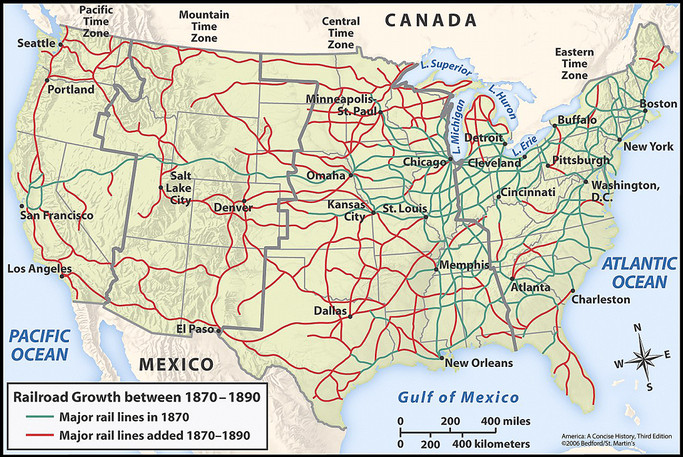
1870-90 Railroad Map

The question I faced was, in 1873, what was the most logical form of transportation between the two cities? Was it train travel, or was it still river boat? A look at the railroad map for 1870-90s showed there were railroads that traveled north, but the more established lines ran east of the Mississippi. Since that was such a wide river to cross, I next checked to see if a railroad bridge crossed the river near St. Louis.


Work on the Eads Bridge, a combined road and railway bridge over the Mississippi River began in 1867. It connected the cities of St. Louis, Missouri and East St. Louis, Illinois. The bridge is named for its designer and builder, James Buchanan Eads. It was the first bridge across the Mississippi south of the Missouri River. Earlier bridges were located north of the Missouri, where the Mississippi is smaller. None of the earlier bridges survive, which means that the Eads Bridge is also the oldest bridge on the river.

Eads Bridge photo taken in 2012 from  LaClede's Landing
 

The west end of the bridge is located on the St. Louis riverfront near Laclede’s Landing, which now is in the historic district and was the northern part of the original settlement founded by the Frenchman, Pierre Laclede. Even today, it had cobblestone streets and vintage brick-and-cast-iron warehouses dating from 1850s. That sounded like a good place for a steamboat to land to disgorge passengers and freight. 

Eads Bridge 1875 drawing by Camille N. Dry- note river traffic

Since the Eads Bridge was not complete until 1874, a year after my immigrant heroine and her family arrived. Based on that information, I wrote the story so the family traveled by steamboat up the Mississippi.

Brunhilde and her family stayed with her stepfather’s oldest brother, who had been a part of the German community in St. Louis since he and his young family arrived in 1848 after a failed revolution in Germany. The second oldest also brought his family. After his first wife died, he remarried. However, when he heard that the new Transcontinental Railroad was being built with its eastern terminus in Omaha, Nebraska, he moved his family to the large German community there. His second wife’s parents, also German immigrants, both died before his wife’s grandmother, Oma Bergmann. This brother, knowing his newly arrived youngest brother has an older stepdaughter, begged her to come and care for the elderly woman who had driven off every caretaker in Omaha he hired. 

For Brunhilde, this means more travel. Should my heroine board another steamboat and travel up the Missouri River to Omaha—a prospect she does not favor after making the trip from New Orleans? Or, should she travel by train, which would take her from the east border of the state to the west? Before I could decide that, I needed to know if, in 1873, there was a bridge across the wide, muddy, and unpredictable Missouri River.

Omaha Union Station

The Transcontinental Railroad was a big project, the planning of which started in 1862 during the Civil War. Actual construction did not start until after. However, in order to complete the dream of connecting the country by rail from the Atlantic Ocean to the Pacific Ocean, it became necessary to have railroad bridges across the large rivers that drained into the Gulf of Mexico.


The Chicago and North Western Railway reached Council Bluffs in 1867. To make the connection across the river, for a time, the Union Pacific tried to run freight trains across the frozen river during the winter. Also, the Union Pacific Transfer company maintained a ferry service from 1866 to 1872.

For an interesting early photograph of a train crossing the river, please CLICK HERE. 

In 1869 the transcontinental railroad was completed. However, that was not satisfactory to the U.P.R.R stockholders, who, in  1871, declared: “The want of a bridge over the Missouri River, at Omaha to connect the eastern railroads with the Union Pacific, has been one of the most annoying incidents connected with the trip to California.”
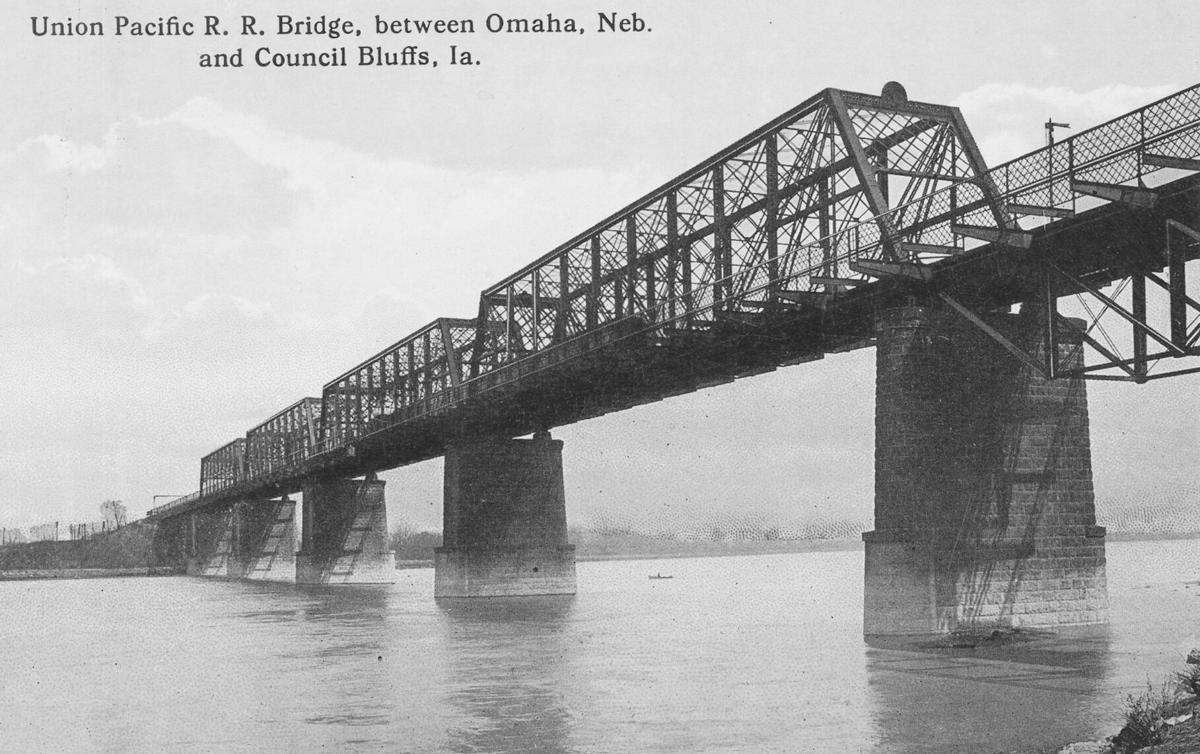

The bridge required 11 spans, 250 feet each. The deck was 50 feet above high water and rested upon one abutment and eleven iron piers, all in place and the larger part already sunk from 60 to 72 feet in the sand, and resting in the bed-rock. 


The new single-track railway bridge was completed in 1872. It cost $1.75 million, which is about $39.6 million in today’s money. It opened on March 27, 1872, a little over a year before my heroine arrived in the United States.

Bridge to Omaha, Nebraska, in 1872

In 1877, a tornado weakened the two easternmost spans, requiring them to be replaced with a wooden trestle. However, that was after the timeframe of my story. My heroine, who ended up being escorted by her step-cousin, who was only a few years older that she was, took the train. They crossed the 1872 bridge to reach Omaha.



The book for which I needed to know this information is Bee Sting Cake by Brunhilde, Book 12 in the Old Timey Holiday Kitchen series. It is currently on pre-order. To find the book description and pre-order link, please CLICK HERE.


Sources:

https://en.wikipedia.org/wiki/Eads_Bridge

https://en.wikipedia.org/wiki/Laclede%27s_Landing,_St._Louis

https://en.wikipedia.org/wiki/Merchants_Bridge

https://blairhistory.com/archive/early-railroads/

https://www.councilbluffslibrary.org/archive/items/show/2406

https://en.wikipedia.org/wiki/Union_Pacific_Missouri_River_Bridge

Wednesday, October 30, 2019

The Union Pacific Railroad and the Crédit Mobilier Fraud


The Central Pacific Railroad was funded privately by four major investors who put their own money on the line until they received government bonds for financing. The Union Pacific Railroad took an entirely different route. Although the infamous Ponzi Scheme came into being in the 1920s, decades after the building of the Union Pacific, it appears it was a cousin to the form of fraudulent financing scheme entered into by some major players in the Union Pacific management.

Dr. Thomas C. Durant, Union Pacific Vice President
At the meeting of stockholders on October 9, 1863, John A. Dix was elected president. Dr. Thomas C. Durant was chosen as vice-president. Durant turned out to be the real leader of the corporation. He had graduated from Albany College of Medicine at the youthful age of 20 but disliked his humdrum position as assistant professor of surgery. Daring, adventurous, and energetic, he threw all of his constructive genius and fortune into the enterprise of building the Union Pacific Railroad.

To Thomas Durant, the official financial incentives were not enough. As a part of their scheme to take advantage of the government subsidies, Durant and entrepreneur, George Francis Train, joined together in March 1864 in a business venture to buy out the Pennsylvania Fiscal Agency, changing its name to Crédit Mobilier. The company was one of the first to take advantage of the new limited liability financial structures. Previously, investors were responsible for the finances of a company if it had problems.

Under limited liability, their only responsibility was for money paid in. Durant created this limited liability company to encourage Union Pacific investors to agree to take on the railroad's construction after contracted employee, Herbert Hoxie, announced that he would fail to meet his deadline for building 247 miles of track. Investors thought that this contract, given the high construction cost, was too great a risk, but the protection offered by Crédit Mobilier convinced them to take on the construction. Durant then manipulated Crédit Mobilier's structure so that he wound up in control of it. Union Pacific effectively paid him via Crédit Mobilier to build the railroad. Durant covered his tracks by having various politicians, including future President James Garfield, as limited stockholders.

Members of Crédit Mobilier
This company was supposedly independent, and thus impartial, from the Union Pacific Railroad. In actuality, it was a front company put together to purchase construction goods for the railroad and issue contracts for construction managers. This extra layer of corporate complexity allowed Durant to pay himself and his cronies to build his railroad. Union Pacific directors funneled projects through Crédit Mobilier, which charged inflated prices or its products and services.  Many of those directors were also investors in Crédit Mobilier. Those inflated charges were paid to this transparent holding company by the bonds. The true cost of the goods and services were paid, and the investors pocketed the difference. Durant achieved considerable profits for himself by this arrangement.

The Union Pacific contracted with Crédit Mobilier to construct 667 miles of the railroad. The actual cost to Crédit Mobilier was about $44,000,000. The contract, using government subsidized funding, was for more than $94,000,000.

How did they get away with it?

The principal means of the fraud was the method of indirect billing. The Union Pacific presented genuine and accurate invoices to the U.S. government, as evidence of actual construction costs incurred and billed to them by Crédit Mobilier of America for payment. The railroad then prepared and presented meticulously detailed invoices to the U.S. government, requesting payment for these bills, accrued by the Union Pacific from Crédit Mobilier, for the construction of the line. The bills reflected only a small additional fee over the cost stated on the Crédit Mobilier invoices for the Union Pacific's operating and overhead expenses, incurred during the line's construction at a time when no traffic (freight or passenger) was being carried.

Any audit of the Union Pacific and its invoices to the U.S. government would not have revealed any evidence of fraud or profiteering. Union Pacific was accepting for payment genuine Crédit Mobilier invoices and which it applied an auditable overhead expense for management and administration of the Union Pacific during construction of the railroad.

The underlying fraud of a common and unified ownership of the two companies, as regards their principal officers and directors, was not revealed for years. Nor was it revealed that, in every major construction contract drawn up between the Union Pacific and Crédit Mobilier, the contract's terms, conditions, and price had been offered by Crédit Mobilier and accepted by the Union Pacific through the actions of corporate officers and directors who were one and the same persons.

Congressman Oakes Ames, Massachusetts
One of the early Union Pacific stockholders was Congressman Oakes Ames. In the 1860's the attention of Oakes Ames, a congressman from Massachusetts, and his brother was drawn to the Union Pacific and the generous subsidies it was receiving from Congress. The two, having made a fortune in the management of their father's shovel works which boasted of an average yearly production of over 1,400,000 shovels a year, bought enough stock that they acquired control over the Union Pacific.

Ames decided that Crédit Mobilier could not work with Durant anymore. Ames took Durant to court and fired him from Crédit Mobilier in May 1867, ousting Durant from his position managing Crédit Mobilier.

Crédit Mobilier replaced Thomas Durant with the Congressman Oakes Ames. In that year, Ames offered to members of Congress shares of stock in Crédit Mobilier at its discounted par value rather than the market value, which was much higher.

The high market value of the stock resulted from the superb performance of Crédit Mobilier of America as a corporation, which in turn succeeded due to its major contract with the Union Pacific. Crédit Mobilier declared substantial quarterly dividends on its stock.
Speaker of the House, Schuyler Colfax, later Vice President

In order to avoid Congressional investigation, a large block of Crédit Mobilier stock held by Congressman Ames as trustee was ostensibly "sold" to influential congressmen for one-third of its actual value. Congressmen included Schuyler Colfax,  then-Speaker of the House (who, by 1872, was the sitting Vice President). However, the "sale" did not require actual money. The sales price was paid from the dividends resulting from the profits on the railroad construction. The congressmen and others allowed to purchase shares at a discount could reap enormous capital gains simply by offering their shares on the market, knowing that they would be purchased at a higher price by investors desiring to own stock in such a "profitable" company. These same members of Congress made the company appear to be profitable by voting to appropriate government funds to cover Crédit Mobilier's inflated charges.

Congressman James Brooks, New York
Most of the Members got rid of their stock quickly, nullifying the large returns they could have received. However, Representative James Brooks of New York (who also served as a government director for the Union Pacific) profited from a large block of shares.

The Crédit Mobilier fraud orchestrated by Thomas Durant and continued by Oakes Ames came to a head on September 4, 1872 when the New York Sun revealed that several members of Congress had accepted cash bribes or shares of Crédit Mobilier stock.

The paper opposed the re-election of Ulysses S. Grant and was regularly publishing articles critical of his administration. Following a disagreement with Ames, Henry Simpson McComb, an associate of Ames and a later executive of the Illinois Central Railroad, leaked compromising letters to the newspaper. The Sun reported that Crédit Mobilier had received $72 million in contracts for building a railroad worth only $53 million. The revelations left the Union Pacific and other investors nearly bankrupt.


Although no one was indicted, the scandal resulted in a Congressional investigation. When the scandal became public, Speaker James Blaine of Maine appointed a select investigation committee chaired by Representative Luke Poland of Vermont in December 1872. Speaker Blaine noted that “A charge of bribery of members is the gravest that can be made in a legislative body. It seems to me . . . that this charge demands prompt, thorough, and impartial investigation.”
 
Political cartoon depicting Uncle Sam telling Ames he should commit hari-kari
On February 27, 1873, the House censured Ames and Brooks for using their political influence for personal financial gain. Congressman Ames died several months later, his reputation ruined.

As for Thomas C. Durant, President Ulysses S. Grant fired him from Union Pacific after it was discovered he had violated the 1862 Pacific Railroad Act by using his control of the Crédit Mobilier to become the majority stockholder in the Union Pacific Railroad. There was also suspicion that Durant had taken money from the company, but those around him feared exposing him. Like many others, he lost a great deal of his wealth in the Panic of 1873. He sold his remaining stock in Union Pacific and started a new railroad company, Adirondack Railroad. He spent the last twelve years of his life fighting lawsuits from disgruntled partners and investors. However, he weathered the financial crisis while numerous Crédit Mobilier investors went bankrupt.


 Escape from Gold Mountain, which was released last month, is now available on Kindle Unlimited. 
Please CLICK HERE for the book description on Amazon. The print version is also available on Barnes & Noble, which you can reach if you CLICK HERE. 


My new Christmas novel, Two Sisters and the Christmas Groom, is also now available. Please CLICK HERE for the book description and purchase link. I appreciate any and all reviews on Amazon and GoodReads.


Sources:
Museum Memories, Volume 1 (Salt Lake City, Utah: International Daughters of Utah Pioneers, 2009), Pgs. 408-410.
http://www.wyomingtalesandtrails.com/sherman3.html
Wikipedia

Tuesday, April 30, 2019

OGDEN UNION STATION, UTAH by Zina Abbott


In less than two weeks, May 10, 2019 marks the sesquicentennial of the joining of the Union Pacific Railroad and the Central Pacific Railroad at Promontory Summit north of the Great Salt Lake in Utah. It is sometimes known as the Golden Spike, or Last Spike, ceremony. I will be featuring details of the first transcontinental railroad in my next few blog posts. 

Locomotive in from the Ogden, Utah, Union Station
Why Ogden?  Ogden was the closest sizable city to the Golden Spike location at Promontory Summit, Utah, where the First Transcontinental Railroad was joined on May 10, 1869. Since one of my great-grandfathers, Edwin Brown, was hired to work for the Union Pacific Railroad once it reached Utah, I have been interested in this event in history for some time. He was present at the original Golden Spike ceremony. Believe me, each time I find a new photograph taken at that event, I scour the faces standing off to the side hoping to see someone who looks like him.


In 2014, I went on vacation for the better part of three weeks. No writing or blogging, only sight-seeing and picture-taking. I lost 200-400 images from my camera, but between my camera and cell phone I still saved 1,800 plus images to my computer. The ones I have about the joining of the Transcontinental Railroad at Promontory Summit come not from the site itself -- those were among the lost -- but from the museum that is part of the Union Station museum in Ogden, Utah.


The name Union Station was commonly given to train stations where tracks and facilities were shared by two or more railway companies. The station is currently home to the Utah State Railroad Museum.


Ogden Union Station today
Charles Trentelman, a member of the Union Station Foundation Board of Directors said. "The railroads changed Ogden from a sleepy agricultural backwater to a bustling transportation and manufacturing hub, the railroads funneled everything they did through this station," he noted.  "Agriculture, business, manufacturing, and tourism all flowed through the Union Station and it was critical to the locals that the station reflect the aspiration of the community for growth and development".

Mural depicting the building of the Central Pacific Railroad

On March 8, 1869, the Union Pacific came to Ogden on its way to Promontory Summit to meet the Central Pacific, thus completing the transcontinental rail line. Four cities near this location, Corrine, Promontory, Uintah, and Ogden, competed with each other for the opportunity to house the train station that would be the junction for railroad travel in the Intermountain West.

Mural depicting the building of the Union Pacific Railroad
Promontory and Uintah lacked the necessary resources to house the Station. Corinne and Ogden competed for many years for the "Junction City" title, until Brigham Young donated several hundred acres of land to the two railroads on the condition that they build the yards and station in west Ogden. 

Interior of Ogden Union Station lobby
Although Union Station no longer serves as a railway hub, it remains a cultural hub due to the museums located at the Station. A museum since 1978, is actually the third version train depot in town and was dedicated on November 22, 1924.  The stations two predecessors set the stage for today's structure.  

The first train station in Odgen-from the Ogden Union Station display
The first train station in Ogden was a small, two-story wooden frame building on the banks of the Weber River, which opened in 1860. The facility quickly became inadequate so the Union and the Central Pacific combined forces in 1889 to build a much larger Union Station, of brick and a center clock tower. 

Old Rio Grande Caboose in front of Ogden Union Station
This small building was also the facility for the narrow gauge Utah Central Railroad (later Oregon Short Line) and the narrow gauge Rio Grande Western (later Denver & Rio Grande Western). Local newspapers complained about, among other things, the quarter mile of wood boardwalk required to traverse the swampy ground to reach the station. In response to these worries the Union Pacific and Central Pacific organized the jointly-owned Ogden Union Railway & Depot Co. (OUR&D) to oversee the construction and management of a new Union Station. 

1891 Drawing of Ogden Union Railway Station
A new structure, considerably larger than the old and constructed of brick, was built, and dedicated on December 31 in 1889. The dedication attracted around 6,000 people. It served the community for several decades. It was designed in the Romanesque Revival style, with a large clock tower in the center. This building, in addition to serving the needs of the railroad, also contained 33 hotel rooms as well as a restaurant, barbershop, and other conveniences for the enjoyment of the traveler.

This station included 33 hotel rooms, a restaurant and even a barbershop.  This station worked well for over three decades.  In 1920, some $11,000 was spent re-papering, painting, and roofing the building.  An underground walkway to separate the tracks to the west was also built.  On February 13, 1923, one of the hotel rooms caught fire and quickly spread to the rest of the station.  No one was killed, or injured, but the Station had to be gutted, with only fragile walls and the clock left standing.  Since the station walls had not been leveled, the Ogden Union Railway & Depot Company, which owned the building, thought they could just restore what was there before including the clock tower. But soon after a stone fell off the clock tower and instantly killed a railroad clerk.  This accident, as well as pleading from City officials for a new building prompted railroad officials to start over with a new design.


Some of the images and information were first published on my own Trails & Rails blog under Robyn Echols. Zina Abbott is my pen name for writing American historical romance. 

Speaking of which, I, writing as Zina Abbott, recently published a book set in Utah. Although it does not involve the Transcontinental Railroad directly, the nearest rail connection to the locality in the series, The Widows of Wildcat Ridge, is in Evanston, Wyoming. My book, Diantha, is now available on Amazon in ebook format, and will soon be available in print. Please CLICK HERE to access the book description and purchase link.

To learn more about the series, The Widows of Wildcat Ridge, and the coming series by many of the same favorite authors, plus some new favorite authors, please join the reader group. CLICK HERE.


Sources:
https://ogdencity.com/1336/History-of-the-Union-Station
Wikipedia