Monday, March 16, 2015

Widow Kennedy's Quest for Land by Linda Hubalek

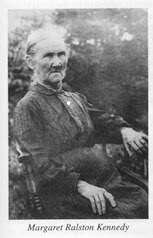
Margaret Ralston Kennedy, featured in book, Thimble of Soil by Linda K. Hubalek
Tomorrow's St. Patrick’s Day makes me think of my Kennedy ancestors, who originally hailed from Scotland, before moving to Ireland, then settling in Pennsylvania in the mid-1700's. 

The next generation moved to Ohio, with a short stop in Illinois before the family was enticed by the 1854 opening of the new Territory of Kansas.  They seemed to always look for expansion of land due to their expanding family.

I featured Margaret Ralston Kennedy in Thimble of Soil. She came with eight of her thirteen children–as a widow–to settle them all together in the new territory in 1855. 

According to records I found in the Watkins Museum in Lawrence, KS, most of the family made the trip by a wagon train. They stopped in Kansas City to meet up with family that made the trip by boat with a year’s worth of supplies and farm equipment. This following newspaper story gave me the idea and outline for my ancestor's story.

Here's an excerpt from the Kennedy Reunion, June 1895, The Jeffersonian Gazette, Lawrence, Kansas.

     Forty years ago last Friday night a party of travelers camped at Hickory Point a few miles north of what is now Baldwin. The company had left Illinois one month previous in search of homes for themselves and children. They traveled in large covered wagons each drawn by four yoke of oxen.

      Traveling northward next morning, at the bow of the hill the beautiful valley of the Wakarusa burst upon their view, with its wide sweep of prairie land covered with luxu­riant grass and flowers of every hue, and bordered and fringed by forest on the hill-sides and the banks of the creek.

     The travelers with one accord decided that this should be their future home and at nightfall they were encamped on the banks of this stream a few rods above where we are now.

     Here they lived for the first two weeks in their wagons and tents, before settling on their different claims. The majority of this company, twenty-three in number, belonged to the Kennedy family. The survivors of that company with their families have met here today to celebrate the fortieth anniversary of their arrival.

     As you talk of old times today, and look in each other's faces, you will not see the wrinkles with which toil and care have furrowed faces, nor the silver thread which father Time has given you, but rather you will remember each other as you were then-strong, stalwart men in the first flush of manhood, and rosy cheeked happy young  mothers-scarcely  realizing  the hardships  that lay before you, yet pluckily  determined to overcome then, whatever they might be.

     The joyfulness of this reunion is saddened by the thought that all of the original number is not present. A mother, three sons and a daughter have fallen asleep but the memory of them lives-will ever remain with us. . . .

     Mrs. Margaret Kennedy, the mother of the Kennedy family though somewhat advanced in years, came to this new country with her children and by her fortitude and courage which were always characteristic of her, sustained them when the days of trouble came. It has been said of her that she was never known to speak an unkind word of any one. As a wife, mother and Christian, she fulfilled the highest ideal of an American woman . . . .

     The men of Kansas during the days of '56 and of this locality in particular, striving to make her a free state had a very hard time, every hand was against him but God's.

     The territorial government and national government were both in the hands of proslavery men, they were liable to be shot down in cold blood any day, their houses burned, crops destroyed, yet after all the blow seem to fall heavier on the women and children. Insufficient food, shelter and clothing sent scores of little children to their graves and weakened and enfeebled the constitution of many women.

     It was the women's lot to remain at home, and endure that weary, weary waiting, while the men went forth to battle, all fearing that at any moment the husband or son would be brought home killed or wounded.

     We children as we meet here today, cannot and never will be able to realize what you have passed through and what changes you have seen since those days. You have seen the system of slavery, which you here helped to make the first armed resistance to, shattered and obliterated. You have seen a territory grow into one of the grandest states in the union. You have seen the unbroken prairies become the garden of the world and the great American desert blossom as the rose. When once the oxen drew his weary load, you have seen the iron horse flying as if he had wings of the morning. You have seen greater chances in your generation than the next three will see.
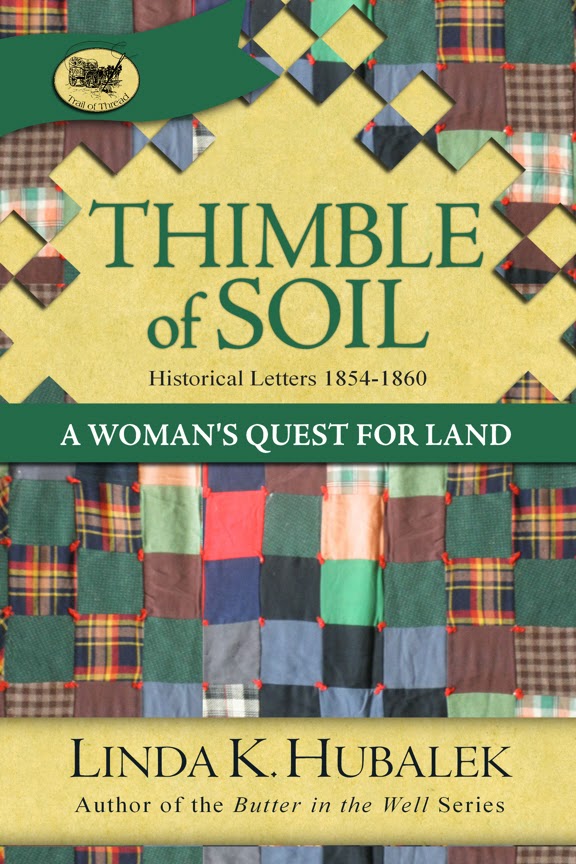
Thimble of Soil by Linda K. Hubalek
What a great background for a book, especially because I'm related to Margaret, and her family played an important role in Kansas' free state history. 

This was quite an undertaking for any family, but because an Irish immigrant dreamed of a better life for their family, generations down the line, including me, have benefited. 

So to my relatives that crossed the sea, I thank you for your adventurous spirit, and I celebrate St. Patrick's Day to honor you.

Linda Hubalek

Saturday, March 14, 2015

Savvy Sayin's

by Anna Kathryn Lanier

1) A good thing about talking to your horse is he doesn't talk back.

2) When you scalp a man more'n once, you begin to run out of hide.

3) Never approach a bull from the front, a horse from the rear or a fool from any direction.

4) Too little temptation can lead to virtue.

5) Outlaws and martyrs are greatly improved by death.

6) When you ain't got nothing to lose, try anything.

7) Life is like checkers.  When you reach the top, you can move anywhere you want.

8) Don't complain of getting old. The only alternative is worse.

9) Fear breeds hate.

10) Married men don't like history too close to home.

11) You can't tell how far a frog will jump or a horse will run by the color of his hide.

12) Advice is handy only before trouble comes.

13) Saddle your horse before sassin' the boss.

14) Nothin' gets nothin'

15) Cowboys are paid $30 a month to out-think cows.

From Savvy Sayin's: True Wisdom From the Real West collected by Ken Alstad

Thursday, March 12, 2015

Wild West Words: Food and Drink


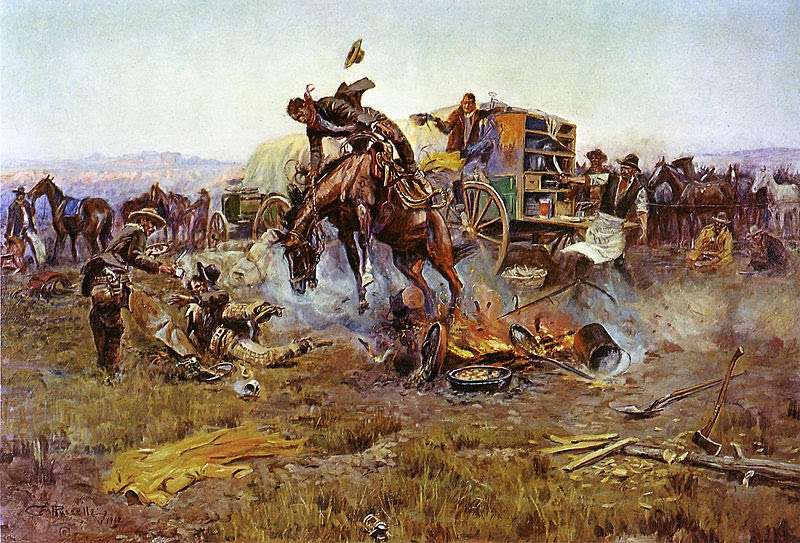
Round Up on the Musselshell, Charles M. Russell, 1919
The last three decades of the 19th Century — 1870 to 1900 — compose the period most people think of when they hear the term “Wild West.” Prior to the Civil War, westward expansion in the U.S. was a pioneering movement, and the period around the turn of the 20th Century was dominated by the Industrial Revolution. But in a scant thirty years, the American cowboy raised enough hell to leave a permanent mark on history.

Cowboys also left a permanent mark on American English. A whole lexicon of new words and phrases entered the language. Some were borrowed from other cultures. Others embodied inventive new uses for words that once meant something else. Still others slid into the vernacular sideways from Lord only knows where.

One of the best ways to imbue a western with a sense of authenticity is to toss in a few bits of period-appropriate jargon or dialect. That’s more difficult than one might imagine. I’m constantly surprised to discover words and phrases are either much younger or much older than I expected. Sometimes the stories behind the terms are even better than the terms themselves.

I keep an ever-expanding cowboy-to-English dictionary on my website — mostly so I know where to look when I need a word or phrase, but also because others sometimes find the material amusing or helpful. Below are a few of the entries related to food and drink.


Camp Cook's Troubles, Charles M. Russell
Ball: a shot of liquor. Originated in the American West c. 1821; most commonly heard in the phrase “a beer and a ball,” used in saloons to order a beer and a shot of whiskey. “Ball of fire” meant a glass of brandy.

Barrel: cheap saloon, often with a brothel attached. American English; arose c. 1875 as a reference to the barrels of beer or booze typically stacked along the walls.

Bear sign: donuts. Origin obscure, but the word was common on trail drives. Any chuckwagon cook who could — and would — make bear sign was a keeper.

Bend an elbow: have a drink.

Benzene: cheap liquor, so called because it set a man’s innards on fire from his gullet to his gut.

Bottom of the barrel: of very low quality. Cicero is credited with coining the phrase, which he used as a metaphor comparing the basest elements of Roman society to the sediment left by wine.

Budge: liquor. Origin unknown, but in common use by the latter half of the 1800s. A related term, budgy, meant drunk.

Cantina: barroom or saloon. Texas and southwestern U.S. dialect from 1892; borrowed from Spanish canteen.

Chuck: food. Arose 1840-50 in the American West; antecedents uncertain.

Dead soldier: empty liquor bottle. Although the term first appeared in print in 1913, common usage is much older. Both “dead man” and “dead marine” were recorded in the context before 1892. All of the phrases most likely arose as a pun: “the spirits have departed.”

Laugh Kills Lonesome, Charles M. Russell
Dive: disreputable bar. American English c. 1871, probably as a figurative and literal reference to the location of the worst: beneath more reputable, mainstream establishments.

Goobers or goober peas: peanuts. American English c. 1833, likely of African origin.

Grub up: eat. The word “grub” became slang for food in the 1650s, possibly as a reference to birds eating grubs or perhaps as a rhyme for “bub,” which was slang for drink during the period. 19th Century American cowboys added “up” to any number of slang nouns and verbs to create corresponding vernacular terms (i.e., “heeled up” meant armed, c. 1866 from the 1560s usage of “heel” to mean attaching spurs to a gamecock’s feet).

Gun wadding: white bread. Origin unknown, although visual similarity is likely.

Jigger: 1.5-ounce shot glass; also, the volume of liquor itself. American English, 1836, from the earlier (1824) use of jigger to mean an illicit distillery. Origin unknown, but may be an alteration of “chigger” (c. 1756), a tiny mite or flea.

Kerosene: cheap liquor. (See benzene.)

Mescal: a member of the agave family found in the deserts of Mexico and the southwestern U.S., as well as an intoxicating liquor fermented from its juice. The word migrated to English from Aztec via Mexican Spanish before 1828. From 1885, mescal also referred to the peyote cactus found in northern Mexico and southern Texas. Dried disks containing psychoactive ingredients, often used in Native American spiritual rituals, were called “mescal buttons.”

Mexican strawberries: dried beans.

Red-eye: inferior whiskey. American slang; arose c. 1819, most likely as a reference to the physical appearance of people who drank the stuff. The meaning “overnight commercial airline flight that arrives early in the morning” arose 1965-70.

The Herd Quitter, Charles M. Russell
Roostered: drunk, apparently from an over-imbiber’s tendency to get his tail feathers in an uproar over little to nothing, much like a male chicken guarding a henhouse. The word “rooster” is an Americanism from 1772, derived from “roost cock.” Colonial Puritans took offense when “cock” became vulgar slang for a part of the human male anatomy, so they shortened the phrase.

Sop: gravy. Another trail-drive word, probably carried over from Old English “sopp,” or bread soaked in liquid. Among cowboys, using the word “gravy” marked the speaker as a tenderfoot.

Stodgy: of a thick, semi-solid consistency; primarily applied to food. Arose c. 1823-1825 from stodge (“to stuff,” 1670s). The noun form, meaning “dull or heavy,” arose c. 1874.

Tiswin (also tizwin): a fermented beverage made by the Apache. The original term probably was Aztecan for “pounding heart,” filtered through Spanish before entering American English c. 1875-80.

Tonsil varnish: whiskey

Tornado juice: whiskey


Tuesday, March 10, 2015

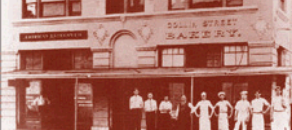
Corsicana, Texas – Home of Collin Street Bakery and the Fruitcake


* * * * * * *


While I happen to love fruitcake, I know a lot of you don't. Like it or not, though, we are familiar with the iconic can and its contents. We've heard the stories about people using them for doorstops, sinkers on stringers and boat anchors. My family even had the running white elephant gag gift at Christmas of the dreaded fruitcake. We drew names and everyone held their breath wondering if they'd be the unlucky recipient. All great fun, but did you ever wonder about Corsicana and the people who started the town?


Well, it just so happens when my husband and I were into genealogy researching a few years back, we discovered his g-g-g-g-grandfather was the founder of that little town.


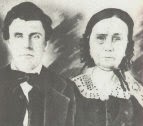
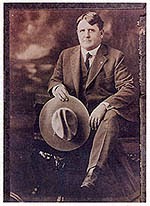
Hampton and Mary Clark McKinney

Hampton McKinney, owned a large farm in Madison County, Ill., just across the river from St. Louis. They didn't have luxuries for they were not to be had, but they always had plenty of everything for Hampton seemed to be in better financial condition than any of the rest of the family. Besides being a farmer, he was a local Methodist preacher and belonged to the Methodist Church South. He never followed this profession as a means of livelihood, but he loved to preach and gave his services for the simple love he had for the work. He loved to read and was a constant reader of the Bible. He always held family prayer in his home every morning as long as he lived. He was a quiet man and took no interest in politics.

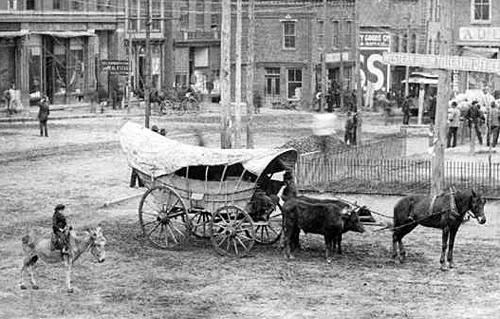
Hampton and his brothers, Jubilee and Jefferson McKinney, had visited different parts of Texas on a prospecting trip, and decided Navarro County was the best place to locate. They left Illinois in the summer or early fall of 1846 - a big party of them, Hampton and his family had three or four wagons and a large carryall drawn by two horses for his wife and the younger children. His brother, Jefferson, his wife and five children, had two large wagons. His sister and her husband and their several children had one big wagon called a Prairie Schooner. It had a different shape and was much larger than the other wagons. His daughter had just married and they came to Texas on their honeymoon, so needed only one wagon. There were several young men and girls in the party who were cousins. The only things they brought were what they would need for the trip - tents, beddings, dishes and cooking vessels. It took two or three months to finish the journey.


Prairie Schooner

 Hampton was the first settler in Corsicana and had the first residence, a one room log house. Afterward, when the town of Corsicana was founded in 1848, he lifted his certificate and put it in Johnson County; however, he reserved a good part of the town property for his own use.

After a time, he moved two little cabins with a hallway between and a shed at the back down to where the court house is now located. The family lived there until he built the first hotel called the McKinney Tavern. It was for many years the only hotel in Corsicana. It had two big rooms down stairs with a long gallery in front, two other rooms at one corner and a long ell back for a dining room and kitchen back of that. The upstairs was one big room. There were big fire places in the rooms but no stoves except the cooking stove. In fact, they had the first cooking stove ever brought into Corsicana, and probably the first one in the county.

Hampton McKinney, died in 1857 of pneumonia, at the age of sixty years. His wife, Mary, died in 1883/84. Many descendants still live in and around the town today.

Thanks for stopping by today. As always I love hearing from you, so if you have time, leave a comment and say howdy!

Carra

  Carra Copelin WebsiteCarra's Blog , Carra's FB page , Carra's Twitter Page


Sunday, March 8, 2015

'Catch-'em-Alive' Jack Abernathy and His Free-Range Kids


By Celia Yeary

Jack Abernathy holds the distinction of being the youngest U.S. Marshal in history. He was twenty-nine years old at the time. Before this prestigious accomplishment, Jack displayed talents that seemed unlikely for the son of a Texas farmer.

He was born in 1876 in Bosque County, Texas. In 1882, his family moved to Nolan County, Texas, where his father entered the booming cattle business. At that time, little six-year-old Jack had become a music prodigy and played the piano in a Sweetwater, Texas saloon. However, when his mother learned of this, she put a stop to it even though he earned $13 a night.

When Jack turned eleven, he worked as a cowboy for the A-K-X Ranch and helped drive a large herd of cattle 500 miles to Englewood, Kansas. At age fifteen, he worked on the J-A Ranch and soon earned a salary increase as "first saddle." His job was to break the meanest, orneriest horses on the ranch so others could ride them.


Jack had become known as "Catch-'em Alive" Abernathy, named such for his unique hunting skill of capturing prairie wolves with only his hands. When President Theodore Roosevelt learned of this, he requested that Jack demonstrate this feat. Teddy was so impressed he appointed him U.S. Marshal of the Western District of Oklahoma Territory, making him the youngest U.S. Marshal in history.

With this position, Jack and his wife Jessie Pearl moved to Guthrie, Oklahoma. Through President Roosevelt, Jack met many famous men of the day--Mark Twain, Jack London, O'Henry, Frederick Remington, Thomas Edison, Alexander Graham Bell, and Andrew Carnegie.

His acquaintance with Thomas Edison helped Jack make motion picture films of the wolf hunt and of his sons, Temple and Bud, and their adventures.
~~*~~
And now...for the rest of the story.
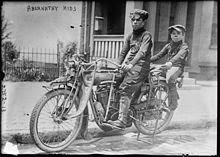
Jack Abernathy's two sons, Louis and Temple, inherited their father's self-reliance.

Image result for louis and temple abernathyIn 1909 the boys rode horseback from Frederick, Oklahoma in the Southwestern corner of the state, to Santa Fe, New Mexico, andback. Louis was nine, and Temple was five.

When the boys completed this first journey, they began planning a horseback ride to New York city, again by themselves, to meet Theodore Roosevelt who had just returned from his trip to Africa and Europe. They made this trip in 1910.
While in New York, the boys supposedly purchased a small Brush Motor Car, which they drove back to Oklahoma.

In 1911, they accepted a challenge to ride horseback from New York to San Francisco in 60 days or less. They agreed not to eat or sleep indoors at any point of the journey. They would collect a $10,000 prize if they succeeded.

After a long trip, they arrived in San Francisco in 62 days, thereby losing the prize but setting a record for the time elapsed for the trip.

As adults, the boys became successful in law and oil.
Their father made this statement to a news reporter:

"Teach a boy self-reliance from the moment he tumbles out of the cradle, and make him keep his traces taut and work well forward in his collar, and 99 times out of a hundred, his independence will assert itself before he is 2 years old. That's my rule, and you don't think I've taken the right tack talk to my boys for five minutes and they'll convince you that they are men in principles even if they are babies in years. God bless 'em."
 
~~*~~
Celia Yeary-Romance...and a little bit 'o Texas
Amazon: https://www.amazon.com/author/celiayeary
My Website
My Blog
Sweethearts of the West-Blog
My Facebook Page 
*****************************
Sources:
Wikipedia
Wikimedia
U. of Neb.-Press
Baylor University-The Texas Collection
Tillman-Ok-History