Showing posts with label St. Patrick's Day. Show all posts

Thursday, March 16, 2023

St. Patrick's Day in American History - by Jo-Ann Roberts


Every March 17th, the United States becomes emerald-green for a day. We wear green clothing, drink green beer and milkshakes, and eat green bagels and grits. Parades in big cities and small towns cheer on bagpipers, step dancers and marching bands. However, these traditions weren't imported from Ireland.

They were made in America.

In contrast, March 17th in Ireland had been more of a holy day than holiday. The Irish would attend church in the morning and attend modest feasts in the afternoon. There were no green-tinted foods, since blue, not green was the traditional color associated with Ireland's patron saint prior to the 1798 Irish Rebellion.

While many people believe Boston was the first to hold a St. Patrick's Day celebration in the American colonies, evidence has been unearthed that St. Augustine, Florida may have hosted America's first St. Patrick's Day celebration. Gunpowder expenditure logs indicate cannon blasts or gunfire was used to honor the saint in 1600, and that residents paraded through the town in honor of St. Patrick...perhaps at the urging of an Irish-Catholic priest living there.


Following the devastating failure of Ireland's potato crop in the mid 1840s, Irish Catholics flooded the United States. They clung to their Irish identities and took to the streets in St. Patrick's Day parades to protest the bigotry of the "Know-Nothings", a political party with strong anti-immigrants and anti-Catholics who believed these groups posed a threat to the economic and political security of native-born Protestant Americans.  

"Many who were forced to leave Ireland during the Great Hunger brought a lot of memories, but they didn't have their country, so it was a celebration of being Irish..."


Attitudes toward the Irish began to soften after tens of thousands of them served in the Civil War. They entered the war as second-class citizens but came back as heroes. Notable among them was the 69th Regiment from New York City or as Robert E, Lee called them, The Fighting 69th. As the Irish slowly assimilated into American culture, those without Celtic blood joined in St. Patrick's Day celebrations.


The meal most associated with St. Patrick's Day celebrations--corned beef and

cabbage--was also an American innovation. When ships came into South Street seaport, many women from the slums of lower Manhattan would run down to the docks hoping there was leftover salted beef they could get from the ship's cook for a penny a pound. They would boil the beef three times--the last time with cabbage--to remove some of the brine.

While St. Patrick's Day evolved in the 20th century into a party day for Americans of all ethnicities, the celebration in Ireland remained solemn. For decades, Irish laws prohibited pubs from opening on holy days such as March 17th. Until 1961, the only legal place to get a drink in the Irish capital on St. Patrick's Day was the Royal Dublin Dog Show.

The party atmosphere spread to Ireland after the arrival of television when the Irish could see all the fun Americans were having. Today, the St. Patrick's Day Festival, launched in Dublin in 1996, now attracts one million people each year.

Though the Irish have now St. Patrick's Day traditions, there is one tradition, however, that might not catch on in Ireland...green Guinness! As Mike McCormack, national historian for the Ancient Order of Hibernians says, "St. Patrick never drank green beer."


Happy St. Patrick's Day!

Coming April 26th!


In the summer of 1864 in Roswell, Georgia, widow Sofie Bishop struggles to manage the small family vineyard on her own. The War Between the States took her husband and her way of life. Now, with her home in ruins her only option was working at the Ivy Woolen Mill. Her woes go from bad to worse when the Yankees arrive on Roswell’s doorstep.


Courteous and kind, Captain Seth Ramsey is not what Sofie expects from a Union officer. However, charming he might be, she’s determined to keep her distance. Even when she finds herself branded as a traitor, arrested, and transported north to an uncertain destiny, she didn’t think she could lose much more to the Yankees.
But she was wrong.
Will his vow of love mend her wounded heart? Or would a marriage of convenience be the best she can offer?


Monday, March 4, 2019

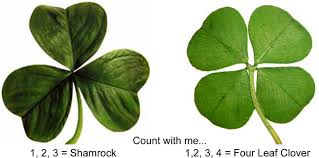
SHAMROCK VS CLOVER By Cheri Kay Clifton


 With St. Patrick’s Day just around the corner, the image that comes to my mind beside a leprechaun and Ireland’s patron saint, St. Patrick, is the green shamrock. 


How many of you know the difference between a shamrock species of clover and the four-leaf kind? “Clover” is a generic term that refers to trefoils, or any of the 300 species that belong to the Trifolium family. These plants have leaves that are separated into three leaflets, but you may find four-leaf, five-leaf or even six-leaf clovers as a genetic abnormality.

 “Shamrock,” on the other hand, comes from the Irish word, “seamrog,” and means “little plant.” It refers to the white clover species or the suckling clover species. Although a real shamrock only has three leaves, that doesn’t mean it’s not lucky. In Irish folklore, the number three is considered very lucky. 


Saint Patrick is said to have used the shamrock as a metaphor for the Christian Holy Trinity. It has been used as a symbol of Ireland since the 18th century and is registered as a trademark by the Government of Ireland.

So, remember, shamrocks are clovers, but not all clovers are shamrocks.


Around our house in North Carolina grew large patches of clover and I loved to search for ones with four-leaves. Over time I had collected a few and still have a couple pressed between plastic. Did they bring me luck? Who knows, but like finding pretty sea shells on our Florida beaches, I enjoyed the challenge of the hunt!

Scientific studies have said that the odds of finding a single four-leaf clover is about one in 10,000.  However, when further analyzed, about a 5-foot square patch of clover could contain 10,000 sprigs and thus, one would have a chance of finding a four-leaf one.  


I’ll conclude this bit of clover trivia with the popular decades old song I would sing while searching for those illusive four-leaf clovers.


I hope you'll visit my website and check out my Wheels of Destiny series,  click here.


Monday, March 16, 2015

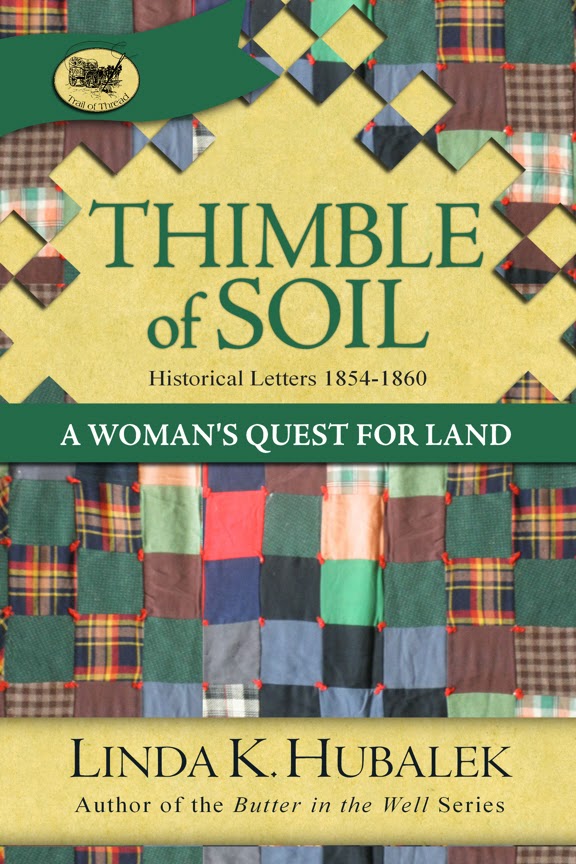
Widow Kennedy's Quest for Land by Linda Hubalek

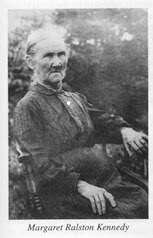
Margaret Ralston Kennedy, featured in book, Thimble of Soil by Linda K. Hubalek
Tomorrow's St. Patrick’s Day makes me think of my Kennedy ancestors, who originally hailed from Scotland, before moving to Ireland, then settling in Pennsylvania in the mid-1700's. 

The next generation moved to Ohio, with a short stop in Illinois before the family was enticed by the 1854 opening of the new Territory of Kansas.  They seemed to always look for expansion of land due to their expanding family.

I featured Margaret Ralston Kennedy in Thimble of Soil. She came with eight of her thirteen children–as a widow–to settle them all together in the new territory in 1855. 

According to records I found in the Watkins Museum in Lawrence, KS, most of the family made the trip by a wagon train. They stopped in Kansas City to meet up with family that made the trip by boat with a year’s worth of supplies and farm equipment. This following newspaper story gave me the idea and outline for my ancestor's story.

Here's an excerpt from the Kennedy Reunion, June 1895, The Jeffersonian Gazette, Lawrence, Kansas.

     Forty years ago last Friday night a party of travelers camped at Hickory Point a few miles north of what is now Baldwin. The company had left Illinois one month previous in search of homes for themselves and children. They traveled in large covered wagons each drawn by four yoke of oxen.

      Traveling northward next morning, at the bow of the hill the beautiful valley of the Wakarusa burst upon their view, with its wide sweep of prairie land covered with luxu­riant grass and flowers of every hue, and bordered and fringed by forest on the hill-sides and the banks of the creek.

     The travelers with one accord decided that this should be their future home and at nightfall they were encamped on the banks of this stream a few rods above where we are now.

     Here they lived for the first two weeks in their wagons and tents, before settling on their different claims. The majority of this company, twenty-three in number, belonged to the Kennedy family. The survivors of that company with their families have met here today to celebrate the fortieth anniversary of their arrival.

     As you talk of old times today, and look in each other's faces, you will not see the wrinkles with which toil and care have furrowed faces, nor the silver thread which father Time has given you, but rather you will remember each other as you were then-strong, stalwart men in the first flush of manhood, and rosy cheeked happy young  mothers-scarcely  realizing  the hardships  that lay before you, yet pluckily  determined to overcome then, whatever they might be.

     The joyfulness of this reunion is saddened by the thought that all of the original number is not present. A mother, three sons and a daughter have fallen asleep but the memory of them lives-will ever remain with us. . . .

     Mrs. Margaret Kennedy, the mother of the Kennedy family though somewhat advanced in years, came to this new country with her children and by her fortitude and courage which were always characteristic of her, sustained them when the days of trouble came. It has been said of her that she was never known to speak an unkind word of any one. As a wife, mother and Christian, she fulfilled the highest ideal of an American woman . . . .

     The men of Kansas during the days of '56 and of this locality in particular, striving to make her a free state had a very hard time, every hand was against him but God's.

     The territorial government and national government were both in the hands of proslavery men, they were liable to be shot down in cold blood any day, their houses burned, crops destroyed, yet after all the blow seem to fall heavier on the women and children. Insufficient food, shelter and clothing sent scores of little children to their graves and weakened and enfeebled the constitution of many women.

     It was the women's lot to remain at home, and endure that weary, weary waiting, while the men went forth to battle, all fearing that at any moment the husband or son would be brought home killed or wounded.

     We children as we meet here today, cannot and never will be able to realize what you have passed through and what changes you have seen since those days. You have seen the system of slavery, which you here helped to make the first armed resistance to, shattered and obliterated. You have seen a territory grow into one of the grandest states in the union. You have seen the unbroken prairies become the garden of the world and the great American desert blossom as the rose. When once the oxen drew his weary load, you have seen the iron horse flying as if he had wings of the morning. You have seen greater chances in your generation than the next three will see.

Thimble of Soil by Linda K. Hubalek
What a great background for a book, especially because I'm related to Margaret, and her family played an important role in Kansas' free state history. 

This was quite an undertaking for any family, but because an Irish immigrant dreamed of a better life for their family, generations down the line, including me, have benefited. 

So to my relatives that crossed the sea, I thank you for your adventurous spirit, and I celebrate St. Patrick's Day to honor you.

Linda Hubalek