Sunday, December 16, 2012

Tanya Hanson and O Tannenbaum


It’s finally looking like Christmas around the homestead. We decided to begin a remodel of all three of our bathrooms the Monday after Thanksgiving. The havoc, dust and early mornings around here (to let the workmen in) were so nonstop we reckoned we’d wait until construction ended to put up our tree.

So...when award-winning western author Cheryl Saint John  invited me to showcase my Christmas tree on her month-long author’ tree showcase,  I “borrowed” my niece Katie’s tree.

My sis also sent a pic of her tree just in case. Hers has a bird theme, is always magazine-perfect, and I love every year finding her a new ornithological ornament.

Well, at Home Depot the other day, picking out paint samples for the various “necessaries,’ the scent of freshly cut pine trees so overwhelmed hubby and me that we caved....gussied up the homestead as well as we could,  and put up our tree even in the turmoil of construction! Ah, what a treat, cuddling up in front of it with a good book...

And that reminded me of a favorite tome my mama gave me. It dates from 1935 and includes not only the music and lyrics of favorite Christmas carols, but a historical tidbit about each one. I wore this thing out as a kid taking piano lessons. Now it’s one of my favorite possessions. 

So I looked up “O Christmas Tree”  

What we call the Christmas tree today has its origins in ancient Rome. During the pagan festival Saturnalia, which honored Saturn the god of seed-sowing, trees laden with decorations and gifts were customary. During the dark ages, the Goths brought the Saturnalia customs back to Germany.

Legend has trees becoming part of Christmas festivities during the time of Protestant reformer Martin Luther (1483-1546.) Out on a winter night, he supposedly was so moved by stars shining on a fir tree that he brought the tree home to his family and hung it with paper stars and candles in honor of the Star hanging over the Christchild’s manger. Hence, the “Tannenbaum.”

As for cuddling up with a good book by your tree or fireplace, might I recommend my latest release, Christmas for Ransom? True, Jack is an outlaw, but a good-hearted guy who loved his gram-maw. And going from a tumbleweed Christmas tree while he’s snowbound with Eliza (they’re hiding from his former gang) to a big knotty pine after he’s all redeemed, married and a daddy is a pretty good thing!

Merry Christmas, and may God bless y’all, every single one!


TANYA HANSON

Friday, December 14, 2012

A Christmas Carol

By Anna Kathryn Lanier
 
On December 19, 1843, one of the holiday's most recognized stories was born – Charles Dickens released his novel “A Christmas Carol.” Taking only a few weeks to write the story, Dickens then self-published it. He ordered lavish binding, gilt edging and hand-colored illustrations. He then set a low price for the book so people could afford it. While this helped sell out his first run print of 6,000 copies, it was not very profitable for Dickens.
 The orginal cover


A Christmas Story tells of a miserly soul, Ebenezer Scrooge, a man who hates Christmas and forces his sour opinion of it onto everyone else. On Christmas Eve night, he is visited by four ghosts, including that of his old partner, who has been sent to warn him to change his ways. The other ghosts are Christmas Past, Christmas Present and Christmas Future. The ghosts help to open Scrooge's eyes to the true meaning of Christmas and do, as Marley wished, change his ways.


Several movies have been made of A Christmas Carol, I believe my favorite is the one with George C. Scott as Scrooge. Though Capt. Picard, aka Patrick Steward, also does a nice presentation of Scrooge.

So, if you have a chance in the next few days, treat yourself either to a reading of A Christmas Carol, or to a viewing of one of the many movies made of it.

Dickens


The drawings are of the original prints ordered by Dickens. The colored prints were the largest expense of the book and accounted for the low profits he made.

Merry Christmas, and God bless us everyone!

This post first appeared on Chattingwith Anna Kathryn Blog December 19, 2008
 
Anna Kathryn Lanier
www.aklanier.com
http://annakathrynlanier.blogspot.com/
Never let your memories be greater than your dreams. ~Doug Ivester 

Wednesday, December 12, 2012

History of the American Christmas by Paty Jager


A true American Christmas is a convergence of many nationalities, traditions, and the work of authors and illustrators.

In American in the 1600’s the Puritans made it illegal to mention St. Nicholas and people weren’t allowed to exchange gifts, light a candle, or sing Christmas carols.

The Dutch immigrants in the 17th century brought with them the legend of Sinter Klaas. It was 1773 when the first Santa appeared in the media as St. A. Claus.
public domain photo

In 1804 The New York Historical Society was founded with St. Nicholas as its patron saint and the members engaged in the Dutch practice of gift giving.

Washington Irving under the pseudonym, Diedrick Knickerbocker, wrote the book, “A History of New York” in 1809. In the book he had Saint Nicholas riding a horse down the street.  Later, in 1812 he revised the book with Santa riding a wagon over the tops of trees.

A poem titled “Santa Claus” by William Gilley in 1821 noted Santa was dressed in fur and drove a sleigh drawn by one reindeer.

Dentist Clement Clarke Moore has been attributed to the 1822 poem  “An account of a Visit From Saint Nicholas” also known as “The Night Before Christmas” In this poem Santa is portrayed as an elf with a miniature sleigh and eight tiny reindeer. The reindeer are named and attributes are given to Santa that later end up in many drawings, sketches and paintings of the jolly old elf.

The first merchant to commercialize Santa was J.W. Parkinson of Philadelphia. in 1841 he hired a man to dress up in a “Criscringle” outfit and climb the chimney of his store.

In 1863 illustrator Thomas Nast started creating images of Santa for the Christmas editions of Harpers Magazine. He continued to entertain Americans with his images through the 1890’s.

The first example of psychological warfare was instituted by Abraham Lincoln in the 1860’s when he commissioned Nast to create drawings of Santa supporting the union soldiers. In the early half of the 1800’s the Northern states didn’t believe in celebrating Christmas, but the Southern states celebrated the event as part of the Social Season with Alabama in 1836 and Louisiana and Arkansas in 1838 making Christmas a legal holiday.

In 1870 Christmas became an American Federal Holiday. At that time, all Americans embraced Christmas changing it from a day of partying or silence to a family and religious day when peace and nostalgia were the themes. It wasn’t until the 20th century that the holiday became commercialized to the extent it is today.


My favorite part of Christmas is giving and because of that anyone who reads this post can go to Smashwords and download for free with this coupon number HN52E my recent release Secrets of a Mayan Moon. This coupon is only good through Dec. 20th. 

Merry Christmas!

Monday, December 10, 2012

ROMANCE IN THE BONE WARS-by Alison Henderson

Please welcome our guest.


She grew up in Kansas City on the edge of the prairie.  One of her favorite memories is of the fringed turquoise cowgirl outfit she received for her fifth Christmas.  She went off to New York to study art history at Vassar College but never lost her admiration for the fortitude of the pioneers who settled the frontier.  She began writing when her daughter entered pre-school and was quickly captivated by the creative process. The Treasure of Como Bluff is her first novella but her third western historical romance.

A girl after our own hearts--a true Sweetheart!
~~*~~
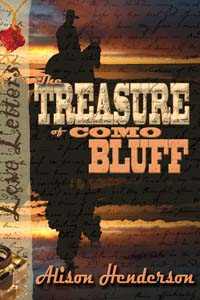
Thank you, Celia and the rest of the Sweethearts, for inviting me to join you today to talk about the historical setting for my new novella, The Treasure of Como Bluff.

 Romance in the Bone Wars
I’m sure many of you are familiar with the Wyoming Bone Wars that took place during the last quarter of the nineteenth century between Professor O.C. Marsh of Yale’s Peabody Museum and Professor Edward Cope of the University of Pennsylvania.  I’ve always found this conflict fascinating for several reasons, not the least of which was the lengths to which these two academics were willing to go to foil each other’s efforts in pursuit of fame and fortune.  Additionally, the combination of the settling of the West with the explosion of scientific discovery at that time makes it doubly interesting.


Marsh and Cope began their paleontological careers as colleagues, but all that disintegrated when Marsh publically humiliated Cope by pointing out that he had incorrectly connected the head of one of his major finds, a plesiosaur called Elasmasaurus, where the tail should go.  From that point on, the gloves were off. 


Although Marsh did lead an expedition to Wyoming in 1870, guided by William F. (Buffalo Bill) Cody, as a rule nineteenth century paleontologists did not do their own digging.  They relied on fossil hunters to ship crates of bones east for study.  They then paid the diggers by the pound or container.  These fossil excavators might have been railroad employees or merely fortune hunters, but whatever their background, there were not scientists.  They used any method available to get the bones out of the ground as quickly as possible with little care for what might have been damaged or destroyed in the process.

 Como Bluff is a barren ridge of rock east of Medicine Bow and west of Rock River.  It is also the site of one of the largest deposits of late Jurassic dinosaurs and early mammals in North America and a primary focus of the rivalry between Marsh and Cope.  There, diggers in the employ of both factions were ordered to do everything they could to disrupt the operations of the other, including dynamiting excavation pits and diverting fossil shipments.

 Sounds like the perfect setting for a romance, right? I thought so when I dreamed up (literally!) the premise for The Treasure of Como Bluff.

 Here’s the blurb:
In her race against rival bone hunters, the last complication paleontologist Caroline Hubbard needs is an unconscious stranger cluttering up her dig site. Nicholas Bancroft might have the chiseled features and sculpted physique of a classical statue, but she's not about to let him hamper her quest to unearth a new species of dinosaur and make her mark on the scientific world.
Nick has come to Wyoming in search of silver but, after a blow to the head, finds himself at the mercy of a feisty, determined female scientist. Despite his insistence that he's just passing through, he agrees to masquerade as Caroline's husband to help save her job. Once their deception plays out, they face a crucial decision. Will they be able to see beyond their separate goals and recognize the treasure right in front of them?

 And an excerpt:

              Nick laughed. “Are you always this grumpy when you’re working?”

            “I’m about to face the biggest challenge of my life, one that will affect my entire future, and you refuse to take it seriously.” She glared at him through narrowed eyes. “I have every right to be grumpy.”

“Perhaps, but remember, you asked for my help. You need me to pull off this deception.”

He was right. She did need him, and if she wasn’t careful he’d get back on his horse and ride out of her life forever. The thought pushed her near the edge of panic. “I know, and I’m sorry. It’s just that this is so important to me.”

Nick slid his arm around her shoulders. “I know. Don’t worry; I won’t abandon you. I owe you. You saved my life, remember?”

When he didn’t release her immediately, Caroline breathed a tiny sigh and allowed herself the luxury of leaning against him, wrapped in the safety and comfort of his arm. She closed her eyes and rested her head against the warm solidity of his chest, absorbing the reassuring rhythmic thump of his heartbeat. She’d always been alone in her quest; it would be a relief to have someone to share it with, even if only for a few days.

She thought she felt something whisper-soft touch the top of her head, almost like a kiss of breeze, but the air was still. It couldn’t have been Nick...could it? She lifted her head and turned until she could see his face. The devil twinkled in those sea-blue eyes, and a lazy smile played across his lips.

“Flip you for the bed.”
~~*~~
Thanks so much for stopping by to share this fun bit of our history with me.
Alison
~~*~~
She invites you to visit her website at www.alisonhenderson.com

This Novella can be found on Amazon as an ebook-$2.99


 Please leave a comment for Alison! 

Saturday, December 8, 2012

Louis L'Amour's Short Christmas Story

By Celia Yeary

Louis L'Amour is a legendary master of tales from the American West frontier. In addition to a large number of novels, he also created many short stories. While researching his life and his work, I learned he had written one short Christmas story titled "The Moon of the Trees Broken by Snow."

American Indians gave names to each of the full moons to keep track of the passing year. The names are associated with the entire month until the next full moon occurs. This helped them keep track of the passing year. Since a lunar month averages 29 days, the dates of the moon change from year to year.
Many full moon names exist, as each tribe has its own.

The names are derived from some event in nature. Although Louis L'Amour does not identify the Native American tribe in his story, the title more closely resembles the moon names of the Dakota Sioux:


Moon When the Trees Pop
Moon When the Eyes Are Sore From Bright Snow
Moon When Berries Are Ripe
Moon When Horns Are Broken Off
 
With some difficulty I found a copy of this short story. Originally, it had been printed in an collection of his stories titled Yondering. But when historians were collecting and printing these short stories, L'Amour's son said this particular one did not belong with the others. So, a second edition was printed which omitted the Christmas story.
The Collected Short Stories of Louis L'Amour: Unabridged Selections from The Frontier Stories: Volume 1
THIS COLLECTION CAN BE
FOUND ON AMAZON
AND IN YOUR PUBLIC LIBRARY

When the internet proved fruitless, I asked my local librarian. She took me to several areas in the library to look for volumes of short stories categorized by author. No luck. Disappointed, I searched the Louis L'Amour shelf for a novel titled Bendigo Shafter  in which he had included a Christmas scene, thinking that might work for my post. During this search, I found three very thick volumes titled: The Collected Short Stories of Louis L'Amour. In volume one, I found "The Moon of the Trees Broken by Snow."

Imagine my excitement!

I checked out the book and read the very short story. It's a parable concerning Christmas, a haunting desolate tale that becomes obvious early in the story. The time is long ago, and the setting is somewhere in the American West.

Brief Synopsis:
A very old man and a twelve year old boy, along with his mother and little sister live in a cave. A long drought has driven everyone away long ago. The four remain, trying to survive, but soon the situation becomes impossible.

The boy had taken on the role of the man of the group, but he had no idea what to do or where to go.

The old man told him of a dream in which he saw men in shining robes following a star. He explained that he had no idea who these people were, or why they were following a star, but...he was certain the message was important.

The boy and the woman paid him no mind, attributing the story to the ramblings of an old man. But one night, when the four were at their lowest point, starving and dehydrated, the old man calls the boy out and tells him to look up. There, he pointed to the dark sky with a full moon and bright stars. One star stood out more than the rest. He told the boy, Follow the Star. The men in shining robes in my dream followed a star, he said.

The next night, the boy goes out and sees the star. He breaks a straight limb from a dead yucca plant and aligns it on the ground with a boulder and the star. There, he said. That is the direction we will take in the morning. The boy did this every night where they rested so he would know which direction to travel the next day, and soon they found damp earth and more seeds to eat.

At one point, the old man told the boy of strange beasts the men with the shining robes rode.

The boy asked what they found at the end of their journey. By that time, snow had fallen. The old man answered that they found a place where animals lived, and inside was a baby on a bed of hay.

The men in shining robes? What did they do?

He said, they brought gifts and bowed down and worshipped him. It was the time of The Moon of the Trees Broken by Snow.

The boy said, I will think on this later. Now, we have much work to do in the place of our new home.
~~*~~
I've learned to love and appreciate short stories, and have written a few. Although I will never match the uniqueness and creativity of Louis L'Amour, I strive to write good ones.
~~*~~
May the remainder of 2012 be good to you and yours, and may
Peace on Earth and Goodwill Toward Men reign in our hearts.

Celia Yeary-Romance...and a little bit 'o Texas


Thursday, December 6, 2012

Christmas Pudding


When we think of a Victorian Christmas dinner the first image to come to mind is a large platter featuring a perfectly cooked Christmas goose. However, many rural families instead served beef or chicken. The one thing though, that every family did have was the Christmas pudding.


Sometimes known as plum pudding or plum duff, it was not an actual milk-based pudding like we think of today. Pudding was an old word for foods boiled or steamed in a bag. Plum referred to the sweet bits of raisins in the pudding.

The origins of plum pudding date back to Medieval times and was prepared on Stir-up Sunday, the Sunday before Advent. Originally the pudding was prepared with thirteen ingredients for Christ and the twelve Apostles. Primarily made of suet, bread crumbs, raisins, sugar and spices, the making of the Christmas pudding was a family event.

Each person took a turn stirring and made a wish for good luck. Some sources mentioned the pudding was stirred clockwise and another said east to west, in honor of the Magi who traveled in that direction. Either way, after the stirring was done a ring, coin or thimble was tossed into the batter.

Next the pudding was packed into a cloth bag and hung until Christmas day. Then it was boiled in beef broth for four to eight hours. After dinner it was turned onto a platter and sprig of holly was placed on top. It was then coated with brandy, set alight and carried to the table.

The head of the household sliced and served the pudding and gave a blessing for all who prepared it. Biting into the portion, a person found the ring it meant marriage.

A coin promised wealth and the thimble, a happy but single life.

There seem to be as many recipes for Christmas pudding as there are internet sites, but this seemed to be the oldest I found, though if I were going to try making it, I would probably use one of the modern one.

"The American Domestic Cook Book For 1868"

Plum Pudding - Take half a pound of flour, half a pound of raisins, stoned and chopped, and some currants washed picked and dried; use milk enough to stir easily with a spoon; add half a pound of suet chopped fine, a teaspoonful of salt, and four well beaten eggs; tie it in a floured cloth, and boil four hours. The water must boil when you put it in, and continue boiling until it is done.


NEW RELEASE!
After a magical waltz in a winter wonderland with the only man who has ever made her believe she is beautiful, Madeline Winthrop doesn't think life could be anymore perfect--until the night of the Christmas ball when she learns everything James Sullivan has told her is a lie.
Revenge against Madeline's brother forces James to do what ever is necessary to get back what was stolen from him, even if he has to use Madeline to do it. But the one thing he doesn't count on is the way she makes him feel.

Excerpt:
He pulled away, and she blinked up at him in a daze. His chest rose and fell as his breath escaped his parted lips in wispy clouds. He shook his head and smiled. “Ye are not clumsy, Maddy. And when ye are in me arms, ye’ll glide around the room like a swan.”


Her heart leapt. “Oh, James, it sounds so wonderful, but...”
“We’ll dance all night. I’ll not be giving ye up to anyone else.”
“People will talk.”
“Let them talk. I want to marry ye.”
Madeline gaped at him stunned. Surely he was teasing. “But I’ve known you less than two weeks.”
“Marry me, Maddy, and we’ll dance every night for the rest o’ our lives.”
James offered her a lifetime with his smile, and because she ached so desperately to believe he loved her, she said yes.


http://www.kathyottenauthor.com

ANOTHER WALTZ NEW RELEASE (Victorian Holiday Novella)
http://www.thewildrosepress.com/index.php?main_page=product_info&cPath=176_135&products_id=4993

Sunday, December 2, 2012

An Encounter With The Bowie Knife

By Paisley Kirkpatrick
In 1858 Xavier Eyma published a short story about encountering James Bowie while traveling the United States. Since the hero in my first story, Night Angel, also carried this same knife, I found the encounter very interesting.
One day while traveling the U.S. Eyma found himself in a carriage with three people: a lady, her husband, and a third individual who was wrapped in a cloak and apparently sound asleep. Suddenly an enormous Kentuckian got into the coach. He was smoking a cigar and he cast a glance around him that seemed to say: ''I am half hoss and half alligator, a true son of Kentucky, flower of the forests."
The he puffed out thick clouds of smoke, without any regard for his fellow travelers, and especially for the young lady whom the smoke very evidently made sick. Thus the husband courteously asked the Kentuckian to stop smoking. The latter replied: ''I have paid for my seat. I shall smoke as much as I please, and nobody in the world shall stop me."
After saying this, he rolled his eyes fiercely and looked around him with a provocative air as if daring anyone to counter reply.
Eyma hesitated a moment, wondering whether he should intervene, but realized he would have little chance against such an athletic adversary, and thought of the impotence of the law which offered no recourse against him.
It was then the traveler, who had been asleep, calmly unwrapped his cloak and sat up straight. He was a man of medium size, rather frail looking, buttoned from top to bottom. He fixed two piercing gray eyes on the Kentuckian and before pronouncing a single word, reached behind his neck and drew out a long knife, sharp as a razor. ''Sir,'' he said to the Kentuckian, ''my name is Colonel James Bowie well known, I believe, in Arkansas and Louisiana. If, within one minute you do not throw your cigar out of the window, I shall stick this knife into your belly just as true as I am going to die someday."
The strange expression in Colonel Bowie's glance was something magnetic and fascinating. The Kentuckian bore it for a few seconds and then he lowered his eyes, took the cigar from his mouth and threw it out of the window.
Colonel Bowie then restored his knife to its peculiar sheath between his shoulders, wrapped himself in his cloak, closed his eyes, went to sleep, and did not say another word during the whole trip.
Since that time, Colonel Bowie's weapon has acquired a sinister celebrity, and its use has become too frequent in the U.S. If on one occasion, that terrible knife performed the good deed of teaching manners to a coarse Kentuckian, it has since then created many mayors, aldermen, and judges. It has become the last argument in many elections in the U.S.A.
Written by Robert E. Pike, found in the May-June, 1955, True West magazine.