Sunday, September 18, 2016

The Truth About Cochise And The Kidnapping of Felix Tellez by Sarah J. mcNeal


Way back when there were only 2 or 3 channels on TV my mother found a broken down old TV for about $5 and it lasted a few weeks. I remember in that period of time a cowboy and Indian program titled “Broken Arrow”. The famous American Indian, Cochise, was portrayed as a hero and played by Michael Ansara. I don’t know if any of you remember the program or Michael Ansara, but he married the actress who played “My Favorite Genie.” 


Michael Ansara as Cochise

Anyway, I have this certain fascination with Cochise and it turns out there a bit of mystery surrounding him.

The Real Cochise

Cochise is remembered because of his part in the conflict between Native Americans and the European settlers who invaded the West. Not much is known about him before he became a leader of the Chiricahua Apaches in Northern New Mexico and Southern Arizona. After decades of conflicts and raids between the Apaches and settlers, both the Europeans and Mexicans on their traditional lands eventually led to the involvement of the United States Military and the establishment of the reservation on the southeastern edge of the territory.

But the conflict with the Anglo-Americans actually began from a misunderstanding. The Apaches attacked a ranch belonging to an Irish-American named John Ward in October of 1860 and kidnapped his adopted son, Felix Tellez. Ward was not at the ranch when the attack occurred, but he was certain the leader of the raid was Cochise. Ward got fired up and demanded that the U.S. Military find Cochise and get Felix back and make Cochise pay for taking the boy. The military did as they were asked and dispatched a force under the command of Lieutenant George Bascom. Cochise had no idea he and his men were in danger so he responded to a request by Bascom to join him for a night of entertainment at a nearby stage station. Naturally, when the Apache arrived, Bascom’s soldiers arrested them. It was sneaky—sort of like the way the FBI catches criminals by making the criminal believe he has won the lottery. The criminal goes to collect his winnings only to learn he has won an arrest and some jail time.

Cochise tried to tell Bascom that he had nothing to do with the kidnapping of Felix Tellez, but the lieutenant refused to believe him. Instead, he ordered Cochise be kept as a hostage until the boy was returned. Cochise, not the kind of man who was going to be imprisoned unjustly, used his knife to cut a hole in the tent where he was held in and escaped. I’m thinking how stupid it was to use a tent as a jail and not take weapons from a suspect, but what do I know.
Following his escape, over the next decade, Cochise and his warriors increased their raids on American settlements and occasionally had skirmishes with soldiers. Some of the settlers panicked and abandoned their homes. The Apache raids took hundreds of lives and caused hundreds of thousands of dollars in property damages. You know how this goes, whatever you do, don’t cause damage to property for Pete’s sake. By 1872, the U.S. was getting fed up with all this and grew anxious for peace. The U.S. government offered Cochise and his people a huge reservation in the southeastern corner of Arizona Territory if they would cease hostilities. Cochise agreed, saying, “The white man and the Indian are to drink of the same water, eat of the same bread, and be at peace.” At this point you just want to holler out to Cochise and say something like, “Hey, don’t you know better than to believe the government?” But you know, American Indians hadn’t learned this vital lesson yet.

The great chief did not get to enjoy his hard earned peace very long because in 1874, he became seriously ill, it is thought perhaps from stomach cancer and died. That night his warriors painted his body yellow, black, and vermilion, and took him deep into the Dragoon Mountains. They lowered his body and weapons into a rocky crevice, the exact location of which remains unknown. Today, however, that section of the Dragoon Mountains is known as Cochise’s Stronghold.


Now comes the sad part. About a decade after Cochise died, Felix Tellez–the boy whose kidnapping had started the war–resurfaced as an Apache-speaking scout for the U.S. Army. He reported that a group of Western Apache, not Cochise, had kidnapped him. Well, don’t that beat all?


Sarah J. McNeal is a multi-published author of several genres including time travel, paranormal, western and historical fiction. She is a retired ER and Critical Care nurse who lives in North Carolina with her four-legged children, Lily, the Golden Retriever and Liberty, the cat. Besides her devotion to writing, she also has a great love of music and plays several instruments including violin, bagpipes, guitar and harmonica. Her books and short stories may be found at Prairie Rose Publications and its imprints Painted Pony Books, and Fire Star Press. Some of her fantasy and paranormal books may also be found at Publishing by Rebecca Vickery and Victory Tales Press. She welcomes you to her website and social media:


Friday, September 16, 2016

The story behind "Helen Heals a Hotelier" by Linda K. Hublaek


Helen Heals a Hotelier by Linda K. Hubalek
This book, Helen Heals a Hotelierbook ten in the Brides with Grit series was an easy continuation of Lorna Loves a Lawyer, book nine, because of its ending.

Lorna, a mail-order bride arrived in Clear Creek, Kansas and married her groom, only to have him disappear the next day. She's left penniless in the frontier town but Lorna Jantz's neighbor, Lyle Elison, comes to her rescue, and they fall in love along the way.

But Lorna is still married, until the same groom uses the same tactic on another mail-order bride, Helen Higby. The dishonest man is caught, but this time Helen is left on her own, with four young girls along.

For me, the best part of writing is researching where a character is "from" to give them a background. 

I chose Gettysburg, PA for Helen which opened up a lot of stories, and hurt for Helen. Why? Her husband and father died on the battlefield, right where they farmed south of town. I read that eight thousand men and three thousand horses died on the three-day battle in July of 1863. Can you imagine the horror and stench this caused? And you're looking for your loved ones? The people in the area had to help bury these soldiers, drag the horses into piles and burn them, and take care of the other thousands of soldiers wounded, from both sides of the armies.

Whoa...that's some major emotional baggage to carry around and try to overcome. But then add the background of why each of her daughters had a different father?

The story may be "sweet" but has depth because of the heroine's background before meeting the new man in her and her daughter's lives. And then you add his background, and his overbearing mother to the mix...

Here's the description:

A sweet historical romance set in 1873. Helen Higby answers an ad for a mail-order bride, but finds out her groom is already married—and wanted by the law—after their wedding ceremony. Now stuck in Clear Creek, Kansas, with her four little girls, Helen needs a way to provide for her family. 

Ethan Paulson is in charge of the family hotel while his parents take an extended trip. Ethan’s fiancĂ©e, Sarah Wilerson, left him at the altar last summer and he’s had a hard time accepting her rejection—until a beautiful woman and her children take up residence in the Paulson Hotel. 

Helen had worked in a hotel in Pennsylvania before traveling to Kansas, so she helps Ethan organize and improve the offerings of the Paulson Hotel, while falling in love with him. 

Sparks fly when Mrs. Paulson, Ethan’s mother, returns to find changes, including a family making themselves at home in the hotel, and in Ethan’s heart. Can chaos and drama turn into love and a happy ending for everyone living in the Paulson Hotel? 


You can find the book on: Amazon 

Thanks for stopping by to enjoy today's Sweethearts of the West blog.

Linda Hubalek


Wednesday, September 14, 2016

IS MY HOME A SEARS KIT HOME?


I could sit and browse the house plans in the old Sears Modern Homes catalogues for ages. I even hoped to discover that an old home we'd lived in in Fort Worth was a kit home, but alas, if it was, it wasn't a Sears home.

If you visit this website,
http://www.arts-crafts.com/archive/kithome/rt-searskits.shtml
you'll find the following list of what to look for when determining if your home is a Sears Kit Home. All photos in this blog post were downloaded from Google images.

"*Look for stamped lumber on the exposed beams/joists/rafters in the basement, crawl space or attic.
*Inspect the back of millwork (moldings and trim) for shipping labels.
*Check the home's floor plan, footprint (exterior dimensions) and room size, using a field guide to Sears homes such as "Finding The Houses That Sears Built" (2004 Gentle Beam Publications).
*Visit the courthouse and inspect old building permits and grantor records.
*Inspect plumbing fixtures for marks, such as "R" or "SR".
*Look for markings on the back of sheetrock.
*Unique column arrangement on front porch and five-piece eave brackets.
*Square block on moldings at staircase landings, where moldings meet at odd angles.
*Verify your home's construction date. If your home was not built between 1908 and 1940, it can not be a Sears Home."


Examples of stamped
lumber.


Goodwall stamp on back of sheetrock. And to the right, SR on plumbing fixture.  The kitchen sink and pedestal sinks had initials underneath near the front, bath tubs in the lower corner furthest from the tub spout.


This front porch column arrangement is unique to Sears homes—"five-piece eave brackets (the diagonal support brace between the roof line and the exterior wall) might also be a sign that you have a Sears Home."


Square blocks at the staircase landings and other angle joints. It was said to make building easier if the modeling was different thicknesses. I like how it looks. I learned from this research about the plinth block shown in the photo to the right. Doesn't it improve the appearance of the connecting molding?


Though there are numerous other ways to evaluate your home, which you can learn online, a sure sign is a shipping label attached to a piece of lumber somewhere out of obvious sight, like in the attic.

Sears Homes are fascinating and you can find many styles with their floor plans included on Google.

If you have an information on Sears Kit Homes, please share with us in the comments below. As always, thanks for stopping by and Happy Reading and Writing!


Monday, September 12, 2016

This Authoring Stuff Ain’t Easy — and a GIVEAWAY

http://kathleenriceadams.com/

There’s an old saying about fiction writing: “It’s easy to write a book. Just sit down and open a vein.”

The advice is meant to be humorous and taken figuratively, but authors sometimes consider a literal interpretation. Unlike like Ernest Hemingway, Sylvia Plath, Hunter S. Thompson, Virginia Woolf, and David Foster Wallace, most of us are not mentally disturbed…usually. However, writing can drive the sanest author over the edge on occasion.

The writing challenges that contribute to temporary insanity are legion and take a variety of forms. Like our stories, “issues” may be plot- or character-driven. No story comes without at least one. Some stories bring along so much baggage, we consider murdering all the characters in one blaze of glory and penning “the end”…at the midpoint.

Here are the challenges the five authors who contributed to the new boxed set A Kiss to Remember faced during our journeys to the happy ending.

Tracy Garrett: Her Sanctuary

Beautiful Maggie Flanaghan’s heart is broken when her father dies suddenly and the westward-bound wagon train moves on without her, leaving her stranded in River’s Bend. But Reverend Kristoph Oltmann discovers the tender beginnings of love as he comforts Maggie, only to find she harbors a secret that could make their relationship impossible.

Tracy: I seem to have a recurring theme in my writing—my heroes prefer to remain the tall, handsome, silent type. Hero Kristoph Oltmann was introduced by my characters as a German immigrant, speaking with an accent. That was in Wanted: The Sheriff, an earlier story in the River’s Bend series. Since he was maintaining radio silence for the most part when I started Her Sanctuary, I had to trick him into talking. When I finally succeeded, I discovered he was born in the good old U.S. of A. Not a trace of an accent — unless you counted the bit of a Missouri twang he’d picked up since moving to River’s Bend. That made for some interesting edits. Someday I want to write a book where the hero talks more than the heroine!

Cheryl Pierson: Gabriel’s Law

Brandon Gabriel is hired by the citizens of Spring Branch to hunt down the notorious Clayton Gang, never suspecting a double-cross. When Allison Taylor rides into town for supplies, she doesn’t expect to be sickened by the sight of a man being beaten to death by a mob—a man she recognizes from her past. Spring Branch’s upstanding citizens gather round to see a murder, but everything changes with the click of a gun — and Gabriel’s Law.

Cheryl: My biggest challenge in this story was to not let them fall madly in love with each other too soon. They’d known one another before in the orphanage where they lived as kids. So once they meet again under the circumstances in the book — the old feelings are still there. How was I going to stop them from acting on those feelings right away? Especially since Allison has saved Brandon from certain death? Well, now you have the beginnings of the story. I hope you’ll get the boxed set and enjoy the rest of this tale and all the others that are included!

Tanya Hanson: Outlaw Heart

Making a new start has never been harder! Bronx Sanderson is determined to leave his old outlaw ways behind and become a decent man. Lila Brewster is certain her destiny lies in keeping her late husband’s dream alive: a mission house for the down-and-out of Leadville, Colorado. But dreams change when love flares between an angel and a man with an Outlaw Heart.

Tanya: I had two main challenges, one so severe I told my editor I wasn’t sure I’d be able to finish. We had to rescue my husband’s mother from an elder-abuse situation that all but sucked the breath out of me. Praise God she’s settled and safe and I met the deadline. On a Friday. My computer crashed on Sunday!

Kathleen Rice Adams: The Dumont Way

The Civil War burned Texas...and fanned the flames of love. The Dumont Way, a trio of romances about a powerful ranching dynasty, includes the never-before-published novella The Trouble with Honey: A marshal’s widow can escape a Union Army manhunt only with the help of an outlaw condemned to hang.

Kathleen: You know a story is going to be difficult when the villain is the only character who behaves. Both the hero and the heroine in The Trouble with Honey had their own agendas from the get-go — and, of course, neither of their agendas coincided with mine. I was forever yanking one or the other back onto the path I had forged for them. They finally agreed to work together, but only if Id change the story. So, I threw away what I’d written and started over — three times. In the future, I plan to begin each story with a cast meeting during which I’ll make clear that rebelling will get the offender(s) shot and hanged.

Livia J. Washburn: Yesterday’s Flame

When smoke jumper Annabel Lowell’s duties propel her from San Francisco in 2000 back to 1906, she faces one of the worst earthquakes in history. But she also finds the passion of a lifetime in fellow fireman Cole Brady. Now she must choose between a future of certain danger and a present of certain love — no matter how short-lived it may be. “A timeless and haunting tale of love.” ~The Literary Times

Livia: Since Yesterday’s Flame is a time-travel story, the biggest challenge was fitting together everything in the past and present so the plot worked out and made sense. Time travel paradoxes can be very tricky!

So, there you have it — five reasons not to take up writing unless you enjoy self-flagellation. Creating fiction can convince the most stalwart soul the clichĂ© “artists must suffer for their craft” is high sarcasm. People often use sarcasm to cover actions and emotions they’d rather not confront. All five of us who contributed to A Kiss to Remember had no choice but to face our demons head-on. Thankfully, the demons suffered defeat…this time.


 Overcoming obstacles is the soul of a good romance, isn’t it? What kind of obstacles do you enjoy watching heroes and heroines overcome on their way to a happily-ever-after ending? Tell us in the comments! I’ll draw one commenter’s name from the trusty ol’ Stetson and send that person an e-copy of A Kiss to Remember.


A Texan to the bone, Kathleen Rice Adams spends her days chasing news stories and her nights and weekends shooting it out with Wild West desperadoes. Leave the upstanding, law-abiding heroes to other folks. In Kathleen’s stories, even the good guys wear black hats.

Her short story “The Second-Best Ranger in Texas” won the 2015 Peacemaker Award for Best Western Short Fiction. Her novel Prodigal Gun won the EPIC Award for Historical Romance and is the only western historical romance ever to final for a Peacemaker in a book-length category.

Visit her hideout on the web at KathleenRiceAdams.com.


Thursday, September 8, 2016

FRONTIER LEGENDS: May they "rest in peace" by Cheri Kay Clifton

We western authors have researched stories of legendary frontiersmen, outlaws, gunslingers, lawmen and Native Americans.  For this post, I’ve written how a few of their stories ended and where they now "rest in peace."


For many notorious outlaws, the Old West clichĂ© is true, they died with their boots on! Not surprising that a number of cemeteries in the West are named Boot Hill.  The most famous one of all is Boot Hill in Tombstone, Arizona.  And its most famous inhabitants are Billy Clanton and Tom and Frank McLaury, all killed at the gunfight at O.K. Corral on October 26, 1881.


Certainly another outlaw at the top of the numerous list of those lying 6 feet under is Henry McCarty, aka, William Henry Bonney, aka, Billy the Kid.  On July 14, 1881, Pat Garret, the Lincoln County, New Mexico Sheriff was questioning a friend of Billy’s at his home in Fort Sumner, New Mexico. Sitting in a darkened bedroom, Garrett was asking Billy’s whereabouts when Billy unexpectedly entered the room.  Billy didn’t recognize Garrett in the dim light and asked, “Quien es?” – “Who is it?”  These were the last words Billy uttered.  Garrett shot Billy twice in the heart.  Billy the Kid was buried the next day at Fort Sumner cemetery.  He was just 22.  The old Fort Sumner Post Cemetery is near present day Fort Sumner, New Mexico.


As for lawman, Pat Garrett, (proper name, Patrick Floyd Jarvis Garrett), he endured a sullied reputation from folks accusing him of killing Billy the Kid without warning.  After finishing his term as Lincoln County Sheriff, Garrett wrote (with the help of a ghostwriter), his experiences with the Kid.  He died his own strange death, shot on the road, while talking to a rancher who he’d leased grazing rights to in order to pay debts.  Originally buried in Odd Fellow Cemetery in 1908, Las Cruces, New Mexico, Garrett was reinterred in the Masonic Cemetery in 1957.


Outlaw Jesse Woodson James held the well know distinction of gang leader, bank robber, stagecoach robber, train robber, and murderer from the state of Missouri and the famous member of the James-Younger Gang. In 1882, he was killed by a member of his own gang who hoped to collect a reward.  Originally buried at his homestead in Kearney, Missouri, his grave was moved to Mount Olivet Cemetery in 1902.  Jesse was 34 years old.


Known as Texas’ most deadly gunman, John Wesley “Wes” Hardin killed over thirty people.  Captured by a Texas Ranger, he was released in 1894 after serving eighteen years in prison.  One year later, Hardin was shot and killed by John Selman, an outlaw-turned-lawman in El Paso’s Acme Saloon.  Selman was gunned down just a year later.  Hardin is buried at the Concordia Cemetery in El Paso, Texas at the age of 42.  Ironically, Hardin’s killer, John Selman is buried just a few feet away. 


John Henry “Doc” Holliday was a gambler, gunfighter, dentist and good friend of lawman Wyatt Earp.  He’s best known for his role as deputy marshal in the events leading up to and following the gunfight at O.K. Corral.  The man suffered nearly his entire life with tuberculosis.  In 1886 he moved to Glenwood Springs, Colorado, hoping that the hot springs vapors would improve his health.  However, a year later after spending two months in bed, he looked down at his bare feet and said, “That’s funny,” and died.  He’d always figured he would have died with his boots on.  He was 36 years old.


The Glenwood Springs cemetery sits high on a steep hill.  At the time of Doc Holliday’s death, the steep road was too icy so he was buried at the bottom of the hill with the intention of his body being moved when the ice thawed.  But, he never was and many years later, a housing development was built at the base of the hill and though a marker sits in the cemetery, his actual remains are probably buried in someone’s back yard!


Don’t want to discriminate, for there was also the female legendary “outlaw queen,” Belle Starr who was a horse thief, outlaw and part-time prostitute, and first woman to be tried for the serious crime of horse thievery by the famous Judge Isaac Parker. In 1889, she was shot in the back and killed by an unknown assailant.  Forty years old, she was buried at her cabin southwest of Porum, Oklahoma. Her daughter, Pearl had the following inscription engraved on her tombstone:
“Shed not for her the bitter tear,
Nor give the heart to vain regret,
‘Tis but the casket that lies here,
The gem that fills it sparkles yet.”


Can’t leave out James Butler “Wild Bill” Hickok, a legend in his time and one of the most famous frontiersman in the West. On August 2, 1876, he was playing poker at the Nuttall & Mann’s #10 Saloon in Deadwood, South Dakota when he was shot from behind by Jack McCall.  At age 39, lying dead on the floor, Wild Bill was holding a pair of black aces and a pair of eights, which has since been known as the “Dead Man’s Hand.” When in Deadwood, I visited his grave at the cemetery. Calamity Jane, who had long been infatuated with Wild Bill during his lifetime, asked to be buried next to him. Her last request was granted when she died on August 2, 1903.


Another famous lawman and gunfighter, Wyatt Berry Stapp Earp, who was marshal of Ellsworth, Kansas in 1873, marshal in Wichita in 1874, and marshal in Dodge City in 1876, spent his final years working mining claims in the Mojave Desert during the winters and summered in nearby Los Angeles, California.  In 1929 at age 80, he died peacefully with his wife, Josie at his bedside.  Earp is buried at Hills of Eternity Memorial Park in Colma, California.


Lt. Col. George Armstrong Custer’s death became one of the most famous American legends known as “Custer’s Last Stand.” Custer finished at the bottom of his West Point class in 1861, yet led courageous service during the Civil War, only to lead his 7th Cavalry troops to their demise at the Little Bighorn Battlefield in 1876. He was 36 years old when he died and is buried at West Point, New York.


In a previous blog, I had reported on Buffalo Bill Cody, the greatest showman the Old West ever knew and his extensive museum in Cody, Wyoming.  After his death in 1917, he was buried on Lookout Mountain in Golden, Colorado.  He was 70 years old.


Speaking of Buffalo Bill, I’d also like to add Phoebe Ann Moses, a sharp shooter who rose to fame in a way most men could only dream of doing and became a legend in her own time!  She was known as Annie Oakley.  Buffalo Bill cast her as “Little Sure Shot” and she did trick shooting with his Wild West show for 16 seasons.  Even at age 60, she was still performing and winning shooting contests.


Her health declined in 1925 and she died of pernicious anemia in Greenville, Ohio at the age of 66 on November 3, 1926. Her body was cremated in Cincinnati two days later and the ashes buried at Brock Cemetery near Greenville, Ohio. Assuming their marriage had been in 1876, Oakley and her expert marksman husband, Frank Butler had been married just over 50 years.
Butler died 18 days later in Michigan. His body was buried next to Oakley's ashes, or, according to rumor, Oakley's ashes, placed in one of her prized trophies, were laid next to Butler's body in his coffin prior to burial. Both body and ashes were interred in the cemetery on Thanksgiving Day (November 25, 1926).

I would be remiss if I didn’t mention at least four Native American leaders who changed the course of history:


Hunkpapa Lakota Sitting Bull, holy man and tribal chief, led several attacks on U.S. forts in the West and played a role in the Battle of the Little Bighorn. Years later, he was offered a pardon.  By 1885, Buffalo Bill had him in his Wild West Show and Sitting Bull gained significant popularity.  He befriended, Annie Oakley and often made public appearances. However, in 1890, after returning to the Agency reservation and during the Ghost Dance Movement, he was accused of encouraging Indian rebellion and his arrest was ordered.  Sitting Bull refused to cooperate and a scuffle ensued.  A nearby Lakota, Catch-the-Bear, shot the arresting officer, who fired back, killing Sitting Bull. Sixteen people were killed in the skirmish, including eight police officers, Sitting Bull, and seven other Sioux. Two weeks later the massacre at Wounded Knee would take place.  Age 59, Sitting Bull was initially buried at Fort Yates, ND, the remains were supposedly dug up in 1953 and moved to Mobridge, SD off U.S. 12.


Crazy Horse, literally "His-Horse-Is-Crazy" was a leader of the Oglala Lakota. He took up arms against the United States Federal government to fight against encroachments on the territories and way of life of the Lakota people, including leading a war party to victory at the Battle of the Little Bighorn.  Four months after surrendering to U.S. troops under General Cook, in May 1877, Crazy Horse was fatally wounded by a bayonet-wielding military guard, while allegedly resisting imprisonment at Camp Robinson in present-day Nebraska.  His remains were given to his elderly parents who secretly buried the 35 year-old Sioux leader somewhere in the wilds near Nebraska’s Red Cloud Agency.  No marker exists showing his final resting place.  He ranks among the most notable and iconic of Native American tribal members and was honored by the U.S. Postal Service in 1982 with a 13¢ Great Americans series postage stamp.


Red Cloud was another highly respected leader of the Oglala Lakota. He led from 1868 to 1909 and was one of the most capable Native American opponents the United States Army faced.  After finally signing the Treaty of Fort Laramie (1868), Red Cloud led his people in the important transition of reservation life. He continued fighting for his people, even after being forced onto the reservation.  He outlived all the other major Lakota leaders of the Indian Wars. He died in 1909 at age 88 on the Pine Ridge Reservation, where he was buried. He is quoted as saying in his old age, “They made us many promises, more than I can remember. But they kept but one – They promised to take our land…and they took it.”


Last but not least is one of the most recognizable names in the world, Geronimo. After years on the warpath, Chiricahua Apache warrior, Geronimo achieved fame when he turned himself in for the final time in 1886. He traveled with Buffalo Bill’s Wild West show and made appearances at fairs and gatherings before dying in the prisoner of war camp in 1909, never achieving the freedom he had been promised. He died quietly of pneumonia in the post hospital at Fort Sill, Oklahoma, in 1909 a few months before his 80th birthday. He was buried in the fort’s Apache cemetery, but tribal legend says his remains were secretly removed to the Arizona Mountains of his youth.

There are so many stories of where the famous legends lie.  As you’ve read, some of the stories of how they died, though sad, were almost as interesting as how they lived. I could go on & on, but have to end somewhere!  I am going to save three special stories to post on my blog next month.

Happy Trails To You,
Cheri


Tuesday, September 6, 2016

BIG NOSE GEORGE: A STORY WORTH RE-TELLING!


Sometimes when you're out on the trail you find a story so bizarre it bears repeating.  This blog was posted back in 2013 when I was a guest here at Sweethearts of the West. But if there's a tale that's bizarre and deserves a repeat it's that of Big Nose George.

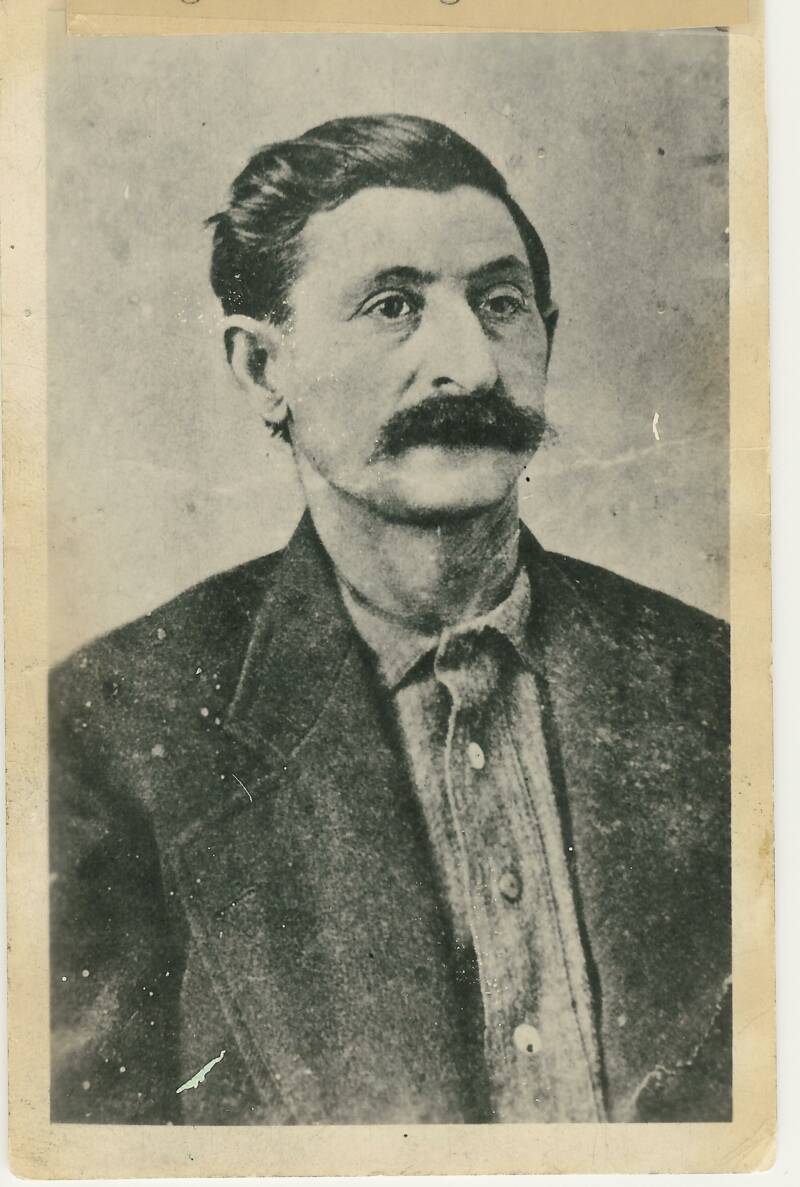
We don’t know much about George Parrot other than he was a cattle rustler, and then joined a gang. Known for his large nose and therefore called Big Nose George, he was a member of a gang of road agents and horse thieves. The leader of the gang was a man named Sim Jan, and they were active in the Powder River country, robbing pay wagons and stagecoaches. Other gang members included: Frank McKinney, Joe Manuse, Jack Campbell, John Wells, Tom Reed, Frank Tole, and “Dutch Charley” Burress.

After a series of successful robberies, the gang decided to expand their operation to robbing trains. On August 16, 1878, they planned to rob a Union Pacific train near Medicine Bow by manipulating the tracks so the train would derail. However, as the outlaws waited in the brush for the train, a section crew from the railroad came along and discovered the tampered rail.

Frank McKinney wanted to shoot the rail crew, but Big Nose George and Frank Tole objected, saying they hadn’t come to kill.  As the crewmen repaired the track, a railroad foreman rode ahead to stop the approaching train and inform the law that the rail had been tampered with. Forced to abort the robbery, the outlaws watched helplessly as the track was repaired. After the workers left, the gang rode off.

A posse was hastily formed and rode out to apprehend the would-be train robbers. Two lawmen tracked the gang to Rattlesnake Canyon in Elk Mountain. The outlaws shot and killed both lawmen. Wanted now for attempted robbery and the murder of two lawmen, the outlaws went their separate ways.

One of the victims killed that day was Robert Widdowfield. Widdowfield was born in County Durham, England, the son of a miner. In 1870, when Widdowfield was twenty-one, the family moved to America and settled in Wyoming where Robert became a deputy sheriff in Carbon County. On August, 19, 1878, he became Wyoming’s first officer to be killed in the line of duty.

The Union Pacific Railroad doubled their efforts in tracking the gang members and county authorities offered a $10,000 reward for their capture. Frank Tole was killed the next month while attempting to rob the Black Hills Stage line.

“Dutch Charley” was apprehended in 1879. However, when the westbound train transporting the outlaw to Rawlins for trial passed Carbon it was stopped by a mob.  “Dutch Charley" was forcibly taken from the train and hanged from a telegraph pole, with one of the widows kicking the barrel out from under “Dutch Charley” and ending his career.

Two years later in Miles City, Montana, Big Nose George, in a drunken stupor, bragged about killing two Wyoming lawmen.  A telegraph was sent to Rawlins, and in July, 1880, Sheriff James Rankin of Carbon County went to Montana to collect his prisoner and bring George back to Wyoming.  A second time, the train bringing a gang member back was stopped in Carbon by the same mob that lynched “Dutch Charley.”  Big Nose was hauled off the train and prepared for hanging. But the outlaw confessed and pleaded for his life, promising to tell all he knew if they let him live. The vigilantes cut him down and he was allowed to continue the journey to Rawlins to stand trial.

When he arrived in Rawlins, he recanted his confession after he was told if he pleaded guilty there would be no trial if his plea was accepted and he would face a mandatory death sentence.  His trial began in November of 1880, and he again changed his plea to guilty. The plea was accepted and on December 15, 1880, he was sentenced to hang on April 2, 1881.

While Big Nose was in jail, he stated Frank McKinney claimed to be Frank James, which led to some speculation that Frank McKinney and the gang’s leader, Sim Jan, were Frank and Jesse James. The only gang members ever caught were:  Frank Tole, “Dutch Charley,” and Big Nose George.  McKinney, Jan and the rest of the gang disappeared.

George attempted to escape on March 22, 1880. Parrot managed to file the rivets of the heavy shackles on his ankles, using a pocket knife and a piece of sandstone. After removing his shackles, he hid until jailor Robert Rankin (brother of Sheriff James Rankin) entered the area.  Big Nose struck Robert Rankin with the shackles, fracturing his skull, but Rankin fought back and called out to his wife, Rosa.  Rosa grabbed a pistol and forced Big Nose back into his cell.


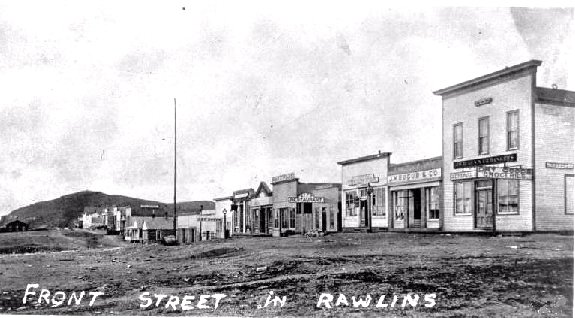
News of the attempted escape spread through Rawlins, and a mob descended on the jail determined to see Big Nose hang. They dragged Big Nose George from the jail to a telegraph pole on what is now Front Street. A crowd of about 200 people gathered.  The first effort using a Kerosine barrel was unsuccessful. On the second attempt, Big Nose was made to ascend a ladder leaning against a telegraph pole. When the ladder was pulled out from under him, Big Nose managed to get his hands free and clung to the pole begging for someone to have mercy and shoot him. No one did. Tired, Big Nose let go and strangled to death.

The body was left hanging for hours until the undertaker cut it down. With no family to claim the body, Doctors Thomas Maghee and John Osborne took possession of it. The doctors wanted to study the outlaw’s brain for the purpose of determining whether there were any visible criminal abnormalities.  The skull cap was removed and given to Lillian Heath (later Lillian Nelson), a fifteen-year-old apprentice of Dr. Maghee. Heath, who became the first woman doctor in Wyoming, used the skull cap as an ashtray, pencil holder and doorstop until her death.  Though Dr. Maghee acted within the medical ethics of the time, Dr. Osborne’s activities became bizarre.

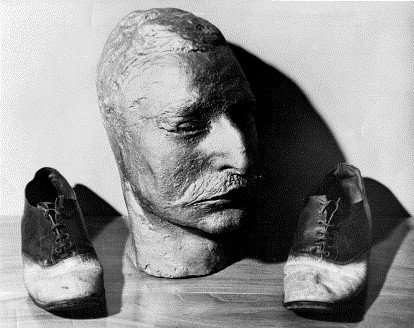
Osborne first molded a death mask of George’s face using plaster of paris. The mask was without ears because while George struggled at the end of the rope his ears were torn off.

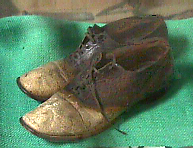
Next, Osborne removed the skin from the dead man’s thighs and chest, which he shipped to a tannery in Denver with a set of grotesque instructions. The tannery was to use the skin, including the nipples, to make him a pair of shoes and a medicine bag. When Dr. Osborne received the shoes, he was disappointed to find they didn’t include the nipples, but proudly wore them despite his instructions not being followed.

The rest of Big Nose George’s dismembered body was kept in a whiskey barrel filled with a salt solution for about a year as Osborne continued his dissection and experiments. Finally, the whiskey barrel was buried by Osborne’s office in Rawlins.

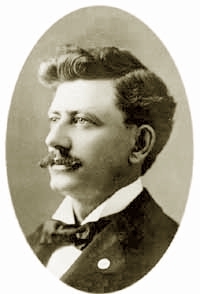
Despite this odd behavior, Osborne was elected as Wyoming’s first Democratic governor, in 1892. Although, the circumstances surrounding his election are a bit sketchy, and it is often said he sneaked into office when the Republicans weren’t looking. Returns from Converse and Fremont Counties were delayed, and the State Canvassing Board was unable to certify the results. Taking matters in his own hands, Osborne took the oath of office on December 2, before a notary public and allegedly crawled along a ledge of the State House and in through the window into the Governor’s Office and refused to leave. The scene culminated with a wrestling match between Acting Governor Barber’s secretary and Osborne for the key to the office.

Governor Osborne wore the shoes made of George’s skin to his inaugural ball, which seems fitting since it appears he was as much a criminal as Big Nose.

Big Nose George was all but forgotten until May 11, 1950, when a construction crew excavating for a new building unearthed a whiskey barrel filled with bones. Included in the mass of bones was a skull with the top sawed off.


A citizen recalled Dr. Lillian Heath Nelson kept a skull cap. Nelson was still alive, but well into her eighties.  Her family was contacted and her husband brought the skull cap to the scene, it fit perfectly with the skull found in the barrel.  Subsequent DNA testing has occurred and verified the results.


Today if you’ve got a hankerin’, the Carbon County Museum in Rawlins displays Big Nose George’s death mask, his skull and the infamous shoes.  Also on display, is a watch given by the County Commissioners to Rosa Rankin for stopping Big Nose’s escape. The shackles used on Big Nose during his hanging and the skull cap are on display at the Union Pacific Museum in Omaha, Nebraska. The medicine bag has never been found.

Not a pretty story, but if your looking for something a little different to see on the trail head on over to Rawlins and take a look at man-shoes!


SOURCES:
http://www.wyomingtalesandtrails.com/rawlinsa.html
http://www.legendsofamerica.com/wy-bignose.html
http://www.carboncountymuseum.org/bignose.html


Kirsten Lynn is a Western and Military Historian. She worked six years with a Navy non-profit and continues to contract with the Marine Corps History Division for certain projects. Making her home where her roots were sewn in Wyoming, Kirsten also works as a local historian. She loves to use the history she has learned and add it to a great love story. She writes stories about men of uncommon valor…women with undaunted courage…love of unwavering devotion …and romance with unending sizzle. When she’s not writing, she finds inspiration in day trips through the Bighorn Mountains, binge reading and watching sappy old movies, or sappy new movies. Housework can always wait.

Friday, September 2, 2016

The Colorful Lore of the California Gold Rush

By Paisley Kirkpatrick
Grass Valley’s history is part of the colorful lore of the California Gold Rush. The first notations about the area are from the late 1840’s when a party of men searching for cattle came upon a “grassy valley”.
Grass Valley’s claim to historic fame is embedded in the vast amounts of gold discovered and extracted from its rich underground mines. In more than 100 years of mining, the mines of Grass Valley made it the richest of all California gold mining towns.
In December 1848, President James K. Polk declared in a State of the Union address that large quantities of gold had been discovered in California. As word spread about the gold rush, prospectors flooded the foothills. The small settlement began looking like a village. Then in 1850, a settler by the name of George McKnight discovered gold in the quartz rock along Gold Hill and the real boom began.
By 1851, thousands of people were living in the bustling town now known as Grass Valley and in the nearby town of Nevada, (later renamed Nevada City when Nevada became a state). Grass Valley suffered a disastrous fire in 1855, and Nevada City burned in 1863, but the towns quickly rebuilt and continued to grow.
My grandparents lived in Nevada City up until I was a junior in high school. I remember when I was in my teens my grandfather told us tales of the gold rush and what happened afterwards. One story that sticks in my mind is that when they tore old saloons down to put in a new highway, they found piles of gold dust that had seeped through the cracks in the wooden floors. If they'd only known way back during the days of the gold rush, the search for gold for some would have been more profitable.
The Empire, Northstar, Pennsylvania, Idaho-Maryland and Brunswick mines became known around the world, attracting hardworking miners and would-be millionaires. As the underground mines grew, skilled hard-rock miners from Cornwall and Ireland arrived. They settled into their new hometown of Grass Valley while mine owners and managers lived in nearby Nevada City. Over the next 100 years the mines extracted more than $400 million in gold, making Grass Valley California’s most prosperous mining town. Unfortunately, gold mining declined in the 1950’s and eventually all of the hard-rock mines were closed.
Both Grass Valley and Nevada City are on the national register of historic places and have multiple buildings on the national register.
The National Hotel in Nevada City and the Holbrook in Grass Valley are reminders of the grandeur of California gold rush hotels. The Golden Gate Saloon in the Holbrook is known as the oldest continuously operating saloon west of the Mississippi!
Information provided by Grass Valley’s Chamber of Commerce