Wednesday, December 10, 2014

And the stockings were hung . . .


I 've said before how much I love Christmas. Winter and the Holidays are absolutely my most favorite time of year. The decorations, the trees, the stockings . . . the excitement and anticipation of the children waiting for Santa Claus. Another of my favorites is the poem by Clement Clarke Moore, and I thought I's share it with you.


‘Twas the night before Christmas, when all through the house
Not a creature was stirring, not even a mouse;
The stockings were hung by the chimney with care,
In hopes that St. Nicholas soon would be there;


The children were nestled all snug in their beds,
While visions of sugar-plums danced in their heads;
And mamma in her ‘kerchief, and I in my cap,
Had just settled down for a long winter’s nap,
When out on the lawn there arose such a clatter,
I sprang from the bed to see what was the matter.
Away to the window I flew like a flash,
Tore open the shutters and threw up the sash.
The moon on the breast of the new-fallen snow
Gave the lustre of mid-day to objects below,


When, what to my wondering eyes should appear,
But a miniature sleigh, and eight tiny reindeer,
With a little old driver, so lively and quick,
I knew in a moment it must be St. Nick.
More rapid than eagles his coursers they came,
And he whistled, and shouted, and called them by name;
“Now, Dasher! now, Dancer! now, Prancer and Vixen!
On, Comet! on Cupid! on, Donder and Blitzen!
To the top of the porch! to the top of the wall!
Now dash away! dash away! dash away all!”


As dry leaves that before the wild hurricane fly,
When they meet with an obstacle, mount to the sky,
So up to the house-top the coursers they flew,
With the sleigh full of toys, and St. Nicholas too.
And then, in a twinkling, I heard on the roof
The prancing and pawing of each little hoof.
As I drew in my head, and was turning around,
Down the chimney St. Nicholas came with a bound.
He was dressed all in fur, from his head to his foot,
And his clothes were all tarnished with ashes and soot;
A bundle of toys he had flung on his back,
And he looked like a peddler just opening his pack.
His eyes — how they twinkled! his dimples how merry!
His cheeks were like roses, his nose like a cherry!
His droll little mouth was drawn up like a bow,
And the beard of his chin was as white as the snow;


The stump of a pipe he held tight in his teeth,
And the smoke it encircled his head like a wreath;
He had a broad face and a little round belly,
That shook, when he laughed like a bowlful of jelly.
He was chubby and plump, a right jolly old elf,
And I laughed when I saw him, in spite of myself;
A wink of his eye and a twist of his head,
Soon gave me to know I had nothing to dread;
He spoke not a word, but went straight to his work,
And filled all the stockings; then turned with a jerk,
And laying his finger aside of his nose,
And giving a nod, up the chimney he rose;
He sprang to his sleigh, to his team gave a whistle,
And away they all flew like the down of a thistle.
But I heard him exclaim, ere he drove out of sight,
“Happy Christmas to all, and to all a good-night.”


I hope you've enjoyed a revisit to Mr. Moore's poem and a glimpse at some of the pictures of my family's Christmases past. We wish y'all a very Merry Christmas!

Carra

Monday, December 8, 2014

GIFTS FOR YOU--FREE READS


By Celia Yeary

SEASON GREETINGS TO ONE AND ALL--

This year has been a good one in many ways, but not so good in others. Health issues in our household have kept us on edge at times, but through the miracle of modern medicine, and the miracle of Christ Jesus, we kept the faith and kept our appointments.
2014 has been bittersweet, but I look back now and consider all the good times with which we've been blessed and choose to remember those.

I could not find an appropriate  topic for my day on the blog, so I decided to post links to a couple of very short stories about couples in the Nineteenth Century. These are 1500 words long, which I wrote under the tutelage of an excellent editor I worked with early on in my adventure of creating stories.

In writing these, I learned how many useless words we authors add to our writing. Each story began with approximately 3000 words, and the editor said, "Nope, only 1500."

I argued with her, but she stood her ground. I would return to the manuscript and try to eliminate words and still have my precious story.
To her, I would say, "Okay. I've cut out 1000 words. That's it. I cannot delete anymore."

This time, I asked her..no, I begged her.. to cut the extra 500 words for me, but she was a hard one.

So, I worked on it again.
When I succeeded in telling each of my stories in 1500 words, I felt as though I'd won a contest!

The first one is titled WISHES DO COME TRUE:
~Western Romance ~
 
Ross doesn't want to make a fool of himself,
but decides to take the risk one more time for the woman he wants.
Anna is practical and independent, and believes she can never marry a man like Ross.
Will Anna send him away once again?
Will Ross take no for an answer?

Click here on the pdf on my publisher's Freebie page:
~~*~~*~~*~~
The second one is titled: MERRY CHRISTMAS, VICTORIA:
~ Christmas Western Romance ~
Victoria yearns for the love of one special man.
However, Cade Hollister treats her as a friend.
As she works in her cold dress shop on Christmas Eve,
he stops by and walks her home.
At the door, he gives her an unexpected kiss.
Cade has loved Victoria for a long time, but he's never found a way to tell her.
This Christmas, though, he takes a chance.
Will his surprise gift make her understand how much he loves her?
A note about "Merry Christmas, Victoria"--
While playing around, trying to write this story, I had the stereo playing a Ray Charles album. The next track in the CD was the old Eddy Arnold song made famous by Ray Charles, "You Don't Know Me."
I happened to be toward the end of the story. I listened the deep emotional words, sang in a way only he can do, and without consciously doing so, I used some of the phrases.

You give your hand to me
And then you say, "Hello"
And I can hardly speak
My heart is beating so
And anyone can tell
You think you know me well...
But, you don't know me..
No you don't know the one
Who dreams of you each night
And longs to kiss your lips
And longs to hold you tight
To you I'm just a friend
That's all I've ever been
No you don't know me.

 Click on the pdf link on the publishers Freebie page:
 

Thanks to you who have bought and read my books, and written reviews,
and sent lovely notes to me about them.
I appreciate every kind word.
I hope you enjoy these stories.
Celia Yeary

Saturday, December 6, 2014

AT THE END OF HIS ROPE: THE CONTROVERSIAL LIFE AND EXECUTION OF TOM HORN by Kirsten Lynn

Recently, I've been talking about everything bright and beautiful in Wyoming, but for this post I thought I'd discuss a controversial figure in Wyoming’s history. Aren’t most Wyoming figures controversial you might ask? If you get a chance to stop for a bit as your run out of the state for a smart tongue, take a look at the story of Tom Horn.


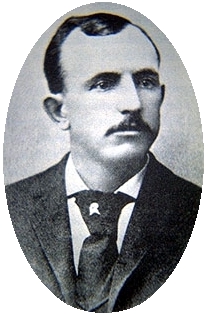
Tom Horn was born in Scotland County, Missouri, in 1860. By his own account, he left home at the age of fourteen.  Taking up a series of livestock and stage-driving jobs, he ended up in Arizona Territory. Horn was intelligent and tough. He had an ear for languages and quickly picked up Spanish and later some of the Apache language.  He’d also picked up an ability as a tracker.
Therefore, it wasn’t a surprise that while still in his teens he became employed by the Army as a scout and interpreter.  The chief of the scouts for the U.S. Army, Al Sieber, recruited Horn in the Army’s campaigns against the Apache. In April 1886, Horn was one of the scouts that escorted the Army column led by Lt. Charles B. Gatewood to find the famed Chiricahua Apache leader, Geronimo.

In his posthumously published autobiography, Horn took credit for the actions of Lt. Gatewood. He claimed it was he whom Geronimo trusted and it was he who convinced Geronimo to surrender. However, the autobiography is the only account of Horn’s involvement with the negotiations.

Whatever the level of his involvement in the surrender of the Chiricahua leader, Horn made a name for himself.The Pinkerton Detective Agency hired Horn, in 1891, to pursue bandits who robbed the Denver and Rio Grande train near Canon City, Colorado. He stayed employed by the Pinkerton’s over the next decade.

About the same time Horn started working for the Pinkerton’s he came to Wyoming.  He already had a reputation for certain skills and his services were sought after by some of the prominent ranchers in the area. A few of his “secret” employers included, Ora Haley, John Coble, Coble’s partner Frank Bosler, and the huge Swan Land and Cattle Company.

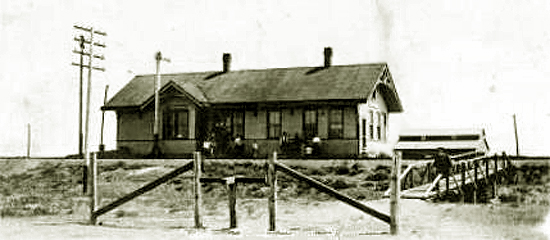
Bosler Depot, 1916
Yep, folks here we are again with those cattle barons.  As discussed in the post on the Johnson County War, the large cattle ranchers were suffering from beef glut and blaming the small ranchers for the lack of grazing land and accusing many of rustling.  As many ranchers went out of business and many longstanding cowboys and more recent immigrants to the Territory took up homesteads and other land claims, the once powerful Wyoming Stock Growers Association found its membership and its revenues from dues dwindling drastically.

After the public outcry against the Sweetwater lynchings and the backlash of the Johnson County invasion, the large cattlemen decided to take care of the “rustling problem” in secret. Enter Tom Horn.

By May of 1892, Horn was working for the Pinkertons and was deputized by U.S. Marshal Joseph P. Rankin to investigate a murder in the aftermath of the Johnson County invasion. But by 1895, Horn was most likely fully employed by private interests when he was suspected of murdering two settlers.

The first was William Lewis. Lewis was an English immigrant who moved to Wyoming in 1888. He settled southwest of Iron Mountain between the Chugwater Creek and Ricker Creek on the Laramie-Albany County line.  Lewis had been jailed for stealing clothing and cheating a boy at a faro game.  He was suspected of cattle theft and under a court order to refrain from butchering cattle.

In July 1895, Lewis received a letter telling him to leave the area.  He ignored the warning, and on July 31st, as Lewis was loading skinned beef into a wagon he was shot three times. The coroner estimated the shooting had been done from a distance of 300 yards.  A rumor circulated about an offer Tom Horn made at the Stockgrowers’ Association and the tall stock detective, Tom Horn, was summoned for questioning.

Horn was located in the Bates Hole region of Natrona County, two counties away. Laramie County Prosecutor, John C. Baird assumed Horn was hiding out after the shooting and prepared an indictment. However, Tom Horn had a number of rancher and cowboy witnesses who were willing to swear straight faced that he had been in Bates Hole the day of the killing.  The alibi couldn’t be shaken and the authorities released him.

Horn immediately rode into Cheyenne and indulged in a ten-day drinking spree dropping hints at the truth. “Dead center at three hundred yards, that coroner said!” And he grinned. “Three shots in that fella ‘fore he hit the ground. You reckon there’s two men in this state can shoot like that.” Publicly, he denied everything. Privately, he created a blood-chilling image of himself as a hired assassin.

The second settler was, Fred Powell.  Powell homesteaded with his wife Mary and 18 month old son Billy east of Laramie County. The marriage was not a blissful one, and Fred carried a long scar on his face where Mary took a butcher knife to him. Powell was charged with stealing cattle and horses at least seven times, each time he was let go for lack of evidence.  Evicted from his homestead he moved to another along Horse Creek, proving up his claim in 1892. Like Lewis, Fred started receiving notes telling him to get out. Powell ignored the warnings.

On the morning of September 10, 1895, Powell and his hired hand Andy Ross were along the creek working when Ross saw Powell clutch his chest and gasp, “My God, I’m shot!”  He collapsed and died.

Again, Tom Horn was the first suspect, and was brought in for questioning. Horn shook his head and kept his face expressionless and his voice calm. He had a strongly supported alibi ready, and again he was released.

Enjoying a night of liquor and entertainment provided by the professional ladies of Cheyenne, Horn made vague insinuations admitting to the killings. “Exterminatin’ cow thieves is just a business proposition with me. And I sort of got a corner on the market.”

After a friend once told him that he didn’t think dry-gulchin’ a man seemed very sporting. Horn replied in amazement, "I seen a lot o' things in my time. I found a trooper once the Apache had spread-eagled on an ant hill, and another time we ran across some teamsters they'd caught, tied upside down on their own wagon wheels over little fires until their brains was exploded right out o' their skulls. I heard o' Texas cattlemen wrappin' a cow thief up in green hides and lettin' the sun shrink 'em and squeeze him to death. But there 's one thing I never seen or heard of, one thing I just don't think there is, and that's a sportin' way o' killin' a man."

After the first two murders, the warning notes were rarely ignored.  The lesson learned.
When Fred Powell's brother-in-law, Charlie Keane, moved into the dead man's home, the anonymous letter writer took no chances on Charlie taking up where Fred had left off and wasted no time on a first notice: "IF YOU DON'T LEAVE THIS COUNTRY WITHIN 3 DAYS, YOUR LIFE WILL BE TAKEN THE SAME AS POWELL'S WAS." This was the message found tacked to the cabin door. Keane left, within three days.

For three straight years, Tom Horn patrolled the southern Wyoming pastures. How many men he killed after Lewis and Powell, if he killed Lewis and Powell will never be known.

One of Horn’s most notable “clients” was Wyoming Governor W.A. Richards who was being plagued by cattle theft on his own land.  Richards was good friends with W.C. “Billy” Irvine president of the Wyoming Stock Growers Association. In a meeting between the two men, Richards told Irvine he would like to meet Tom Horn, but didn’t want him coming to the Governor’s office. Irvine offered to hold the meeting in the WSGA President’s office just down the hall.  Horn, in his usual calm manner, informed the Governor he would either drive every rustler out of Big Horn County, or take no pay. But when he finished the job to the governor’s satisfaction he would receive $5000.00. Horn put no limit on the number of men he planned to kill. Though stunned, Richards agreed. After Horn left Richards told Irvine, “So that is Tom Horn! A very different man from what I expected to meet. Why, he is not bad-looking, and is quite intelligent; but a cool devil, ain’t he?”

Horn continued his work as a cattle detective through the 1890s. In 1900, he murdered Matt Rash and Isom Dart, two suspected cattle thieves, in Brown’s Park where the Colorado, Utah and Wyoming borders intersect.  The crimes received little notice in Wyoming.

The only thing cattlemen hated more than homesteaders were sheepherders. And while the large and small cattlemen fought amongst themselves the sheepherder entered the territory taking over land and grazing their destructive herds over the already crowded land.  But it didn’t take long for the eyes of the cattleman to turn his wrath on the sheepherder. We’ll get into all this in more detail next week, but for now we’re looking at one particular sheepherder Kels Nickell.

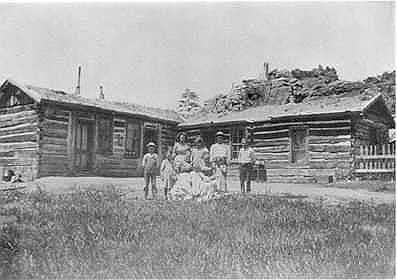
Nickell Homestead
Seven miles from Iron Mountain was the ranch of Kels Nickell, the only sheepherder in the area. On July 18, 1901, Nickell’s fourteen-year-old son, Willie was shot and killed by two bullets to the back. Willie, tall for his age, wore his father’s coat and hat and rode his father’s favorite horse, and therefore it was believed the killer mistook him for Kels. Though Willie fell face down, someone turned the body over and placed a stone under Willie’s head. There were no footprints or shells left at the scene.  Seventeen days after that, Kels was shot, wounding him in the arm, hip and side. While he was in the hospital, masked men clubbed a number of Kels’ sheep to death.  The Nickell family moved to Saratoga not long after he recovered.


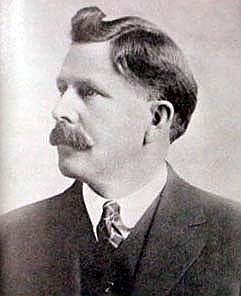
Joe LeFors
Deputy U.S. Marshal Joe LeFors was hired by the county commissioners in Cheyenne to investigate the crime. LeFors used letters from a former boss in Miles City, Montana stating the need for someone to do a “secret” job to lure Tom Horn out of hiding.

Horn left John Coble’s place in Bosler meeting LeFors at the U.S. Marshal’s office in Cheyenne on January 11, 1902. LeFors secreted a stenographer, Charles Olnhaus, and a witness, Laramie County Deputy Sheriff Leslie Snow, behind a locked door. Over the course of a two hour interview, LeFors led Horn into making a series of incriminating remarks about the Nickell killing. The most damaging statement being, “It was the best shot I ever mad and the dirtiest trick I ever done.”

Horn allegedly told LeFors that he had been paid in advance and received $2,100 for killing three men and taking five shots at another. He told LeFors the reason there were no footprints is he was barefoot. LeFors asked whether Horn had carried the shells away, to which Horn responded: "You bet your [expletive deleted] life I did." On Monday, January 13,  Laramie County Sheriff Edwin J. Smalley, accompanied by Deputy Sheriff Richard A. Proctor and Cheyenne Chief of Police Sandy McNeil arrested Tom Horn in the bar of the Inter-Ocean Hotel. Deputy United States Marshal Joe LeFors watched.

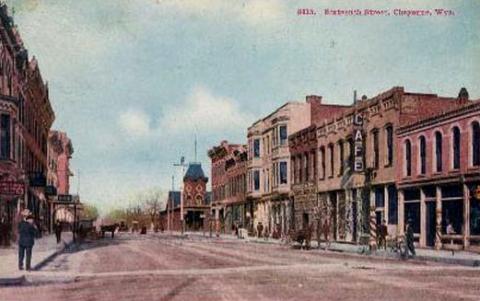
16th Street, Cheyenne, 1902
John Coble paid for Horn’s defense, with the general counsel for the Union Pacific, John W. Lacey representing Horn.  The trial was held during an election year with both Prosecutor Walter R. Stoll and Judge Richard Scott up for re-election. On top of this, public interest in the case was overwhelming and the trial received widespread newspaper coverage in Wyoming and Colorado.
Horn’s defense was three-fold:

(1.) Horn was under the influence of liquor, tended to make things up, and became talkative when drunk. Witnesses were produced that Horn had been drinking. He denied making the statements in the Scandinavian. He contended that his jaw had already been broken when he was in the Scandinavian and with the cast he could not talk.

(2.) Horn had an alibi and could not have been in the Nickell ranch at the time of the killing. He was in Laramie City, as proven by the fact that Horn's horse, Pacer, was lodged at the Elkhorn Livery in Laramie City for a ten-day period at the time of the killing. Witnesses testified that Horn was nowhere near the Nickell Ranch at the time of the slaying.

(3.) The killing could not have occurred as he described to LeFors in the following regards: (a.) Dr. Amos Barber testified, based on learned texts, that the wounds could not have been inflicted with a 30-30 similar to Horn's. (b.) Frank Stone had bunked with Horn several days later and had observed no injury to Horn's feet such as would have been produced had Horn gone barefoot. One of Horn's lawyers testified to having examined the area of the Nickell gate where the killing took place. He testified that the area was strewn with cacti and rocks such that no one could go barefoot in the area. Samples of the rocks were introduced into evidence. (c.) Horn, in his statement to LeFors, described the shooting as coming from one direction. The fatal shot came from another.

Horn took the stand in his own defense. The cross-examination by the prosecutor, Walter Stoll, was devastating. Statement by statement, Horn admitted making the various statements testified to by LeFors, Snow and Ohnhaus with the exception of one statement which Horn did not remember but conceded he might have made.

Horn’s lawyer closed emphasizing all evidence was circumstantial, and Horn’s supposed confession was nothing but drunken boasting.

The prosecution claimed Horn killed Willie Nickell to keep the boy from reporting his presence in the area.  But in the day before sequestered juries it is likely they had their minds made up before they entered the courtroom.


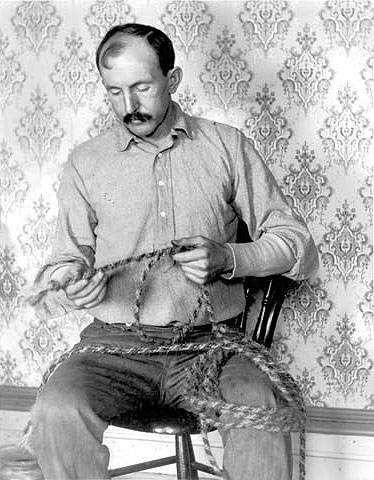
Despite appeals to the Governor to spare Horn and fears that Horns numerous friends would attempt a jail break, on November 20, 1903, Horn was hanged at the Cheyenne jail.  Prior to his hanging, Horn spent his time in jail braiding a rope. When it was clear his time was at an end, Horn wrote John Coble:

Dear Johnnie:
Proctor told me that it was all over with me except
the applause part of the game.

You know they can't hurt a Christian, and as I am
prepared, it is all right.

I throuroughly appreceiate all you have done for me.
No one could have done more. Kindly accept my thanks,
for if ever a man had a true friend, you have proven your-
self one to me.

Remember me kindly to all my friends, if I have any
besides yourself.


Tom Horn remains a controversial character due to the lingering questions regarding his guilt or innocence in the Nickell murder.  There's also a question regarding the WSGA's involvement with the trial, and the contention Horn was a scapegoat for the powerful cattlemen. Horn’s supporters and later historians questioned his confession to LeFors stating LeFors got Horn drunk and tricked him. Others stand firm that not only did Horn kill Willie Nickell, but an unknown number of men, and that Horn received a fair trial and was represented by one of the finest trial attorneys in Wyoming.

Like the outcome of the Johnson County War, more than the question of Horn’s guilt or innocence is the political shift evident in Wyoming during his trial. Horn, friend of cattle barons was convicted and executed. Their power once unquestionable was on the dwindle as ordinary Wyoming citizens refused to cower under their heavy hand.

SOURCES:

Carlson, Chip.  Tom Horn: Blood on the Moon : Dark History of the Murderous Cattle Detective, High Plains Pr., Sept 2001. 

Ball, Larry D.  Tom Horn in Life and Legend.  University of Oklahoma Press., 2014.
http://www.wyohistory.org/essays/tom-horn

http://www.wyomingtalesandtrails.com/horn.html


Kirsten Lynn writes stories based on the people and history of the West, more specifically those who live and love in Wyoming and Montana. Using her MA in Naval History, Kirsten, weaves her love of the West and the military together in many of her stories, merging these two halves of her heart. When she's not roping, riding and rabble-rousing with the cowboys and cowgirls who reside in her endless imagination, Kirsten works as a professional historian.

Wednesday, December 3, 2014

An Old Christmas Classic: Minced Meat Pies


Much like today, Christmas is the old west was filled with family traditions and sharing the festivities with friends old and new.  Families gathered for traditional Christmas dinners, carols were sung and old family recipes were made and consumed. Among the favorites were mince meat pies, cranberries, chestnuts and desserts, plum puddings and custards.

Mince meat pies is one of those dishes that always left me wondering what it was exactly that made it such a holiday tradition. Its not a typical, modern day (American) dish. The pies are known by a few other names as well, such as Christmas Pies or Twelfth Night pies and feature meat, fruit and spices. Mixing fruit and spices with the meat helped preserve them without the use of drying or salt and the pies could last up to two months if the weather was cold so this was a dish that lasted for some time and could see families through long winters.

The pies can be traced back to the thirteenth century and recipes varied by region, but most varieties contained meat, suet, raisins, currants, sugar, lemon peels, eggs, apple, oranges, spices (cinnamon, cloves and nutmeg to represent the gifts of the Magi to infant Jesus) and brandy.

By the 1800's, mince pies had transformed into a more modern version and the meat was left out. I'm curious enough to try and make one of these some day so I'm going to share the recipe for anyone else curious about this old victorian classic.

------------------------------


FRUIT MINCEMEAT

1/4 cup melted butter
1/3 cup brown sugar
2/3 cup raisins
1/3 cup sultanas (white raisins)
1/3 cup black currants
1/3 cup candied peel
1 granny smith apple, peeled, cored and grated
1/3 cup chopped glace cherries
1/2 teaspoon cinnamon
1/2 teaspoon mixed spice
1/2 teaspoon nutmeg
3-4 T brandy


PASTRY
4 ½-5 cups cake flour, loosely measured
½ cup corn starch
½ cup powdered sugar
14 T butter
1 egg
1 tsp vanilla extract

Directions:

Fruit Mincemeat :Combine all ingredients and set aside for flavors to mingle.

Pastry : Sift flour, corn starch, and powdered sugar. Rub in the butter. Beat egg and vanilla together then add, mixing well. Knead into a ball. Do not over work.

Roll out thin on a floured board and cut into 3" rounds. Place rounds in a patty pan or a baking sheet. Place a heaped teaspoon of filling in the middle of each pastry round and cover with second pastry round. Press edges together with the prongs of a fork and prick each top twice.

Bake at 350F for 18-20 minutes or until golden. Cool slightly before removing to cooling rack. Dust lightly with powdered sugar.

------------------------------

Since Christmas is only a few weeks away, I've reduced the price of my historical western novel, A Willow Creek Christmas to .99¢ at Amazon.Com until Dec. 20th. This story sat at #1 on the western romance chart over on Amazon last year for four weeks and is part of the USA TODAY best selling Willow Creek Series.


A Willow Creek Christmas by Lily Graison 

Running from a life she no longer wanted…
Widowed with two young children, Keri Hilam is desperate to escape her abusive brother in law, going so far as sneaking away in the dead of night in hopes of finding a better life. She never regrets leaving, not even when they find themselves stranded, starving, and alone. Fate brings them to Willow Creek, Montana, where they’re rescued by an unlikely hero, an ex-confederate soldier who seems more monster than man.

Hiding from a past he can’t seem to forget…
The war leaves Noah Lloyd scarred and bitter. When the girl he left behind broke his heart, he turned his back on the life he used to know, and sought refuge in a dusty little town that afforded him the solitude he wanted. Finding a woman and her kids hunkered down in an abandoned line shack in the middle of a blizzard is the last thing he needs. They’re ragged, half starved and vulnerable, but he’s determined to leave the trio in the care of the town marshal.

Can a future together erase all the pain…
But the innocence of a child at Christmas breaks through Noah’s hard exterior and Keri’s tender care allows him to see that life may be worth living. All he has to do is let go of his past and let this unlikely family love him.

BUY THE EBOOK FROM AMAZON.COM


About Lily Graison

USA TODAY  bestselling author Lily Graison writes historical western romances and dabbles in contemporary and paranormal romance. First published in 2005, Lily has written over a dozen romance novels that range from sweet to spicy.

She lives in Hickory, North Carolina with her husband, three high-strung Yorkies and more cats than she can count and is mother of two and grandmother of three. On occasion, she can be found at her sewing machine creating 1800’s period clothing or participating in civil war reenactments and area living history events. When not portraying a southern belle, you can find her at a nearby store feeding her obsession for all things resembling office supplies.

To see the dresses Lily has created, visit her Pinterest page.

Website | Facebook | Twitter | Goodreads | Pinterest | Google+ 
Wattpad | Instagram | Push Page

Tuesday, December 2, 2014

Five Hundred Dollar Reward!

By Paisley Kirkpatrick
Wells, Fargo & Co. Will pay Five Hundred Dollars for the arrest and conviction of the robber who stopped the Quincy Stage and demanded the Treasury Box, on Tuesday afternoon, August 17th, near the old Live Yankee Ranch, about 17 miles above Oroville. By order of J. J. Valentine, Gen'l Supt., Rideout, Smith & Co., Agents. Oroville, August 18, 1875.
Old-timer's say Black Bart was a courteous and jovial fellow who would rise early, eat a hardy breakfast in the hotel dining salon, and take his usual stroll through town, tipping his fancy felt derby to the ladies. On occasion he would walk to the Ohio Stables on the corner of Huntoon and Miners Alley to rent a horse for the day or so. Unbeknown to Mr. Stevens, the proprietor, he was fanning the countryside reconnoitering for his next daring performance, commencing with the dramatic line: ''Throw down the box!"
Black Bart's favorite hangout was in the smoke-filled poker hall over Sam Mullen's Gem Saloon. It was there that Bart accumulated the latest news about various gold shipments. As the story goes, he was a frequent loser. As it turned out he was laying the groundwork for much higher stakes, for he was of the opinion that a man who was winning at cards was much freer with his conversation than one who was losing. Once again he preferred a table close to the back window for easy access over the rooftops and down into the relative safety of Miners Alley.
Black Bart spent approximately three months in Oroville at a time. Then he would bid adieu for parts unknown. He invariably returned about three months later for a similar period of time. Gradually he became one of the most respected men about town. The rumor went that he was a prominent San Francisco investor who came to look over private mining interests in the territory. He was invited to many of the town's gala affairs and was intimate with practically every citizen of consequence.
Bart was also known as an intellectual, for he spent much of his time reading in the little volunteer library which was set up by the ladies of Oroville at the Union Hotel. In fact, so well informed was he on literature that he was asked by the ladies to serve on their committee, an honor which he graciously accepted. Imagine the shock in 1883 when his picture was circulated in Oroville with the following caption beneath: ''Black Bart--Notorious Outlaw Is Finally Captured!" Chagrin must have filled every corner of the ladies' committee room as they endeavored to replace their departed member.
After his release from San Quentin for good behavior, Black Bart returned to Oroville, where he was received with open arms--a hero no less, for robbing Wells Fargo express boxes was no small achievement, especially when it was done with an empty gun. Already he was legend, and Orovillains delighted in the fact that such a character was an integral part of their fabulous history. Nonetheless, the sheriff did keep close tabs on Bart's activities when he paid the town a visit. However, most were convinced that Mr. Boles, as he was now called, would live up to his words, given in reply to a reporter who questioned him about his literary career: ''Young man, didn't you hear me say I would commit no more crimes?"
A few weeks after his last visit to Oroville Mr. Boles disappeared from the annals of the West and was never heard from again. Even Wells Fargo, reputedly to have placed him on a small pension to avoid further embarrassments, could not locate his whereabouts.
Published by American West Publishing House, Issue No. 8, 1961

Friday, November 28, 2014

TWO NEW PRP CHRISTMAS ANTHOLOGIES AND GIVEAWAYS! by Cheryl Pierson


Hey everyone! Hope you all had a wonderful Thanksgiving yesterday! I have some exciting news to announce--We've just released two new Christmas anthologies at Prairie Rose Publications! Present for a Cowboy is our sweet/sensual collection, and Wild Texas Christmas is our sensual/spicy anthology. They're both chock full of wonderful stories and just perfect for this busy holiday time.


PRESENT FOR A COWBOY
Christmas is on the way and our western heroines are in search of the perfect PRESENT FOR A COWBOY!

Livia J. Washburn’s TINSELTOWN kicks off this exciting holiday collection. Set in the “Roaring ’20’s” in Hollywood, western movie actor Pecos must rescue a young woman in danger—and finds love in the bargain. The rescue of a young, abused boy in Gail L. Jenner’s JUST IN TIME FOR CHRISTMAS opens the door to love for a young woman and a loner who has sworn off relationships. Linda Carroll-Bradd’s CLARI’S HERO features a man who views himself as anything but a hero—and a woman who shows him otherwise, and Lorrie Farrelly’s CHRISTMAS TREASURE is an unexpected gift that can’t be measured in gold. In Sarah J. McNeal’s story, a lonely widow’s perceived indiscretion may cost her and her cowboy their happiness WHEN LOVE COMES KNOCKING.

This sweet/sensual collection of wonderful Christmas stories has something for everyone!


WILD TEXAS CHRISTMAS
Is Christmas wilder in Texas? It just might be! These cowboys and their ladies sure have their hands full—and Christmas brings them together to sort it all out!

Cheryl Pierson’s LUCK OF THE DRAW is the story of a handsome gambler and a beautiful witch. With their own particular talents, they discover life is one big poker table—and love can be had if they are willing to risk it all! Can a lumber baron and a railroad heiress save a small Texas town? Kathleen Rice Adams pens some holiday magic in THE LAST THREE MILES. When dreams turn to vengeance for a young gun-handy woman, it takes the love of a marshal to convince THE KID IN BLACK that Christmas really is a time of miracles. In THE TEXAN WHO STOLE CHRISTMAS by Jacquie Rogers, a Texas cowhand is snowed in for Christmas in Idaho. When he becomes part of the town’s “Secret Christmas Angel” game, will he be able to part with his heart? A lady gambler and a con man find themselves in an unlikely situation that could save both of their hearts if they’re willing to trust one another in Kaye Spencer’s A GIFT OF CHRISTMAS HOPE.

This sensual/spicy collection of holiday tales is sure to warm your heart and bring smiles as big as Texas!

I WILL BE GIVING AWAY A COPY OF EACH OF THESE ANTHOLOGIES TODAY SO BE SURE TO LEAVE A COMMENT TO BE ENTERED IN THE DRAWING!

Amazon buy links:

PRESENT FOR A COWBOY
http://www.amazon.com/Present-Cowboy-Livia-J-Washburn-ebook/dp/B00PZ8VKP6/ref=sr_1_1?s=digital-text&ie=UTF8&qid=1417142380&sr=1-1&keywords=Present+for+a+Cowboy

WILD TEXAS CHRISTMAS
http://www.amazon.com/Wild-Texas-Christmas-Cheryl-Pierson-ebook/dp/B00PZ9EV38/ref=sr_1_1?s=digital-text&ie=UTF8&qid=1417142438&sr=1-1&keywords=Wild+Texas+Christmas


Wednesday, November 26, 2014

THANKSGIVING AND SUKKOT (TABERNACLES) AND A BLESSING

By Mary Adair. Guest Author


Thanksgiving has always been one of my favorite holidays. I give thanks every day for my blessings, but to have a day set aside for thanks giving is truly special.  Knowing many  (if not all) Americans celebrate by remembering all the good things and wonderful people in their lives for which they are thankful adds to the festivity.

I decided to look into the roots of the celebration, and this is what I learned. According to some scholars, before coming to the new world, the Pilgrims lived for a decade among the Sephareic Jews in Holland.  Holland was considered a safe haven from religious persecution at the time.  

The Pilgrims, being devout Calvinist and Puritans considered themselves as “new Israel”. I can see where they likely learned that Sukkot commemorated Israel’s deliverance from the religious persecution in ancient Egypt and thought of it as a parallel to their own situation.


After they immigrated to the promised land of America, it is not surprising to me that the Pilgrims may have considered the festival of Sukkot when planning their own celebration. The Pilgrims considered their perilous journey to the new world as a type of exodus and wanted to associate their new celebration to the appropriate Biblical holiday.

It is interesting to me that the Jewish observance of their holiday always falls on Thursday and there is a special prayer of “Thanksgiving” before eating the meal.  It is also interesting to note that the Hebrew word for turkey is tarnegol hodu, literally “Indian chicken”.  Is it a happy coincidence that we customarily eat turkey on thanksgiving?


We all have times of ups and downs. We all have something and someone (probably more than one someone) to be thankful for. My Thanksgiving wish for all my friends and family is well expressed in this:

Cherokee Prayer Blessing

May the Warm Winds of Heaven Blow softly upon your house.
May the Great Spirit Bless all who enter there.
May your Moccasins Make happy tracks in many snows,
and may the Rainbow Always touch your shoulder. 


Mary Adair is the author of the Passion series: PASSION'S VISION, RAVEN'S PASSION, AND PASSION'S PRICE. These center around the struggles of a colonial Cherokee woman visionary and an emissary of the King of England. Those and others of Mary's titles are available on Amazon and other online vendors.

Happy Thanksgiving!


Photos courtesy Google commons